Arctic

Offshore leasing plan excludes Arctic

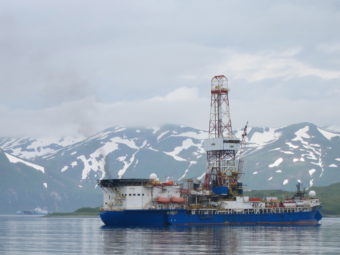
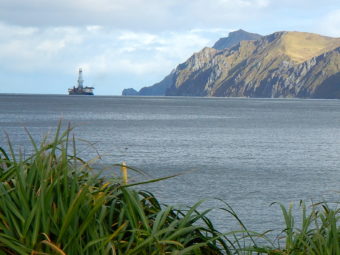
The Noble Discoverer in Unalaska in 2012. (KUCB file photo)
Shell’s Noble Discoverer rig in Unalaska in 2012. (KUCB photo)

The Obama administration has removed the Arctic Ocean from any new oil and gas leasing for the next five years.
The Interior Department announced its new plan for offshore leasing Friday morning.

The plan does not include any new lease sales in the Beaufort or Chukchi Seas off Alaska — which had been included in an earlier draft.

It does include one lease sale in northern Cook Inlet, in 2021.

In a written statement, Interior Secretary Sally Jewell said the department is forgoing lease sales in the Beaufort and Chukchi due to the “unique and challenging Arctic environment and industry’s declining interest in the area.”

In the year since Shell abandoned its effort to drill in the region, several companies have given up offshore leases they already held.

The decision is a win for environmentalists, who have pushed to place the Arctic off-limits to drilling because of the potential effect on climate change and the risk of a possible oil spill.

Niel Lawrence, with Natural Resources Defense Council, said it would take a decade or more to produce oil from the Arctic.

“We’ll be in a world that does not need that oil, that has moved on from fossil fuels,” Lawrence said. “Flooding the world with more oil could really hurt efforts to contain climate change and keep it from being really disastrous.”

But the decision was blasted by industry groups and Alaska’s elected officials. Governor Bill Walker released a statement saying he is “disappointed.” Sen. Lisa Murkowski called the decision short-sighted.

“You’ve got a decision that effectively is going to send all of the benefits of production overseas,” Murkowski said. “It’s stunning. And, I don’t know. I’m frustrated.”

Her view was echoed by Lucas Frances of the Arctic Energy Center, a partnership between the Alaska Oil and Gas Association and the Independent Petroleum Association of America. He said the U.S. is missing an opportunity to project strength in the Arctic.

“The U.S. has that opportunity to be a leader in this space,” Frances said. “But in removing Arctic leases, the potential sale of Arctic leases, it removed the investments that could be made down the road.”

Meanwhile, the Arctic Slope Regional Corporation released a statement saying the decision “cripples” North Slope communities’ ability to pursue economic development. In a speech at the Resource Development Council conference in Anchorage earlier this week, CEO Rex Rock, Sr., said removing the possibility of new Arctic exploration ignores local voices.

“Slamming the door shut on opportunity does nothing to help my region or my people, either now, or in the future,” Rock said.

The decision would be difficult for the incoming Trump administration to immediately undo. Replacing the plan would require going through much of the public process again, likely taking years.

Meanwhile, environmentalists are holding out hope for a more permanent withdrawal of Arctic waters from oil and gas leasing, under a special section of the law governing offshore development. That’s a separate decision, which would come from the White House.

Elizabeth Harball contributed to this report. 

Obama’s last chance to weigh in on Arctic drilling has industry worried, enviros hopeful

Shell's Noble Discoverer drill rig
Shell’s Noble Discoverer drill rig leaving Unalaska, Oct. 12, 2015. (Photo by John Ryan/KUCB)

In the aftermath of Donald Trump’s upset election victory, President Barack Obama still has two months left in office to close out policy decisions and try to cement any final pieces of his legacy.
One open question is offshore oil and gas leasing.

Environmentalists want Obama to place the Arctic off limits to offshore drilling, in part to combat climate change.

The oil industry is lobbying to keep it open. A decision is expected any day.

And depending what Obama does, it might not be so easy for a Trump administration to override it.

If you were in Washington, D.C. this fall, you might have seen several ads promoting offshore oil and gas drilling in Alaska — including one urging the audience to “tell Washington to support Native Alaskans. Include the Arctic in the next offshore leasing program.”

The ads were part of a campaign by a coalition of industry and labor groups, including the Alaska Oil and Gas Association, the Independent Petroleum Association of America, the Arctic Slope Regional Corporation and Arctic Inupiat Offshore.

It’s one side of a fight that’s been happening largely out of sight of Alaskans, as industry groups and environmentalists both target administration officials and lawmakers in D.C. in the final days of the Obama presidency.

At stake is the Department of the Interior’s five-year plan for offshore oil and gas leasing, which will determine what areas are made available to industry through 2022.

“It’s not final until it’s out there in the public record, in the Federal Register,” said Lucas Frances of the Arctic Energy Center, which has been pushing to keep the Arctic open for drilling. “We want them to understand what’s at stake for Alaskans and what’s at stake for domestic energy production.”

At the moment, companies aren’t exactly clamoring to drill in the Arctic Ocean.

The drop in oil prices have made the expensive and risky region less appealing, and ever since Shell announced it was abandoning its high-profile exploration effort last year, many companies have given up the leases they already held.

But Frances said just because there isn’t interest now doesn’t mean there won’t be in the future. And once the leases are removed, he said, it’s harder to put them back in — and companies are less likely to include the Arctic in their plans.

“The opportunity to invest needs to happen now, for development to happen in 10, 15, 20 or even 25 years from now,” Frances said. “If you don’t have the opportunity to even pursue exploration, if you don’t have a lease sale, you do not have those investments.”

If the Obama administration does remove the lease sales, a Trump administration could always rewrite the plan. But that would require going through much of the public process all over again.

“And that does take time,” Frances said. “So you’re looking at potentially a year and a half to two years to make any revisions to a new plan.”

The incoming administration might decide it’s not worth the time.

National environmental groups are counting on that. They’ve been pushing the administration to remove the Arctic from the five-year plan. They already scored one victory this year when the Interior Department decided not to offer offshore leases in the Atlantic Ocean, citing local opposition.

“It makes no sense at all to do offshore drilling in the Arctic Ocean,” said Niel Lawrence of the Natural Resources Defense Council.

Lawrence said Shell’s experience proved Arctic drilling costs too much and comes with too many unknowns. He argued that companies haven’t proved they can prevent or clean up a major oil spill in the region. And he said it would be years before companies could produce oil from the region.

“By the time that oil flows, we’re going to have to be in a world that is using far less fossil fuel,” Lawrence said. “Over time, we are either going to ramp way down on fossil fuels, or we are going to cook the planet.”

Lawrence and others would like to see the Obama administration go even further, permanently removing the Arctic from offshore oil and gas leasing under a special provision of law.

Emily Yehle is a reporter for E&E News in D.C. She said that might be even harder for a Trump administration to undo.

“The Outer Continental Shelf Lands Act does not specifically give any future presidents the authority to end that withdraw,” Yehle said. “So they think that it would be permanent.”

The offshore leasing plan is expected to be released this week.

High-level U.S., Canadian military chiefs meet again to confer on Arctic training, operations

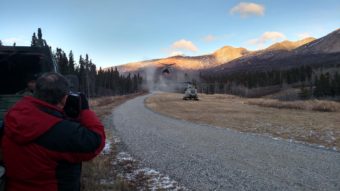
A second Chinook helicopter carrying U.S. and Canadian general/admiral-ranking officers and their staffs kicks up dust Tuesday upon landing at Black Rapids Training Site after a flight from Eielson Air Force Base. (Photo by Tim Ellis/KUAC)

Ten high-level U.S. and Canadian commissioned and noncommissioned officers toured the Army’s Black Rapids Training Site in Delta Junction on  Tuesday.

The event was part of an ongoing series of meetings intended to enable commanders of the two militaries to operate jointly in the far north.

Despite growing tensions between U.S. and Russia around the world, Air Force Lt. Gen. Ken Wilsbach said the Arctic for the most part is a conflict-free zone.

“We want to maintain the Arctic as a peaceful place, as it’s been for a while,” Wilsbach said. “And if anyone was to challenge us in the Arctic, we’ve got to be ready to meet that challenge.”

To help keep the peace, senior commanders of the U.S. and Canadian military and Coast Guard units that operate in the far north this week held another in a series of semi-annual meetings in Alaska to get to know their counterparts and capabilities of the units they command.

The sessions enable commanders to exchange ideas on training and operating in the vast, empty and frigid expanses on land and at sea around North America’s Arctic, Wilsbach said.

“So it’s a defensive mission that is very difficult to accomplish,” he said, “because of the size of the region, as well as the environment.”

Wilsbach heads up the Alaskan Command, headquartered at Joint Base Elmendorf Richardson.

He says the meetings like those held Monday through Wednesday around Anchorage, Fairbanks and Fort Greely now include sessions that place greater emphasis on responding to disasters – operations Wilsbach expects will become more frequent as the warming climate melts sea ice and opens up shipping lanes around the Arctic.

“That is the most likely thing that we’ll be asked to do in the near future,” he said.

Canadian Forces Brig. Gen. Pat LaRoche, who serves as liaison and deputy for Wilbach in his capacity as head of North American Air Defense Command’s Alaska Region, said an event last summer focus greater attention on that mission.

“Perfect example – the Crystal Serenity, a cruise ship that sailed all the way across from Alaska through the Northwest Passage, and in to New York,” LaRoche said. “So, what if something happens with that ship along the way? Who’s going to be called to rescue these folks, right?”

That was the scenario behind an exercise held in September that challenged military and civilian emergency responders to evacuate passengers from a cruise ship that’d run into trouble in the Bering Strait.

The exercise was held just as a real cruise ship, the Crystal Serenity, was sailing through the area and on to the Northwest Passage en route to New York City – with 1,700 people aboard.

“There’s a lot of tourism in the Arctic,” LaRoche said. “So, that’s an issue.”

He said both Canadian and U.S. militaries also are called to respond to natural disasters, such as wildfires, earthquakes and volcanoes.

“We have to be ready across the whole spectrum,” LaRoche said.

Wilsbach, who also serves as 11th Air Force Commander, hosted this round of meetings and tours, part of the so-called General Officer/Flag Officer Summit.

This week’s get-together included a tour of the Black Rapids Training Site, about 30 miles south of Fort Greely, where the generals spoke with media.

An Alaskan Command spokesman says the next summit meeting, scheduled for March, will be held for the first time in Canada – at Yellowknife, the capital of the Northwest Territories.

Federal government announces annual NPR-A lease sale

A Doyon drill rig putting in new wells at the ConocoPhillips CD5 drill site on the North Slope. (Rachel Waldholz/APRN}
A Doyon drill rig putting in new wells at the ConocoPhillips CD5 drill site on the North Slope. (Rachel Waldholz/Alaska’s Energy Desk)

The federal government announced it will hold its annual oil and gas lease sale for land in the National Petroleum Reserve Alaska, or NPR-A, on Dec. 14.

The Bureau of Land Management will take bids on leases for over 1 million acres in the reserve.

ConocoPhillips produced the first barrels of oil in the reserve last year. The company is expanding its footprint there. According to Conoco spokeswoman Natalie Lowman, construction on the company’s Greater Moose’s Tooth 1 project begins this winter, and permitting is underway for Greater Moose’s Tooth 2 project.

The state of Alaska also will hold an oil and gas lease sale for state land on the North Slope and the Beaufort Sea area in December.

The lease sales come at a time of renewed interest for oil development on the North Slope. In recent months, small companies Caelus Energy and Armstrong Oil and Gas have announced potentially huge finds in the region.

Edward Itta remembered for balancing two worlds

Former North Slope Borough Mayor Edward Itta. (Photo courtesy of the Itta family)

Former North Slope Borough Mayor Edward Itta died Sunday in Utqiagvik, formerly known as Barrow. Family members said the cause was cancer. He was 71.

Itta was a powerful voice for North Slope communities. He was perhaps best known for first opposing, and then negotiating with Shell when the oil company wanted to drill in the Arctic Ocean. Above all, he insisted Inupiaq communities have a say in development in the region.

“After all the battles over the wilderness and the oil are done, we are the ones that have to live with the consequences,” he told an Arctic symposium in Seattle in January 2015. “We are the most directly impacted people. Decision makers, policy makers at all levels, need to understand that.”

As mayor, Itta became known for balancing the need for oil development and protecting subsistence.

He grew up as one of 11 children. In a phone interview Monday, his sister, Brenda Itta-Lee, recalled an older way of life, with little in the way of a cash economy, dependent on subsistence.

“Whaling, especially, was very important to Edward,” she said.

Then-North Slope Borough Mayor Edward Itta testifying before Department of Interior Secretary Ken Salazar, 2009. (Photo courtesy of the Department of the Interior)
Then-North Slope Borough Mayor Edward Itta testifying before Department of Interior Secretary Ken Salazar in 2009. (Photo courtesy Department of the Interior)

Itta-Lee said she and her siblings grew up with a foot in two worlds — traditional and modern, Inupiaq and English. Her brother became a whaling captain who negotiated with oil companies.

“He could speak just as powerfully in two languages,” Itta-Lee said. “We (had) a Western American schooling, where we were taught an American way of life. And Edward also mastered how to survive successfully in that setting. So he was very much admired for being bilingual and also bicultural.”

It was a crucial skill set when he became mayor of the North Slope Borough in 2005. Interest in the Arctic was on the rise, especially from oil companies. Shell developed big plans to drill in the Arctic Ocean.

But the company hadn’t consulted local communities, who worried about the impact on marine mammals, and especially on the whale migration.

Itta wasn’t having it. He insisted the Inupiat have a seat at the table, eventually suing the federal government to demand a more thorough environmental review.

Journalist Bob Reiss wrote about Itta’s long fight and eventual negotiation with Shell in his 2012 book “The Eskimo and The Oil Man.”

“It was too much, it was too fast, it was too soon, Edward said,” Reiss said Monday. “Here was this mayor that Shell had not even taken into account, who came up with the strategy of challenging them in court, and who brought the second largest oil company on Earth to its knees, in court. Just stopped them dead.”

Reiss said Itta agonized over his choices. North Slope communities depend on oil revenue to sustain their quality of life and public services, and on-shore oil production was in decline. Yet the ocean is central to both life and identity, and offshore drilling could threaten that.

“He said to me once, and this sort of epitomized everything, he said, ‘Well, what if it’s me?'” Reiss said. “And he meant more than, ‘What if it’s me?’ ‘What if it’s me, what if it’s my family?’ he said. ‘What if it’s me who stops the oil?’ Meaning, stops the money, stops the taxes, stops the building. ‘What if it’s me?’ But then a second later, he said, ‘Well, what if it’s me who allows the oil, and then something goes wrong, and then we lose the whales?'”

Reiss recalls sitting in on a meeting between Itta and Shell that encapsulated that struggle. Itta had come back from whaling camp to meet with oil industry executives.

“The whales only come twice a year,” Reiss said. “Edward was a whaling captain. He was responsible for the lives of his men. These are relatives, these are his best friends. Certainly the last thing that a whaling captain wants to do is leave the camp and go back to town. Which he did that day because — and this is the way the book starts, actually — Edward is on a snowmobile back to town, and a private jet is on the way up from Houston, with the top people at Shell. ”

The Shell executives wanted Itta to reassure people on the North Slope that drilling would be safe, Reiss said. Itta refused, saying Shell hadn’t done its homework, and hadn’t talked to the community.

“Well, I will say, Edward took their head off (that day),” Reiss said, laughing. “He really did! And it was great to watch as a journalist.”

The borough’s lawsuit helped force a more thorough environmental review, and over years of negotiations, Itta convinced Shell to build in measures to protect marine mammals, including a planned pause in work during the whale migration.

Department of Natural Resources Commissioner Andy Mack worked for Itta during those years, as the government affairs director for the North Slope Borough.

Asked how he liked working for Itta, Mack said, “Loved it. Loved every minute of it.”

“He’s a tremendously powerful example of a person who was really true to his principles, but practical,” Mack said. “He was also very committed to the people that he worked for.”

Above all, Reiss said, Itta had heart.

“Whether he was talking with an Inupiaq person, whether he was talking to a Yup’ik, whether he was talking with a Norwegian, or a senator, or an admiral, or an oil person, Edward could really feel your heart, and respond to it, as one human does to another. And I think that’s why he is as beloved as he is,” Reiss said. “Yeah, he was a leader. Yeah, he had brains. Yeah, he knew how to get through Washington. But when you were in a room with Edward, you were two people talking, and you were talking from the heart.”

Giant snowballs wash up on Siberian beach

There were snowy, icy balls everywhere.

Videos and photos from western Siberia, on the Gulf of Ob, showed an entire beach covered in snowballs that had apparently washed ashore. In one image published online by the Siberian Times, a woman sat on the frozen balls. In another, a dog ran near the balls, which had also formed what looked like a vertical mass of balls mashed together into an icy ball-wall.

The BBC reports that the balls started washing up about two weeks ago. They’re strung along some 11 miles of coast and are said to range from about the size of a tennis ball up to almost 3 feet across.

Here’s a video of the beach shot by someone named Valery Togo, who told the Russian news site Vesti Yamal that he lives in the nearby town of Nyda, which is on the Yamal Peninsula just above the Arctic Circle.

The BBC reports the chilled orbs that washed ashore “result from a rare environmental process where small pieces of ice form, are rolled by wind and water, and end up as giant snowballs.” It adds:

“Russian TV quoted an explanation from Sergei Lisenkov, press secretary of the Arctic and Antarctic Research Institute:

” ‘As a rule, first there is a primary natural phenomenon — sludge ice, slob ice. Then comes a combination of the effects of the wind, the lay of the coastline, and the temperature and wind conditions.’

” ‘It can be such an original combination that it results in the formation of balls like these.’ “

The Collins English Dictionary defines “slob ice” as “sludgy masses of floating ice” in Canadian English.

Rare and original as the ball-forming process might be, this is not the first time humans have witnessed these globular creations. In 2010, a Chicago Tribune video showed snowballs that washed up along Lake Michigan.

In 2015, a man waded into the water — again in Lake Michigan — to heft a couple of frozen balls himself, and videotaped it. He and other witnesses to the snowball phenomenon have noted that the main body of water is not frozen even though the balls are.

That same year, waves of icy spheres turned a Maine lake into an undulating ball-mass, captured on video by a Facebook user called Stone Point Studio.

Copyright 2016 NPR. To see more, visit http://www.npr.org/.
Site notifications
Update notification options
Subscribe to notifications