Rachel Waldholz, Alaska’s Energy Desk

Decades-old federal policy placed Newtok in the path of climate change

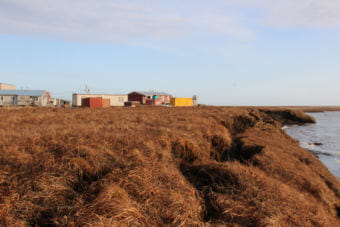
The nearest homes are now just 40 feet from the edge of the Ninglick River. The village could lose that amount of land in just one or two storms. (Photo by Rachel Waldholz/Alaska's Energy Desk)
The nearest homes are now just 40 feet from the edge of the Ninglick River. The village could lose that amount of land in just one or two storms. (Photo by Rachel Waldholz/Alaska’s Energy Desk)

On a chilly afternoon last November, I went to visit George Carl, the vice president of the Newtok Village Council. He’s a slight, wiry man in his mid-60s with a bushy gray mustache and a pair of surprisingly hip blue glasses perched on his nose.

I stopped by with Andrew John, Newtok’s tribal administrator. We were greeted with instant coffee and – to Andrew’s delight – cinnamon rolls.

Newtok, in Western Alaska, is perhaps the most endangered village in Alaska. It’s built on permafrost, and it’s losing about 70 feet of land each year as the Ninglick River eats away at the shore. George Carl’s house is one of the closest to the river.

“It’s going to reach my house pretty soon. Probably next summer,” he said.

A 2003 report found that most of Alaska’s 200-plus rural villages face flooding and erosion. By 2009, as many as 12 villages were already considering some kind of relocation.

But moving a whole village is astronomically expensive. So who’s going to cover those costs? Who is responsible?

Some advocates say the answer is the federal government. They say it’s largely because of federal policy that some of these villages are so vulnerable to climate change in the first place.

George Carl thinks he’ll see the end of this Newtok. Residents expect the village to become uninhabitable within a matter of years, as the river consumes houses and, eventually, the school and runway.

He also remembers the beginning: He was born a few miles away, at a site called Old Kealavik.

But in 1958, the Bureau of Indian Affairs built a school at the nearby seasonal camp of Newtok. The story goes that the site was chosen because that was as far as the barge with the building supplies could make it. So that’s where it stopped, and that’s where the school was built.

When Carl was about six, his family moved to be near the school. Families from all over the region did the same.

“I remembered a guy who was telling our parents that if you want to have our kids put in the school, just move here,” he said.

At the time, this was happening all over the state. Many Alaska Native families still moved around seasonally. Carl’s family lived in a sod house, the traditional housing built from the tundra. If a river changed directions and a site flooded, the camp could be rebuilt somewhere else.

But when the government started building schools, the villages grew around them, rooting people in place. Other infrastructure followed: clinics and airstrips and power plants.

Many of the sites were chosen the way Newtok was – convenience for the builders, not longevity for the village.

“No really good planner, or no really good developer would go out to this area and say, ‘Well this is a great place to build a new community!’,” said Sally Russell Cox, a planner with the state of Alaska who has worked with Newtok since 2006.

She says their locations have made villages like Newtok more vulnerable to climate change.

“That compounded with you know the warming that we’ve seen over quite a lot of years has really impacted these communities,” Cox said.

Many locations were already vulnerable to environmental change. And now the landscape is changing faster than expected, with climate-driven shifts like the loss of sea and river ice.

Newtok hopes to relocate to a new site, about nine miles upriver. The village has been trying to move for more than two decades, but it’s been a struggle to find the funding. One estimate puts the price tag for relocation at $130 million.

Some advocates say Alaska’s history means the federal government has a special responsibility for village relocation.

Robin Bronen is with the Alaska Institute for Justice. She’s working with more than a dozen villages trying to decide whether and how to move.

“There is some responsibility I think from the federal government because the federal government made the decision to create sedentary coastal communities in the locations now where people are not being able to stay,” she said.

At times, Congress has seemed to recognize that responsibility. This spring, lawmakers approved $15 million to help Newtok move, as part of the bipartisan spending bill signed by President Trump. George Carl and others say that’s a big deal for Newtok. But — it’s a one-time fix. It will jump-start the move, but not complete it. And it doesn’t help other communities in the same situation.

The schools, of course, did more than simply root people in place. The ripple effects of that policy are still being felt across Alaska today. In Newtok, some 60 years later, George Carl still remembers the culture shock. Everything was in English.

“First days of school…I wasn’t understanding nothing at all. Just totally nothing,” he said.

He says students weren’t allowed to speak Yup’ik.

But many fundamental ways of life continued. For Carl, life in Newtok still revolves around subsistence hunting and fishing. This time of year, for instance, residents hunt for muskrat, mink and otter.

That’s why, for George Carl and others in Newtok, it’s so important to relocate to a site nearby – and for families to stick together, and not scatter to other villages and cities around the state. He says he can’t imagine moving to Anchorage.

“You know I’m adapted to Mother Nature and the ocean and the river, you know, that kind of food,” he said.

The federal government made his family move once. Now, he’s asking for help to move again: this time, to a place of his own choosing.

This story is adapted from the podcast Midnight Oil: The Big Thaw. Subscribe on iTunesNPR One or wherever you get your podcasts.

Alaska mission to China kicks off with ceremony, trade talks…and speed dating

Ron Risher of Icicle Seafoods talk to Crescent Xuan, Manager of International Trade for the Sichuan Jinggong Flavor Co., during a “speed dating” event designed to bring companies with Alaska products to Chinese consumers on Tuesday, May 23, 2018, in Chengdu, China. (Photo by Rashah McChesney/Alaska’s Energy Desk)
Ron Risher of Icicle Seafoods talk to Crescent Xuan, Manager of International Trade for the Sichuan Jinggong Flavor Co., during a “speed dating” event designed to bring companies with Alaska products to Chinese consumers on Tuesday, May 22, 2018, in Chengdu, China. (Photo by Rashah McChesney/Alaska’s Energy Desk)

Imagine flying all the way to China for a blind date. Or waiting for that Alaskan from halfway around the world to make the first move.

That’s kind of what it was like Tuesday for David McCarthy, co-owner of the 49th State Brewing Company, a craft beer brand with brewpubs in Denali and Anchorage.

McCarthy is traveling with Alaska’s trade delegation to China. The mix of Alaska companies and officials, led by Gov. Bill Walker, began their official visit this week at the annual China-U.S. Governor’s Forum in Chengdu.

The meeting brings together U.S. governors and regional Chinese leaders to talk about trade and investment, and allows for face-to-face meetings between local businesses.

Gov. Bill Walker watches a show during a banquet capping the day of the Fourth Annual China-U.S. Governors Forum on Tuesday, May 22, 2018, in Chengdu, China. Walker is leading a 10-day trade mission with Alaska entities into China, hoping to deepen trade ties between the two. (Photo by Rashah McChesney/Alaska’s Energy Desk)

That’s where the speed-dating comes in. After a long day of ceremony and seminars, McCarthy sat down with several Chinese companies.

And, just like a real date, there were a lot of tentative ni hao’s (or hellos). There were glances toward the interpreters (don’t you wish you had one of those on a real date?). And then…there were some surprises.

Take one of McCarthy’s dates – a company from the northern part of China, interested in pairing McCarthy’s beer with Alaska seafood and selling it in mobile carts. The area, the translator noted, has a big population. Really big.

“50 million!” McCarthy marveled. “That’s a big market. ”

He asked the translator if she knew the population of Alaska. She didn’t.

“750,000,” he said, to laughter.

McCarthy and co-owner Jason Motyka are hoping to sell their beer directly into China. They talked about flying it into Beijing or Shanghai — anywhere Chinese consumers can drink Alaska beer, then hop on a plane and go see the state for themselves.

So, did the speed-dating work?

McCarthy said there were some promising exchanges.

“We did trade numbers with the last guys,” he said. “And maybe we’re going to go out for drinks later too!”

The short meetings were a chance for Alaska businesses to introduce themselves directly to what they hope will be a giant market of new customers. At the end of the day, it wasn’t immediately clear that anyone had landed that special someone. But several members of the delegation said they were astonished by the amount of interest in Alaska products, recipes and  brands.

Crescent Xuan is the head of the international trade department at Sichuan Jinggong Flavor Company. She spent a lot of time talking to the four seafood companies that are traveling with the Alaska delegation

She said her company is interested in incorporating Alaska salmon into their food flavorings. And, she said, these short, fast meetings left her wanting to know more.

“Because I think the time is so short,” Xuan said. “If I had more time, more chance to communicate with the company and the people… We say, the more time for communication, more time for understanding.”

To that end, many of the companies traded numbers and promised to follow up. Just like a promising first date.

Rashah McChesney is in China May 19 – 30, 2018, traveling with Governor Bill Walker and the Opportunity Alaska: China Trade Mission. She’s filing stories for Alaska’s Energy Desk, the Alaska Public Radio Network and NPR.

What should Alaska do about climate change? Now’s your chance to weigh in.

Meeting of Governor Walker's Climate Action Leadership team, chaired by Lieutenant Governor Byron Mallott, on the University of Alaska Fairbanks Campus, in Fairbanks, Alaska, April 12, 2018. David Lienemann/Office of Governor Bill Walker
DEC Commissioner Larry Hartig speaks to other members of the Walker Administration’s Climate Action Leadership team on the University of Alaska Fairbanks Campus, April 12, 2018.
(Photo courtesy of David Lienemann / Office of Governor Bill Walker)

Think you know what Alaska should do about climate change? Now’s your chance to be heard.

The Walker Administration is asking for public input as it develops a sweeping new climate policy for the state. The governor’s climate change task force has released an updated draft of the policy, and the public has until June 4 to weigh in online.
The draft proposes a series of short-term targets to shrink the state’s carbon footprint. Those include cutting greenhouse gas emissions by about a third from 2005 levels; increasing energy efficiency by 15 percent; and generating half the state’s electricity from renewable sources — all by 2025.

The task force proposes Alaska increase investments in the state’s clean energy economy and promote natural gas as a potential “bridge fuel.” But it emphasizes that the state remains dependent on oil production, and suggests using oil revenue to fund a “strategic transition” to renewable energy and a more diversified economy.

The draft also recommends the state play a more active role in helping local communities adapt to climate change, including planning for threats like coastal erosion, severe flooding and reduced access to subsistence foods.

Perhaps most controversially, the draft says the state should consider a version of a carbon tax — a carbon fee and dividend program — to encourage the switch away from fossil fuels. But the draft dropped language from an earlier version, which called it “an economic and ethical imperative” to transition away from fossil fuels.

Walker established the 20-person Climate Action Leadership Team this past winter. The task force is chaired by Lt. Gov. Byron Mallott, and includes representatives from environmental groups, local communities, the University of Alaska system, commercial fishing, mining and the oil industry. The team is required to recommend a final statewide climate policy and action plan to the governor by September.

Can the courts force action on climate change? Sixteen young Alaskans hope so.

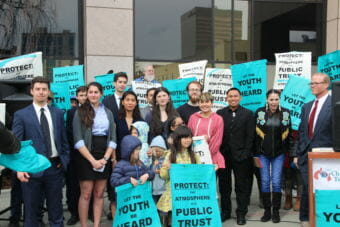
The young plaintiffs in Sinnok v State of Alaska gathered with their attorneys and supporters outside the Nesbett Courthouse in downtown Anchorage after oral arguments on Monday, April 30. The state is asking the court to dismiss their lawsuit. (Photo by Rachel Waldholz / Alaska's Energy Desk)
The young plaintiffs in Sinnok v State of Alaska gathered with their attorneys and supporters outside the Nesbett Courthouse in downtown Anchorage after oral arguments on Monday, April 30. The state is asking the court to dismiss their lawsuit. (Photo by Rachel Waldholz / Alaska’s Energy Desk)

An Anchorage judge heard arguments Monday on whether a lawsuit brought by 16 young Alaskans suing the state over climate change should advance.
The plaintiffs in the case, Sinnok v. State of Alaska, argue the state is violating their constitutional rights by failing to limit greenhouse gas emissions – and they’re asking the courts to intervene.

But the state says climate change policies must be decided by the legislature and the executive branch, not the courts.

About a dozen of the young plaintiffs, ranging from kids in elementary school to college students, sat in the front row of the small courtroom during the hour-long arguments.

They watched as Assistant Attorney General Seth Beausang, arguing for the state, asked the court to dismiss the case entirely. Beausang said past court rulings have established that only the elected branches of government can balance the impacts of climate change against other interests, like economic development.

“The court said that weighing all those interests was a policy decision entrusted to the political branches, and not to the courts,” Beausang said.

That ruling came in a similar climate change case, Kanuk v State of Alaska, dismissed by the Alaska Supreme Court in 2014.

That case and this new one were both brought with the help of an Oregon-based nonprofit, Our Children’s Trust, which has filed legal actions on behalf of young people across the country demanding action on climate change.

The young plaintiffs in this case say that in the years since the 2014 Supreme Court ruling, Alaska has implemented a de facto climate policy by continuing to encourage activities like oil and gas production. Attorney Andrew Welle of Our Children’s Trust argued that this policy violates the plaintiffs’ constitutional rights, requiring the courts to step in.

“The state’s climate and energy policy is causing catastrophic harm to Alaska’s climate system and endangering plaintiff’s lives and liberties and their very futures,” Welle said. “These claims are squarely within the authority of the court.”

Bob Shavelson is with the environmental group Cook Inletkeeper. His 5- and 8-year-old daughters are named as plaintiffs in the lawsuit. Standing in the hallway outside the courtroom after the hearing, he said the case is about much more than which branch of government is responsible for policymaking.

“I think it’s one of the most important lawsuits, if not in the past decade in Alaska, in the state’s entire history,” Shavelson said. “We’re really talking about the future of Alaska here.”

Alaska Superior Court Judge Gregory Miller will decide whether the case can move forward. Attorneys for both sides said they expect a ruling within the next six months.

At crucial moment, Denali Commission faces leadership gap

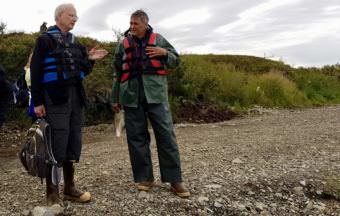
Larry Hartig, left, Alaska Department of Environment Conservation Commissioner and Federal Co-chair of the Denali Commission Joel Neimeyer. (Photo by Christine Trudeau/KYUK)
Joel Neimeyer of the Denali Commission, right, speaks with DEC Commisioner Larry Hartig on a 2017 visit to Mertarvik, the site where the village of Newtok hopes to rebuild. Neimeyer’s last day on the job is April 20. (Photo by Christine Trudeau/KYUK)

The top job at the federal agency tasked with coordinating the relocation of Alaska villages threatened by climate change will soon be vacant.
Joel Neimeyer will step down as federal co-chair of the Denali Commission when his term expires Friday. The Trump Administration has not yet named a replacement.

The vacancy comes at a crucial moment for the agency. In March, Congress doubled the commission’s budget to $30 million, directing it to work with villages facing coastal erosion, flooding and degrading permafrost.

Originally the brainchild of former Alaska Sen. Ted Stevens, the Denali Commission was established by Congress in 1998 to fund economic development and infrastructure in rural Alaska. In 2015, then-President Barack Obama added another mission: assisting Alaska communities threatened by climate change, like Newtok, Shishmaref and Kivalina.

That has been a major focus for Neimeyer. During his eight years as the head of the agency, the commission has pivoted from funding new infrastructure to maintaining existing projects — and trying to raise awareness of climate impacts.

Neimeyer said it’s sometimes been a lonely job.

“The Denali Commission has always been sort of the red-headed stepchild,” Neimeyer said in an interview, a week before his term was set to end. “Regional commissions by their nature are unusual…So we are sort of an island out there as an agency. And the biggest challenge will always be to get cabinet-level agencies to pay attention to what we identify are issues of the day.”

One of the biggest ‘issues of the day’ during Neimeyer’s tenure has been the question of what to do about Alaska villages facing potential destruction. Neimeyer waged a dogged effort to unlock federal funding for climate-related erosion, work that paid off when Congress added $15 million to the commission’s budget as part of this year’s budget deal. Most of that money will go to relocate Newtok, the Western Alaska village most at risk.

But now that the funding has finally arrived, Neimeyer’s term is ending. His exit leaves a big hole at the agency: only the federal co-chair can sign off on spending, so Neimeyer and his staff have worked overtime to approve projects before his last day.

Still, he said, it’s a good time to hand over the reins.

“Not everyone gets to cross the finish line, and I understand that,” Neimeyer said.

The Trump Administration has twice proposed eliminating the Denali Commission entirely. Neimeyer, who was appointed under Obama, is a Democrat. He said the agency needs a Republican head to make the case for it within a Republican administration.

“There may be some things that are bittersweet, but I know that my continuance as the federal co-chair won’t help the agency in the long run,” Neimeyer said. “What actually will help is new blood.”

Who that new blood might be remains an open question. The Alaska congressional delegation must nominate potential candidates to be appointed by the Trump Administration. A spokesperson for Sen. Lisa Murkowski said the senator is currently vetting potential candidates, but offered no prediction on when a replacement might be announced.

Draft Walker climate policy urges Alaska to transition away from fossil fuels

Mendenhall Glacier
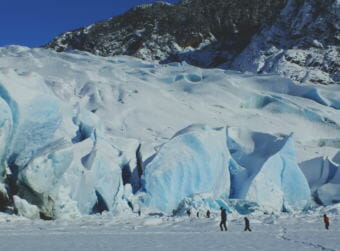
Some visitors to the Mendenhall Glacier on Feb. 17, 2018 stay on the trail over the lake ice, but others venture dangerously close to the glacier’s face with thin ice, open water, and constantly calving bergs. (Photo by Matt Miller/KTOO)

The state of Alaska should reduce its use of fossil fuels, increase investment in renewable energy and plan for a global transition away from oil and gas.

Those are some of the first recommendations from Governor Bill Walker’s climate change task force, which is meeting in Fairbanks today. The 20-person team was appointed by the governor last fall to write a state climate policy.

The first draft of that policy is out and the recommendations run the gamut — from putting a price on carbon, to supporting a more diversified economy, to improving how climate change is taught in schools, to creating an emergency response fund.

Michael LeVine is a task force member and senior Arctic fellow with the environmental group Ocean Conservancy. He said the big takeaway is how widely Alaska will feel the effects of climate change.

“The choices we make about our communities and our economies can’t be cabined into a corner and called ‘climate change issues,'” LeVine said. “They are Alaskan issues. They are issues that affect all of our people, all of our communities and our economy.”

So far, the draft is short on key details. It calls for the state to reduce carbon emissions by 2030, but it doesn’t say by how much. And it doesn’t put a price tag on any of its proposals. Task force members say those numbers will come later.

The document also says that while the state economy will remain dependent on resource development for the immediate future, “these resources are finite and contribute to climate change.” And it declares that it’s “an economic and ethical imperative” for the state to prepare for a worldwide switch from fossil fuels to renewables.

The draft stops short of recommending that the state limit oil development. Instead, it proposes Alaska promote natural gas as a “bridge fuel” and “maximize revenue” from current oil and gas production to help support a transition to renewables.

Team members stress the draft is just the beginning of a conversation. The policy will be revised throughout the year, with opportunities for public input.

Heading into Thursday’s meeting, Sam Schimmel, who at 17 is the youngest member of the task force, said he already had some edits in mind.

“I’m here to make sure the Native youth voice and the youth voice is heard,” Schimmel said. “We need to make sure that we are able to continue to carry out our lives with respect to culture and identity, but we also have to recognize that the world is changing.”

A final climate policy and action plan are due to the governor by September.

Site notifications
Update notification options
Subscribe to notifications