Rachel Waldholz, Alaska’s Energy Desk

Newtok to Congress: thank you for saving our village

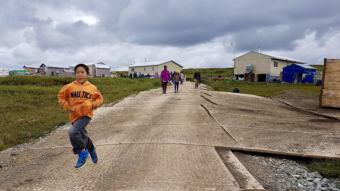
Excited Newtok children sprint down to Mertarvik's newly extended boat harbor. (Photo by Christine Trudeau/KYUK)
Excited Newtok children sprint down temporary roads in Mertarvik, the site where the village hopes to relocate. (Photo by Christine Trudeau/KYUK)

On the day President Trump signed a massive spending bill in Washington, D.C., Paul Charles and George Carl of Newtok sat down in a hotel conference room in midtown Anchorage to take stock of an event they still couldn’t quite believe was real.

The budget bill included $1.3 trillion in spending and was more than 2200 pages long. But for Newtok, there’s just one page that matters.

Newtok Village Council vice president George Carl at home in November 2017. Behind him is a photo of himself, village council president Paul Charles and relocation coordinator Romy Cadiente with Alaska Senator Dan Sullivan. (Photo by Rachel Waldholz / Alaska’s Energy Desk)

That’s page 458. It doubles funding for the federal Denali Commission, giving the agency an extra $15 million. The commission said last week it plans to spend that money to help Newtok relocate, accomplishing a goal that’s been out of reach for more than two decades.

Carl, Newtok’s village council vice president, said the decision is life-changing.

“It’s like saving our people in that small village,” Carl said. “I’d like to thank who made this possible…Thank you very, very much.”

Newtok is rapidly losing land to a combination of erosion and thawing permafrost and residents expect they’ll have to abandon their homes within a matter of years. The village first decided to move in 1994. It acquired a new site several miles away in a land trade with the U.S. Fish and Wildlife Service in 2003. Ever since, the village has been trying to piece together enough funding to move.

The $15 million in this year’s spending bill is just a fraction of what Newtok needs. The cost of moving the entire village is estimated at well over $100 million. But village council president Paul Charles said this is the crucial seed money that will make everything else possible.

“It’s not that the whole village is going to relocate all at one time, but $15 million is a lot of money to build [homes],” Charles said.

The relocation plan is unconventional: The village plans to retrofit old military barracks from Joint Base Elmendorf-Richardson in Anchorage and barge them out to the new site. Engineers estimate that will be cheaper than building new houses from scratch, helping to avoid some of rural Alaska’s high construction costs.  If all goes well, the new funding plus existing grants could go toward the construction of 28 houses at the new site, said village relocation coordinator Romy Cadiente. His goal is to have people living there full-time by the fall of 2019.

At that point, Cadiente said the new site, Mertarvik, would be a permanent community. He hopes it would have enough residents to be eligible for traditional infrastructure funding, including money for a school, an airport and water and sewer systems.

“We hope to attract additional agencies with the message, ‘This is not a conceptual design anymore,'” Cadiente said. “‘This is a real, active project. Can you please help us?'”

Charles, Carl and Cadiente said the funding was the result of work by many people, from the Alaska congressional delegation and the Denali Commission to the village council’s relentless attorney, Mike Walleri, and countless federal and state officials.

But Cadiente pointed out that the $15 million is a one-time funding stream. Several other Alaska villages are considering relocation, and even more need help dealing with erosion if they’re going to stay in place.

They can’t all rely on a special act of Congress. Cadiente said ultimately, the country needs to find a different way to fund climate-related issues like coastal erosion.

As for Paul Charles, he had a message for other villages facing a similar situation:

“Don’t quit what you are working for,” Charles said, speaking in Yup’ik. “To accomplish what we are striving for, we go through difficulties, we keep working through the problems. We accomplish our goal when we keep working toward it.”

Julia Jimmey at KYUK in Bethel contributed translations from Yup’ik to English for this report.

Congress poised to approve $15M for village relocation in Alaska

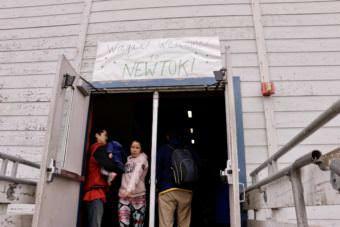
Newtok welcomes guests before their trip over to the new village site, Mertarvik. (Photo by Christine Trudeau/KYUK)
Newtok welcomes guests before their trip over to the new village site, Mertarvik, in August 2017. (Photo by Christine Trudeau/KYUK)

Congress is set to approve a major increase in funding for Alaska villages threatened by climate change.

The spending bill passed by the U.S. House of Representatives on Thursday would double the budget of the federal Denali Commission, which funds infrastructure in rural Alaska, to $30 million.

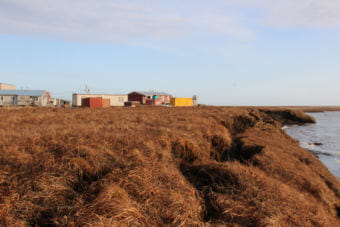
The nearest homes are now just 40 feet from the edge of the Ninglick River. The village could lose that amount of land in just one or two storms. (Photo by Rachel Waldholz/Alaska's Energy Desk)
The nearest homes in Newtok are now just 40 feet from the edge of the Ninglick River. The village could lose that amount of land in just one or two storms. (Photo by Rachel Waldholz/Alaska’s Energy Desk)

The new money is aimed at addressing “the most urgent needs” of Alaska villages facing “erosion, flooding and permafrost degradation,” according to instructions accompanying the bill.

Joel Neimeyer is the federal co-chair of the Denali Commission. He said virtually all the new money will go toward moving the village of Newtok, in Western Alaska.

The village is losing about 70 feet of land annually to coastal erosion, and residents worry it will be completely uninhabitable within a few years.

Newtok has been trying to move to a new site, Mertarvik, which is several miles away. Neimeyer said the new funding could finally break the logjam.

“We’re very excited that this $15 million will allow the community of Newtok to realize their dream of moving to Mertarvik,” Neimeyer said.

Newtok has been trying to piece together enough funding to move for more than a decade. But the village has found itself in a Catch-22: Government agencies that fund housing won’t build homes where there’s no infrastructure. But agencies that fund infrastructure — like water, sewer or power — won’t spend money on a village where nobody lives.

The new money could break that cycle. The village plans to move used barracks from a military base in Anchorage and convert them into housing at the new site. Officials estimate moving the barracks will be significantly less expensive than building new homes, stretching out any funding.

“I would hope that this $15 million would get us halfway to where the community needs in terms of housing stock,” Neimeyer said. “That really is a real community. There are enough people living there that the other funding agencies will have to say, ‘that is a community and our money will be put to good use.'”

That would be a landmark moment for Newtok, and for the state of Alaska, which has not managed to move any of the coastal villages coping with erosion and climate change, despite years of work.

If Newtok can move successfully, Neimeyer said, it could be a model for other threatened villages, like Shishmaref, Shaktoolik or Kivalina.

“If we in Alaska can show Congress we can take their funds and put it to good use, and show that we can do this efficiently, effectively and smartly, perhaps that will open up the checkbook for the other communities,” Neimeyer said.

On Thursday, leaders in Newtok said they were not quite ready to talk about the funding. After years of waiting, they are holding off until the bill is officially passed into law.

The spending bill now goes to the U.S. Senate, which must pass it by Friday night to avoid triggering a partial government shut down.

Feds approve $1.7M to buy out homes in Newtok

The nearest homes are now just 40 feet from the edge of the Ninglick River. The village could lose that amount of land in just one or two storms. (Photo by Rachel Waldholz/Alaska's Energy Desk)
The nearest homes are now just 40 feet from the edge of the Ninglick River. The village could lose that amount of land in just one or two storms. (Photo by Rachel Waldholz/Alaska’s Energy Desk)

The state and federal government have announced $1.7 million in funding to buy out seven homes in the eroding village of Newtok in Western Alaska.

Newtok is threatened by a combination of thawing permafrost, flooding and coastal erosion. Residents worry the village could be uninhabitable within a few years. The community has been trying for years to relocate to a new site upriver, a process the Army Corps of Engineers has estimated could cost $130 million.

The new grant comes just months after the state refused to submit a previous application from Newtok for federal disaster funding, saying it was incomplete. The Newtok Village Council protested that decision, and accused the state of blocking access to much-needed aid.

The grant is funded by both the state and the Federal Emergency Management Agency, or FEMA. It’s part of FEMA’s Hazard Mitigation Grant Program, a special fund aimed at reducing the risk of future disasters.

In a statement, Mike Sutton, the new head of the state Division of Homeland Security and Emergency Management, said the program is not designed to move whole communities. But, he wrote, the fund is crucial because the erosion threatening Newtok and other Alaska villages does not qualify for traditional disaster relief.
Without this grant, he wrote, “it is likely the residents would see their homes taken by the river without any financial help.”

In Western Alaska, there’s water where there should be ice

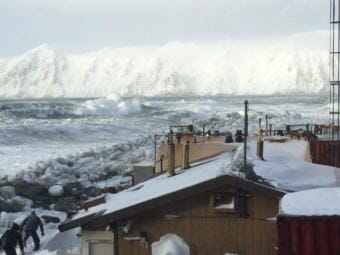
Waves hammered the shore in Diomede during a storm on Feb 20, after the island lost its buffer of sea ice. (Photo courtesy of Frances Ozenna)

It’s been a record-breaking winter in Western Alaska. Temperatures in parts of the state have reached more than 40 degrees above normal, and sea ice cover in the Bering Sea has dropped to levels never before recorded.

Last week, social media across the region lit up as residents posted photos and videos of open water where, normally, there’s ice. In some communities, people say it’s the first time they can remember seeing wide open water in February.
The tiny island village of Diomede, in the middle of the Bering Strait, got national attention after a resident posted a video of giant waves crashing onto shore and surging between buildings during a storm on Feb. 20.

Beyond the waves? Open water, all the way to the horizon.

And that’s definitely not normal, said tribal coordinator Frances Ozenna.

“This is really amazing to see, this change,” Ozenna said in a phone interview Friday. “I don’t think anybody was really expecting this to happen.”

She said it’s the first time she can remember ever seeing this much open water in front of Diomede at this time of year: normally the sea ice grows from January all the way through March. But this year, it’s been unpredictable, she said, moving every day, with water opening and closing.

Then on Feb. 20, a major storm blew away what ice there was, and left the village without protection from the waves. The storm flooded Diomede’s water treatment plant and knocked out power. Chunks of ice and debris were tossed onto the beach and the village’s heliport.

“It’s very odd,” Ozenna said. “This is supposed to be the coldest time of the year.”

It’s not just Diomede. The entire Bering Sea is seeing record low levels of sea ice, said Brian Brettschneider, a climatologist based in Anchorage. Brettschneider said ice in the Bering Sea is currently at the lowest level in nearly 40 years of satellite data.

Part of the issue is warm temperatures: Brettshneider said parts of Western Alaska and the North Slope, including St. Paul, Kotzebue and Utqiagvik, are having their warmest winter on record.

“You have warm air running over record warm water,” he said. “It’s really hard to get sea ice to form in that situation.”

The drastic drop this year might be an anomaly. Brettschneider said he wouldn’t be surprised if next year, sea ice levels are significantly higher.

But he said the overall pattern is clear.

“The trend line certainly is bad,” Brettscheinder said. “My interpretation of that is, this is going to be more likely than not in the years to come.”

That’s left people like Ambrose Towarak shaking their heads.

Towarak is a commercial fisherman in Unalakleet, on Norton Sound. He posted a photo on Facebook of open water in front of town – something he also said he’s never seen this time of year.

“Everybody in the community is like, ‘It’s February! We shouldn’t be hearing ocean waves crashing on the beach,'” Towarak said in an interview Friday.

But that’s exactly what’s happening. Towarak’s friend Jeff Erickson posted a video on Facebook showing waves rolling onto the shore.

In a comment below the video, Erickson posted the lyrics to Bob Dylan’s 1960s anthem.

“In the words of an ancient sage,” Erickson wrote, “…the times, they are a-changin’.”

Tsunami warning prompts hundreds of Alaskans to evacuate to higher ground

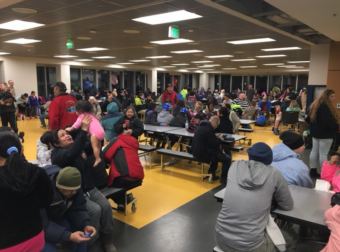
Kodiak residents evacuated to the high school during a tsunami warning on Jan. 23, 2018. (Photo by Mitch Borden / KMXT)

The National Weather Service issued a tsunami warning for nearly the entire Gulf of Alaska this morning, after a magnitude 7.9 earthquake struck 175 miles from Kodiak around 12:30 a.m.

The warning was canceled four hours later.

But Alaskans across the state woke up to the shaking and an emergency alert buzzing their cell phones, warning them to move away from the coast.

In coastal communities like Sitka, Kodiak and Unalaska the alert was followed by tsunami sirens.

Unalaska residents gather in City Hall during a tsunami warning early on Jan. 23, 2018. (Photo by Zoe Sobel / KUCB)

Many Sitka residents evacuated to local schools. Mackenzie Bovard said when she saw the alert on her phone, she wondered if it was another false alarm, like the missile alert in Hawaii two weeks ago.

“I didn’t feel very panicked,” Brovard said. “I was like, “Really, do we have to get up? Can’t I just go back to sleep?”

But her family did evacuate, along with hundreds of others.  By 2 a.m., when the wave was expected to hit Sitka, the high school was crowded with residents hoping to remain high and dry.

The tsunami warning was downgraded to an advisory around 3:30 a.m.

Ken Macpherson, a watchstander at the National Tsunami Warning Center in Palmer, said a wave of about six inches was recorded in Kodiak.

“So we definitely did have a wave in the Gulf of Alaska tonight,” Macpherson said. Just not a very big one.

Joshua Hector was down by the water in Kodiak when the city’s tsunami siren went off. He ran out and started looking for a ride to get to higher ground.

“I was waving down quite a bit of people,” Hector said. “People were just driving by because they were freaking out. I finally got somebody to stop. A kind lady, she was just leaving the McDonald’s. She was a worker there, I believe. And she said ‘Yes, you can come with me.’ So, thank God she helped me out.”

Kodiak residents evacuated to the high school during a tsunami warning on Jan. 23, 2018. (Photo by Mitch Borden / KMXT)

Hector joined hundreds of people gathered at the Kodiak High School.

In Unalaska, tsunami sirens started wailing just before 2 a.m. Residents were encouraged to move at least 50 feet above sea level.

Around 200 people sheltered at Unalaska’s city hall and the health clinic, including Iata Akopo.

Akopo is new to Unalaska, but in 2009 he experienced a major tsunami at home in Samoa.

“Back in 2009, September 29, our island was hit with tsunami,” Akopo said. “An earthquake, and then not even a minute [later, the] tsunami showed up out of nowhere. We lost loved ones and a lot of people, so I’ve been through this.”

He was relieved that this time was different. After two hours of evacuation, city officials told Unalaskans it was safe to head home.

The Alaska Earthquake Center reported no damage from the quake.

Emily Kwong and Robert Woolsey at KCAW, Sitka; Mitch Borden at KMXT, Kodiak; and Zoe Sobel at KUCB, Unalaska contributed to this report.

New York City sues oil industry over climate change

New York City Mayor Bill de Blasio, center, announced that the city is suing five major oil companies over climate change. The city also announced it will divest from companies owning fossil fuel reserves. (Photo courtesy of New York City Mayor's Office)
New York City Mayor Bill de Blasio, center, announced that the city is suing five major oil companies over climate change. The city also announced it will divest from companies owning fossil fuel reserves. (Photo courtesy of New York City Mayor’s Office)

New York City is taking aim at the oil and gas industry.

Mayor Bill de Blasio announced today that the city is suing five oil and gas companies – including Alaska’s top three oil producers – and seeking to hold them responsible for damages caused by climate change.

The suit names Exxon Mobil, BP and Conoco Phillips along with Chevron and Royal Dutch Shell.

The city also announced it will divest its pension funds from all companies that own fossil fuel reserves.

In making the announcement, De Blasio had tough words for the oil and gas industry. He recalled the aftermath of Hurricane Sandy, which crippled New York City in 2012.

“I remember how desperate it was,” de Blasio said. “I remember how much fear and confusion there was. And this was a tragedy that was wrought by the actions of the fossil fuel companies. Let’s be clear. That’s where it came from.”

The city argues that the five companies are responsible for a significant fraction of greenhouse gas emissions, and that the oil industry overall misled the public about the risks of climate change. The oil industry has disputed that claim.

Several California communities have also brought similar cases.

In response to the lawsuit, Exxon Vice President Suzanne McCarron posted a statement online.

“I want to use this opportunity to be 100 percent clear about where we stand on climate change,” McCarron wrote. “We believe the risk of climate change is real and we are committed to being part of the solution.”

McCarron wrote that the company welcomes any “good faith attempts” to address climate change, but said “lawsuits of this kind…simply do not do that.”

In an email, Shell spokesman Curtis Smith wrote, “Climate change is a complex societal challenge that should be addressed through sound government policy and cultural change to drive low-carbon choices for businesses and consumers, not by the courts.”

A Conoco Phillips spokesperson said the company does not comment on pending litigation.

BP’s Alaska unit also had no comment. BP Alaska President Janet Weiss sits on Alaska’s climate change commission.

Site notifications
Update notification options
Subscribe to notifications