Sens. Pete Kelly, R-Fairbanks, and Charlie Huggins, R-Wasilla, linger after the Senate adjourned sine die, July 18, 2016. (Photo by Jeremy Hsieh/KTOO)
Moody’s Investors Service has downgraded Alaska’s credit rating for the second time in six months, citing the state’s massive budget deficit and its failure to find a long-term political solution.
In a report released Monday, Moody’s wrote that Alaska’s savings accounts will buy the state “several more years” to figure out its fiscal future. But, analysts wrote, the downgrade reflects the state’s “political inability — at least for now” to address the budget challenges brought on by lower oil prices.
The announcement came just a week after the legislature gaveled out of an unprecedented fifth special session without voting on the governor’s proposals to overhaul state finances.
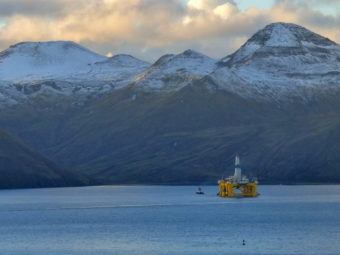
Shell’s Polar Pioneer leaving Dutch Harbor on Oct. 12, 2015, heading for Washington state. (Photo by John Ryan/KUCB)
The Obama Administration on Thursday issued new regulations covering offshore drilling in the Arctic.
The new rules will hold oil companies in the Arctic to a higher standard than those drilling in other regions, including the Gulf of Mexico.
But currently, there are no companies with plans to drill in the Arctic Ocean off Alaska — and that seems unlikely to change any time soon.
The Department of the Interior began formulating the regulations after Shell’s first effort to drill in the Arctic in 2012 resulted in a series of serious mishaps.
Speaking on a conference call with reporters on Thursday, Assistant Interior Secretary Janice Schneider called the new rules “world class.”
“This rule seeks to set the highest safety and environmental standards for companies interested in Arctic exploration,” Schneider said.
The regulations essentially codify the rules imposed on Shell during its 2015 drilling season, including a requirement that companies keep a second rig available at all times to drill a relief well.
Shell called those regulations a contributing factor in its decision to pull out of the Arctic last fall.
But Abigail Hopper, Director of the Bureau of Ocean Energy Management, said the rules were prompted by mistakes that Shell itself made in 2012.
“We realized that one of the challenges was a lack of contractor oversight, and a deficit in planning the entire operation,” Hopper said. “So we have required…what’s called an integrated operations plan. That is a plan from the very beginning of the program, all the way through demobilization at the very end.”
The Interior Department is also deciding whether to include the Arctic in its next round of offshore lease sales. That is a separate decision, expected later this year.
The new regulations only cover floating operations, not near-shore projects like Hilcorp’s Northstar unit or its proposed Liberty project, which drill from man-made gravel islands in the Beaufort Sea.
The regulations prompted predictable reactions from industry and environmental groups.
The Center for Biological Diversity emailed out a statement saying, simply, “Arctic drilling can’t be made safe, period.”
But other environmentalists called the regulations a good first step.
“If, in fact, companies ever do want to come back and explore in the Arctic Ocean, they’ll know what the basic safety and prevention requirements are, and they’ll be substantially improved over what they used to be,” said Michael LeVine, of the conservation group Oceana.
But, Levine said, he doesn’t believe any company is truly prepared yet to deal with risks like oil spills in Arctic waters.
Meanwhile, Kara Moriarty of the Alaska Oil and Gas Association repeated her organization’s warning that regulations will slow Arctic development.
“Obviously we’re still trying to sift through all 348 pages,” Moriarty said. “But at first blush, it does appear the federal government is creating additional cumbersome regulations that will make it more challenging to entice companies back to the Arctic when oil prices rebound.”
It remains an open question what it would take to entice companies back to the Arctic, regulations or no regulations.
With the exception of Hilcorp’s near-shore operations, no company currently has any plans to drill in the Chukchi or Beaufort Seas.
In the nine months since Shell announced it was abandoning its nearly decade-long quest in the region, several companies, including ConocoPhillips, Norway’s Statoil, and the Spanish company Repsol have relinquished leases: of more than 700 leases purchased in the Arctic since 2003, only 43 are still held by companies.
Rachel Mills is the manager at Urban Greens in downtown Anchorage. She was laid off from the contractor ASRC Energy Services in January after the company was hit hard by falling oil prices and Shell’s decision to end Arctic drilling. Photo: Rachel Waldholz/Alaska’s Energy Desk
For the first time in nearly 30 years, Alaska is in a recession.
With oil prices at half their recent peak, the state has shed more than 2,000 jobs from the energy industry since this time last year.
That means many Alaskans are adjusting to a new reality: lost paychecks, career changes — and the possibility they might have to leave the state entirely.
On a sunny afternoon in downtown Anchorage, there’s a late lunchtime rush at Urban Greens, a sandwich shop on the corner of Third & G.
Behind the counter is a young woman in red flannel and big glasses who seems to know the name of every other person walking through the door and their usual lunch order.
When I visited, Rachel Mills was the manager at Urban Greens. But go back several months, and she had a very different role — as a botanist for ASRC Energy Services, an oil and gas contractor.
When Shell announced it was pulling out of the Arctic last fall, it hit her company hard. A few months later, right around the time oil plunged to a 12-year low, Mills was told she no longer had a job.
“It was a January sunny day, and I’m just sitting in the kitchen, and I’m thinking, wow, so this is what it’s like to fail,” Mills said.
That same month, the state — one of the few other employers for a botanist — announced a hiring freeze, as low oil revenue prompted budget cuts.
“I have all this education,” Mills said. “I did everything by the book. I worked really hard. I got the job. Everyone likes me … and it doesn’t matter.”
Mills isn’t alone. She’s part of a wave of Alaskans who have lost work in the last year, as the state has seen its first real dip in jobs in nearly three decades.
According to Department of Labor economist Neal Fried (who is also a board member at Alaska Public Media), with the exception of a brief slowdown in 2009 when the Great Recession hit tourism, Alaska has seen economic growth every year since 1988. Until now.
“This is an interruption of that,” Fried said. “I think we will define this, possibly, as a new period.”
In some ways, the downturn came late to Alaska. The price of oil started dropping in the summer of 2014 and the bust hit states like North Dakota soon after.
But in Alaska, employment held steady. The state actually gained oil and gas jobs through the beginning of 2015.
Fried said those gains built on a remarkable period for the state, as oil prices drove industry job numbers to record highs.
“2014, which was not very long ago, was the largest oil industry workforce we have ever had in our history,” he said.
In fact, Alaska still has historically high numbers of people working in oil and gas, more than 12,000. And Fried worries those record highs might mean record losses.
Since last May, the state is down about 2,100 jobs in the industry. Those numbers don’t include people in related fields like engineering and construction; they likely don’t even include people like Mills, who worked for a contractor.
Alaska has gained jobs in other areas, like health care and retail, but Fried said it’s not the same.
“Those are hard jobs to replace,” he said. “It’s not like closing down Sports Authority.”
That’s in part because of the pay difference. Fried estimates oil and gas jobs pay over two and a half times the average in other industries.
Brad Campbell is facing that reality. He worked as a financial analyst at BP for more than 15 years, until he was laid off in June.
“Two years in a row I went through uncertainty. Am I going to have a job or not?” he said. “I’m kind of relieved I don’t, now. At least I know.”
Campbell would like to remain in oil and gas. “I like being able to put energy on the market — my little bit of role putting energy on the market,” he said.
And he’s doing everything possible to hang onto his home.
“I’m a little worried about getting a job that pays well,” he said. “But I’m just going to have faith that it’s going to work out.”
Above all, he said, he wants to stay in Alaska, where he’s lived since 1983.
As for Rachel Mills, she left her job at Urban Greens. She’s now working in the back office at another local restaurant — and sending out job applications in her field.
The current gig, like her last one, came with a major pay cut and no benefits.
When her husband mentioned that Urban Greens was looking for a new manager, Mills jumped at it – even though it meant a major pay cut. (Photo by Rachel Waldholz/Alaska’s Energy Desk)
But, she says, she feels lucky to have a salary —and it’s better than when she was waiting to be laid off from her job in oil and gas.
“It was agony,” she said. “You’re just standing around, knowing there’s nothing to work on.”
That’s the uncertainty facing many people around the state, as they wonder how long this new period will last, and whether the end is in sight — or if this is just the beginning.
Close
Update notification options
Subscribe to notifications
Subscribe
Get notifications about news related to the topics you care about. You can unsubscribe anytime.