Rachel Waldholz, Alaska’s Energy Desk

Man on a mission: Gov. Walker and the gas line

Bill Walker, fifth from left. As a Valdez City Council member, Walker traveled with a delegation from the Organization for the Management of Alaska Resources (later the Resource Development Council) to meet with California Gov. Jerry Brown to advocate for a gas line, 1977. (Photo courtesy of Bill and Donna Walker)
In 1977, as a Valdez City Council member, Walker traveled with a delegation from the Organization for the Management of Alaska Resources to meet with California Gov. Jerry Brown. (Photo courtesy of Bill and Donna Walker)

The announcement this summer that Alaska will pursue a state-owned natural gas pipeline is a major U-turn after more than a decade of negotiations with the big three North Slope oil companies.

But one person has been advocating this approach all along: Bill Walker.

For years, Walker argued the state should take control of the project, instead of putting its faith in the industry.

Then, he became governor.

This week, Alaska’s Energy Desk is exploring the the state’s 40-year quest for a natural gas pipeline in the series Pipeline Promises.

Today, we look at Gov. Bill Walker’s decades-long mission to build a gas line.

About a year ago, Gov. Bill Walker stood before reporters, addressing his most recent dust-up with the state’s oil companies.

In a moment of exasperation, he said, look. This is about Alaska’s future.

“It has to do with controlling our destiny, and not allowing somebody else to control our destiny,” he said in a press conference before the legislature’s special session on the gas line. “I stand firm on that principle.”

This is the heart of the Bill Walker philosophy: this gas line, this “piece of pipe,” as he calls it, is central to Alaska’s destiny, and it is never going to get built unless the state takes charge. We simply cannot leave it to the oil companies, he argued.

Now, Alaska has a chance to test that theory.

For the man in the driver’s seat, the seeds of this philosophy were planted almost fifty years ago, with the state’s other pipeline – the oil pipeline.

“I graduated from high school in ’69 in Valdez, and I could not afford to go to college,” Walker said in a recent interview. “I mean, there was no way I could afford to go to college.”

Bill Walker during college. (Photo courtesy of Bill and Donna Walker)

What saved him, he said, was early work on the trans-Alaska pipeline. He still remembers getting his dispatch – the piece of paper calling him up for a job on the project.

“I’ve gotten a number of degrees in my life, and I can’t tell you a single name of the person that gave me [them],” he said. “But I can tell you the name of the person who gave me that dispatch. His name was Jim Robinson, it was at the Johnson Trailer Court in Valdez, and I stood there with a couple of my buddies, and I thought, ‘This is my ticket, for my future.'”

Walker says what the last pipeline meant to him, the next line could mean for a whole new generation. Jobs, of course. Revenue for the state. Cheap energy that could launch whole new industries. New incentive for companies to explore the North Slope.

His first encounter with the gas line came a few years after that moment in the Valdez trailer court. Walker was in his mid-20s. He’d just met his wife, and he was serving on the Valdez City Council.

“And the mayor said, ‘who wants to work on the gas line?'” Walker said. “I said, ‘well, I’ll work on the gas line. I worked on the oil line, so I’m happy to work on the gas line.'”

He ended up traveling to California to meet with then- (and now-) Gov. Jerry Brown to advocate for an Alaska LNG line to ship gas to the West Coast. That version of the project, like so many after it, fizzled. But Walker stayed involved in oil and gas — and often found himself at odds with the state’s dominant industry.

In the late 1990s, the gas line came back into his life. He was called to a meeting of mayors from the North Slope, Fairbanks and Valdez. They had formed a group called “Gasline Now!”

“[They said], what can we do to add a few more percentage of return to the gas line, so the producers would build a gas line?” Walker said.

The idea was to jump-start a project by using the local governments’ tax-exempt status to try to tempt the oil companies to the table. The result was the Alaska Gasline Port Authority (AGPA).

Then-Valdez Mayor Bill Walker congratulates Alyeska's Marine Terminal manager on the arrival of the one billionth barrel of oil, 1979. (Photo courtesy of Bill and Donna Walker)
Then-Valdez Mayor Bill Walker congratulates Alyeska’s Marine Terminal manager on the arrival of the one billionth barrel of oil, 1979. (Photo courtesy of Bill and Donna Walker)

Walker ended up working with the Port Authority for more than a decade, trying to advance what he called an All-Alaska Gasline. (During this time, he also represented the City of Valdez in a long-running court battle with the North Slope producers, arguing the companies had undervalued the trans-Alaska pipeline in order to pay lower property taxes.)

Craig Richards went to work for Walker as a 27-year-old lawyer in the early 2000s. He went on to become Walker’s law partner, confidant and ultimately his first attorney general.

“Bill wasn’t doing academic papers. Bill was doing the real deal, he was meeting with Fortune 500 companies, and having real meetings about ways to monetize the gas. It was just very enticing,” Richards recalled.

He said the Port Authority years taught Walker several things. There were moments when Walker thought he’d pulled it off. He brought in big outside companies, like the California utility Sempra Energy, or Mitsubishi, who were interested in a project. They’d reach out to the North Slope companies who controlled the gas.

But, Richards said, “Phone never rang. Dead silence.”

“The answer of course, is that producers weren’t interested at that stage in making a pipeline happen,” Richards said. “They were interested in accomplishing other goals.”

Goals like using gas line negotiations with the state to lock in their oil and gas taxes and a friendly regulatory regime, Richards said.

Critics say the Port Authority never put together enough of a project to merit a real response.

But Richards said for him and Walker, the lessons were clear: The oil companies have their own priorities and their own timeline. If the state wants a gas line, it can’t wait for the companies to lead the way.

“One, he decided that he needed to be governor, if he was going to really see the gas line go to the next phase. And that was the beginning of his political ambitions,” Richards said. “And two, he realized it’s gotta be the state of Alaska that does this. At least in terms of the pre-development work.”

In 2010, Walker ran against then-governor Sean Parnell in the Republican primary, with the gas line as his main issue. An ad from that era features Walker speaking to the camera: “Folks ask me if I’m a one-issue candidate, and I’ll admit and it’s certainly no secret, I am committed to Alaskans building an all-Alaska gas line,” he says.

He lost that year, but ran again in 2014, as an independent. By then, Parnell and Republican lawmakers were advancing a new plan, a partnership with the big three North Slope producers –  ExxonMobil, BP and ConocoPhillips – as well as the pipeline company TransCanada: the Alaska LNG project.

Bill Walker was not a fan.

“The fatal flaw of what [Parnell] is doing is, again, again, he has put control of Alaska’s future in the hands of companies that have competing projects around the world,” he told KTVA’s Rhonda McBride in an interview in May 2014.

Gov. Bill Walker 2015 02 19
Gov. Bill Walker at a press conference Feb. 19, 2015. (Photo by Skip Gray/360 North)

Then, the unexpected happened: Walker won the election.

Former Anchorage Daily News reporter Bill White has researched the history of the gas line. I asked him if Walker’s single-minded pursuit of a state-owned project is his white whale – his Moby Dick.

White: It’s his big obsession, for sure. Remains to be seen if it’s his white whale.

Alaska’s Energy Desk: Why?

White: Well, maybe he’s right. I wouldn’t bet on it, but maybe he’s right.

Now, Walker has a chance to prove it.

When he took office, oil and gas prices were plunging. Suddenly Alaska faced a massive revenue shortfall, and Walker was more convinced than ever that a gas line is the solution.

Low prices also created an opening, changing the dynamics of the Alaska LNG project Walker had inherited from Parnell.

On February 9, 2016, the state’s three oil-company partners sat down with Walker’s team.

“It was a day I’ll never forget,” Walker said.

According to both the governor and ExxonMobil, the companies told him that lousy market conditions and slow negotiations with the state meant they probably couldn’t move the project ahead as planned.

They proposed either slowing down or letting the state take over.

For Walker, this was his moment. And he seized it.

“I thought, my goodness. How long have we waited for this opportunity,” he said. Within months, his administration had announced it would pursue a state-owned project.

For many Alaskans, news that the big three oil companies have stepped back from the project is a sign the state’s gas line dream has hit another wall. But Walker doesn’t see it that way.

“We have proved over the last forty years what won’t work,” he said. “This is the first time we’ve said, let’s try it, one time, like other sovereigns do around the world.”

It’s not a wall, he said. “It’s a starting gate.”

Oil and subsistence in the warming Arctic: A conversation with Tom Kizzia

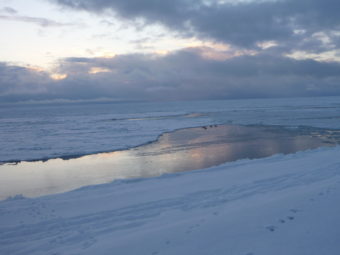
The view from Point Hope, late winter 2015. (Photo by Ellen Chenoweth/University of Alaska Fairbanks)
The view from Point Hope, early winter 2015. (Photo by Ellen Chenoweth/University of Alaska Fairbanks)

In the most recent issue of The New Yorker, Alaska writer and longtime former ADN reporter Tom Kizzia looks back at the debate over offshore drilling in North Slope communities. Kizzia visited Point Hope to report on how climate change is affecting the region’s twin pillars: oil development and subsistence hunting.
He spoke with Rachel Waldholz of Alaska’s Energy Desk from Homer, where he lives. His article, Whale hunters of the warming Arctic, appears in the Sept. 12 issue of the magazine.

Steve Oomittuk, who was born and raised in Point Hope, hopes broadband won't aggravate the problem of Western culture overwhelming Native culture – especially among youth. (Image courtesy of Jiri Rezak/Greenpeace)
“I love my way of life,” Steve Oomittuk, a former mayor of Point Hope, told Kizzia. “My grandfather’s life. The cycle of life. The connection to the land, the sea, the sky.”  (Image courtesy of Jiri Rezak/Greenpeace)

Kizzia said it’s easy to label communities as either for or against oil development, but in his reporting he found many residents who could see both sides.

KIZZIA: I think a lot of people really kind of held both opinions at the same time, was my sense. Individually they would sort of lean one way or lean the other, but the flag-waving leaders on either side weren’t as common as the people who had this deep ambivalence or anguish about what they might be doing to their whaling future [if they allowed offshore drilling]. At the same time, if they didn’t have the property tax income [from oil development] to keep civilization running up there, how are they going to live? So that was what was impressive to me, that sort of ambivalence in the middle that so many people had.

WALDHOLZ: What drew you to this particular story?

KIZZIA: Well, I think underlying that debate over offshore oil is the question of how the climate is changing, the ice is melting and what’s going to happen to the ancient culture up there if the ice goes away. They’re looking at a warmer future that’s going to really change the way things are done up there and they’re trying to figure out how to respond to that. In that sense, they’re just like all Americans, but it’s so much more concentrated. You can see the dilemma within the Inupiaq culture in some ways more easily as an outsider than you can when you look at our North American culture. But it’s really the same dilemma.

WALDHOLZ: You open the story with this amazing scene out on the sea ice, and I’m wondering if you can describe that for our listeners.

KIZZIA: It was a year ago in the spring. The ice had gotten so thin that they couldn’t hunt bowheads anymore off of Point Hope. Basically the hunters were just out there on their own, just watching the whales swim by. I saw some amazing photos, you could see the black backs of the whales right there, and you couldn’t catch them.

And while they’re out there, suddenly there are three warning shots. And the warning shots meant the ice lead had broken off behind them and they were on a piece of ice that was threatening to float away and take them out to sea. They got back and they could see a hundred yards of blue water between them and the shore-fast ice. And their solution was to take their snowmachines and get a good running start, and just skip like stones across the open ocean to get back onto the ice on the shore side. It was just a pretty terrifying moment for a lot of people — and something the kids would do, I’m told, in the lagoons up there in the summer, practice with their snowmachines. And it turned out to be a pretty useful technique for saving their lives.

WALDHOLZ: You have this line toward the end of the story where you say people have worried they may need to choose between oil and subsistence — but now they’re facing the prospect of potentially losing both. Is it really that bleak?

KIZZIA: Well, I hope not. I mean, clearly nobody wants that to happen. But I just wanted to describe in broad strokes how that situation is beginning to come into focus as a possibility, and there’s not a real easy checklist of things we can do to deal with that. But I think as a journalist, trying to recognize what the challenges are is sometimes the first step. And in Alaska that’s often clouded by our short term interests — [it’s] hard to see the big picture.

Should the Permanent Fund invest in oil tax credits?

Former Attorney General Craig Richards addressed the Alaska Permanent Fund Corp. board on Sept. 2, 2016. Photo: Rachel Waldholz, Alaska's Energy Desk
Former Attorney General Craig Richards addresses the Alaska Permanent Fund Corp. board on Sept. 2, 2016. (Photo by Rachel Waldholz/Alaska’s Energy Desk)

The Alaska Permanent Fund Corp. board had an unusual visitor at their meeting Friday.

Former Attorney General Craig Richards showed up to pitch an unconventional investment idea: oil and gas tax credits.

The presentation came as Gov. Bill Walker’s administration faces a problem — or rather, as several of Alaska’s smaller oil and gas companies face a problem.

Those companies have earned tax credits from the state for things like exploration work. But for the last two years, the governor has vetoed payments for those credits. That means companies are holding IOU’s from the state, with no idea when they’ll actually get paid.

The administration estimates the state now owes more than $700 million in those IOU’s, or redeemable tax credits.

In the past, companies could sell the rights to those credits to a bank or outside investor. But that market has dried up.

And that, Richards told the Permanent Fund board, creates an opportunity.

“The proposal to the Permanent Fund would be that they view these tax credits very much like a state of Alaska bond,” Richards said in an interview after his presentation. “You have the potential to purchase a credit from the state … for yields that are something like 10 percent, whereas if you were going to go buy a state of Alaska or a state of Washington bond, it might yield 2 percent.”

Richards was a Permanent Fund board member himself until he resigned as attorney general in June. He’s currently on contract with the governor’s office, where he’s been brainstorming solutions to the oil tax credit dilemma, along with Walker’s oil and gas adviser, John Hendrix.

He said, like bonds issued by the state, tax credits are debt Alaska has to pay.

The difference is, there’s no deadline. So it may be several years or more before that payment comes.

But many companies need the money sooner than later. They were planning to use it to pay for next year’s work, or took out loans against the credits and now have to pay those loans back.

Right now, they don’t have many options.

They can sell their credit certificates to bigger companies on the North Slope, which can use them to offset future taxes. But for various reasons, the credits aren’t actually worth all that much to those companies. Richards said he’s hearing the big producers are only willing to pay maybe 20 or 30 percent of the credits’ face value.

What you need, he said, is an outside investor who isn’t bound by the same rules as North Slope producers. They might be willing to buy the rights to those credits, for, say, 70 percent of face value, on the assumption that at some point the state will pay the full amount.

Would go for this plan, if he were still on the Permanent Fund board?

“If I could get the tax credits at 70 cents on the dollar, absolutely,” Richards said. “If I could only get them at 95 cents on the dollar, probably not.”

As for the current Permanent Fund board members, they asked only a few questions, giving no real indication what they thought of the plan.

Kara Moriarty of the Alaska Oil and Gas Association was also listening. Her group represents several companies who are owed credits.

Moriarty said she still has plenty of questions. But no matter what, she said, the key issue remains the same.

“Whether you’re paying an investor … or you’re paying the companies themselves, at the end of the day it still comes down to, when is the state going to pay it?” she said.

For now, that’s a question with no clear answer.

Clock is ticking on state dispute with Prudhoe Bay leaseholders

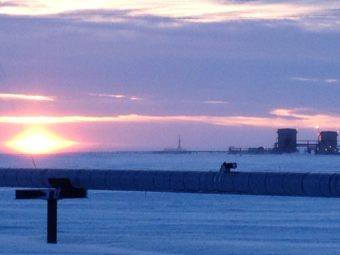
Prudhoe Bay. (Photo courtesy of BP)
Prudhoe Bay. The Department of Natural Resources has refused to approve the oil field’s 2016 Plan of Development until operator BP includes detailed marketing information for its massive gas reserves. (Photo courtesy BP)

The clock is ticking on a dispute between Gov. Bill Walker’s administration and the state’s largest oil producers.

The Department of Natural Resources has rejected the annual plan for Prudhoe Bay, demanding detailed new information on how North Slope companies plan to market the field’s natural gas reserves.

But companies have resisted, arguing the information the state wants either does not exist or would be illegal to hand over.
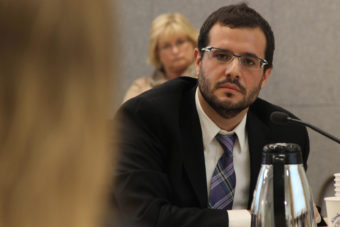
Thursday, Sept. 1, was the deadline for the field’s main operator, BP, to submit a new plan. The state now has 60 days to respond.

This fight started back in January, with a letter from former Natural Resources Commissioner Mark Myers. The letter asked BP to include detailed information on its efforts to market the field’s oil and — more to the point — natural gas reserves.

That request was new because right now there isn’t a clear path for major gas sales from Prudhoe Bay. The state and North Slope producers have been trying to build a pipeline to bring that gas to market for decades. At the time of the letter, the state was in a four-way partnership with the main Prudhoe Bay leaseholders — BP, ExxonMobil and ConocoPhillips — though that partnership is now dissolving, as the state takes control of the project.

When BP submitted its plan in March, the Division of Oil and Gas responded with a bullet-point list of details it still required — including potential customers, volumes and pricing terms for natural gas sales.

BP refused, calling the state’s request “extraordinary,” “unprecedented,” and “unlawful.” The company argued, in part, that sharing marketing information with competitors — including the state — would violate antitrust laws.

BP also said much of the information the state wants simply doesn’t exist, because nobody is currently selling gas from the North Slope. And it pointed out the state was well aware of its major efforts to monetize its gas, through the Alaska LNG project.

ExxonMobil and ConocoPhillips both sent letters supporting BP’s position.

The state wasn’t satisfied. On June 30, Division of Oil and Gas Director Corri Feige sent a letter declaring the Prudhoe Bay 2016 Plan of Development incomplete. The division extended the previous year’s plan and gave BP two months to try again.

With the new plan submitted, the state has until Nov. 1 to respond. (BP’s most recent letter and updated plan have not been released publicly; the division said it will release the plan once it has been reviewed for confidential information.)

It’s unclear what will happen if the state rejects the plan again. A company can’t operate a field without an accepted plan of development  — so in theory, at least, the dispute could disrupt production at Alaska’s largest oil field.

But a Division of Oil and Gas spokesperson insisted that’s not in the cards, saying the state is confident it will get the information it wants, and the division can issue another extension — or more — if needed.

State takes control of gas line megaproject; consultant warns of major risks

Nikos Tsafos of Enalytica warned lawmakers of major unkowns in a state-led gas line project. "If I were taking over a $50 billion project, I would be a lot more worried than I feel folks are worried," he said. Photo: Rachel Waldholz, Alaska's Energy Desk
Nikos Tsafos of Enalytica warned lawmakers of major unkowns in a state-led gas line project. “If I were taking over a $50 billion project, I would be a lot more worried than I feel folks are worried,” he said. (Photo by Rachel Waldholz, Alaska’s Energy Desk)

The state of Alaska is formally taking over the massive North Slope gas line project.

After months of mixed signals, Gov. Bill Walker’s administration and the state’s three current partners — ExxonMobil, BP and ConocoPhillips — told lawmakers this week that the state will take the lead on the Alaska LNG megaproject as soon as this fall.

It’s a stunning departure from the approach the state has pursued for the last two years, marking yet another phase in Alaska’s decades-long quest for a gas line. And at a joint hearing of the House and Senate Natural Resources committees this week, lawmakers were told the new approach comes with major new risks.

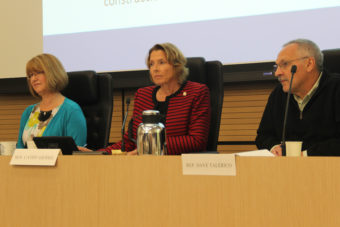
Lawmakers from the House and Senate Natural Resources Committees listened to testimony on Aug. 25, 2016. From left: Sen. Mike Dunleavy, R-Wasilla; Sen. Anna MacKinnon, R-Eagle River; Sen. Cathy Giessel, R-Anchorage; Rep. Dave Talerico, R-Healy; Rep. Benjamin Nageak, D-Barrow; and Rep. Bob Herron, D-Bethel. Photo: Rachel Waldholz, Alaska's Energy Desk
Lawmakers from the House and Senate Natural Resources Committees listened to testimony on Aug. 25, 2016. From left: Sen. Mike Dunleavy, R-Wasilla; Sen. Anna MacKinnon, R-Eagle River; Sen. Cathy Giessel, R-Anchorage; Rep. Dave Talerico, R-Healy; Rep. Benjamin Nageak, D-Barrow; and Rep. Bob Herron, D-Bethel. Photo: Rachel Waldholz, Alaska’s Energy Desk

The legislature’s consultant, Nikos Tsafos of Enalytica, stepped up to the mic at about 3 p.m. Thursday to give his verdict on the state’s newest proposal.

“Let me put this very candidly,” he said. “If I were taking over a $50 billion project, I would be a lot more worried than I feel folks are worried.”

“There’s so much stuff that comes with it,” Tsafos said. “And most of the things that have been offered as reassurance, have yet to reassure me.”

The state’s decision comes with too many unknowns and a plenty of risk, Tsafos said. During an hour of testimony, he sometimes had the air of a man frantically trying to flag down a train before it heads off a cliff, warning that if the three oil companies are stepping back, it likely doesn’t make sense for the state to step forward.

“You usually want to take over economic projects, not uneconomic projects,” he said at one point.

A combination of low oil and gas prices worldwide and the high costs of the Alaska LNG project have prompted the state’s three partners to reconsider their investment.

ConocoPhillips testified Thursday they are unlikely to fund any project into 2017.

ExxonMobil said they were willing to continue the current project, but on a slower timeline.

Gov. Bill Walker’s administration has rejected that proposal, arguing the project must not be delayed, and should come online as scheduled in the mid-2020’s.

The Walker administration is opting to push forward on its own.

The state is ignoring other options, Tsafos said.

“There is a spectrum of where we are right now to the state taking it over, and I can think of about six permutations in between,” he said. “We’ve gone from one to the other, and I have no idea why we we’re not doing any of the things in between.”

At the end of the day, he said, a state-led project could make sense — but Alaska hasn’t yet done the homework to prove that’s true.

Walker administration officials acknowledge there’s work to do.

The new head of the Alaska Gasline Development Corp., Keith Meyer, said he’s considering two major changes.

First, increased — or full — state ownership of the project. That could exempt all or part of the project from federal taxes, and drive down its cost.

Second, he hopes to bring in outside investors who might be willing to accept a lower rate of return than the state’s current oil company partners — for instance, pension or equity funds.

Can you do both at once? Meyer said right now that’s unclear.

“What we’re trying to figure out now, and it’s going to take some significant work, [is] can we have those two things live together?” he told lawmakers Wednesday.

A report from the outside consulting firm Wood Mackenzie offered some support for both of those approaches, suggesting that either could lower the project cost. But lawyers consulted by the legislature cast doubt on whether a project with outside investors would qualify to be exempt from federal taxes.

Speaking after the hearing, House Natural Resources Committee co-chair Dave Talerico, R-Healy, said the two days of testimony had raised more questions than answers.

“One of the biggest things I’m taking away from this is the amount of risk we may be taking on,” Talerico said. “I think that’s a consideration that we really need to think about.”

Lawmakers may not have much time to think.

The project will begin to transition over to the Alaska Gasline Development Corporation in October, with the state expected to take full control by the end of the year.

Report: Gas line project not competitive without major changes

Lawmakers listened to testimony from Wood Mackenzie's David Barrowman at a joint hearing of the House and Senate Resources Committees on Aug. 24, 2016. From left: Sen. Anna MacKinnon, R-Eagle River; Sen. Cathy Giessel, R-Anchorage; and Rep. David Talerico, R-Healy. Photo: Rachel Waldholz, Alaska's Energy Desk
Lawmakers listened to testimony from Wood Mackenzie’s David Barrowman at a joint hearing of the House and Senate Resources Committees on Aug. 24, 2016. From left: Sen. Anna MacKinnon, R-Eagle River; Sen. Cathy Giessel, R-Anchorage; and Rep. David Talerico, R-Healy. Photo: Rachel Waldholz, Alaska’s Energy Desk

Alaska’s natural gas pipeline project, as currently envisioned, is not competitive and likely cannot succeed in the current market. That’s the conclusion of a new report from outside consulting firm Wood Mackenzie.

But, the report said, major changes, similar to those being proposed by Gov. Bill Walker’s administration, could make the project more viable.

Under the current model, Alaska is partnering with the three major North Slope producers — ExxonMobil, BP and ConocoPhillips — to build the pipeline.

David Barrowman of consulting firm Wood Mackenzie told lawmakers that the Alaska LNG, as currently envisioned, is likely too expensive to compete with other LNG projects around the world. Photo: Rachel Waldholz, Alaska's Energy Desk
David Barrowman of consulting firm Wood Mackenzie told lawmakers that the Alaska LNG, as currently envisioned, is likely too expensive to compete with other LNG projects around the world. Photo: Rachel Waldholz, Alaska’s Energy Desk

Wood Mackenzie’s David Barrowman told lawmakers on Wednesday that his firm compared that project with other liquefied natural gas projects around the world, and found that it’s simply too expensive.

“The competitiveness of Alaska LNG does not rank well when compared to other…peer projects that could supply North Asia,” Barrowman said. “The ranking means that under current pricing assumptions it would certainly struggle — and even if oil prices rise to about $70 a barrel. Then it would be difficult to make acceptable returns.”

But, Barrowman said, there are ways to lower the project’s cost.

One option is bringing in outside investors to fund the gas line, instead of the partners funding it themselves. Another path is full state ownership, which might lower federal taxes.

Those are both options the state is considering as it seeks to take control of the project, said Keith Meyer, the new head of the Alaska Gasline Development Corporation.

Meyer and Barrowman testified at a joint hearing of the House and Senate Natural Resources Committees. The hearing will continue Thursday with testimony from the state’s three current partners, ExxonMobil, BP and ConocoPhillips.

Site notifications
Update notification options
Subscribe to notifications