Rachel Waldholz, Alaska’s Energy Desk

Supreme Court surprise: Westlake winner in District 40

12Waldholz_AKSupremeCourt
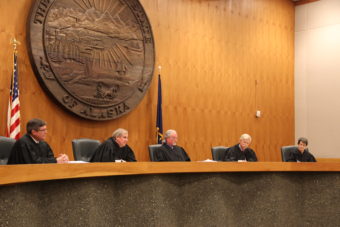
Members of the Alaska Supreme Court today reversed the lower court’s decision and reinstated Dean Westlake as the winner of the Democratic primary in House District 40. (Photo by Rachel Waldholz/Alaska’s Energy Desk)

The Alaska Supreme Court is sending Dean Westlake to Juneau.

In a decision late Wednesday afternoon, the court reinstated Westlake as the winner of the Democratic primary in House District 40, which covers the North Slope and Northwest Arctic.

It reversed a lower court ruling last week which had tipped the election to the incumbent representative, Benjamin Nageak of Barrow.

Reached by cell phone in Kotzebue just after the order was issued, Westlake said he was “absolutely ecstatic.”

“When I got the news, I just had to go for a ride,” Westlake said, laughing. “I was sitting in my office, and I thought, this is wonderful, that people that go to vote understand that absolutely no one is going to take that right away from you.”

Nageak could not immediately be reached.

The Supreme Court heard arguments this morning in the disputed primary election.

The arguments centered on events in the village of Shungnak, where poll workers let all 50 voters cast ballots in both Democratic and Republican primary races in August, instead of requiring them to choose.

The state admitted that was a mistake. But Assistant Attorney General Laura Fox, representing the Division of Elections, argued those votes should still count. Democratic primaries are open to anyone, so all the voters were eligible to participate, and it was only possible to vote once in this race, Fox said.

“They all only got one vote in this race, and this is the only race that’s been challenged, and the only race that the court has to look at here,” Fox said.

Nageak’s lawyers argued that if poll workers had followed the rules, at least a few of those voters would have chosen the Republican ballot and never voted in the Democratic primary at all —  possibly changing the outcome. Westlake won 47 of 50 votes in Shungnak, and he won the race over all by just 8 votes.

Last week, the lower court agreed with Nageak and threw out 12 votes in Shungnak — and two in Kivalina — giving Nageak the win.

The lower court based that number on testimony from former Alaska Republican Party chair Randy Ruedrich, who calculated the average number of voters who chose the Republican-only ballot in the last four elections.

The Alaska Republican Party has supported Nageak’s challenge. Although he’s a Democrat, Nageak caucuses with the Republican majority in the state House.

In its appeal, the state called Ruedrich’s calculation “nonsensical.” Fox pointed out that Ruedrich used raw numbers without adjusting for voter turn-out, and the state’s brief suggested he chose to include only those past elections that favored his conclusion

The justices seemed to agree.

“Is that really a matter for expert testimony? It’s just math,” Justice Joel Bolger said to Nageak’s attorney, Stacey Stone.

Bolger noted that Ruedrich’s math only included elections back to 2008, even though the attorney’s brief included numbers going back to 2006.

“Is there anything in the record that shows why the 2006 results were neglected?” he asked.

“No, your honor, the only reason those results were neglected is because of the speed at which this trial happened,” Stone replied.

“But it only takes a moment to calculate these averages,” Bolger said.

Meanwhile, Chief Justice Craig Stowers seemed troubled that nobody had actually asked anyone in Shungnak how they meant to vote. He said no amount of math could tell the court which ballots voters would have chosen, especially when there was a hotly contested race on the Democratic ballot, and not on the Republican one.

“Could not these villagers, who knew a lot about these candidates, and were very interested in this particular election, have decided to choose all, or substantially all, of the ballots from the ADL?” he asked. The ADL ballot included the Democratic Party, Alaska Independence Party and Libertarian Party primaries.

The five justices arrived at their decision within hours. In a two-paragraph order issued Wednesday afternoon, they reversed the lower court’s decision, upholding the original election results.

Only Justice Daniel Winfree dissented, arguing the entire election should be voided and held again.

District 40 primary fight heads to Alaska Supreme Court

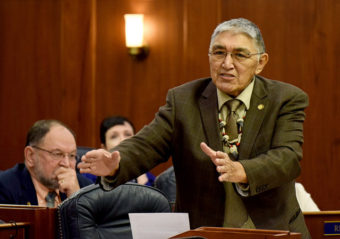
Rep. Benjamin Nageak, D-Barrow, speaks in the Alaska House of Representatives during debate on House Bill 123 to establish a marijuana control board in Alaska, April 14, 2015. (Photo by Skip Gray/360 North)

The Alaska Supreme Court will hear arguments Wednesday in a lawsuit over the Democratic primary in House District 40, which stretches from Kotzebue to Kaktovik.

House District 40, the state's northernmost, includes the North Slope and Northwest Arctic. (Image courtesy of the Division of Elections)
House District 40, the state’s northernmost, includes the North Slope and Northwest Arctic. (Image courtesy Division of Elections)

The outcome could determine the balance of power in the state legislature next year.

The Division of Elections originally declared Dean Westlake of Kotzebue the winner, beating incumbent Rep. Benjamin Nageak of Barrow, by eight votes.

But Nageak challenged those results, pointing to voting irregularities in several precincts. Last week, a Superior Court judge threw out 12 votes from the village of Shungnak and two from Kivalina, giving Nageak a narrow, two-vote win.

The state appealed that decision to the Alaska Supreme Court.

With no other candidates running in the general election, whoever wins the primary will head to Juneau in January, and the decision could tip control of the House. Though both candidates are Democrats, Nageak caucuses with the Republican majority, while Westlake has said he will join other Democrats.

Oral arguments will begin at 10 a.m. Wednesday in the Boney Courthouse in downtown Anchorage. The justices are expected to rule by Friday, Oct. 14 — that’s the deadline for the state to begin mailing out ballots for the general election in November.

Walrus return to Point Lay — but this year, they’re late

A young Pacific Walrus bull in coastal Alaska waters. (Photo by Joel Garlich-Miller/USFWS)

About a thousand walruses are hauled out on a barrier island near the village of Point Lay, about 180 miles southwest of Barrow.

The haul out is part of an unnerving trend. This year marks the eighth time in a decade that large numbers of walruses have crowded onto land in the area. The animals have been driven to shore as sea ice retreats, limiting access to their usual feeding grounds.

But this year’s haul out — so late in the fall — was a surprise.

Andrea Medeiros is a spokesperson for the U.S. Fish and Wildlife Service. She said scientists were pretty sure it wasn’t going to happen this year. Then, she said, “Next thing I know, I get an email from one of our biologists saying, ‘The walruses are hauling out,’ and I’m like, ‘Ahh!'”

Residents in Point Lay contacted the Fish and Wildlife Service with the news Friday morning.

Medeiros said the haul out is forming about a month later than in the past. Usually at this time, walruses are heading south to Russian waters for the winter. And although sea ice receded to its second lowest level on record this summer, there was lingering ice over the walruses’ traditional feeding grounds.

The Fish and Wildlife Service and the Native village of Point Lay are asking people to stay away from the area during the haul out to avoid disturbing the animals and causing a stampede.

“The risk there is when they are onshore and the animals get spooked, the larger animals will flee to the water and crush the small animals in the process,” Medeiros said. “So it leads to a lot of preventable mortality.”

Biologists are continuing to monitor the haul out as it forms. In the past, up to 40,000 animals have gathered in the area.

State calls a truce in Prudhoe Bay dispute

Andy Mack DNR Commissioner
Alaska Natural Resources Commissioner Andy Mack at a press conference in Anchorage on June 28, 2016. Mack sent a letter Sept. 20 approving the Prudhoe Bay plan of development. (Photo by Graelyn Brashear/Alaska Public Media)

Gov. Bill Walker’s administration has called a truce in its dispute with the big three North Slope oil producers over plans for Prudhoe Bay.

The Department of Natural Resources has approved the field’s latest development plan, ending a standoff that raised fears the Walker administration was threatening companies’ leases at the site, potentially disrupting production at the state’s largest oil field.

The dispute goes back to January, when the Walker administration requested detailed information about how BP, which operates Prudhoe Bay, plans to market the field’s massive natural gas reserves. It was the first time the state has made such a request; Prudhoe doesn’t currently ship gas, only oil.

But the state wants assurances that BP and Prudhoe’s other owners, ExxonMobil and ConocoPhillips, are preparing to make the gas available to a potential North Slope pipeline project.

“The state’s position is that we’re at a point where we need to prepare for major gas sales,” said new DNR Commissioner Andy Mack. Mack spoke by phone from Seoul, South Korea, where he was traveling with the governor and other state officials in an effort to promote Alaska’s gas line project.

BP refused the Walker administration’s request, arguing the information the state wants either doesn’t exist or would be illegal to release under antitrust laws. In June, the state declared the Prudhoe Bay plan incomplete and gave BP two months to try again.

That decision raised concerns the state might be considering action against the companies’ leases if they didn’t cooperate.

But the state reversed course. On Sept. 20, Mack sent a letter approving the companies’ plan (as first reported by the Alaska Journal of Commerce). In an interview, Mack said the state didn’t get all of the information it requested, but the administration has been encouraged by the companies’ public statements in support of a state-led gas line project.

“There’s always a request and then there’s a response, and in many cases it’s not a perfect match, and I think that’s the case here,” he said. “But we felt comfortable at the end of this process that it was the right thing to do for the state of Alaska to approve the plan through 2017.”

The approval letter included the caveat that the state expects more detailed information next year.

State Sen. Cathy Giessel, R-Anchorage, chairs the Senate Resources Committee. She said the letter seems to leave the issue open.

“I think there is definitely a tone of ongoing threat to the leases on the North Slope, based on Commissioner Mack’s letter,” Giessel said. “That’s a concern to me.”

Meanwhile, the head of the state Division of Oil and Gas, Corri Feige, announced plans to resign the same day Mack’s letter was sent. Feige has been the face of the Walker administration in the dispute for the past few months.

Mack said her decision had nothing to do with the Prudhoe Bay plan. A spokesperson for the Division said Feige was not available to comment.

Permanent Fund will not invest in oil tax credits

An Alaska Permanent Fund Corp. sign in the office in Juneau, March 14, 2016. (Photo by Skip Gray/360 North)

The Alaska Permanent Fund Corp. has rejected a proposal from Gov. Bill Walker’s administration to invest in state oil tax credits.

Former Attorney General Craig Richards presented the idea to the fund’s board earlier this month. The administration is looking for ways to ease the pain for smaller oil companies after the governor vetoed $430 million in credits that companies expected would be paid this year.

The Permanent Fund board said in a statement that the expected returns “do not justify taking on the associated risks.”

The man with the plan: Can Keith Meyer sell the gas line?

As the state of Alaska takes the lead in the effort to build a natural gas pipeline from the North Slope, it finds itself taking responsibility for what would be one of the largest, most complex projects in the world.

The man in charge is Keith Meyer, the new president of the Alaska Gasline Development Corp.

This week, Alaska’s Energy Desk is digging into the gas line project in the series, Pipeline Promises.

Today, Rachel Waldholz introduces us to the man with the plan.

Keith Meyer took over as the new president of the Alaska Gasline Development Corp. in June 2016. (Photo courtesy of AGDC)

To hear Keith Meyer tell it, this gas line project should not be that hard.

Back in June, when Meyer was about two weeks into his new job, he was called up to testify before lawmakers. And he said it’s always puzzled him that Alaska’s gas line has had so much trouble getting off the ground.

“Yes, it’s a big project,” he said. “[But] it’s not the biggest pipeline, it’s not the highest pipeline, it’s not the largest diameter pipeline, it’s not the largest LNG plant.”

It’s not an engineering problem at all, he said. “This project, I think, where it suffers, is not technical complexity. It’s the paperwork.”

That’s right. The project that’s eluded the state and some of the world’s largest oil companies for some four decades? It’s a paperwork problem.

That take left many people wondering – who is this guy?

“I consider myself a gas guy,” Meyer said, in an interview at AGDC’s offices just after he was hired.

Meyer has a vaguely 1950’s vibe: salt and pepper hair, hipster glasses. He says things like, neat and by golly.

He’s worked on pipeline and natural gas projects for more than 35 years, and said he’s known about Alaska’s project since the very first day of his career, back in 1980.

“And I remember at that time thinking, as a young buck in the industry, wow, that is a neat project,” he said. “You know, someday I might get to work on a project like that…So I was thrilled at the opportunity to be the one to bring it home.”

Meyer comes across as supremely confident he can bring it home.

But he inherited a project in flux. Earlier this year, Alaska’s three partners – ExxonMobil, BP and ConocoPhillips – told the state they likely wouldn’t move the project forward on the expected timeline.

The state decided to take over – which puts Meyer, and AGDC, in charge.

His first challenge is tackling the project’s Achilles heel: its price tag.

“Right now it’s high cost,” he told the Legislature in June. “So now our focus has to be on how do we get the cost reduction. How do we get the cost down?”

Meyer’s answer: re-imagining the project’s financing.

The existing project structure is pretty simple. The state is in a four-way partnership with the oil companies. Each party puts up their $10 to $15 billion – and voila! Project financed.

But with our partners headed for the exits, how does Alaska finance the project on its own?

Meyer said – we don’t have to.

He wants the state to quit acting like a deep-pocketed oil major and start acting like a scrappy pipeline company. You don’t pay for the project yourself. You bring in outside investors. You put together a deal. That’s what he means by “paperwork.”

“This is significantly different than the way it was done [to date],” he said. “However, it’s very similar to the way most of the pipelines in the US have been built and also the way most of the LNG facilities now have been built.”

Gov. Bill Walker has ruled out dipping into the Permanent Fund, the state’s $54 billion piggy bank. Meyer said the project also wouldn’t rely on general obligation bonds — the state’s everyday credit card, used for expenses like highway projects.

Instead, the state would rely on project financing. Essentially, AGDC will go out and try to secure customers — perhaps utilities in Japan that want to buy gas, or the North Slope producers themselves, who would pay to ship their gas down the pipeline. If the state can lock down long-term contracts, it can take those contracts to the bank — or, more likely, to private equity firms — using the contracts as the foundation to secure loans or investors for the first stage of the project.  Once construction is underway, Meyer said, other third-party investors might want a piece of it, such as pension funds, insurance companies, infrastructure investors.

If that sounds pretty complicated — well, it is. But Meyer has some experience in this.

His calling card in the natural gas world is his work on Cheniere Energy’s Sabine Pass import terminal in Louisiana in the mid-2000’s.

“Keith played a huge role in one of the more important players in this remarkable period for energy,” said Wall Street Journal reporter Gregory Zuckerman, who wrote about Cheniere Energy in his 2013 book, The Frackers. “He was part of this effort to import natural gas when it seemed like the country needed it.”

Cheniere Energy managed to do pretty much what Meyer is proposing in Alaska: it didn’t own any gas, it didn’t have deep pockets, but it locked in contracts with big companies that wanted space in its terminal and used those contracts to go out and get financing to build the project.

Zuckerman said Meyer gets part of the credit for that, for promoting the project and making the case to investors.

“He was among the people that concluded some of the best agreements and contracts for Cheniere, according to people close to the matter. So he would be a good person to pull that off,” Zuckerman said. “The challenge, obviously, is that these are really expensive projects. And the energy business, as we’ve learned over the last few years, can change dramatically.”

That’s what happened to Cheniere. The Sabine Pass project was put together in the mid-2000’s, when the U.S. thought it was facing an energy shortage. Then the fracking boom swamped the gas market. Cheniere’s value plunged. The company only saved itself by turning its import project into an export project. By then, Meyer had left the company.

There are major differences between the projects. LNG import projects are by definition simpler and cheaper than export projects. And the Sabine Pass import project was also much smaller than Alaska’s project – something like the difference between financing a Kia and a Tesla.

I asked Meyer if he had ever put together project financing for something the size of the Alaska LNG project, which is estimated to cost at least $45 billion.

“No one has,” he said.

In other words, financing the project as it currently exists would be unprecedented.

Meyer’s goal, of course, is to keep the project well below $45 billion, through a combination of cheaper financing, the potential tax benefits of state ownership, and, perhaps, building it in multiple phases.

But he said he’s under no illusions about the challenges. Alaska’s project is big. It’s expensive. He’s confident there’s a growing market for natural gas, but there are a lot of LNG projects competing to fill that demand.

But, he said, if Alaska waits, the competition will only get worse.

“We’re fighting with some of the biggest companies in the world, some big countries,” he said. “And, by golly, we’ve got to get out there and fight for this Alaskan project.”

Site notifications
Update notification options
Subscribe to notifications