Rachel Waldholz, Alaska’s Energy Desk

From rotten ice to wildfires: hunting and fishing becomes complicated in a changing Alaska

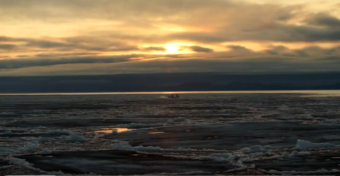
Screenshot from the video Silavut Atlannuraqtuq, Our Changing Weather, about climate change in Northwest Alaska. (Image courtesy of the Maniilaq Association and ANTHC)

Alaskans have heard stories for years about how climate change is affecting subsistence hunting and fishing. Now researchers are trying to quantify that impact– and they’re finding the biggest problem is access.

This summer, Maija Lukin set out to document changes around her home community of Kotzebue.

For Lukin, the impacts of climate change are personal. She says her six-year-old niece is learning different rules for hunting and fishing than she did growing up.

“She’s going to grow up learning, oh, we (always) have to check the ice,” Lukin said. “I never had to check the ice, ever.”

Lukin heard similar stories all over the region, when she visited several villages this year with a videographer in tow.

Lukin was the tribal environmental manager for the Maniilaq Association, the regional nonprofit. (She’s now moved on to the National Park Service.) She didn’t tell people she was making a video about climate change. She just asked, how has the weather changed in your lifetime?

And, she says, people talked. And talked. And talked.

Iditarod musher John Baker told her, when he started running dogs 20 years ago, he could train year-round.

“This year, I started running first of September,” Baker said. “And I’m having to run them only early in the morning because it’s so warm.”

Carl Thomas of Deering said unreliable ice has made it difficult to hunt bearded seals, or oogruk.

“This year, me and my friend actually shot an oogruk, and we tried to walk to it, but we couldn’t get to it because the ice was so rotten,” Thomas said.

Their stories and more were captured in Lukin’s video, Silavut Atlannuraqtuq, or Our Changing Weather.

Above all, people talked about how unpredictable the weather is now, and how that makes it harder to get out on the land.

Those are exactly the kinds of issues University of Alaska Fairbanks biologist Todd Brinkman and his team found when they set out to assess the impact of climate change on subsistence use.

“Our take-home finding was relatively surprising, in that we found that climate effects on the environment are having the largest impact on people’s ability to travel across landscapes and access these resources,” Brinkman said.

In other words, the biggest effects right now aren’t on, say, the populations of caribou or seals. The biggest effects are on people’s ability to get to those animals.

Brinkman and his colleagues conducted interviews in four villages — Wainwright and Kaktovik on the Arctic coast; and Venetie and Fort Yukon in the Interior — for a paper published this fall.

Residents told them ice is thinner. Rivers are shallower. Permafrost is deteriorating. The biggest problem is just getting places.

Brinkman said that’s a surprise for wildlife biologists, who are used to focusing on a species’ population size.

“We make this assumption that if there’s an abundance of fish or game, hunting opportunities will follow suit, and they’ll be just fine,” he said. “But we found despite abundant resources, people were having trouble accessing them because of how the climate was changing the local environment.”

One example of this: Bowhead whales. The bowhead population is growing. But harvests have been uncertain because of thinner sea ice and unpredictable weather.

“Whalers have to be much more careful when they’re spring whaling, which occurs on sea ice — getting out to their whaling location, and finding a landing that’s stable enough to actually get the whale back onto after they harvest it,” Brinkman said. “So they may just be spending more time looking for ways to get out to their whaling area.”

The question is, how big a deal is all of this? Are these changes just inconveniences — or something more?

That’s what Brinkman’s newest research is focused on.

“Are people not able to meet their needs?” he said. “Are they forced to make serous sacrifices? Are they forced to abandon hunting areas altogether?”

To answer those questions, Brinkman and his colleagues have distributed GPS-equipped cameras in nine villages. As residents travel around the region, they’re asked to take photos of the kind of landscape changes that get in the way — from open water on rivers to fallen trees from recent wildfires.

Researchers will then cross-reference that data with satellite and aerial images from NASA dating back to the 1980s, to determine whether these kinds of disturbances are happening more frequently than in the past.

Another big question is how communities are adapting to these changes, whether through new technology or new approaches.

Maija Lukin has one answer: Facebook.

“Because it’s real time,” she said. “If you have enough friends who are hunters, berry pickers or fishers, then you know where the safe ice is, and so you can see them posting pictures, and you can say, hey, Onion Portage, tons of caribou, go right now!”

Keeping its promise, Interior Dept. gives Ahtna region more say in moose, caribou hunt

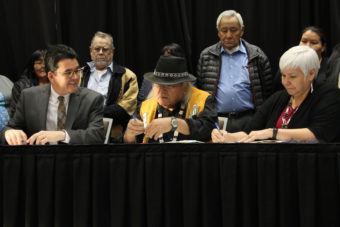
Deouty Interior Secretary Michael L. Connor joins Christopher Gene (center) and Karen Linnell of the Ahtna Intertribal Resource Commission to sign an agreement giving Alaska Native tribes in the Ahtna region more say over subsistence resources. (Photo by Rachel Waldholz/Alaska's Energy Desk)
Deputy Interior Secretary Michael L. Connor joins Christopher Gene (center) and Karen Linnell of the Ahtna Intertribal Resource Commission to sign an agreement giving Alaska Native tribes in the Ahtna region more say over subsistence resources. (Photo by Rachel Waldholz/Alaska’s Energy Desk)

In its final days, the Obama administration is forging ahead with a promise to include Alaska Native tribes in the management of fish and wildlife on federal land.

Deputy Interior Secretary Michael Connor was in Anchorage today to announce a pilot project giving Native communities in the Ahtna region greater say in managing the subsistence hunt for moose and caribou.

The Ahtna region includes eight villages from Cantwell to Gakona to Copper Center along the Parks and Richardson Highways in Southcentral Alaska. It’s one of the most accessible hunting areas in the state, attracting hunters from up and down the Railbelt.

That has put pressure on subsistence resources, Connor said. The goal of the agreement is to try to relieve some of that pressure.

“We think over time we will develop better strategies that will allow them better access to critical subsistence resources, which has been a big issue for those communities,” Connor said.

The announcement comes a month after Interior Secretary Sally Jewell spoke to the Alaska Federation of Natives convention in Fairbanks and issued an order aimed at expanding the tribal role in managing federal lands.

The announcement was met with emotion at the Bureau of Indian Affairs conference in downtown Anchorage.

Karen Linnell is the executive director of the Ahtna Intertribal Resource Commission (AITRC), which will represent the tribes in the partnership. She choked up as she described the agreement as the culmination of 45 years’ work to gain a greater say in the management of their traditional lands.

“I just want to thank the people back home for their support in getting this done. It’s a monumentous occasion!” Linnell said, to a standing ovation at the Dena’ina Center.

Speaking afterward, she said the agreement represents incremental progress in a long fight.

“This is just a little bit closer to being more in the driver’s seat. We’re almost there,” she said. “Not so much driver’s seat, but being able to sit at the table, and be on the bus, is important.”

The pilot project will allow the Ahtna Commission to manage the subsistence moose and caribou hunt on federal land for tribal members. It will also create a local advisory committee and formalize a bigger role for local communities in federal wildlife management decisions.

It’s the second such cooperative management agreement in Alaska. The first governs the harvest of king salmon on the Kuskokwim River.

Both Linnell and Connor stress the agreement will not affect access for non-Native rural subsistence and sport hunters. Gov. Bill Walker and Lieutenant Governor Byron Mallott released a statement applauding the agreement.

The push to increase collaboration with tribes has been a hallmark of the Interior Department under President Obama; it remains an open question whether the incoming Trump administration will continue the policy.

New head of Subsistence Board says local voices are essential

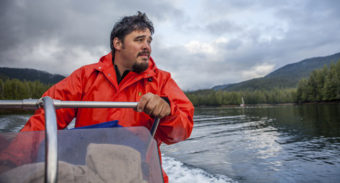
Hydaburg Mayor Tony Christianson in Eek Inlet off Prince of Wales Island in Southeast Alaska. (Photo courtesy The Nature Conservancy)

Hydaburg Mayor Anthony Christianson has been appointed the new chair of the Federal Subsistence Board.
The board governs subsistence hunting and fishing on all federal land in Alaska, covering some 60 percent of the state. It’s been at the center of major controversies like the fight over king salmon on the Yukon and Kuskokwim Rivers.

Christianson has served on the board for four years. He says as chairman, his job will be to listen to everyone.

“I like to keep an open ear, and listen to what everybody has to say. It’s almost like listening to testimony,” he said. “You’ve got to go in, you’ve got to be really unbiased.”

The Interior Department announced Christianson’s appointment on Tuesday. At 40, he’s been mayor of Hydaburg, on Prince of Wales Island in Southeast Alaska, for more than a decade. He’s run the environmental program at the local tribe, the Hydaburg Cooperative Association, for almost twenty years.

Christianson was first appointed to the subsistence board in 2012, when the Interior Department overhauled the board, adding two seats for members of the public to give rural residents more of a say. Previously, the board was made up exclusively of representatives from federal agencies.

Christianson said listening to local residents is essential. He wants to elevate the role of the Regional Advisory Councils, made up of local community members. And, he said, his own experience hunting and fishing has shaped how he views the board’s mission.

“Being a [subsistence] user, eating it every day, handing that tradition down to my family, and showing them why it’s important that we have strong environmental programs, that we have regulations, that we have management plans, to protect the way of life for ourselves, I think is critical to the future of Alaska,” he said.

Christianson is replacing Tim Towarak of Unalakleet, who stepped down in September.

Offshore leasing plan excludes Arctic

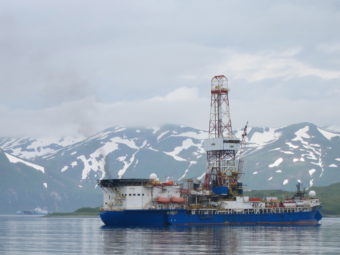
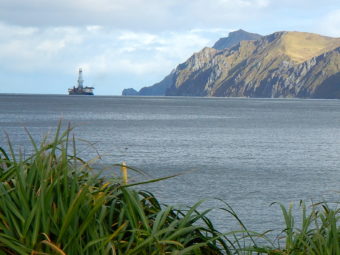
The Noble Discoverer in Unalaska in 2012. (KUCB file photo)
Shell’s Noble Discoverer rig in Unalaska in 2012. (KUCB photo)

The Obama administration has removed the Arctic Ocean from any new oil and gas leasing for the next five years.
The Interior Department announced its new plan for offshore leasing Friday morning.

The plan does not include any new lease sales in the Beaufort or Chukchi Seas off Alaska — which had been included in an earlier draft.

It does include one lease sale in northern Cook Inlet, in 2021.

In a written statement, Interior Secretary Sally Jewell said the department is forgoing lease sales in the Beaufort and Chukchi due to the “unique and challenging Arctic environment and industry’s declining interest in the area.”

In the year since Shell abandoned its effort to drill in the region, several companies have given up offshore leases they already held.

The decision is a win for environmentalists, who have pushed to place the Arctic off-limits to drilling because of the potential effect on climate change and the risk of a possible oil spill.

Niel Lawrence, with Natural Resources Defense Council, said it would take a decade or more to produce oil from the Arctic.

“We’ll be in a world that does not need that oil, that has moved on from fossil fuels,” Lawrence said. “Flooding the world with more oil could really hurt efforts to contain climate change and keep it from being really disastrous.”

But the decision was blasted by industry groups and Alaska’s elected officials. Governor Bill Walker released a statement saying he is “disappointed.” Sen. Lisa Murkowski called the decision short-sighted.

“You’ve got a decision that effectively is going to send all of the benefits of production overseas,” Murkowski said. “It’s stunning. And, I don’t know. I’m frustrated.”

Her view was echoed by Lucas Frances of the Arctic Energy Center, a partnership between the Alaska Oil and Gas Association and the Independent Petroleum Association of America. He said the U.S. is missing an opportunity to project strength in the Arctic.

“The U.S. has that opportunity to be a leader in this space,” Frances said. “But in removing Arctic leases, the potential sale of Arctic leases, it removed the investments that could be made down the road.”

Meanwhile, the Arctic Slope Regional Corporation released a statement saying the decision “cripples” North Slope communities’ ability to pursue economic development. In a speech at the Resource Development Council conference in Anchorage earlier this week, CEO Rex Rock, Sr., said removing the possibility of new Arctic exploration ignores local voices.

“Slamming the door shut on opportunity does nothing to help my region or my people, either now, or in the future,” Rock said.

The decision would be difficult for the incoming Trump administration to immediately undo. Replacing the plan would require going through much of the public process again, likely taking years.

Meanwhile, environmentalists are holding out hope for a more permanent withdrawal of Arctic waters from oil and gas leasing, under a special section of the law governing offshore development. That’s a separate decision, which would come from the White House.

Elizabeth Harball contributed to this report. 

Ask a Climatologist: Alaska’s ‘relentless’ streak of warm temperatures

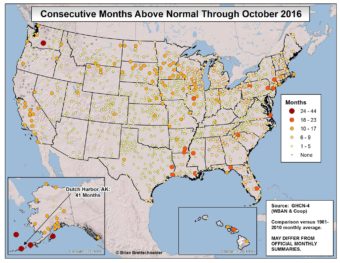
Weather stations in Alaska have logged an "unprecedented" run of above-normal temperatures, says climatologist Brian Brettschneider. (Graphic courtesy of Brian Brettschneider)
Weather stations in Alaska have logged an “unprecedented” run of above-normal temperatures, says climatologist Brian Brettschneider. (Graphic courtesy Brian Brettschneider)

According to an announcement this week from the World Meteorological Organization, 2016 is on track to be the warmest year ever. If current trends continue, it would be the third straight year of record-breaking heat.

That trend has been particularly noticeable in Alaska, where two thirds of major weather stations have logged above normal temperatures every single month of 2016.
Brian Brettschneider is a climatologist in Anchorage who closely tracks Alaska climate data and trends. Alaska’s Energy Desk is checking in with him regularly as part of the segment, Ask A Climatologist.

Brettschneider said what we’re seeing this year is unprecedented.

Interview transcript:

Brian: Well, first of all, it’s been warm everywhere. From Barrow down to Juneau, over to Bethel, Fairbanks: everyone’s been way above normal. But if you had to pick out one spot, it would be the areas that are closest to the Gulf of Alaska and the Bering Sea. Those are areas that have been far above normal. For example, Homer has been more than 1.5 standard deviations above normal every month of 2016. There’s only six stations globally that can say that. Places like Dutch Harbor have been above normal for over three consecutive years, every single month. Cold Bay, St. Paul, very similar. Fairbanks, Anchorage, over 12 consecutive months. So the [closer] you get to the Gulf of Alaska, to the Bering Sea, the more dramatic the warmth has been.

Rachel: And what is causing these relentless warm temperatures?

Brian: You’ve got a couple things going on. One is, globally, temperatures have been increasing for a number of decades, so we’re starting with this higher baseline. And then we’re coming off a near-record El Nino, which really supercharged the atmosphere, added a lot of warmth from the oceans into the atmosphere. So that really enhanced things. Although now we’re in a La Nina, officially delcared a few days ago, and we’re still experiencing this unrelenting heat..

Rachel: Is this the new normal? Is this what climate projections say we should be seeing right now, with global warming, or is this a blip?

Brian: Probably some of both. There are really no long-term global climate models that said, hey, this was going to be happening this quick. This was more 30, 40, 50 years down the line. That said, these kind of warm episodes are going to be more likely with the increase in the baseline temperatures globally.

Rachel: Anything else people should know about this relentless above-normal streak we’ve been on?

Brian: Well, there’s really no end in sight. It should be added that we’re still tracking at record low sea ice. So a lot of the warmth that’s in the Arctic Ocean that typically is locked away due to ice cover, isn’t. So that warmth is still being released out into the atmosphere. Over the entire Arctic basin, there has been 20, 30, 35 degree above normal temperatures for weeks on end, and the rate of sea ice growth has dropped dramatically.

Do you have a climate question for Brian? Email akenergydesk@alaskapublic.org.

Obama’s last chance to weigh in on Arctic drilling has industry worried, enviros hopeful

Shell's Noble Discoverer drill rig
Shell’s Noble Discoverer drill rig leaving Unalaska, Oct. 12, 2015. (Photo by John Ryan/KUCB)

In the aftermath of Donald Trump’s upset election victory, President Barack Obama still has two months left in office to close out policy decisions and try to cement any final pieces of his legacy.

One open question is offshore oil and gas leasing.

Environmentalists want Obama to place the Arctic off limits to offshore drilling, in part to combat climate change.

The oil industry is lobbying to keep it open. A decision is expected any day.

And depending what Obama does, it might not be so easy for a Trump administration to override it.

If you were in Washington, D.C. this fall, you might have seen several ads promoting offshore oil and gas drilling in Alaska — including one urging the audience to “tell Washington to support Native Alaskans. Include the Arctic in the next offshore leasing program.”

The ads were part of a campaign by a coalition of industry and labor groups, including the Alaska Oil and Gas Association, the Independent Petroleum Association of America, the Arctic Slope Regional Corporation and Arctic Inupiat Offshore.

It’s one side of a fight that’s been happening largely out of sight of Alaskans, as industry groups and environmentalists both target administration officials and lawmakers in D.C. in the final days of the Obama presidency.

At stake is the Department of the Interior’s five-year plan for offshore oil and gas leasing, which will determine what areas are made available to industry through 2022.

“It’s not final until it’s out there in the public record, in the Federal Register,” said Lucas Frances of the Arctic Energy Center, which has been pushing to keep the Arctic open for drilling. “We want them to understand what’s at stake for Alaskans and what’s at stake for domestic energy production.”

At the moment, companies aren’t exactly clamoring to drill in the Arctic Ocean.

The drop in oil prices have made the expensive and risky region less appealing, and ever since Shell announced it was abandoning its high-profile exploration effort last year, many companies have given up the leases they already held.

But Frances said just because there isn’t interest now doesn’t mean there won’t be in the future. And once the leases are removed, he said, it’s harder to put them back in — and companies are less likely to include the Arctic in their plans.

“The opportunity to invest needs to happen now, for development to happen in 10, 15, 20 or even 25 years from now,” Frances said. “If you don’t have the opportunity to even pursue exploration, if you don’t have a lease sale, you do not have those investments.”

If the Obama administration does remove the lease sales, a Trump administration could always rewrite the plan. But that would require going through much of the public process all over again.

“And that does take time,” Frances said. “So you’re looking at potentially a year and a half to two years to make any revisions to a new plan.”

The incoming administration might decide it’s not worth the time.

National environmental groups are counting on that. They’ve been pushing the administration to remove the Arctic from the five-year plan. They already scored one victory this year when the Interior Department decided not to offer offshore leases in the Atlantic Ocean, citing local opposition.

“It makes no sense at all to do offshore drilling in the Arctic Ocean,” said Niel Lawrence of the Natural Resources Defense Council.

Lawrence said Shell’s experience proved Arctic drilling costs too much and comes with too many unknowns. He argued that companies haven’t proved they can prevent or clean up a major oil spill in the region. And he said it would be years before companies could produce oil from the region.

“By the time that oil flows, we’re going to have to be in a world that is using far less fossil fuel,” Lawrence said. “Over time, we are either going to ramp way down on fossil fuels, or we are going to cook the planet.”

Lawrence and others would like to see the Obama administration go even further, permanently removing the Arctic from offshore oil and gas leasing under a special provision of law.

Emily Yehle is a reporter for E&E News in D.C. She said that might be even harder for a Trump administration to undo.

“The Outer Continental Shelf Lands Act does not specifically give any future presidents the authority to end that withdraw,” Yehle said. “So they think that it would be permanent.”

The offshore leasing plan is expected to be released this week.

Site notifications
Update notification options
Subscribe to notifications