Rachel Waldholz, Alaska’s Energy Desk

Edward Itta remembered for balancing two worlds

Former North Slope Borough Mayor Edward Itta. (Photo courtesy of the Itta family)

Former North Slope Borough Mayor Edward Itta died Sunday in Utqiagvik, formerly known as Barrow. Family members said the cause was cancer. He was 71.

Itta was a powerful voice for North Slope communities. He was perhaps best known for first opposing, and then negotiating with Shell when the oil company wanted to drill in the Arctic Ocean. Above all, he insisted Inupiaq communities have a say in development in the region.

“After all the battles over the wilderness and the oil are done, we are the ones that have to live with the consequences,” he told an Arctic symposium in Seattle in January 2015. “We are the most directly impacted people. Decision makers, policy makers at all levels, need to understand that.”

As mayor, Itta became known for balancing the need for oil development and protecting subsistence.

He grew up as one of 11 children. In a phone interview Monday, his sister, Brenda Itta-Lee, recalled an older way of life, with little in the way of a cash economy, dependent on subsistence.

“Whaling, especially, was very important to Edward,” she said.

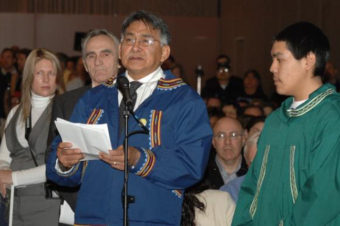
Then-North Slope Borough Mayor Edward Itta testifying before Department of Interior Secretary Ken Salazar, 2009. (Photo courtesy of the Department of the Interior)
Then-North Slope Borough Mayor Edward Itta testifying before Department of Interior Secretary Ken Salazar in 2009. (Photo courtesy Department of the Interior)

Itta-Lee said she and her siblings grew up with a foot in two worlds — traditional and modern, Inupiaq and English. Her brother became a whaling captain who negotiated with oil companies.

“He could speak just as powerfully in two languages,” Itta-Lee said. “We (had) a Western American schooling, where we were taught an American way of life. And Edward also mastered how to survive successfully in that setting. So he was very much admired for being bilingual and also bicultural.”

It was a crucial skill set when he became mayor of the North Slope Borough in 2005. Interest in the Arctic was on the rise, especially from oil companies. Shell developed big plans to drill in the Arctic Ocean.

But the company hadn’t consulted local communities, who worried about the impact on marine mammals, and especially on the whale migration.

Itta wasn’t having it. He insisted the Inupiat have a seat at the table, eventually suing the federal government to demand a more thorough environmental review.

Journalist Bob Reiss wrote about Itta’s long fight and eventual negotiation with Shell in his 2012 book “The Eskimo and The Oil Man.”

“It was too much, it was too fast, it was too soon, Edward said,” Reiss said Monday. “Here was this mayor that Shell had not even taken into account, who came up with the strategy of challenging them in court, and who brought the second largest oil company on Earth to its knees, in court. Just stopped them dead.”

Reiss said Itta agonized over his choices. North Slope communities depend on oil revenue to sustain their quality of life and public services, and on-shore oil production was in decline. Yet the ocean is central to both life and identity, and offshore drilling could threaten that.

“He said to me once, and this sort of epitomized everything, he said, ‘Well, what if it’s me?'” Reiss said. “And he meant more than, ‘What if it’s me?’ ‘What if it’s me, what if it’s my family?’ he said. ‘What if it’s me who stops the oil?’ Meaning, stops the money, stops the taxes, stops the building. ‘What if it’s me?’ But then a second later, he said, ‘Well, what if it’s me who allows the oil, and then something goes wrong, and then we lose the whales?'”

Reiss recalls sitting in on a meeting between Itta and Shell that encapsulated that struggle. Itta had come back from whaling camp to meet with oil industry executives.

“The whales only come twice a year,” Reiss said. “Edward was a whaling captain. He was responsible for the lives of his men. These are relatives, these are his best friends. Certainly the last thing that a whaling captain wants to do is leave the camp and go back to town. Which he did that day because — and this is the way the book starts, actually — Edward is on a snowmobile back to town, and a private jet is on the way up from Houston, with the top people at Shell. ”

The Shell executives wanted Itta to reassure people on the North Slope that drilling would be safe, Reiss said. Itta refused, saying Shell hadn’t done its homework, and hadn’t talked to the community.

“Well, I will say, Edward took their head off (that day),” Reiss said, laughing. “He really did! And it was great to watch as a journalist.”

The borough’s lawsuit helped force a more thorough environmental review, and over years of negotiations, Itta convinced Shell to build in measures to protect marine mammals, including a planned pause in work during the whale migration.

Department of Natural Resources Commissioner Andy Mack worked for Itta during those years, as the government affairs director for the North Slope Borough.

Asked how he liked working for Itta, Mack said, “Loved it. Loved every minute of it.”

“He’s a tremendously powerful example of a person who was really true to his principles, but practical,” Mack said. “He was also very committed to the people that he worked for.”

Above all, Reiss said, Itta had heart.

“Whether he was talking with an Inupiaq person, whether he was talking to a Yup’ik, whether he was talking with a Norwegian, or a senator, or an admiral, or an oil person, Edward could really feel your heart, and respond to it, as one human does to another. And I think that’s why he is as beloved as he is,” Reiss said. “Yeah, he was a leader. Yeah, he had brains. Yeah, he knew how to get through Washington. But when you were in a room with Edward, you were two people talking, and you were talking from the heart.”

State, Native Corps ask U.S. Supreme Court to enter fray over polar bear habitat

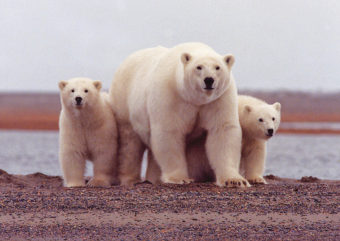
A polar bear mother watches carefully with her cubs along her side along the Beaufort Sea. (Photo courtesy USFWS)

The State of Alaska and a dozen Native organizations have filed a petition with the U.S. Supreme Court, asking it to overturn a ruling that designated vast swaths of coastal Alaska as critical habitat for polar bears.
In 2010, the U.S. Fish and Wildlife Service set aside more than 187,000 square miles of land and water — an area larger than California — as critical polar bear habitat. The bears are listed as threatened under the Endangered Species Act, largely because of the impacts of climate change. The critical habitat designation means any industry or development in the area faces more scrutiny from regulators.

The State of Alaska sued, arguing the inclusion of so much land was not justified by science or the law, and would impose too heavy a burden on development in the region.

A lower court initially agreed with the state, throwing out the designation in 2013. But this February, the Ninth Circuit Court of Appeals reinstated the critical habitat ruling.

The state is joined in the petition by the North Slope Borough and Arctic Slope Regional Corporation, along with regional and village corporations representing communities from Kaktovik to Bethel.

Interior race between political veterans could shape Alaska Senate

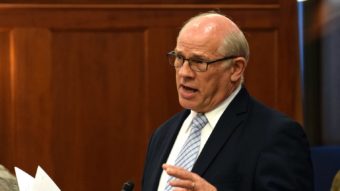
Sen. John Coghill, R-North Pole (Photo by Skip Gray/360 North)
Sen. John Coghill, R-North Pole. (Photo by Skip Gray/360 North)

One of the most watched races in the state is happening in and around Fairbanks, where two longtime politicians are running in a matchup that could help decide control of the Alaska Senate.

The incumbent, North Pole Republican John Coghill, faces a challenge from Luke Hopkins, a Democrat and former mayor of the Fairbanks North Star Borough. The race hinges on how each candidate would approach the state’s budget crisis.

Democrat Luke Hopkins got into the race with a splash last May, releasing a letter in which he wrote that the legislature had “utterly failed Alaskans.”

Hopkins said lawmakers ducked their responsibility when they left Juneau without passing a long-term plan to deal with the budget shortfall.

“I got really concerned that there wasn’t a sustainable fiscal plan, and I thought that’s what the state really needs, and I still believe in that very strongly,” he said in a phone interview this week.

Former Fairbanks North Star Borough Mayor Luke Hopkins was appointed to the board of the Alaska Gasline Development Corporation on Friday, Nov. 20. (Photo by Rachel Waldholz/APRN)
Former Fairbanks North Star Borough Mayor Luke Hopkins, in his brief time on the board of the Alaska Gasline Development Corp. (Photo by Rachel Waldholz/Alaska’s Energy Desk)

Hopkins said incumbent John Coghill, who served as the Republican majority leader, bears responsibility for that.

It’s a line of attack Hopkins’ allies have driven home. The outside group Together for Alaska, which favors higher oil taxes and is largely funded by labor groups and the oil and gas attorney Robin Brena, has run ads criticizing Coghill as a “do-nothing legislator.”

Coghill said that’s simply not true.

“The accusation, ‘do-nothing,’ is because somebody wanted one particular thing and didn’t get it,” he said with a laugh.

He ticked off a list of the legislature’s accomplishments in the last session: budget cuts, Medicaid reform, criminal justice reform. The Republicans in the Senate even passed a bill to restructure the Permanent Fund and use the earnings to pay for part of the budget, though that idea died in the House.

The problem is, the things they got done aren’t all that popular. The Permanent Fund restructuring, for instance, would have cut the PFD in half — something Gov. Bill Walker later did himself.

But Coghill said they were necessary.

He’s particularly proud of the criminal justice reform bill, which he sponsored with Anchorage Democrat Johnny Ellis.

“The thing that, I think, got my attention more than anything is that two-thirds of the people coming out of prison were going back within three years,” he said. “And that’s just not an acceptable rate of criminal justice return.”

He said a major goal is to cut the prison population and direct more people into behavioral health programs, cutting down on recidivism and saving money at the same time. The final bill included a wide range of reforms and won bipartisan support.

Coghill said the legislature should take that approach and apply it to two of the biggest areas of state spending: education and health and social services.

“And this is where Luke and I would probably disagree immensely,” he said. “We have 130,000 students and our outcomes are not that good, but our costs are way high. I’d be willing to look at, can we do it better, can we do it more frugally?”

That might mean distance education or consolidation, he said.

Coghill is open to a statewide sales or income tax — he said he’d prefer a sales tax — or even revisiting oil taxes. But only as a last resort.

Like Hopkins, Coghill has received significant support from outside groups. One is The Accountability Project, which has received contributions from business, industry and Republican sources. They helped pay for an ad attacking Hopkins, and saying he’s for “higher taxes, more spending, bigger government.”

But Hopkins said lawmakers kicked the can down the road when they didn’t pass new revenue measures in the last session.

“We have to come up with a sustainable fiscal plan, and there’s huge holes in it,” he said. “And I don’t think – and I agree with the governor’s assessment, and the administration’s – that we can’t cut our way out of this.”

He opposes any new cuts to the University of Alaska, and wants to preserve education funding.

And he said Coghill and Republicans were too quick to cut the Permanent Fund dividend and dip into savings.

While those actions are probably necessary in the end, Hopkins said, he wouldn’t support them until every sector of the Alaska economy is paying its “fair share.” That means revisiting oil taxes and doing away with certain tax credits on the North Slope. It also means an income or sales tax. (He said an income tax would be more fair). And it means looking at the whole slew of new taxes proposed by the governor last year, from motor fuels to mining and fishing.

“Be the statespeople that you’ve been elected to be,” he said. “Look at these, compromise as necessary, and vote them up or down. But the issue is, what do we want our state to look like in one year, two years, five years from now? We see that the oil revenue is probably not going to be coming back, so that’s what we have to prepare for. What state do we want to see?”

How the district’s voters answer that question could have ripple effects across the state. Political observers say the race is one of two that could flip control of the Senate, along with the Anchorage match-up between Republican Cathy Giessel and labor leader Vince Beltrami.

For Trump volunteer, Clinton presidency raises fears of ‘last days’

Margie Ward says she believes Donald Trump will win the presidency -- and if he doesn't, she worries there will be "a huge change, and it won't be for the better - maybe what some people refer to as the Last Days."
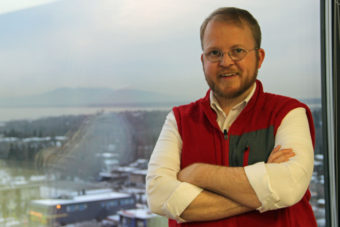
Margie Ward says she believes Donald Trump will win the presidency. But if he doesn’t, she worries there will be “a huge change, and it won’t be for the better — maybe what some people refer to as the last days.” (Photo by Rachel Waldholz/Alaska’s Energy Desk)

As election day approaches, we’ve been checking in with voters around the state, asking them what issues matter most and who they’re supporting for president.

On Friday, Alaska’s Energy Desk visited the Trump campaign headquarters in Anchorage, to hear from volunteer Margie Ward.

Ward is 68. Her husband, former state Sen. Jerry Ward, is the Alaska State Director for the Trump campaign. She’s a longtime activist in Republican politics, but she says Donald Trump is the first presidential candidate she’s worked for since Pat Buchanan’s primary run in 1996.
You can find our other interviews with Alaska voters here:

In Anchorage, a Trump supporter keeps the faith

For this Anchorage Republican, Johnson trumps Trump

In St. Paul, this Alaskan vows ‘Never Trump’

Young Clinton fan ‘totes’ her support

For this Anchorage Republican, Johnson trumps Trump

A self-described “progressive Republican,” Sam Moore voted for Mitt Romney, John McCain and George W. Bush. But this time around, he says he can’t support Donald Trump. He’s voting for Libertarian Gary Johnson, instead. (Photo by Rachel Waldholz, Alaska’s Energy Desk – Anchorage)
A self-described “progressive Republican,” Sam Moore voted for Mitt Romney, John McCain and George W. Bush. But this time around, he says he can’t support Donald Trump. He’s voting for Libertarian Gary Johnson, instead. (Photo by Rachel Waldholz/Alaska’s Energy Desk)

Libertarian vice presidential candidate Bill Weld is stumping in Anchorage this week. Weld is running with Gary Johnson, the former New Mexico governor and two-time Libertarian presidential nominee. Weld himself is a former governor of Massachusetts.

Recent polls show the ticket pulling anywhere from 7 to 18 percent of the vote in Alaska.

One of those voters is 31-year-old Samuel Moore, of Anchorage. Moore is a financial analyst who’s active in local Republican politics. But while he voted for Mitt Romney, John McCain and George W. Bush, he says he can’t support Donald Trump.

You can find our other interviews with Alaska voters here:

In Anchorage, a Trump supporter keeps the faith

In St. Paul, this Alaskan vows ‘Never Trump’

Young Clinton fan ‘totes’ her support

For this Anchorage Republican, Johnson trumps Trump

For Trump supporter, Clinton presidency raises fears of ‘last days’

Ask a climatologist: Will we have a snowy winter?

The first snow of the year in Anchorage, Oct. 21, 2016. (Photo by Rachel Waldholz/Alaska's Energy Desk)
The first snow of the year in Anchorage, Oct. 21, 2016. (Photo by Rachel Waldholz/Alaska’s Energy Desk)

Last week, Juneau saw its first snow before Fairbanks for the first time in some 70 years. With the exception of the Southern Kenai Peninsula and Southeast Alaska, the entire state is below normal for snow — from Anchorage to Fairbanks to Barrow.

That’s leaving a lot of Alaskans wondering, is this a sign of what’s to come?

Brian Brettschneider is a climatologist in Anchorage who closely tracks Alaska climate data and trends. Alaska’s Energy Desk is checking in with him regularly as part of the segment, Ask A Climatologist.

Brettschneider told me that the late snow doesn’t tell us much about what’s to come. In fact, you shouldn’t believe anyone who tells you they know what kind of snow year it’s going to be.


Brian: We can paint with broad brushes that we think it’s going to be a big precipitation winter, or we think it might be a low precipitation winter. But the shades of gray on that continuum are so large, that I’d really be hesitant — and I think most climate scientists would — to say one way or the other.

Rachel: So we can’t predict snow with any kind of confidence. Can we say anything about temperature?

Brian: Well, globally we’ve had month after month after month of record warm temperatures. Here in Alaska, we’re on track for by far our warmest year on record. So we would expect, given no other changes in atmospheric conditions, that we would continue well above normal. Now, we’ll throw a little caveat in there, and that is, NOAA has re-issued their La Nina watch. And typically, when there’s a La Nina, temperatures in Alaska trend toward the cooler side. So, if that does occur, we might expect some lower temperatures. But that’s far from certain.

Rachel: And if we do have a warm winter, does that tell us anything about the amount of snow we might see?

Brian: If you’re in a really marginal snow area, like Juneau or a lot of places in Southeast, where the difference between 30 and 35 degrees is the difference between snow and rain. Here in Anchorage and in much of mainland Alaska, the difference between, say, 25 and 30 degrees isn’t a snow or rain deciding line. It can be a more wet snow and or a more dry snow.

When temperatures are warmer, the air actually can hold a little bit more moisture, so in some cases you end up with more snow with a little bit warmer temperatures. But that doesn’t necessarily play out everywhere.

Rachel: So Alaskans who are wondering what the winter is going to look like are just going to have to wait and see?

Brian: I tell everyone who asks me — and a lot of people do ask me — “What’s the snow going to be like?” I won’t quite say, “Your guess is as good as mine.” But the probabilities are so difficult, it’s really kind of a fool’s errand to state one way or the other.

Do you have a climate question for Brian? Email akenergydesk@alaskapublic.org.

Site notifications
Update notification options
Subscribe to notifications