Rachel Waldholz, Alaska’s Energy Desk

Newtok asks: Can the U.S. deal with slow-motion climate disasters?

Newtok is asking for ongoing erosion and thawing permafrost to be qualified for federal disaster relief from FEMA. Village relocation coordinator Romy Cadiente spoke with reporters about the effort to relocate the village, Aug. 15, 2016. (Photo by Eric Keto/Alaska’s Energy Desk)

The village of Newtok has requested a federal disaster declaration from President Barack Obama to address ongoing erosion and thawing permafrost. It’s one of the first tests of whether the nation’s disaster relief laws can be used to deal with the slow-moving impacts of climate change.

Disaster declarations, which make a community eligible for federal funding, are usually reserved for specific catastrophic events — like a hurricane or landslide. But Newtok is applying for damage that has occurred through many smaller incidents over the last ten years. It’s a long shot, but village relocation coordinator Romy Cadiente says, at this point, the village doesn’t have a lot of options.

“We just need to get out of there,” Cadiente said. “We really do. For the safety of the 450 people there. We need to get out of there.”

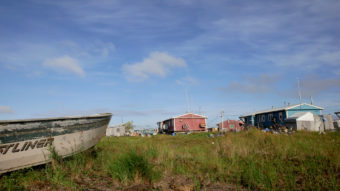
The village of Newtok, August 2016. (Photo by Hanna Craig/Alaska Public Media)

Many Alaska villages are facing erosion and thawing permafrost made worse by warming temperatures, but Newtok’s needs are maybe the most immediate. The village has lost its barge landing, sewage lagoon and landfill. It expects to lose its current drinking water source this year, and the airport and school by 2020. More than half the homes in the village have been damaged by thawing permafrost. Six homes are at immediate risk from coastal erosion.

The community is ready to move: there’s a new site, with several houses already built. The major problem, Cadiente said, is money. Money for key and expensive infrastructure, like a new airstrip, school, and water source.

“The price tag on this village move is astronomical,” Cadiente said. “We’re thinking probably in the $150 to $300 million range. And what we have right now is nowhere near.”

And, after more than a decade of waiting, Newtok needs that money now.

Alaska had hoped to fund the relocation with a grant from the federal Department of Housing and Urban Development, but the state learned last winter it had been turned down. Officials cast about for another solution and settled on the Stafford Act. That’s the law that governs disaster relief, coordinated by the Federal Emergency Management Agency (FEMA).

The only problem? It’s never been used for a multi-year disaster before. That’s according to Newtok village attorney Mike Walleri and Erin Ward, of FEMA’s Region X office.

But Walleri argues nothing in the law prevents the president from declaring a disaster for a multi-year event like the thawing permafrost in Newtok.

“You know, disasters are not planned, and they don’t come in one size fits all,” he said. “And FEMA over its life has, I think, understood that. And it’s tried to adapt to the changing circumstances of these disasters.”

Newtok is the first test of that theory.

Rob Verchick teaches at the Loyola University College of Law in New Orleans, where he focuses on disaster law and climate adaptation.

“This is a trailblazing effort that will definitely put problems like this on the radar screen for federal and state policy makers and make it impossible for the public, I hope, to avoid these kinds of discussions in the future,” Verchick said. “Because Newtok may be the first community to make such a request, but it is not the only community that’s experiencing these kinds of problems.”

Verchick said the request, whether it’s accepted or not, is a milestone.

“At the very least what this shows is we have a huge gap in our federal laws and in our federal planning, because there are lots of communities that are going to be facing this kind of a problem, many of them on the coast and many of them tribal communities,” Verchick said. “And we need some kind of a federal approach, some kind of a federal policy, to address concerns like these.”

As for Romy Cadiente – he’s just hoping the answer from the White House is yes.

The request is now under review by FEMA. Newtok is hoping to get an answer before the Obama administration leaves office on Jan. 20.

Feds release plan to stem decline of Cook Inlet belugas

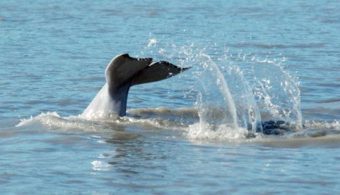
LGL Alaska Research Associates documented beluga whales in Cook Inlet as part of a photo identification project. The whales are listed as endangered. (Photo courtesy of LGL Alaska Research Associates)
A beluga whale fluke in Cook Inlet. NOAA Fisheries has included belugas on their list of the eight most threatened species the agency monitors. (Photo courtesy of LGL Alaska Research Associates)

The National Oceanic and Atmospheric Administration has released its final plan to increase the population of Cook Inlet’s beluga whales and get them off the endangered species list.

Biologists estimate there are now about 340 belugas in Cook Inlet, down from more than a thousand in the 1980s. Researchers think the population dropped steeply in the 1990s because of unregulated subsistence hunting, but the whales haven’t bounced back since hunting was curtailed in 1999.

Mandy Migura of NOAA Fisheries says nobody knows why.

“There is no clear explanation and no obvious single threat that is preventing this population’s recovery,” Migura said. “It’s likely that it’s a combination of multiple factors.”

The recovery plan lists 10 of those potential factors, which it says should be limited. One potential threat is noise from human activity in Cook Inlet, which is home to some the state’s largest population centers, including Anchorage.

Migura says the Cook Inlet belugas, which are present year-round, are genetically distinct from Alaska’s other beluga populations. The population was listed as endangered in 2008, and NOAA Fisheries has included belugas on their list of the eight most threatened species the agency monitors.

Bruce Dale, director of the state Division of Wildlife Conservation, says the recovery plan’s goals are either too vague or too difficult to measure — making it nearly impossible to get belugas off the endangered species list.

“And when you have them unnecessarily on the list, then other activities in the Inlet are restricted, unnecessarily,” Dale said.

That includes activities like oil and gas exploration, coastal development or commercial and recreational fishing.

The environmental group Cook Inletkeeper, which first petitioned to list belugas under the Endangered Species Act, says the plan doesn’t go far enough. Advocacy Director Bob Shavelson said the fact that no one knows what’s causing the decline is reason for more caution. He’d like to see further restrictions placed on industry and municipal activities that could be affecting the species.

“It’s more of the same,” Shavelson said of the new recovery plan. “You’re not going to see these hard and fast rules that we believe are necessary to truly provide a platform for the beluga to improve.”

The recovery plan itself does not include new regulations, but federal agencies must take the plan into account when permitting activity in the Inlet.

The feds are finally paying to move a village, but it’s not in Alaska

The village of Newtok, August 2016. (Photo by Eric Keto/Alaska's Energy Desk)
The village of Newtok in August 2016. (Photo by Eric Keto/Alaska’s Energy Desk)

Alaska villages facing rapid erosion have been trying to move for decades. But they’ve always run up against one major problem: money.

Then this year, for the first time, the federal government made tens of millions of dollars available to relocate a small Native village threatened by climate change.

The problem? That village is in Louisiana, not Alaska.

One day this past January, Washington D.C. reporter Christopher Flavelle got an email. It announced the results of a federal competition awarding nearly $1 billion to communities from New York to California to improve their “resilience” in the face of disasters and climate change. One project was for the relocation of a small tribe in Louisiana: 60 people for $48 million. Flavelle was intrigued.

“I’ve spent the past year looking at that corner of climate policy,” he said.

That corner is what happens when people have to move because of climate change.

Flavelle writes for Bloomberg View. He wrote about the Louisiana town, Isle de Jean Charles. Then he had a thought. He called up the Department of Housing and Urban Development, the agency that awarded the money.

He said to HUD, “Hey, I don’t think this is the only town in this situation. In fact I’ve heard of coastal towns in Alaska. And I wonder, why is it that this place in Louisiana got money, but these other towns in Alaska did not? How did you decide?”

HUD clammed up.

“They were surprisingly reluctant to talk about it.” Flavelle said. “In fact, entirely reluctant.”

Meanwhile, in Alaska, officials were asking the same questions.

Sally Russell Cox is a planner with the state who helped prepare Alaska’s request asking for more than $280 million for four villages, including Newtok, in western Alaska. Newtok has lost its landfill, sewage lagoon, and barge landing. Erosion threatens the school, airport and drinking water. It’s estimated it will cost $80 million to $130 million to move the whole village of about 350 people to a new site upriver.

Cox says the team was “blown away” when Alaska got nothing. After all, President Barack Obama had just visited the state, and talked about exactly this issue.

She says the state still isn’t sure why it lost out, but apparently one reason is Alaska didn’t put up enough state money to match the federal funds.

“We didn’t have it,” said Cox. “Because, I mean, why are we asking for this money if we already have money committed to it?”

But Christopher Flavelle says that’s not the whole story. For instance, Louisiana didn’t commit any money specifically for the Isle de Jean Charles relocation. In the end, he says, HUD had a check list, and Alaska just didn’t score well.

Alaska officials voiced their bafflement. In a letter to HUD officials, Gov. Bill Walker said the decision “simply astonishes me,” while Sen. Lisa Murkowski called it “unacceptable.”

HUD spokesman Lee Jones says the agency always has three, four or five times as many applicants as it can fund.

“Their proposals might be able to demonstrate as much need, as much innovation, as much integrity as the winners,” he said. “It’s just, at some point, the dollars only go so far. And a billion dollars is lot of money, no question about it, but it’s not a lot of money when you’re trying to address issues of infrastructure resiliency, which is a fairly costly exercise in most communities.”

For Cox, the lesson is there needs to be more funding and a better way to decide who gets it.

“You don’t do it in a competition,” she said with a laugh. “I mean, that’s crazy! Because you’re rewarding those that have the best marketing or the best grant writing skills.”

Instead, she says, we need a system to decide which communities are most in need, and make sure they get funding first.

Bloomberg’s Christopher Flavelle agrees. He says it needs to be clear why one community gets money and another doesn’t.

“Just as important as finding the right way to move a town is, I think, finding the right way to decide which towns to move. And there has to be some sort of standard that is transparent and credible and defensible.”

Right now this is a pretty rare issue. There are not a ton of communities talking about relocation due to climate change. But Flavelle says, that’s going to change.

“This isn’t just Alaska. And it’s not going to just be little towns along the coast that you’ve never heard of. This is going to be more and more of the United States,” he said. “And either we figure it out how to deal with it now, when it’s a small problem and the costs aren’t huge, or we wait, and we try to develop some sort of a response, some sort of a policy, when we’re pressed … when something really bad has happened.”

Obama brought attention to threatened Alaska villages, but little funding so far

Waving goodbye to Kotzebue from the doorway of Air Force One. (Official White House Photo by Pete Souza) https://medium.com/the-white-house/behind-the-lens-photographing-alaska-for-real-this-time-2f466ddf8f7d#.shdh8q6di
Waving goodbye to Kotzebue from the doorway of Air Force One. (Official White House Photo by Pete Souza)

It’s been more than a year since President Barack Obama visited Alaska, and became the first sitting president to travel above the Arctic Circle.

The trip was designed to draw attention to climate change in the lead up to last year’s international conference in Paris, and the president went out of his way to highlight Alaska villages threatened by rapid erosion.

But as Obama prepares to leave office, most of those villages find themselves no closer to a solution.

On September 2, 2015, Obama stepped up to the microphone in the Kotzebue school gym and greeted the loudly cheering crowd.

Obama said he had come north for one big reason: to raise the alarm about the dangers of climate change in one of the places where it’s most obvious.  Places like the eroding village of Kivalina, which he flew over on his way to Kotzebue.

For many Alaskans, he said, it’s no longer a question of if they will have to relocate, but when.

“Think about it,” Obama said. “If another country threatened to wipe out an American town, we’d do everything in our power to protect it.”

Climate change, he said, should be no different.

“What’s happening here is America’s wake-up call,” he said. “It should be the world’s wake-up call.”

Taking in the sights from Air Force One, Sept. 2, 2015. (Official White House Photo by Pete Souza) https://medium.com/the-white-house/behind-the-lens-photographing-alaska-for-real-this-time-2f466ddf8f7d#.shdh8q6di
Taking in the sights from Air Force One, Sept. 2, 2015. (Official White House Photo by Pete Souza)

Maija Lukin was mayor of Kotzebue during the president’s visit. She also worked on climate change issues for the Maniilaq Association, the regional nonprofit.

Lukin said personally, she was pretty excited about Obama’s visit. And professionally, she hoped it would draw attention to the issues facing rural Alaska. Which it did, she said. And she appreciates that.

But, she said, attention isn’t enough.

“When the president says something like ‘the United States would do anything in its power to make sure that these places aren’t wiped off the face of the Earth,'” she said, “you gotta put your money where your mouth is.”

On that front, the response hasn’t matched the rhetoric.

Five months after the president’s visit, the Obama administration released its major funding proposal, as part of its final budget request to Congress: $400 million over 10 years for issues including village relocation in rural Alaska.

The money would have been part of a proposed $2 billion “Coastal Climate Resilience program” overseen by the Interior Department. But U.S. Sen. Lisa Murkowski, R-Alaska, called that essentially a bait and switch. The program would have been paid for by taking revenue away from other oil-producing states, and had little chance of passing Congress. Murkowski accused the Obama administration of using Alaska as simply a “backdrop” for his climate change agenda.

During his visit to Kotzebue, Obama also announced that the Denali Commission, which has historically built infrastructure in rural Alaska, would be the lead federal agency coordinating relocation efforts.

Joel Neimeyer, co-chair of the Denali Commission, says that’s a pretty big deal.

The view from Air Force One of Kivalina, as President Barack Obama flew to Kotzebue, Sept. 2, 2015. (Official White House Photo by Pete Souza) https://medium.com/the-white-house/behind-the-lens-photographing-alaska-for-real-this-time-2f466ddf8f7d#.shdh8q6di
The view from Air Force One of Kivalina, as President Barack Obama flew to Kotzebue, Sept. 2, 2015. (Official White House Photo by Pete Souza)

“There would be one federal agency that could marshal all the federal agencies together and then be responsive to the state and the individual communities,” he said.

But the new assignment came with no new funding.

The Obama administration requested an additional $4 million a year for the commission. But Congress has yet to appropriate it.

Neimeyer says the Denali Commission is doing what it can within its small existing budget. But it’s frustrating.

“All of Alaska now knows the Commission has this assignment,” he said. “My concern is, if in future appropriations there are no funds for this effort, that’s immaterial to rural Alaska. They’re still going to come to us and say, this is your assignment. See it through.”

For awhile this year, Neimeyer says, he even had trouble getting a call back from the White House to clarify his agency’s new assignment.

Obama, of course, has many fans in rural Alaska. They point out there’s only so much the president can do. It’s Congress that controls the federal purse strings.

And Sally Russell Cox, a planner with the state who’s worked on relocation for about a decade, says the issues are clearly getting more attention.

“The federal agencies are now engaged at a very high level,” she said. “So there’s a lot of high-level attention to how funding and other resources can be pooled to help these communities.”

Agencies including the departments of Agriculture, Energy and Interior have made money available for things like water infrastructure, energy efficiency and planning. But nothing close to the amounts needed to move a whole village.

The Army Corps of Engineers has estimated it will cost $80 million to $130 million just to move the 350 or so people in Newtok, one of the most threatened villages.

Cox says the state will continue to do what it can. But, she says, the federal government has a special responsibility, because in many cases, villages are where they are because the federal government put them there — often by choosing the location for a school.

With Obama on his way out the door, that federal responsibility now falls to Congress and the incoming Trump administration.

Maija Lukin, in Kotzebue, says she hopes the next president will pay attention, because rural Alaska is running out of time.

“We don’t call them climate change adaptation plans, we call them a survival plan,” she said. “So how are we going to survive, how are we going to ensure that our culture stays alive in our changing weather?”

Exxon’s Tillerson, Trump’s choice for State Dept., has history in Alaska

ExxonMobil CEO Rex Tillerson at a 2012 meeting with Russian president Vladmir Putin.
ExxonMobil CEO Rex Tillerson at an April 2012 meeting with Russian president Vladmir Putin. (Photo courtesy the Russian Government)

President-elect Donald Trump has chosen ExxonMobil CEO Rex Tillerson as his nominee for secretary of state.

National attention has focused on Tillerson’s close ties to Russia, but he — and his company — also has a long history in Alaska.

For the last few years, Tillerson has perhaps been known best in Alaska for his public disagreements with Gov. Bill Walker over efforts to build a natural gas pipeline from the North Slope.

“I doubt the governor is going to be invited to any State Department formal dinners,” said Larry Persily, a longtime industry observer.

Exxon holds the state’s largest share of natural gas reserves, and was, until recently, the lead partner in the effort to build a gas line, a role the state is now taking over.  Last year, Tillerson, who said he’s been involved in Alaska natural gas projects at Exxon since 1985,  told World Gas Intelligence that Alaska has been its own “worst enemy” on the pipeline project, saying the state changes its approach every time it changes governors. Gov. Walker has frequently fired back.

Exxon has feuded and negotiated with many Alaska governors over the years: over the gas pipeline, the development of the Point Thomson field, the value of the trans-Alaska pipeline, and of course, oil taxes.
Asked if Exxon under Tillerson was active in the state’s perennial debates on the subject, Sen. Bert Stedman, R-Sitka, started to laugh.

“Oh yes, yes, yes,” Stedman said. “Of course they are. All three major companies are.”

Stedman is one of the legislature’s experts on oil and gas issues. He said Exxon has its own style.

“You’re not going to find a finer company than Exxon, at least that I’ve ever been around and worked around,” Stedman said. “But they’re tough negotiators.”

“Exxon has the Exxon culture,” he added. “Very formal, very straightforward.”

Stedman said he’d be pleased to have a cabinet member that’s familiar with Alaska and with the Arctic, which Tillerson certainly is. Exxon owns more than a third of Prudhoe Bay, the state’s largest oil field, and operates the field at Point Thomson, which came online earlier this year. It’s one of the companies that owns the trans-Alaska pipeline.

Exxon’s long history in the state also includes its most famous black eye: the Exxon Valdez oil spill in Prince William Sound in 1989.

Lois Epstein, of The Wilderness Society, said that history still lingers.

“There’s still a lot of concern in Alaska, over 25 years after the Exxon Valdez tragedy, the spill, that Prince William Sound hasn’t fully recovered and that there was significant harm to the local economy,” Epstein said.

Tillerson was CEO of ExxonMobil in 2008 when the U.S. Supreme Court slashed punitive damages for the spill from $5 billion to $500 million, reducing the pay out to many Alaskans.

When it comes to another environmental issue of interest in Alaska, Exxon’s track record on climate change under Tillerson is complicated.

Last month, the company officially came out in support of the Paris agreement to cut global carbon emissions. That makes Tillerson potentially the only one of Trump’s nominees so far to publicly hold that position. Epstein pointed out that as secretary of state, Tillerson would be one of the nation’s top negotiators on international climate agreements.

“I do think the fact that ExxonMobil has endorsed the Paris climate agreement is a good thing, so at least in terms of climate change, we are cautiously hopeful with Mr. Tillerson,” she said. “Particularly compared to some of the other nominees for the cabinet.”

But Exxon is also under fire from environmentalists and some state attorneys general after reporting raised questions about whether the company understood the science behind climate change for decades internally while externally funding organizations that fanned doubts about it.

Newtok to ask Obama for federal disaster declaration

The village of Newtok in western Alaska, in August 2016. (Photo by Eric Keto/Alaska's Energy Desk)
The village of Newtok in western Alaska, in August 2016. (Photo by Eric Keto/Alaska’s Energy Desk)

The village of Newtok plans to request a federal disaster declaration from President Barack Obama before he leaves office. The village is facing rapid erosion due to climate change, and officials say a disaster declaration may be the best chance to unlock federal funds for relocation before the existing village becomes uninhabitable.

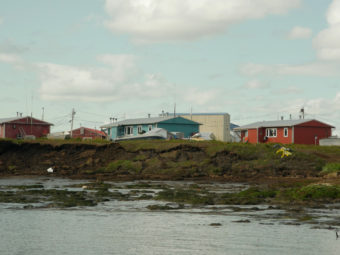
The village of Newtok has lost ground at a rate of 67 feet per year since 1954, according to a recent engineer's report. Here, the shoreline is pictured in August 2016. (Photo by Hanna Craig/Alaska Public Media)
The village of Newtok has lost ground at a rate of 67 feet per year since 1954, according to a recent engineer’s report. Here, the shoreline is pictured in August 2016. (Photo by Hanna Craig/Alaska Public Media)

There’s no question Newtok faces disaster. Erosion and melting permafrost have destroyed the landfill, the sewage lagoon, and the barge landing. An engineer’s report this month estimates the village of about 350 people will lose four to six homes by next fall, and the school sometime in 2018.

Joel Neimeyer is co-chair of the Denali Commission, the federal agency charged with coordinating village relocation in Alaska. He said many places are facing threats from erosion — but Newtok is in a class by itself.

“I’ve worked all across rural Alaska for 31 years, been to over 100 communities. I’ve never seen anything like this,” Neimeyer said.

The problem is, Newtok faces a slow motion disaster. And that’s not what federal disaster relief is set up for. The Federal Emergency Management Agency, or FEMA, is designed to respond to specific events: a hurricane, a flood, an earthquake.

And the federal government has historically insisted Newtok seek funding through more traditional avenues. But Mike Walleri, the attorney for the Newtok Village Council, said at this point, that’s not going to work.

“We just simply don’t have time,” Walleri said.

That’s the message representatives from Newtok took with them on a trip to Washington D.C. this fall. Walleri said it was an eye opener for people in the capital. Despite President Obama’s trip to Alaska last year highlighting exactly this issue, he said, official Washington didn’t realize the true state of things.

“Most people had not been aware that Newtok could not take advantage of what they call the catalog of federal assistance, simply because the village will be destroyed before the normal federal assistance can be applied for and implemented into the field,” he said.

Walleri said despite the traditional limits on FEMA, the president has a lot of leeway in defining a disaster. And a 2013 change in the Stafford Act, which governs disaster relief, allows tribes to request a federal disaster declaration directly, instead of going through the state.

That declaration would make the village eligible for funding from agencies across the government. That could include direct assistance to individuals to repair or replace homes, money to replace public utilities, and funding that could be used to move to the new village site upriver. Walleri said Newtok needs about $80 million.

It’s far from a sure thing. Even if the president issues the disaster declaration, Congress would still have to appropriate the money.

But Newtok thinks it’s worth a try. Walleri said the tribe hopes to make the request within two weeks.

Site notifications
Update notification options
Subscribe to notifications