Rachel Waldholz, Alaska’s Energy Desk

Start-up gambles time is right for Alaska solar power

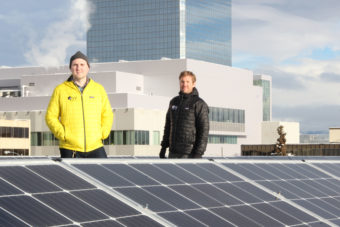
Stephen Trimble and Chase Christie of Arctic Solar Ventures show off the company’s largest installation to date: an 86-panel commercial installation in downtown Anchorage. (Photo by Rachel Waldholz/Alaska’s Energy Desk)

Alaska’s solar industry lags far behind many other states.

But with prices dropping dramatically around the world, some entrepreneurs see a new opportunity.

One major challenge is simply convincing people that solar works in Alaska — and that, in fact, Alaska might be ideal solar territory.

The newest solar array in Anchorage sits on top of a two-story office building downtown. Climb up a ladder, through a hatch and onto the roof, and there it is: 86 solar panels sitting in several inches of fresh snow.

Stephen Trimble is the founder of Arctic Solar Ventures, the Anchorage start-up that installed this system at 880 H Street. Surveying the roof in a neon yellow jacket with his business logo stitched into the front, he says over the course of the year, this array will produce almost 15 percent of the building’s total electricity needs — and that’s not bad.

“This is a 20,000-square-foot commercial building,” Trimble said, as Chase Christie, the company’s vice president, adds, “Built in the 1970s. Uses a tremendous amount of electricity.”

At a cost of about $100,000, the system will pay for itself in nine to 12 years, Trimble and Christie said. Over 30 years, they estimate it will save the building owner — who in this case is Anchorage Mayor Ethan Berkowitz — some $300,000.

That’s the math that’s starting to make solar pencil out in Alaska.

The state doesn’t have the generous local incentives that have helped the industry thrive elsewhere. But in the past few years, Trimble said, costs have dropped so quickly that those incentives are no longer necessary.

It was enough to convince him, at least, to take a leap.

“One day I came home and told my wife (now company vice president Jacqueline Savina) … I said, I think I want to start a solar company in Alaska,” Trimble said. “And she was kind of like, what? That’s crazy.”

That reaction is one of the biggest barriers solar companies face in Alaska, Trimble says: education.

That means educating regulators, who often haven’t dealt with solar before; and educating a workforce in a region with very little experience in solar installation. But above all, it means educating consumers: convincing people that solar is an option in Alaska, a state better known for darkness and cold. And harder yet, convincing them that Alaska might even have some advantages.

Take the installation at 880 H Street. In mid-February, there’s snow on the roof, snow on the roads, snow on the park strip. All that snow is actually a plus, said Erin Whitney of the Alaska Center for Energy and PowerShe said the spring — especially March and April — can be particularly good months for solar power in Alaska.

“That’s because of the position of the sun as well as the reflection of light from snow surfaces,” Whitney said. “(And) I would actually add to that, cold temperatures, which enhance solar photo-voltaic production.”

Snow and cold: Call them Alaska’s secret solar super powers.

Boosters like to point out the state’s solar potential is comparable to Germany, which is the world leader in solar installations.

Whitney stresses the state isn’t exactly on the edge of a revolution.

“The solar industry is still very nascent in Alaska,” she said.

A recent report from the Solar Foundation ranked Alaska  51st out of 50 states (the list also includes Washington, D.C.) in solar jobs per capita.

The report notes that Alaska solar jobs actually doubled from 2015 to 2016, to a grand total of 64. That’s less than half the number in the next-lowest performer, Wyoming.

And it’s a pretty good shorthand for the solar industry as a whole: it’s growing, but from a very low base.

The two utilities that serve most of Anchorage — Municipal Light & Power and Chugach Electric Association — say solar power represents well under 1 percent of their total generation. But Chugach also said the number of photo-voltaic solar installations in its area more than doubled from 2015 to 2016, for a total of about 70.

For Stephen Trimble and Arctic Solar Ventures, this is a moment of opportunity and risk.

His company hasn’t turned a profit yet — they’re hoping to cross that threshold later this year.

The installation downtown is their biggest system to date.

Trimble and Christie like to keep an eye on it.

“We drive by it a lot, make sure it’s doing good,” Trimble said.

“We hope to see a lot more just like this,” Christie said. “Generating clean energy from your own roof? There’s something very Alaskan about that, I’d say.”

Questions raised over new tanker escort tugs for Prince William Sound

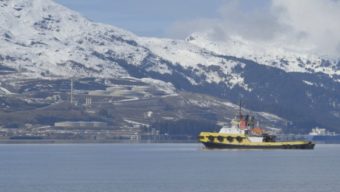
Crowley Marine Services currently holds the contract to provide oil tanker escorts and spill response and prevention in Prince William Sound. (Photo by Eric Keto/APRN)
Crowley Marine Services currently holds the contract to provide oil tanker escorts and spill response and prevention in Prince William Sound. (Photo by Eric Keto/Alaska’s Energy Desk)

A watchdog group is raising questions about whether new tugboats planned for Prince William Sound are up to the job of escorting oil tankers through the region.

The new tugs are part of a major transition taking place in the system set up to prevent oil spills after the Exxon Valdez.
Last year, Alyeska Pipeline Service Co., the operator of the trans-Alaska pipeline, surprised communities in Prince William Sound when it announced it would be parting ways with its longtime tugboat operator, Crowley Marine Services, and bringing in a new company: Louisiana-based Edison Chouest Offshore.

Alyeska said one reason for the switch is Edison Chouest’s commitment to build brand new vessels to replace the current, aging fleet. That fleet includes the tugboats that escort oil tankers to and from the pipeline terminal in Valdez and barges standing by in case of a major spill.

But now a report is raising questions about the design of those new boats.

Donna Schantz is the executive director of the Prince William Sound Regional Citizens’ Advisory Council , which commissioned the report. She said tugboats play a major role in preventing oil spills – and they have to be able to do that work in pretty rough conditions.

“They need to save a fully laden tanker in seas of up to 15 feet and winds of 45 knots,” Schantz said.

The citizens’ council was created by Congress to provide local oversight after the Exxon Valdez oil spill. Schantz says they’re closely watching the transition between operators.

“It’s the largest change-over of equipment and personnel that the system has seen since it was created after the 1989 Exxon Valdez oil spill,” she said. “So we just want to make sure the level of care is taken to make sure we don’t lose any of the safeguards that we worked so hard to put into place.

Alyeska’s choice of a new operator raised some eyebrows when it was announced last year.  Edison Chouest has operations around the world, but it’s perhaps best known in Alaska for the Aiviq tugboat, which was towing Shell’s Arctic drill rig, the Kulluk, when it grounded near Kodiak in 2012.

The citizens’ council hired Vancouver-based naval architect Robert Allan to review Edison Chouest’s plans for the new tugs (designed by the Dutch shipbuilder Damen). Allan’s firm raised concerns about several issues, including a bow shape he worries might slow the tugs down and collect water in high seas. In an interview, Allan called the designs “less than ideal” for what’s supposed to be a state-of-the-art new fleet.

“I don’t in any way, and certainly didn’t say in my report, that there’s anything about either of these designs that is any way unsafe,” Allan said. “It’s just a question of, could be better.”

 Allan also says the information he received didn’t include evidence that design testing was done to make sure the boats could handle rough conditions.

An Edison Chouest representative referred questions to Alyeska, which said it’s confident in the tug designs. Alyeska spokesperson Michelle Egan said the company takes Allan’s report seriously. But, she said, his firm only reviewed limited, preliminary plans, which — in some cases — have already changed.

“We’ve gone through the report. We have identified a number of areas where changes were already made in the design,” Egan said. “And then there are clearly places in the report where there is a professional difference of opinion between two different sets of marine architects.”

One of those differences of opinion is the bow shape, which Egan said hasn’t changed.

Egan said the new vessels come with new benefits, including more horsepower and updated winches for towing; and she said Alyeska will be sharing more information as the transition unfolds. Donna Schantz, of the citizens’ council, said that information can’t come soon enough. Edison Chouest is slated to take over the oil spill prevention and response contract in Prince William Sound in July 2018.

Correction: An earlier version of this story stated the new tugs would be built by the Dutch shipbuilder Damen. Damen designed the vessels; it is not building them. 

Trump transition limits EPA participation in Alaska environmental conference

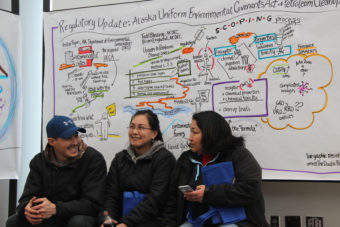
Participants at the Alaska Forum on the Environment in downtown Anchorage on Feb. 9, 2017. (Photo by Rachel Waldholz/Alaska’s Energy Desk)

Trump transition officials ordered the Environmental Protection Agency to limit its participation in an Alaska environmental conference this week.
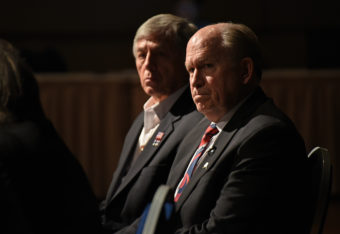
The Alaska Forum on the Environment gathers more than a thousand people in downtown Anchorage each year to discuss topics ranging from rural drinking water and sanitation to climate change. Thirty-four EPA staffers were scheduled to attend.

But forum director Kurt Eilo said he got a call on Friday, just three days before the conference opened, telling him the EPA delegation would be cut by half.

“We got a phone call from the local office of EPA and we were informed that EPA was directed by the White House transition team to minimize their participation in the Alaska Forum on the Environment to the extent possible,” Eilo said.

The EPA is normally a major partner in the forum, presenting on everything from recycling and brownfields to climate change. EPA officials were scheduled to participate in about 30 sessions.

In an emailed statement, transition official Doug Ericksen said the decision was an effort to limit excessive travel costs at the EPA.

This is one small example of how EPA will be working cooperatively with our staff and our outside partners to be better stewards of the American people’s money,” Ericksen wrote.

Some EPA staff who didn’t make the conference would have come from Seattle or Washington, D.C. But Eilo said some EPA staff based just blocks away in downtown Anchorage were also told not to attend.

Eilo said the EPA worked hard to minimize disruption and only one of the conference’s more than 100 sessions was cancelled because of the change.

Kurt Eilo is the executive director of the Alaska Forum on the Environment. A former EPA enforcement officer, he said the EPA’s decision to cut its delegation in half raised concerns. (Photo by Rachel Waldholz/Alaska’s Energy Desk)

But, he said, the decision raised concerns that it might be a sign of what’s to come.

“There’s a lot of uncertainty among folks here at the forum,” he said. “There’s concern about the tribal programs, there’s concern about how we’re going to address things like climate change in the next upcoming administration.”

In January, the former head of the EPA transition team, Myron Ebell, told the AP he’d like to see the agency’s budget reduced and its staff cut by half.

On Thursday, participants kicked snow off their shoes as they walked into the Dena’ina Center. Many attendees had flown in from communities in rural Alaska, where the EPA partners with tribes to fund programs on drinking water, sanitation and trash collection. Breakout sessions focused on issues like emergency response and coastal erosion.

Billy Maines is the environmental coordinator for the Curyung Tribal Council in Dillingham. He said he hoped the agency wouldn’t cut direct assistance to villages in rural Alaska, which are often dealing with issues many American communities take for granted.

“They’re trying to clean up their dumps, landfills, trying to recycle and get what waste goes into their communities, out of their communities,” he said.

Walker, House Dems aim to put climate policy back on the table

Lt. Gov. Byron Mallott (with Gov. Bill Walker, right) is heading up an effort to develop a formal climate change policy. Pictured April 20, 2016. (Photo by Skip Gray/360 North)

Climate change has always been a sticky issue for Alaska policymakers. In a state that sits on the front lines of global warming but remains deeply dependent on oil, it sometimes seems like the easiest option is just not talking about it at all.
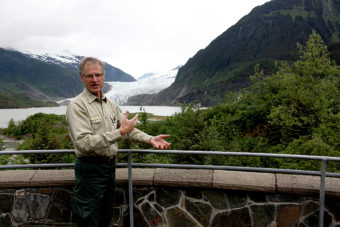
But now, Gov. Bill Walker and Democrats in the state House are considering some tentative steps to tackle the issue. And they’re picking up where another Alaska governor left off.

The Walker administration has been signaling for months that it wants to develop a formal climate change policy. The governor even previewed the effort in his State of the State speech on Jan. 18.

“Alaska is the only Arctic state in the nation, and we are ground zero for climate impacts,” Walker said. “We must maintain the integrity of our land, air and water for future generations. My administration is developing a framework to engage Alaskans in this effort [to] protect our way of life.”

In the speech, Walker sounded a lot like the last Alaska governor to tackle climate change — Sarah Palin.

“As the largest and only Arctic state, we’re also studying climate change, through our DEC-led sub-cabinet,” Palin said in her last State of the State speech in 2009. Her sub-cabinet — essentially a working group of government officials established by administrative order in 2007 — was the last major statewide policy effort on climate change.

Larry Hartig chaired that effort, as commissioner of the Department of Environmental Conservation — a job he still has, two governors later. He said when his team first started talking about climate change adaptation, they were ahead of their time.

“In the early years, I would go to meetings with other states or other countries, and I would be talking about adaptation, and they would look at me like I was doing something sinful,” Hartig said, because talking about climate change was supposed to mean talking about stopping climate change, by cutting greenhouse gas emissions.

“It was like you were distracting people from the real work if you wanted to talk about how you’re going to adapt to change,” he said. “It was kind of like giving up.”

Now, of course, nearly ten years later, adapting to climate change is no longer an outlandish idea.

Palin’s sub-cabinet was supposed to draft an overarching state climate strategy, to deal with impacts, cut emissions and triage the most threatened communities. Hartig says a lot of good work came out of that effort; you can still find the reports online. But there was never any final strategy. Under Gov. Sean Parnell, the focus shifted. The sub-cabinet is still on the books, but it last met in 2010.

Now, Walker is trying to revive that effort, and he’s tapped Lt. Gov. Byron Mallott to head it. I asked Mallott what’s in the works.

“Well, there is a climate policy process in the works,” he said. “What’s in it, is a work in progress.”

If that sounds vague, well, it is — deliberately so, Mallott said. He said he knows climate change is a touchy subject, and he’s trying to get a lot of input before moving forward. He said he wants to get beyond the political debate over what causes climate change and focus on dealing with its impacts.

“Let’s get at making progress in such a way that regardless of your core belief as to what causes it, [we can] focus on its reality and how do we deal with that,” Mallott said. “Because if I start from the place, ‘I believe it’s human caused,’ then I’ve already begun to disengage from voices that believe differently. And they need to be heard.”

Ultimately, Mallott said, the state needs to plan not only for environmental change, but for changes in international policy and the markets, which, he said, are likely moving toward a low-carbon future whether Alaska likes it or not.

The administration is aiming to release something more concrete this spring.

Meanwhile, Rep. Andy Josephson, D-Anchorage, the new co-chair of the House Resources Committee, plans to introduce a climate bill within weeks.

Josephson said the issue has taken on a new urgency since the November election.

“It’s a higher priority because I don’t have a White House anymore that cares,” he said. “And that is profoundly concerning and frustrating. So for the next three years and 11 and a half months, it’s not going to come from the federal government.”

Josephson said his bill will likely call for an outside commission to recommend specific legislation. He’s also considering a climate change mitigation fund. That would add a small per-barrel carbon tax on oil production to fund climate adaptation, like evacuation roads or new schools for eroding villages.

But there is less appetite in the Republican-controlled state Senate.

Cathy Giessel, R-Anchorage, is chair of the Senate Resources Committee. She said Alaska already taxes oil production to pay for infrastructure — that’s basically how the state budget works.

And she pointed out that Alaska has a different set of incentives than, say, California. In a state that still gets much of its revenue from oil, she said, if we want more money to deal with climate impacts, we need more oil production, not less.

“Should we hamper Alaska in developing our financial means to handle these challenges?” she asked. “I think that it would be very short-sighted and imprudent.”

Giessel, who is also the Senate chair for Arctic Policy, said she has doubts about whether human activity is the main driver behind climate change. And she worries that even discussing the issue opens up a dangerous can of worms.

“Every day we have change in our environment. Of course we plan for change,” Giessel said. “But there are many folks that take this opportunity to advocate for completely shutting down our state. And that’s the risk when you start opening this kind of conversation up.”

How will climate science in Alaska fare under Trump? No one knows yet

John Neary Mendenhall Glacier (Photo by Elizabeth Jenkins/KTOO)
“[Climate change] is real. It is happening. We can see it out our windows,” said John Neary, who heads the Mendenhall Glacier Visitor Center “And we’ll continue to say that. But we’ll say it in an engaging, positive way that connects people instead of just infuriates people.” (Photo by Elizabeth Jenkins/Alaska’s Energy Desk)

Federal agencies and scientists both inside and outside government endured a roller coaster of a week as President Donald Trump’s new administration took the reins. Many worry that funding for science and environmental research could be on the chopping block under the new president – along with public communication about climate change. But so far, the only sure thing is: nothing’s for sure.

For those who study climate change — or communicate about it — it was not a reassuring first week.

Memos went out to employees at the Departments of  Interior and Agriculture limiting public communication. The White House removed sections of its website on climate change, and the Environmental Protection Agency at first said it would follow suit, then backtracked.

This came on top of the new president’s own statements on climate change. In the past, Trump has called global warming a hoax (he later said he was joking) and said during the campaign he’d “cancel” the Paris agreement to limit carbon emissions, though after the election, he told the New York Times he’s keeping an “open mind.”

To Larry Hinzman, vice chancellor for research at the University of Alaska Fairbanks it all points to one thing: he expects federal funding for climate research to drop.

“I’m sure that there will be less of an emphasis on climate research,” Hinzman said. “There’s just no question that’s going to be true.”

Hinzman said Alaska is a hub for climate research, and “the lion’s share” of funding for that work comes from the federal government. He hopes the university can shift its emphasis.

“We will reorient our efforts,” he said. “Still doing very similar work, still looking at how our terrestrial ecosystems are evolving, still looking at how fisheries change…looking at shipping. We’ll still be doing a lot of work that was related to climate research, it just has other foci now, other purposes.”

Hinzman spoke Thursday at the Alaska Marine Science Symposium, which gathered scores of scientists in Anchorage, many of them focused on the effects of climate change.

One of them was Carin Ashjian, a scientist at the Woods Hole Oceanographic Institution in Massachusetts. She worries the new administration doesn’t value basic science.

“I’m very concerned,” Ashjian said. “I see an atmosphere of hostility toward science that I think is unfounded. And I also think it’s against the national interest.”

It’s in the nation’s interest, she said, to understand how the environment is changing, so communities, industry and government agencies can plan for those changes.

For Brendan Kelly, director of the Study of Environmental Arctic Change, the key concern is that federal researchers be allowed to work free of political influence. Kelly served in the White House Office of Science and Technology Policy under former President Barack Obama.

“The gold standard of high-quality science that comes out of this country, and has for a long time, is threatened when any entity of government – congress, the administration, whatever – starts to meddle with that peer-reviewed process,” Kelly said.

But, he said, it’s too soon to say what the Trump administration will do.

“I start by saying to everybody, take a deep breath,” he said, with the reminder that all transitions are messy.

That was also the message at the Mendenhall Glacier Visitor Center in Juneau.

Last Monday, John Neary, the visitor center’s director, got an email. It was from the United States Department of Agriculture, his boss.

“It said stop all media until we review how this is going to move forward,” Neary said. “It’s not abnormal to get that kind of a memo at the change of a presidential administration.”

Neary has worked for federal agencies for over 30 years. He said he’s seen this kind of directive during transitions before: back when President Obama was sworn into office, and during the Bush administration before that.

The next day, he received another message from the higher-ups; it said the Mendenhall Glacier Visitor Center could continue “normal communications.”

Neary said that includes posting on social media about climate change. He said it’s not a political issue.

“It is real. It is happening. We can see it out our windows,” Neary said. “We understand, based on all the facts, that it’s in part because of our actions as humans on Earth. And we’ll continue to say that. But we’ll say it in an engaging, positive way that connects people instead of just infuriates people.”

Neary said unless he hears otherwise, that’s the plan. For now, it’s business as usual at the Mendenhall Glacier.

Obama denies Newtok’s request for disaster declaration

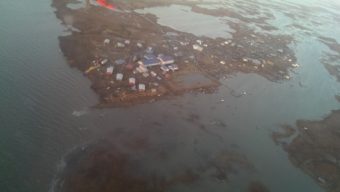
The village of Newtok, seen from above in the summer of 2016. (Photo courtesy of Romy Cadiente)

President Barack Obama has turned down a request from the western Alaska village of Newtok for a disaster declaration.

Newtok applied for relief based on erosion and thawing permafrost that are expected to destroy the village within three years. It was a test of whether the nation’s disaster laws apply to slow-moving impacts linked to climate change.

On Wednesday, the answer from the White House was: no.

Newtok’s village relocation coordinator, Romy Cadiente, learned the village’s request for a disaster declaration had been turned down in a phone call Wednesday, Jan. 18. “I was shocked,” he said. (Photo by Eric Keto/Alaska’s Energy Desk)

Romy Cadiente, Newtok’s village relocation coordinator, heard the news in a phone call Wednesday morning from Kenneth Murphy, the regional administrator for the Federal Emergency Management Agency, or FEMA.

“We were shocked,” Cadiente said.

After years of trying to scrape together funding, Cadiente said he thought the disaster declaration was Newtok’s best chance to access the tens of millions of dollars needed to move the village out of harm’s way.

A recent engineering report estimates the village is losing an average of 70 feet of land per year to the Ninglick River, and Cadiente said the situation is now dire.

“We’re going to lose homes this year,” he said. “We’re going to lose our water supply this year. It is dangerous for our village. Where do we put these people? Do you ship them off to Bethel, and if so, who pays for all that stuff?”

Erin Ward is a spokesperson for FEMA Region 10, which covers Alaska, Washington, Oregon and Idaho. She said, as a matter of policy, the agency doesn’t offer details on why a president chooses to deny a major disaster request, adding only that Newtok’s request did not fit the requirements of the Stafford Act, the law that governs disaster relief.

“Based on a review of all the information available, a major disaster declaration under the Stafford Act is not appropriate to address the situation,” she said.

Newtok’s request was unusual. It identified damage that has taken place over multiple years, as well as damage expected in the coming three years. Disaster declarations are usually issued in response to a single specific event.

Newtok attorney Mike Walleri argued that the president had the authority to declare a disaster for a multi-year event. (Photo by Eric Keto/Alaska’s Energy Desk)

Mike Walleri is the village attorney. He said the existing system fails communities like Newtok.

“What this means as a practical matter is the village is going to have to wait until these homes are destroyed, rather than taking any preemptive disaster response,” Walleri said.

That approach is inefficient, expensive and unsafe, he said.

Cadiente said the decision was particularly disappointing given that Obama visited Alaska in 2015 to draw attention to climate change, and the president even mentioned climate refugees during his farewell address earlier this month.

“Without bolder action, our children won’t have time to debate the existence of climate change,” Obama told a cheering crowd in Chicago. “They’ll be busy dealing with its effects: more environmental disasters, more economic disruptions, waves of climate refugees seeking sanctuary.”

That’s Newtok, Cadiente said.

“And when the storms get more severe, the flooding, the erosion, the permafrost degradation, what happens to us?” he asked. “What do we do now?”

In the near term, Newtok plans to appeal the decision. The village has 30 days to submit an updated request to the incoming Trump administration.

Longterm, Cadiente said, the village will continue working with state and federal agencies to try to move the village piece by piece.

We’re never going to give up on this,” he said. 

Site notifications
Update notification options
Subscribe to notifications