U.S. Secretary of State Rex Tillerson is in Alaska for the meeting of the Arctic Council. (Photo by Rachel Waldholz/Alaska’s Energy Desk)
As representatives from eight Arctic nations gather in Fairbanks, one issue is looming over the meeting: climate change.
The Arctic Council is the main forum for international cooperation in the Arctic, and the meeting has drawn foreign ministers from across the North, including U.S. Secretary of State Rex Tillerson.
In a ceremony Thursday morning the U.S. will formally hand over chairmanship of the Council to Finland, but the hand-off comes at a moment when U.S. Arctic policy is up in the air.
The Obama administration had emphasized climate change and scientific research during the two-year U.S. chairmanship. But the Trump administration is currently debating whether to pull out of the international Paris agreement to limit carbon emissions.
That’s raised concerns among the international crowd gathered in Fairbanks this week.
“Of course it raises concerns,” said Annika Nilsson with the Stockholm Environment Institute in Sweden. “The U.S. is a big emitter of greenhouse gases; that needs to change.”
Participants also voiced concerns about whether the U.S. will remain engaged in the region. The Trump administration has proposed major budget cuts to the State Department, which oversees American participation in the Arctic Council.
But Ambassador David Balton, the chief U.S. Arctic official, says American policy in the region hasn’t really changed since the early 90s, even as each new administration puts its stamp on it.
“This new administration has not yet begun that process,” he said. “But my own feeling is that U.S. interests in the Arctic are long-term and enduring, and they have a lot to do with the state of Alaska, and that’s not changing. So, if the past is prologue, one might not expect so much change.”
The Arctic Council meeting begins at 10 a.m. Thursday, May 11th, at the Carlson Center in Fairbanks.
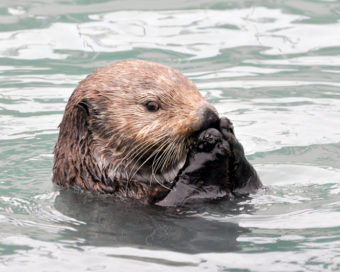
A sea otter in Resurrection Bay. (Photo by Heather Bryant)
When the Exxon Valdez spilled 11 million gallons of crude oil into Prince William Sound in 1989, the immediate effects were obvious. Researchers estimate that hundreds of thousands of sea birds and thousands of sea otters died within months, among other impacts.
But in the years that followed, some populations rebounded quickly, while others still haven’t recovered. Now, nearly three decades later, scientists are starting to understand why.
Dan Esler is a biologist with the U.S. Geological Survey in Anchorage. He started studying the aftermath of the Exxon Valdez spill in 1994. And he definitely didn’t expect he’d still be studying it all these years later – in part because biologists didn’t believe it would take that long for wildlife to recover.
“Even back in ’94 there were some surprised about the evidence that some species weren’t fully recovered already,” Esler said. “And this was five years after the spill. So even that seemed like it was a long duration for recovery.”
Little did they know. Species like sea otters and harlequin ducks wouldn’t be declared “recovered” until 2014 — 25 years after the spill.
But other species did much better.
So Esler and his team asked: why? Why did some species bounce right back, while others still haven’t recovered?
One reason, they found, was that some wildlife kept running into oil, years after the spill. That oil lingered buried in beach sediment, in areas where species like harlequin ducks or sea otters forage for food.
“Especially in the case of sea otters, as they’re digging in the sediment to pull out clams and other prey, there’s a risk they would dig into a pocket of oil,” Esler said.
Biologists found signs of oil exposure in harlequin ducks up until 2011. And even otters that didn’t die from their initial oil exposure showed possible health effects years later.
Other species didn’t have that problem – bald eagles for instance. Once the initial spill had dispersed, eagles weren’t particularly likely to encounter oil again. And eagles can reproduce pretty quickly. The bald eagle population was declared recovered in 1995.
But for species that take longer to reproduce, the spill was devastating. Two groups of killer whales – a resident pod and the AT1 transient population – still haven’t recovered.
“And it’s not that they’re still being exposed to oil,” Esler said. “It’s that, because of the life history of these animals, which is really based on very long-lived adults and relatively low annual reproduction, it’s almost impossible for them to have recovered in a short time frame.”
Or even a long one. Esler’s team notes research indicating that one of the two, the AT1 population, may never recover.
The takeaway? Esler said there’s no such thing as a single response to an oil spill. Some species can shake it off. For others, a spill can have ripple effects for generations.
The view of Kivalina from Air Force One on Sept. 2, 2015, as President Barack Obama flew to Kotzebue. (Official White House Photo by Pete Souza)
By the end of the century, researchers predict climate change could displace millions of people across the country, as rising sea levels and erosion hit coastal communities. As policymakers start to grapple with that reality, there’s a specific phrase making the rounds: “managed retreat.” In other words, relocating whole neighborhoods or communities and retreating from the coast.
A new study looks at examples around the world — including some in Alaska.
The Netherlands is famous for its ability to make land from water. The country has a mind-boggling system of pumps and levees that drain and protect coastal areas. But in recent years, the country has been lowering some of those levees, allowing some communities to flood.
“The purpose of that was, by absorbing all of that water upstream, there are larger towns downstream that would be much safer in the case of these high river flows,” said Miyuki Hino, a researcher at Stanford University.
It’s one of 27 examples her team looked at around the world. In each case, people have moved, or tried to move, because of environmental changes. They range from the decision not to rebuild in areas hit by the 2004 tsunami in Sri Lanka to abandoning sinking land in Louisiana to eroding coastal villages in Alaska.
One of the most successful examples is the Dutch program. It’s called “Room for the River” and it’s about stepping back and retreating from flood zones.
Hino said her team found two important factors in every example they studied.
Number one: does the community in question want to move?
Number two: “Whether broader society, beyond the residents, really benefited from retreat taking place,” Hino said.
In other words, the move was most likely to happen — and most likely to satisfy most of the people involved — when the community itself wanted to move, and the broader government agreed. And that was most likely to happen when there were clear benefits to people outside the directly affected community, situations like the Dutch example.
But in Alaska, Hino said, that’s been a challenge.
Villages like Newtok, Shishmaref and Kivalina have been trying to move for years. But neither the state, nor Congress, nor federal agencies have mustered the funding to help them. In situations like those, “there’s a perception that broader society does not significantly benefit from retreat taking place,” Hino said. “And as a result, it’s a major struggle to get the necessary government support to do so.”
But Robin Bronen, of the Alaska Institute for Justice, argued that interpretation isn’t quite right. Bronen has studied efforts to relocate coastal villages in Alaska for the last decade.
“In the paper, they talk about that scenario as a lack of political will, which is not what I would say,” Bronen said.
The problem in Alaska hasn’t been a lack of political will, she argued: state and federal agencies have been trying to help villages move.
Instead, she said, the problem is that the U.S. simply doesn’t have the right laws.
“There’s this urgent need to protect populations from climate change, but we don’t have the laws in place to facilitate it,” Bronen said. “[That] means that government agencies don’t have mandates or funding to make it possible to actually implement what everybody agrees is the best long term adaptation strategy.”
For instance, U.S. disaster laws will pay to help individual families move after a major hurricane — but they can’t help a whole community relocate in the face of slow-moving erosion or sea level rise. That was proved most recently this winter, when the village of Newtok requested a presidential disaster declaration, and was turned down.
But Bronen and Hino agree on one thing: “It seems very likely that people will be on the move in a changing climate,” Hino said. “The question is how.”
BP is still struggling to contain an out-of-control production well on the North Slope, after a failed attempt to shut it down Friday night. The well continued to vent natural gas Saturday evening, more than a day and a half after BP first reported a gas release and “spray” of crude oil.
The area near the well remained too unsafe for workers to approach Saturday. But BP said flights over the area suggested that oil from the well was likely contained to the drill pad, and may not have reached the surrounding tundra. The company confirmed there have been no injuries, and no reports of impacts to wildlife.
“The focus today is on developing plans to fully and safely secure the well,” BP said in a statement.
Representatives from the Alaska Department of Environmental Conservation (ADEC), U.S. EPA and the North Slope Borough had traveled to Prudhoe Bay to form a “unified command” with BP to manage the response.
In a situation report released Saturday afternoon, ADEC said it was too soon to pinpoint why BP lost control of the well. But the report identified two separate leaks in the well, and noted that the well itself had “jacked up,” or risen several feet out of the ground.
This is a continuing story. Check back for updates.
Original story | 5 p.m. Friday, April 14
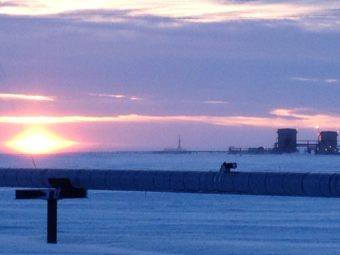
BP is working to contain an out-of-control production well at the Prudhoe Bay oil field on the North Slope. The well is currently venting natural gas and has released at least some crude oil into the environment.
State regulators say they don’t yet know how serious the incident is, or what amount of oil or gas has been released.
In an emailed statement, BP said nobody was near the well at the time of the release, and there have been no injuries.
Regulators were still waiting for details Friday afternoon.
“It’s been spewing gas and some amount of crude, and some of it’s getting onto the surrounding tundra,” said Dan Seamount, a commissioner with the Alaska Oil and Gas Conservation Commission. “We don’t have any volumes yet.”
Seamount said it’s been years since an incident like this took place on the North Slope. The drill site, DS2, is about five miles from the industry hub of Deadhorse.
On Friday afternoon, BP was working to depressurize the drill site, to reduce the amount of gas venting from the well. Regulators said no workers were being allowed near the well until that happened, because of the fire hazard.
“When a well has lost control, it becomes unpredictable, and we want to make sure that the people that respond to the site do so in a safe way,” said Ashley Adamczak, with the state Department of Environmental Conservation (ADEC) in Fairbanks.
Adamczak said once workers are able to approach the well, the company and regulators will be able to get a better sense of what caused the incident and how much oil and gas was released.
BP first noticed the release at about 7:30 a.m. Friday, according to a situation report from ADEC. The report said representatives of ADEC, EPA and the North Slope Borough would establish a unified command with BP to develop cleanup plans.
But as of 4 p.m. Friday, there was no word on when BP expected to have the well under control. Seamount said it could be hours, or days. The company hadn’t yet submitted a plan for shutting in the well to the Alaska Oil and Gas Conservation Commission for approval.
“It sounds like the problem is going to be taken care of,” Seamount said, adding, after a pause: “Not sure when.”
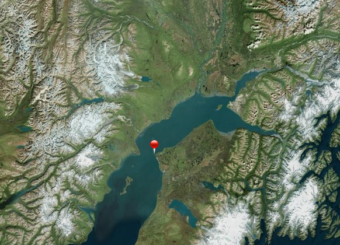
Location of a natural gas line repaired by Hilcorp in Cook Inlet. (Image courtesy Alaska Department of Environmental Conservation/NASA)
A natural gas leak in Cook Inlet has finally been repaired, more than three months after it began.
The oil and gas company Hilcorp says a dive team managed to install a clamp on its pipeline late Thursday night, after a week of work and 12 dives.
The leak, in a line near Nikiski, was discovered in early February, though federal regulators say it probably began in December. Divers couldn’t get down to repair the line for weeks after the discovery, because of winter sea ice conditions in the Inlet.
In a press release today, Hilcorp says the culprit was a dime-sized hole in the bottom of the pipeline, where it was resting on a boulder on the sea floor. The company says divers will inspect the rest of the gas line and a nearby oil pipeline in the coming days.
The company has shut down two other pipelines in Cook Inlet in recent weeks, after suspected oil and gas leaks. State regulators now say an oil sheen near Hilcorp’s Anna drilling platform did not come from a pipeline, but instead likely came from the platform itself. Hilcorp is still investigating whether there may be a leak in a natural gas line from its Steelhead platform.
The string of incidents has drawn scrutiny from both regulators and environmentalists. The state Department of Environmental Conservation and federal regulators plan to conduct a review of oil and gas infrastructure in Cook Inlet, much of which dates back to the 1960s.
And some conservationgroups are raising concerns about a new project Hilcorp is advancing in the Arctic Ocean. They say the company’s inability to respond to a problem in Cook Inlet, within easy reach of the state’s major population centers, calls into question whether the company can operate safely in the far more remote Beaufort Sea. Industry representatives dispute that connection.
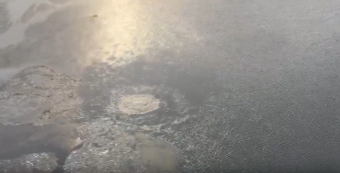
Still from footage taken by a helicopter of a gas leak in Cook Inlet in early February 2017, obtained by the environmental group Cook Inletkeeper.(Image courtesy Cook Inletkeeper)
Dive teams are finally working to repair Hilcorp’s leaking natural gas pipeline in Cook Inlet.
The leak was discovered in early February, though regulators say it actually began in December. But repairs were delayed by winter ice conditions in the Inlet, which made it too dangerous for divers to work.
In a press release Monday, the company said dive crews are putting a temporary clamp on the pipeline, which carried fuel to drilling platforms in Cook Inlet. Two platforms were shut down in late March to limit the leak, and the company says the line won’t be returned to service until permanent repairs are made.
In recent weeks, Hilcorp shut down two other pipelines in the Inlet because of suspected oil and gas leaks.
But the company now says it believes an oil sheen spotted near one of its platforms did not come from a pipeline leak, as originally thought. In a second press release on Monday, Hilcorp said the line from its Anna platform passed a pressure test over the weekend and a dive team reported on Monday that they had found no damage.
The company is still investigating what might have caused the oil sheen.
It’s also investigating a third pipeline, from its Steelhead platform. The company found indications of a potential leak from that line during an audit of its Cook Inlet infrastructure prompted by the first leak.
Close
Update notification options
Subscribe to notifications
Subscribe
Get notifications about news related to the topics you care about. You can unsubscribe anytime.