Rachel Waldholz, Alaska’s Energy Desk

Newtok says state agency blocked access to disaster funding

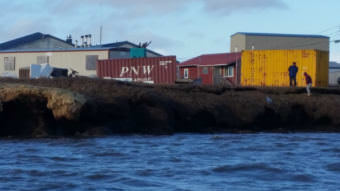
Erosion has brought the local river within 40 feet of structures in Newtok, Alaska. (Photo courtesy of Romy Cadiente, Newtok Village)

Residents of the village of Newtok say a state agency blocked its application for federal disaster funding, directing millions of dollars to other Alaska communities.

Newtok had planned to use the money to buy out more than a dozen homes at risk of destruction in the rapidly eroding village. Now, that funding will likely go to communities in the Mat-Su Valley.

Village leaders say state and federal agencies have made it almost impossible to access funding.

To get a sense of what Newtok is facing, tribal administrator Andrew John pointed to a photo from a storm earlier this month. In just that storm, he said, the village lost more than 20 feet of land. The local river is now within 40 feet of the nearest structures.

But the village council says the relevant state agency has abdicated its responsibility to prepare for what’s coming.

“Basically the Division of Homeland Security has a ‘no-action’ option with regards to the destruction of Newtok,” said Mike Walleri, Newtok’s lawyer.

Despite years of working with the village, Walleri said, the state has no plan to relocate people if their homes are destroyed this year or next.

Newtok has been trying to move for more than a decade, as a combination of thawing permafrost and coastal erosion has brought the water closer and closer. The village has a new site picked out upriver. The big problem is money.

In 2015, the state approved a plan to use about $3 million of state and federal disaster funding to relocate a dozen of the most threatened houses. But then, the village lost its barge landing to erosion. Moving the homes became impossible. So, the Newtok Village Council asked to use the money to buy out the existing homes, and build new houses at the new site.

This summer, the state agency in charge of administering the grant, the Division of Homeland Security and Emergency Management, ruled that Newtok’s application was incomplete. The Division refused to submit the plan to FEMA, the Federal Emergency Management Agency.

So the money Newtok was counting on will likely go to Butte and Sutton in the Mat-Su Borough, instead.

Walleri said residents are dumbfounded.

“We believe that was dishonest,” Walleri said. “We believe that was basically bureaucratic subversion of the plan. And we think that essentially Homeland Security is attempting to abandon the village.”

Mike O’Hare runs the Division of Homeland Security. He said Newtok’s application was missing key elements, and the Division ran out of time to fix the problems.

“It’s bureaucratic. I get it. I’m a bureaucrat,” O’Hare said in an interview Wednesday. But, he said, “we have rules that we have to follow from the federal government.”

O’Hare said he understands the village’s frustration.

“We’re all frustrated, we all want them to succeed. But we have bureaucratic requirements that we have to fulfill. Otherwise we’re being irresponsible with the people’s money,” he said.

O’Hare said the state faced an August deadline before it would have to return the money to FEMA, so it opted to redirect the funding to communities with complete applications. (The funding comes from FEMA’s Hazard Mitigation Grant Program, which aims to reduce future risk after a major disaster declaration.)

But the engineering firm DOWL, which is working with Newtok to manage the relocation effort, said the application was complete – and the state dragged its feet, which ran out the clock. DOWL coordinated final revisions to the application, which was originally prepared by the firm CRW Engineering.

“I don’t know how to say this, but, it’s just, it’s not right,” said DOWL’s Adison Spafford, who helped Newtok submit the final application. “Given the tribe’s involvement and investment, to try to get these funds to save the people living in Newtok, it’s just pretty unacceptable.”

O’Hare said the village can apply for other funding. But that will take time. And Newtok had hoped to use this money to build in 2018.

The Newtok Village Council said the bigger problem is that state and federal emergency management agencies are making it almost impossible to access funding. This is the third time in the last two years that Newtok thought funding was on its way, only to be disappointed.

Last year, the Obama administration denied Newtok’s request for a federal disaster declaration, along with one from the village of Kivalina. FEMA said coastal erosion, flooding and thawing permafrost do not meet the requirements of federal disaster law. The Department of Housing and Urban Development also rejected Newtok’s application for funding through the National Disaster Resilience Competition. That application was prepared in part by O’Hare’s division.

Newtok relocation coordinator Romy Cadiente said agencies keep moving the goalposts.

“We didn’t do this, or we still need to do that…These are real people’s lives that they’re dealing with,” Cadiente said. “If this is a doable thing, tell us what we need to do. If it’s not, tell us.”

Newtok residents worry one or more homes may be lost this winter. Village Council president Paul Charles and vice president George Carl both live in houses near the edge of the river.

Carl said Newtok needs help now.

“If you come to Newtok, you’ll see the truth of the village,” Carl said. “They’re in critical condition, some of the houses are ready to fall in the river.”

After Alaska’s Energy Desk called the state with questions this week, the governor’s office intervened.

The Newtok Village Council was called to a meeting Thursday morning with the governor’s chief of staff, Scott Kendall, and Major General Laurie Hummell, who oversees the Division of Homeland Security.

Walleri said both committed to making Newtok’s relocation a priority. They proposed committing Alaska National Guard units to assist with an effort to move temporary barracks from Joint Base Elmendorf-Richardson to the new village site. The proposal would be one way to provide housing at the new site. The governor’s office also agreed to look at options for other funding.

Walleri said Director O’Hare apologized to the village on behalf of his division. (A spokesman later clarified that O’Hare apologized for the village’s frustration, but stands behind the division’s ultimate decision.)

Newtok is introducing several resolutions at the Alaska Federation of Natives convention this week to address issues related to relocation. One resolution asks for changes in federal disaster law to include problems like coastal erosion and thawing permafrost. Another asks President Trump to redirect funds originally committed under the Paris climate agreement to help developing nations adapt to climate change, and instead send that money to Alaska Native and Native American communities.

Correction: An earlier version of this story stated the engineering firm DOWL prepared Newtok’s application to the Hazard Mitigation Grant Program. In fact, the firm CRW Engineering prepared the original application. DOWL worked with Newtok to submit final revisions this year. Update, Nov. 2: This article has also been updated to include a clarification from the Division of Homeland Security on Director O’Hare’s apology.

Climate change roundtable puts Alaska contradictions on full display

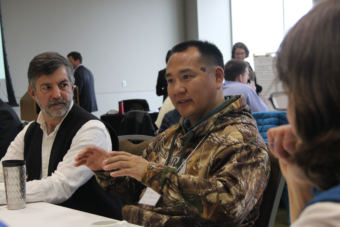
John Hopson, Jr., (r) of Wainright and Rand Hagenstein (l) of The Nature Conservancy joined representatives from oil and gas, mining, environmental groups and local communities at the Walker administration's climate change round table in Anchorage on Oct. 4, 2017. (Photo by Rachel Waldholz/Alaska's Energy Desk)
John Hopson, Jr., (r) of Wainright and Rand Hagenstein (l) of The Nature Conservancy joined representatives from oil and gas, mining, environmental groups and local communities at the Walker administration’s climate change round table in Anchorage on Oct. 4, 2017. (Photo by Rachel Waldholz/Alaska’s Energy Desk)

A downtown Anchorage conference room hosted an unusual meeting Wednesday, as Lt. Gov. Byron Mallott gathered a cross-section of Alaskans to brainstorm paths forward on climate change.

Representatives from the oil and gas and mining industries joined environmentalists and local community leaders to spitball solutions. The Walker administration plans to use the ideas to inform a state climate policy currently in the works.

About 35 people sat around tables on the second floor of Anchorage’s Dena’ina Center. Giant notepads on easels sat ready for participants to jot down thoughts, each with a label: adaptation, mitigation, research and response.

“I don’t need to emphasize here that climate change is real,” Mallott told the gathering in his opening remarks, calling it a “generational” challenge.

“There is no stopping what is happening,” he said.

Lt. Gov. Byron Mallott listened to participants in the Walker administration's climate change round table in Anchorage, Oct. 4, 2017. (Photo by Rachel Waldholz/Alaska's Energy Desk)
Lt. Gov. Byron Mallott listened to participants in the Walker administration’s climate change round table in Anchorage, Oct. 4, 2017. (Photo by Rachel Waldholz/Alaska’s Energy Desk)

But as participants gathered in groups to brainstorm, the state’s contradictions were on full display. Alaska is an oil state that sits on the front lines of global warming. The room included people who depend on oil for their livelihood, and those coping with the impacts of climate change on the ground – represented at the same table, sometimes by same person.
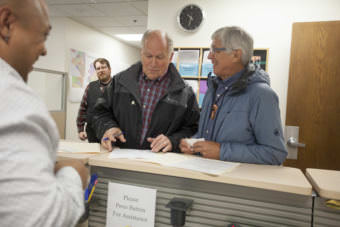
Joshua Kindred pointed out that paradox; he works for the Alaska Oil and Gas Association, the industry’s main advocate in the state. Kindred said the word that comes to mind when he thinks about trying to address climate change is “quixotic.”

“We’re a state that produces 500,000 barrels a day, on a planet that consumes almost a hundred million barrels a day,” Kindred said. “When we talk about things like reducing our carbon footprint, and what we can do at the local level, I think we have to acknowledge the fact that we have very limited control to change the long-term path of climate change. So, how do we advocate on a global level?”

Sitting across from him, Karen Pletnikoff said she sees plenty of opportunities for Alaskans, and the Alaska oil industry, to move the needle on climate change. Pletnikoff is with the Aleutian Pribiloff Islands Association, which is working with communities to plan for climate impacts.

“I think your specific industry has a wonderful opportunity to do a lot to protect the environment by preventing methane escapes in the North,” she told Kindred.

Across the room, former Lt. Gov. Mead Treadwell argued that action on climate change doesn’t have to threaten oil production. He said he’s hopeful new technology might emerge to capture carbon emissions – and suggested Alaska should be at the forefront of carbon capture and sequestration.

“I think the joke’s going to be on those who think oil and gas is going to go away. I think we have to be part of trying to make sure oil and gas are clean,” Treadwell said. “We’ve done a pretty good job with oil and gas over the last 30 years. And if carbon’s a new problem, let’s figure out a way to get it out of there. That doesn’t mean kill it.”

Joel Neimeyer, with the federal Denali Commission, raised the issue of Alaska villages that may have to abandon their current sites because of climate change.

Neimeyer said the state needs to make up its mind and declare a position – whether Alaska favors relocating whole villages to new sites or just moving individual families into cities, which is much cheaper.

“If the State of Alaska is about relocating villages and not relocating families, I think that would be a good thing to know,” Neimeyer said.

In the end, he said, relocation is probably out of the state’s hands: it will come down to whether Congress is willing to loosen the federal purse strings.

“I think if the State of Alaska says, ‘This is our policy,’ that would be helpful to Congress,” Neimeyer said. “Now, will they consider it? Yeah. Will they actually adopt it in the end? We don’t know.”

“Will they pay for it?” interjected Adm. Thomas Barrett.

Barrett heads up the Alyeska Pipeline Service Co., which operates the trans-Alaska pipeline.

“Yeah, will they pay for it. Ultimately, that’s what it comes down to,” Neimeyer agreed.

Mallott said exchanges like that, between people on all sides of the issue – including the oil industry and those working with communities in the path of climate change – were the whole purpose of the meeting.

The governor’s office plans to use ideas raised in the brainstorming session to develop its climate action plan, which it aims to release later this year.

Walker admin appoints climate adviser, promises new policy “soon”

Alaska Gov. Bill Walker and Lt. Gov. Byron Mallott file for re-election on Monday, August 21, 2017, at the Division of Elections in Juneau, Alaska. The two are filing as unaffiliated candidates — though Mallott maintains his personal affiliation with the Democratic party. (Photo by Rashah McChesney/Alaska’s Energy Desk)

The Walker administration has said for more than a year that it’s working on a new set of policies to address climate change.

Those policies have yet to materialize.

But Lt. Gov. Byron Mallott told an Anchorage audience Tuesday that a plan is coming soon, and he announced a new climate point person in the executive branch.

Alaska Lt. Gov. Byron Mallott with Nikoosh Carlo, the new special adviser for climate. (Photo courtesy of the Office of the Lieutenant Governor)

Mallott told a gathering of ocean researchers in Anchorage that climate change is an urgent challenge for Alaska. He pointed out that indigenous people have been some of the first to feel the impacts, both in Alaska and around the world.

“Without question, the First Peoples of our state live in the places where climate change is most affecting lives,” Mallott said.

But in the big picture, he said, “we are all indigenous to island Earth.”

Speaking after his talk, Mallott said the Walker administration is still hammering out a strategy that will build on the state’s last big climate policy push, under former Gov. Sarah Palin.

“There’s a lot of work going on, and we hope to be able to bring it to focus within the next couple of months,” he said.

But at least a few things are clear: for the first time, Mallott said, any plan must include cuts to carbon emissions. And, he said, Alaska has to look at the big picture.

“Continuing development of petroleum resources is very important to our economy and our state’s near-term future,” he said. “But at the same time, we need to begin planning for a future in which carbon-based fuel and energy is ultimately phased out.”

Mallott said he expects the governor to announce an administrative order on climate policy “soon.”

That’s been the administration’s line for awhile now.

But there has been at least one formal step this year: This month, Gov. Walker appointed Nikoosh Carlo to the newly created position of senior climate adviser.

“I think I probably took a deep breath and paused for a long time,” Carlo said, laughing, about her reaction when asked to tackle climate policy. “It’s such a huge issue.”

Originally from Fairbanks and Tanana, Carlo most recently worked with the U.S. State Department’s delegation to the Arctic Council. She also ran the commission that wrote Alaska’s official Arctic Policy.

Carlo said her first step will be outreach: bringing together local and tribal leaders, industry and citizen groups. It’s going to be a long process, she said.

“But I’m excited,” Carlo said. “I think the interest to address this issue is definitely there within the state. I think we’re all going to come together on this. We have to.”

What can Kodiak teach the world about renewable energy? A lot.

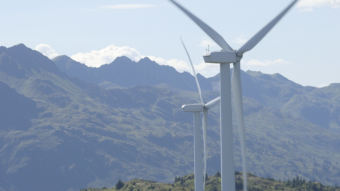
Kodiak generates about 20 percent of its electricity from wind. The Kodiak Electric Association has installed six turbines on Pillar Mountain since 2009. (Photo by Eric Keto/Alaska's Energy Desk)
Kodiak generates about 20 percent of its electricity from wind. The Kodiak Electric Association has installed six turbines on Pillar Mountain since 2009. (Photo by Eric Keto/Alaska’s Energy Desk)

Since 2007, Kodiak has transformed its grid so that it now generates almost 100 percent of its power with renewable energy.

The local electric co-op has managed to do that while keeping rates stable. In fact, the price of electricity in Kodiak has dropped slightly since 2000.

It’s a model with lessons for remote communities from the Arctic to the equator — and for cities on the big grids of the Lower 48, from New York to Houston.

It seems like just about anywhere you go in Kodiak, you can look up and see the wind turbines. There are six of them spinning on Pillar Mountain, above town.

Giant, elegant and charismatic, the wind turbines are the most visible symbol of Kodiak’s quest to go nearly 100 percent renewable. And if the wind is blowing, they might account for 80 percent of the power used at any given moment. In the utility world, that’s a huge number.

But over the course of an entire year, wind only supplies about 20 percent of the region’s power.

The real workhorse in Kodiak’s system? Hydropower.

“Hydro is the key,” said Jennifer Richcreek, who works for the local electric co-op. “It was the key for us. And I see it as the key throughout the country.”

When the Kodiak Electric Association, or KEA, set a goal of 95 percent renewable energy back in 2007, the utility already had a major head start: Terror Lake, Kodiak’s hydro project, was built by the state in the 1980s.

Ian Baring-Gould works for the National Renewable Energy Laboratory in Boulder, Colorado. He said many communities don’t have that option.

“Kodiak is very unique in that it has great hydro resources and a good wind resource very close to the load center, which is really unique and has allowed them to do what what they’re doing,” Baring-Gould said.

But, he said, Kodiak is still an example for other remote communities. KEA has proven it’s technically feasible to add a ton of renewable energy to a small grid – and that it can make sense economically.

Kodiak generates about 20 percent of its electricity from wind. The Kodiak Electric Association has installed six turbines on Pillar Mountain since 2009. (Photo by Eric Keto/Alaska's Energy Desk)
When the wind is blowing, it might supply up to 80 percent of the power generated by Kodiak Electric in any given moment. In the utility world, that’s a huge number. (Photo by Eric Keto/Alaska’s Energy Desk)

Other cities might not have Kodiak’s exact combination of wind and hydro. “But they have other combinations,” Baring-Gould said. “And they might not be able to get to 100 percent, which Kodiak can do, but they could get to 80 percent or 40 percent or 65 percent.”

And the way Kodiak built its system is also a lesson, he said. KEA built on its hydro resource step by step, problem solving for nearly a decade. The result is a system that combines wind and hydro, along with batteries and flywheels — a particularly sci-fi way to store energy. Along the way, it became perhaps the first system in the world to combine flywheels and batteries in this way.

Baring-Gould said that process is a blueprint for other remote communities with stand-alone grids, from the Arctic to the Philippines.

But Kodiak isn’t just an example for small communities. There are lessons for the big grids of the Lower 48, too.

To understand why, just read the news: Hurricane Harvey knocked out power to tens of thousands of people, and was followed by Hurricane Irma, which left millions without electricity.

Massive storms like Irma and Harvey — and Hurricane Sandy before them — can leave tons of people without power for days or longer. And that’s increasing interest in microgrids: stand-alone systems that can disconnect from the larger grid. Places like hospitals, military bases and industrial sites want to be able to separate from the grid and generate their own power during emergencies.

Once you go down that path, there can be a lot of other benefits.

Brian Hirsch is an energy consultant in Anchorage. He said industrial sites or major hospitals with a microgrid might find it’s sometimes cheaper to generate some of their own power.

“And then you have some decision-making going on,” he said. “When does it make sense for me to generate my own power? When does it make sense for me to sell power back to the bigger grid? When does it make sense for me to just shut my stuff down and buy power from the grid like I typically do?”

Seafood processors are some of the largest energy consumers in Kodiak, which has generated more than 99 percent of its electricity from renewable sources since 2014. Here, the Ocean Beauty seafood plant. (Photo by Eric Keto/Alaska’s Energy Desk)

What Kodiak has, by necessity, is similar to those stand-alone microgrids. Like so many other communities in Alaska, it’s too remote to connect to any larger grid.

Baring-Gould said Alaska knows how to run the kinds of self-contained grids the rest of the world is just starting to wake up to.

“Alaskans have been doing this for 50 years,” he said. Kodiak just proves you can take it a step further.

If you need proof that this is not all pie-in-the-sky, just visit some of the system’s largest energy users: fish processors.

James Turner manages the Ocean Beauty seafood plant in Kodiak. Inside, it’s a blur of bright lights, fish parts on conveyor belts and workers in hairnets and gloves. And then there are the freezers: many, many different kinds of freezers.

Plants like this use a lot of power. So the cost and reliability of electricity are a big deal, Turner said. And Kodiak Electric has delivered on both.

I asked Turner if it’s important that his freezers and conveyor belts run off renewables.

“It is to me, absolutely,” he said. “It’s better for the environment…our industry is run off the environment. You know, everything that we do comes out of the sea.”

“There are certain things we have to burn diesel on,” Turner said. “But power isn’t one of them.”

In Kodiak, that’s taken care of by the wind and the rain.

National labs to field test microgrid tech in Cordova

Panelists spoke about microgrid innovation in Alaska at a U.S. Senate Energy Committee field hearing in Cordova, June 10, 2017. From left, Cordova Mayor Clay Koplin, Abraham Ellis of the Sandia National Laboratories, Gwen Holdmann of the Alaska Center for Energy and Power, Meera Kohler of the Alaska Village Electric Cooperative, and Geoff Larson of the Alaskan Brewing Co. (Photo by Rachel Waldholz/Alaska’s Energy Desk)

Several national labs and universities will partner with the Alaska community of Cordova to field test new technologies on the city’s power grid.

The goal is to find innovations that could help the rest of the country avoid the kind of widespread power outages that have followed Hurricanes Irma and Harvey.
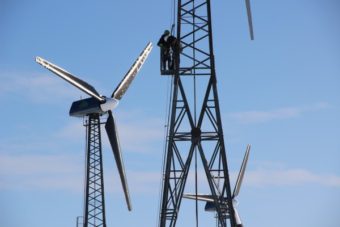
The U.S. Department of Energy has awarded $6.2 million for the project.

Cordova Mayor Clay Koplin, who’s also CEO of the city’s electric cooperative, called the grant a win-win.

“The project works both ways,” he said. “Cordova Electric is going to learn a lot about this technology, but the labs are going to learn a lot about actual microgrid environments and what does and doesn’t (work).”

Microgrids, or stand-alone electric grids, are a necessity in much of rural Alaska, where there’s no larger grid to connect to.

But there’s growing interest in the Lower 48, especially after Hurricane Sandy in 2012 – and now Hurricane Irma – left millions of people without power for days or weeks. Hospitals, military bases, and whole towns want to be able to disconnect from the larger grid and generate their own power in an emergency.

Cordova currently runs on a combination of hydro power and diesel generation. The grant will allow the community to add a battery for energy storage, and test out new system controls to get the different parts of the grid talking to each other. That technology can also be key for integrating more renewable energy into a grid.

Koplin said Alaska is a perfect laboratory, because communities have decades of experience running small grids.

“It gives us an opportunity to share some of our capabilities, which are becoming in increasing demand from other countries, they’re starting to recognize that Alaska has a lot of energy leadership on the electric energy side,” he said. “And it also gives us access to world-class technical resources.”

Cordova will work with three national labs and several universities, along with the Alaska Center for Energy and Power at the University of Alaska Fairbanks, and the Alaska Village Electric Cooperative.

Can an Anchorage start-up lure renewable energy investors to rural Alaska?

Patrick Boonstra of Intelligent Energy Systems, and Kwigillingok wind tech Benny Daniel check a turbine after a blizzard the night before. (Photo by Rachel Waldholz/APRN)

In recent years, communities across rural Alaska have pushed to add renewable energy and reduce the use of expensive diesel to power their communities.

The majority of those projects have been funded with state and federal grants. But as the state budget has contracted, those grants have dried up.

Now, a start-up company in Anchorage wants to take a new approach: connecting private investors to the state’s remote villages.

Piper Foster Wilder moved to Alaska a couple years ago after working on renewable energy in the Lower 48. She saw a gap between the way renewables are viewed down south, and the way they’re viewed up here.

“There was nothing fringe-y, alternative or outside-of-the-mainstream about renewable energy,” in the Lower 48, Foster Wilder said. “This is the business of suit-and-tie wearing people, who are making a lot of money doing it.”

“That argument is still being made in Alaska,” she said.

Foster Wilder hopes to bring some of that suit-and-tie attitude to the state with her start-up, 60Hertz Microgrids. It’s one of four companies chosen this year by the Anchorage business incubator Launch Alaska, which offers seed money and coaching to local ventures.

In the past, Foster Wilder said, the state might have covered the cost of a wind turbine or solar array for a rural community, perhaps with a grant from the Renewable Energy Fund. With shrinking state budgets, that’s generally no longer an option. And it can be hard for communities to qualify for affordable loans for renewable projects.

So, Foster Wilder said, it’s time to try a different model.

She said Outside investors are looking for renewable energy projects to put money into, because of attractive tax incentives.

“This was the lightbulb that went off for me a year ago,” she said. “I was meeting with an investor, and he said, ‘Piper, I just want to bring $200 million of clean energy capital to Alaska. Can you help me do that?'”

The answer, at the time, was no. But Foster Wilder aims to change that, connecting money to rural villages.

60Hertz hopes to aggregate several community projects, creating a big enough pool that it’s attractive to investors willing to lend money at low interest rates – and so the projects themselves can benefit from economies of scale.

“Our goal is to simplify the process, to be a bridge between money and need,” Foster Wilder  said. “So, who are investors that want to take advantage of the incentives of investing in renewable energy? And who are the people that need that capital, so they can pay for this infrastructure in a fair way?”

Will it work? So far, it’s untested. 60Hertz is running a contest this fall, looking for communities to partner with. Foster Wilder hopes to give her concept a real-life road test in the coming year.

Site notifications
Update notification options
Subscribe to notifications