Rachel Waldholz, Alaska’s Energy Desk

Tillerson proposes scrapping Arctic and climate envoys

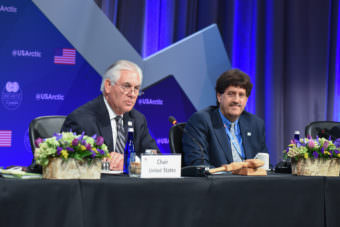
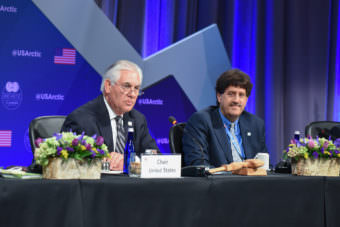
United States Secretary of State Rex Tillerson chaired the 10th Ministerial Meeting of the Arctic Council in Fairbanks, AK on May 11, 2017. (Photo by Arctic Council Secretariat /Linnea Nordström)

Secretary of State Rex Tillerson wants to do away with special envoys focused on the Arctic and climate change, as part of his effort to overhaul the State Department.

The proposal comes just months after Tillerson visited Alaska and spoke about the importance of the Arctic. Some worry it’s a sign the Trump administration will be less engaged in the region.

Tillerson came to Fairbanks in May to hand over the chairmanship of the Arctic Council, the main organization for cooperation among the world’s eight Arctic nations.

“The United States has been privileged to lead the Arctic Council at a time when the Arctic region has been facing unprecedented change and challenges,” he told diplomats.  The Council has focused on issues like increasing ship traffic as sea ice recedes, oil and gas development and rapid environmental change.

But according to a letter first reported by CNN, Tillerson wants to scrap the position created just three years ago by the Obama administration to focus on the region.

The Special Representative for the Arctic Region is one of about three dozen special envoys Tillerson hopes to eliminate or merge into existing bureaus. It’s part of a larger effort to streamline the State Department; the Trump administration has proposed cutting the agency’s budget by nearly a third.

Mike Sfraga heads up the Polar Initiative at the Woodrow Wilson Center in D.C. He said the appointment of the special representative in 2014 was a sign the U.S. was taking the Arctic seriously. The position was part of a deliberate effort under the Obama administration to raise the profile of Arctic issues.

“The rest of the world took notice that the United States had a special representative for the Arctic,” Sfraga said. “And just that alone…I think, in my opinion, was well worth the position.”

Critics, including in Congress, say the State Department has too many special envoys, who duplicate work that could be done by existing bureaus.

But Sfraga said he wishes the U.S. would hang onto this one. He said just about every other nation involved in the Arctic has an ambassador-level position focused on the region.

“There simply is not somebody who the United States points to and says, ‘that is our point person, at the highest levels of the government, on the Arctic,'” Sfraga said.

Still, the role was always nebulous.

“I don’t know that the role comes with a job description,” said Nils Andreassen, who runs the Institute of the North in Anchorage.

The only person who’s held the position is retired Coast Guard chief, Admiral Robert Papp. Andreassen said Papp focused on raising awareness of the Arctic, even within the U.S., and that kind of outreach will be the biggest loss.

“He really felt strongly that if he could bring America to the Arctic and the Arctic to America, then being able to address all the challenges would be that much easier, because people would understand them differently,” Andreassen said.

Also on the State Department chopping block: the Special Envoy for Climate Change. That position was also created during the Obama administration. Until last year, it was held by Todd Stern, who led the U.S. team that negotiated the Paris climate accord. President Trump has announced the U.S. will pull out of that agreement.

Under Tillerson’s proposal, the responsibilities of both the Arctic and climate change envoys would be absorbed into the State Department’s Bureau of Oceans and International and Scientific Affairs.

As sea ice recedes, walruses gather near Point Lay earlier than ever

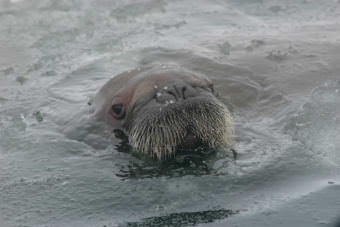
A curious Pacific Walrus calf checks out the photographer in 2004. (Photo by Joel Garlich-Miller, USFWS)

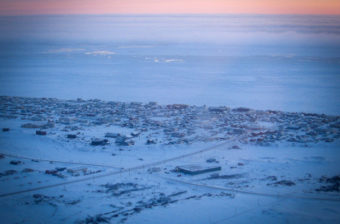
Several hundred Pacific walrus are hauled out on a barrier island near the village of Point Lay, on the Chukchi Sea coast.

It’s the earliest such haul out since the walrus first started showing up in 2007 — and may be linked to this year’s rapidly retreating Arctic sea ice.
Andrea Medeiros is a spokesperson with the U.S. Fish and Wildlife Service. She said during this time of year, adult female and young walrus in the region usually haul out on sea ice to rest while feeding.

“When that ice retreats to the deeper water, they can’t do that,” Medeiros said. “They need a place to rest after they’ve fed, so they will travel to the shore and haul out there to rest in between feeding periods.”

This year, sea ice in the Chukchi Sea has retreated to the deep water beyond the continental shelf earlier than in the past, Medeiros said. The walrus started gathering on the barrier island near Point Lay around August 3.

As many as 40,000 animals have hauled out on the narrow islands in recent years, putting them at risk for overcrowding. As in the past, Fish and Wildlife and the Village of Point Lay are asking people to stay away from the animals, to avoid causing stampedes.

Fish and Wildlife is currently deciding whether to list the Pacific walrus under the Endangered Species Act. Environmental groups argue that the loss of sea ice threatens to drive the animals toward extinction. 

Sweeping government climate report warns of rapid warming in Alaska, Arctic

Winter sea ice locking in Nome for the winter. (Photo by Laura Collins/KNOM)

A new government report warns that regions across the U.S. are feeling the effects of rapid climate change, with some of the greatest impacts in Alaska and the Arctic. And it states the evidence that human activity is driving climate change is stronger than ever.
A final draft of the assessment was posted online by the New York Times, which reported that scientists are worried the Trump Administration might try to change or suppress it.

The report says it is “extremely likely” that human activity is the “dominant cause” of recent warming — adding there is “no convincing alternative explanation.” That contradicts statements from Trump administration officials — and from the president himself.

The report is part of the National Climate Assessment, which is released every four years.

John Walsh is with the International Arctic Research Center at the University of Alaska, Fairbanks.

“It’s a distillation of the latest information about climate change as it affects the United States,” Walsh said. 

Walsh contributed to the chapter on Alaska and the Arctic. He said the region has seen changes even in the short time since the last report, four years ago.

“The temperatures and the sea ice in Alaska have really moved into new territory in the last few years,” Walsh said. 

Since 2014, Alaska has seen three of its warmest years ever and record low sea ice.

The report concludes it’s “virtually certain” that human activity has contributed to the loss of sea ice and glaciers, declining snow cover, and rapidly increasing temperatures across the Arctic. And it states that changes in the region could have impacts on the climate around the globe.

Walsh said, whatever fears scientists might have, he’s seen no political interference in the report to date.

“There was no attempt to steer the report one way or another,” he said. “Scientists were free to express what they thought.”

The Trump administration is supposed to review and formally approve the report later this month. 

Cordova hosts U.S. Senate field hearing on microgrids

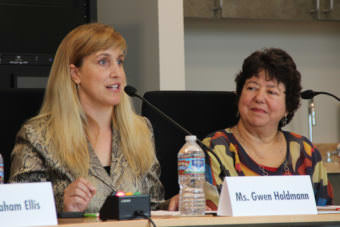
Gwen Holdmann of the Alaska Center for Energy and Power, left, and Meera Kohler of the Alaska Village Electric Cooperative, testified before U.S. Senators Lisa Murkowski and Maria Cantwell on June 10, 2017 in Cordova. (Photo by Rachel Waldholz/Alaska’s Energy Desk)

When it comes to emerging energy technologies, many remote Alaska communities are on the cutting edge. That was the message from Cordova this weekend, where U.S. Senator Lisa Murkowski held a field hearing of the Senate Energy and Natural Resources Committee, which she chairs.

The focus of the hearing was microgridsself-contained electrical grids, which can operate unconnected to any larger transmission system. They’re a necessity for just about every Alaska community off the road system. Most of the grids are powered by diesel, but more and more communities are trying to cut costs by adding renewables like wind or expanding hydropower.

In the process, the state has become a testing ground for technologies that are increasingly interesting to the rest of the world.
Abraham Ellis is with the Sandia National Labs in New Mexico.

“We are interested in those technologies to figure out ways to improve the energy resilience for cities,” he said. “For defense applications, and things like that, that really need to keep on going with electricity supply, even if the normal grid fails for whatever reason.”

Reasons like a major storm or cyber attack.

When Murkowski asked panelists to predict the future of energy in Alaska, she got a range of futuristic answers.

Cordova Mayor Clay Koplin predicted efficient smart grids, in which appliances can communicate with the larger grid about the best times to run.

“As I open my freezer and close it, and take salmon in and out of it, it can learn my habits with very inexpensive robust sensor technology, ” he said. “And if it’s talking to our electric system and knows when renewable energy is available, it can decide when it needs to cycle.”

Meera Kohler, of the Alaska Village Electric Cooperative, said micro nuclear reactors or nuclear batteries might eventually be part of the solution in rural Alaska. And Gwen Holdmann, of the Alaska Center for Energy and Power, said she sees major potential in hydrokinetic systems that can harness the power of rivers, waves and tides.

All of the panelists stressed the need for federal investment in local energy innovation, especially during the state’s current budget crunch.

The Trump administration has proposed major cuts to some renewable energy programs, but Murkowski said Congress has its own priorities.

“And I certainly know where my priorities are,” Murkowski said. “It’s trying to figure out how we here in Alaska can better access our energy resources in a way that allows for affordability, that allows for clean, diverse supplies, and that really helps build on some of the innovation that we’ve seen here in communities like Cordova and around the state.”

Murkowski was accompanied by Senator Maria Cantwell of Washington, the Committee’s ranking Democrat. Cantwell told panelists that when it comes to energy systems of the future, Alaska is “the tip of the spear.”

Muted reactions from Alaska officials to Trump decision on Paris Climate Agreement

President Trump’s decision to withdraw from the Paris climate accord drew muted reactions from Alaska officials on Thursday.

U.S. Sen. Lisa Murkowski told reporters she’s “agnostic” on the Paris accord itself. But, she said, she hopes the U.S. won’t “fall back” in its efforts to address climate change, adding that Alaskans are already seeing impacts.

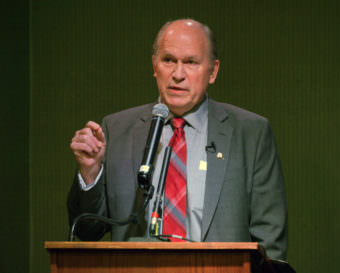
Gov. Bill Walker released a statement highlighting the effects of climate change across the state, but he stopped short of criticizing President Trump’s decision.

In his statement, Walker said shrinking sea ice and coastal erosion are causing “social and economic upheaval,” adding that the communities of Shishmaref, Kivalina and Newtok are “literally washing into the ocean.” And he noted that erosion and thawing permafrost will affect military installations across the state.

Alaska hasn’t seen any official statewide policy initiatives on climate change since an effort under former Governor Sarah Palin, nearly a decade ago. Democrats in the state House introduced a bill this spring to create a statewide climate change commission, but the bill never made it to a vote on the floor and faced opposition from Republicans in the state Senate.

The state was exempted from the Clean Power Plan, the Obama administration’s hallmark climate policy under the Paris agreement. But the Walker administration has indicated it hopes to advance some kind of state climate policy this year.


Tillerson gets earful on climate change from Arctic governments

United States Secretary of State Rex Tillerson chaired the 10th Ministerial Meeting of the Arctic Council in Fairbanks on May 11, 2017. (Photo by Arctic Council Secretariat Linnea Nordström)

Secretary of State Rex Tillerson got an earful from governments around the Arctic today — on the topic of climate change.

Tillerson was in Fairbanks to chair a meeting of the Arctic Council, which brings together nations and indigenous groups from around the region. The U.S. was formally handing over the rotating chairmanship to Finland.

The Arctic Council takes a keen interest in climate change, and it’s waiting to see how the Trump administration will handle the issue – and whether the U.S. will withdraw from the international Paris climate accord.

Tillerson tackled the issue head-on during his opening statement.

“We are appreciative that each of you has an important point of view,” he said. “And you should know that we are taking the time to understand your concerns. We’re not going to rush to make a decision, we’re going to work to make the right decision for the United States.”

The Trump administration has indicated it will decide whether to remain in the Paris agreement within weeks.

Many of Tillerson’s counterparts took the opportunity to press for action, including Swedish foreign minister Margot Elisabeth Wallström, who asked what the planet say if it had a seat at the table.

“Perhaps our planet would say, I’ve been your best friend since the industrial revolution,” Wallström said. “I’ve done everything I can to dampen and absorb. I’ve tried to keep Greenland and the permafrost in Siberia intact. And I have sent you no invoices. But it is about to change.”

That point was made over and over again. Each Arctic nation and indigenous group had three minutes to speak and hardly any let the chance pass without mentioning climate change.

The Gwich’in Council International declared, without coordinated action, “our culture cannot survive.” Finland, the incoming chair, called global warming “the main engine of change” in the region.

Michael Sfraga is with the Wilson Center in Washington, D.C. He says the emphasis was notable.

“It was not lost on anyone that the emphasis on climate change was there,” he said. “And of course messaging to the administration in this country, I believe, that the other seven have recognized the importance of the Paris agreement. And I don’t think they were shy about underscoring their commitment to recognizing and dealing with climate change.”

That message is also clear in the joint statement released by the Council after the meeting, called the Fairbanks Declaration.

The Declaration, approved by the entire Council, included strong language on the impacts of climate change in the Arctic – acknowledging the Paris climate agreement and calling for global action.

The Council also adopted the third binding agreement in its 20-year history — to improve scientific cooperation.

Site notifications
Update notification options
Subscribe to notifications