Rachel Waldholz, Alaska’s Energy Desk

Climate change hits Alaska’s rural water and sewer systems

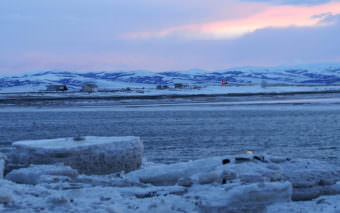
Open water, seen from the beach in Unalakleet in November 2015. (Photo by Zachariah Hughes/Alaska Public Media)

For decades, Alaska has struggled to get running water and sewer systems to its rural communities. An estimated 3,000 households — or about 10,000 people — still lack both. Now, that job may be getting harder, as climate change exacerbates old problems and creates new ones.

For years, the village of Unalakleet has piped in drinking water from a creek several miles away. The water main runs along the beach, buried underground.

Or, at least, it was buried. In the last several years, that beach has taken a beating. City council member Judie Kotongan remembers one storm in particular.

“The surf just was pounding — it moved Conexes,” Kotongan said, describing shipping containers sitting by the water. The storm tore away parts of the bank, exposing the water main.

Unalakleet has always had fall storms, but in recent years the village has lost its armor. Sea ice forms later, and storms have eaten away at the coast line.

Kotongan says residents worry one big storm could cut off their drinking water supply.

“It’s very urgent,” she said. “We’ve been struggling with water problems ever since that storm.”

It’s not just Unalakleet. Communities around the state are dealing with new threats to water and sewer systems from environmental changes linked to global warming.

Bill Griffith oversees the Village Safe Water program, among others, at the Alaska Department of Environmental Conservation.

“It does feel at times like you thought you had the water and sewer challenge already solved for some communities, and now you’re going back to the drawing board,” he said.

Griffith has been working on these issues in Alaska since 1993 and funds projects all over the state. He said there’s been a shift in the kinds of requests he receives.

Thawing permafrost is warping water and sewer lines. Along the coast and rivers, erosion is threatening the lakes that communities use for drinking water or the lagoons where they dump sewage. Streams and reservoirs that used to be reliable sources of water are now less reliable.

“It’s one of those things that you might have been looking at for a while but you just weren’t connecting the dots,” Griffith said.

But sometime over the last five or ten years, he realized that more of the issues coming across his desk were linked to warming temperatures. There’s no real way to quantify it: the state doesn’t track which maintenance problems are caused by environmental change (though Griffith hopes to start).

But Griffith said, from where he’s sitting, it’s pretty clear.

Perhaps the most dire example is the village of Newtok, in Western Alaska, which has been trying to relocate for more than a decade.

The village is losing about 70 feet of land each year to the Ninglick River. Erosion has wiped out the sewage lagoon, and residents are now forced to empty their honey buckets into the rivers.

Laura Eichelberger is a researcher and assistant professor at the University of Texas at San Antonio. She visited Newtok last summer to study the impacts of the community’s limited access to clean water.

Eichelberger described raw human waste and toilet paper floating in the same water where people keep their boats.

“I’m almost at a loss for words on how to describe that,” she said. “Because it shows you how few options people have when both of the rivers that they rely on for subsistence are also their sewage lagoon.”

Newtok’s drinking water source is also at risk. It sits about 60 feet from the river, and the village expects to lose it sometime this year.

Eichelberger said residents are doing a remarkable job managing under intolerable circumstances. But ultimately, something’s got to give.

“The environment is now changing faster than we can respond,” she said. “It’s not that we weren’t contending with melting permafrost, or problems with turbidity, or poor water quality, or damage to infrastructure, or flooding or erosion before. But the pace of that in particular areas is problematic.”

That rapid change is also hitting the North Slope Borough.

Last August, the village of Point Lay lost its fresh water source when its reservoir suddenly drained into the Kokolik River. Ice wedges in the permafrost separating the lake from the river had disintegrated.

“You have to say it’s climate change, global warming, whatever you want to call it,” said Kenneth Robbins, an adviser to the North Slope Borough mayor. “The permafrost is more active than it has been in the past.”

Robbins said permafrost temperatures are rising. The active layer, which thaws each year, is expanding. And sudden disasters are more likely — like Point Lay’s reservoir simply disappearing.

“Yes, it’s a natural lake. Yes, it’s near a natural river. They both change in shape, and historically did those things happen? Absolutely,” said Robbins. “But I think they’re happening more often now than they used to.”

Robbins said the borough has purchased a desalination unit in case Point Lay or another village has to rely on salt water. There’s an effort underway to drill groundwater wells. And the borough is now using different engineering techniques to install water and sewer lines into permafrost.

Whatever happens, Robbins said, he’s confident people on the North Slope will adjust.

“The culture and the people have lived here for thousands of years,” he said. “I think if they’ve proven anything, they adapt.”

Are you seeing climate change impacts on infrastructure in your community? We want to hear from you! Email akenergydesk@alaskapublic.org or connect with Alaska’s Energy Desk on Facebook.

Beyond believers and deniers: for Americans, climate change is complicated

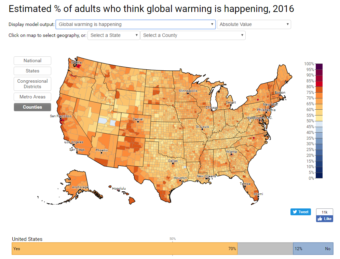
Researchers with the Yale Program on Climate Change Communication track how Americans think about global warming. You can find the full set of maps here.  (Image courtesy of the Yale Program on Climate Change Communication)

On Tuesday, President Donald Trump signed an executive order aimed at rolling back many of the Obama administration’s efforts to curb climate change. The order comes as surveys show Americans remain divided over global warming’s causes and consequences.

But those divisions often show up in unexpected ways, and researchers at Yale have landed on a particular way of describing our complicated, contradictory climate change opinions.
Anchorage resident Laura Oden is not pleased with the president’s order. She even looked up the White House telephone number to vent her frustration.

Does she believe global warming is happening?

“Absolutely,” she said.

And that it’s caused mostly by human activity?

“Yes! The answer is yes!” she said. “And we should stop doing this – we should stop – ” and she let out an exasperated shout.

Stop arguing over climate change, she meant.

That’s unlikely to happen any time soon. But Anthony Leiserowitz, of the Yale Program on Climate Change Communication, says the conversation Americans are having about global warming is a lot more interesting than the way it’s sometimes portrayed.

His program recently published updated surveys and maps in a decade-long project tracking how the country thinks about climate change.

And are Americans split? Sure, Leiserowitz said.

“But it’s also too simplistic to simply say, well, there are climate believers and climate deniers. That’s not accurate either,” he said.

Instead, his team argues you can group the American public into roughly six categories.

Call them climate change personality types. For instance, Laura Oden? She’s probably one of those who Leiserowitz calls the “alarmed.”

“They’re firmly convinced it’s happening, it’s human caused, it’s urgent, they strongly support policy action, they really want to know – what can I do to get involved?” he said, adding that people in this group make up about 18 percent of Americans.

On the other end of the spectrum? The “dismissive.”

“That’s nine percent of the country who are firmly convinced it’s not happening, it’s not human caused, it’s not a serious problem,” Leiserowitz said. “And many of whom flat out tell us that they think it’s a giant conspiracy.”

In between, there’s a whole range of opinions: the “concerned,” the “cautious,” the “disengaged” and the “doubtful.”

To find some real life examples, Alaska’s Energy Desk dropped by one place you’re sure to find Alaskans of all stripes – the Costco parking lot in East Anchorage.

Guy Hopson, 69, was waiting outside. Hopson is retired; he lives in Eagle River. And he might be what the Yale researchers call “cautious.”

“Do I believe in climate change? There’s definitely some temperature changes, yeah,” Hopson said. “But I don’t know that there’s anything we could do about it or should do about it.”

Hopson believes global warming is happening and said it’s already affecting people in Alaska. He used to work for the Army Corps of Engineers, and described the Corps’ efforts to deal with coastal erosion in the village of Shishmaref.

But Hopson said he has no idea whether global warming is caused by human activity.

That’s a pretty common take. The Yale researchers found that while 70 percent of Americans believe global warming is happening, only 53 percent believe it’s caused primarily by humans. Thirty-two percent said it’s caused by natural changes, while about 19 percent said they just don’t know.

Climate scientists overwhelmingly agree that global warming is happening, is serious and is driven by human activity; but in the survey, less than half of Americans (49 percent) knew that.

Bill, 20, is a student at the University of Alaska Anchorage (he didn’t want to give his last name). He said he knows most scientists believe climate change is happening. He just disagrees.

“I believe the earth was created, and weather happens how it’s supposed to happen,” he said.

That might put him in the category the Yale researchers call “doubtful:” people who don’t really think global warming is happening, but if it is, think humans likely can’t or shouldn’t do anything about it.

Christopher Hossain was shopping with his parents. He’s 15. And you could put him in the “concerned” category. He believes climate change is real – but is it going to affect him?

“Probably. But not, like, in ten years. Probably when I’m their age,” he said, gesturing to his parents, who stood laughing nearby.

In other words, not for awhile. Christopher has a lot of company in that opinion. Nationwide, 70 percent of people said global warming will harm future generations — but only 40 percent said they expect it to harm them personally.

And Alaskans were no more likely to say climate change will harm them, despite the fact that warming is happening here faster than anywhere else in the country.

Christopher’s dad, cab driver Mohammad Hossain, is less relaxed than his son about the potential consequences.

“I am a part of the world, so it will affect me, too,” he said. “The last two years, what was that? That was not real Alaska. There was no cold, no snow. You can see it! You don’t have to be a scientist.”

Feds worry oil pipeline near leaking Cook Inlet gas line also at risk

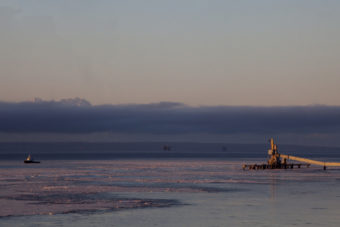
Cook Inlet oil platforms are visible from shore near Kenai, Alaska. (Photo by Rashah McChesney/Alaska’s Energy Desk)

Federal regulators are raising concerns about a second pipeline in Cook Inlet.

It’s been more than a month since the oil and gas company Hilcorp discovered a leak in a natural gas pipeline fueling one of its offshore drilling platforms. That line continues to leak methane into the Inlet near Nikiski. The company has said, due to hazardous ice conditions, repairs are unlikely to begin until later this month at the soonest.

Now, federal regulators are ordering the company to inspect a second pipeline, which runs parallel to the first — but carries crude oil instead of natural gas. Regulators say an oil leak could cause much more environmental damage than the current natural gas leak. Both pipelines run through key habitat for endangered beluga whales.
In a letter today, the federal Pipeline and Hazardous Materials Safety Administration said the same conditions which likely ruptured the first pipeline also threaten the second. Those include strong tides causing the pipeline to rub against the floor of the Inlet.

In a statement, Hilcorp said it will work with state and federal agencies to respond to their concerns. But for now, the company said, there’s no sign of damage to the oil line.

Climate bill faces tough sledding in Alaska legislature

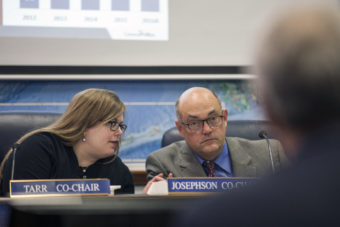
Rep. Geran Tarr and Rep. Andy Josephson, Anchorage Democrats and co-chairs of the House Resources committee, hear testimony from oil and gas industry representatives on Wednesday Feb. 1, 2017, in Juneau, Alaska. (Photo by Rashah McChesney/Alaska’s Energy Desk)

Two Anchorage Democrats have introduced a bill to create a statewide commission on climate change. But even its authors doubt the bill has much of a chance, at least this session. Still, they argue, it’s a step in the right direction.

Both Reps. Andy Josephson and Geran Tarr have introduced climate-related bills in the past, without much success. Then, this session, control of the state House flipped — and Josephson and Tarr went from legislative backbenchers to co-chairs of the powerful House Resources Committee, which sets the agenda on natural resource issues.

But that doesn’t mean climate policy will suddenly have an easy time time in the Alaska legislature.

Asked if he’s confident his bill could clear the House, Josephson paused for a long moment. “That’s a very good question,” he said finally.

And that’s in the chamber his caucus controls. Never mind the Republican-controlled Senate, where the relevant committee chair, Cathy Giessel of Anchorage, has said there’s no need for climate legislation.

The bill itself would create a climate change commission with a permanent presence in the governor’s office. It would essentially re-boot an effort launched under former Gov. Sarah Palin, which lapsed under her successor, Sean Parnell. The commission, made up of department heads and community representatives from around the state, would work with the governor to develop a statewide climate strategy, potentially covering anything from relocating villages to promoting renewable energy sources and reducing greenhouse gas emissions.

The commission’s work would be funded with a penny-per-barrel tax on oil, equal to a current tax that goes toward oil spill prevention and response efforts. Josephson estimates it will bring in about $1.7 million per year. That’s a drop in the bucket compared to the costs of relocating even a single community (the Army Corps of Engineers has estimated it will cost $80 to $130 million to fully relocate Newtok, for instance) — a point Josephson readily admits.

“It’s not enough,” he said. “What we had to look at is, what were sources of revenue, and what might be politically acceptable within the current make-up of the legislature?”

Instead, Josephson said he sees the funding as seed money: enough to get the office up and running so it can go after outside grants from federal or private sources for climate adaptation and mitigation.

One challenge for the legislation is timing. Lawmakers are currently consumed with the state’s budget crisis, leaving little room on the agenda for other issues. For now, both Josephson and co-sponsor Tarr said their goal is simply to get the bill moving. Tarr said that would give lawmakers time during the interim to seek feedback from communities around the state — and perhaps give the bill a better shot at passing next session.

“I’m doubtful that it would make it all the way through before the end of the session, given the big responsibilities we have with the fiscal plan,” Tarr said. “But I think we should start the conversation.”

State concerned about tanker escort design for Prince William Sound

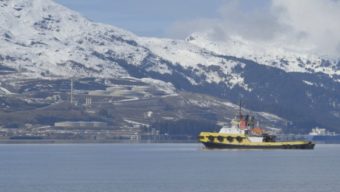
Crowley Marine Services currently holds the contract to provide oil tanker escorts and spill response and prevention in Prince William Sound. (Photo by Eric Keto/APRN)

State regulators are asking the operator of the trans-Alaska pipeline and oil shippers to offer more proof that new tugboats being built for Prince William Sound are up to the job of preventing major oil spills.

In late February, the Alaska Department of Environmental Conservation wrote that design information submitted so far is “unacceptable for the department’s decision making process,” adding that “the very limited data provided to date indicates that substantial vessel design deficiencies may exist, particularly in the area of winter operations.” (The letter was first reported by the Alaska Dispatch News.)
Pete LaPella is an environmental specialist with the department in Valdez.

“If we weren’t concerned, we wouldn’t be having this discussion,” he said.

The department oversees the oil spill prevention and response system set up after the 1989 Exxon Valdez disaster in Prince William Sound. Under that system, the Alyeska Pipeline Service Co., which operates the trans-Alaska pipeline, maintains a fleet of tugboats to escort oil tankers to and from the Valdez Marine Terminal, as well as barges that can respond in case of a spill. Last year, Alyeska announced plans to switch contractors for the first time, bringing in the Louisiana-based company Edison Chouest Offshore. As part of the contract, Edison Chouest is building new vessels to replace the current, older fleet.

But LaPella said the state hasn’t yet received information proving those new boats can operate in Alaska, especially in the winter. And, he said, it’s unclear what kind of testing has been done to confirm the vessels can handle Prince William Sound.

“It’s our job to trust but verify,” LaPella said. “And that’s what we’re trying to do, is work with industry to make sure that what they’re doing is going to be in the best interest of the state of Alaska.”

The state’s letter echoes concerns raised last month by the region’s official oil spill watchdog group, the Prince William Sound Regional Citizens’ Advisory Council.

Alyeska spokesperson Michelle Egan said the company is working with the state to supply the necessary information.

In testimony before the Alaska Legislature on Wednesday, Alyeska President Thomas Barrett expressed some frustration with regulators, saying the department hasn’t been clear about what it needs. But, he said, Alyeska and Edison Chouest are confident their plans will pass muster.

“We’re asking, quite frankly with DEC, we’ve said, give us the list of what you think you need to have, and when to have it, and we’ll get it to them,” Barrett said.

The companies plan to have the new vessels in place by July 2018.

Murkowski says Trump policies on Arctic, climate still unclear

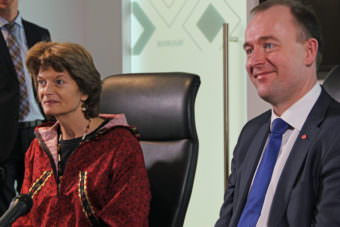
Alaska Sen. Lisa Murkowski, left, and Norwegian member of parliament Eirik Sivertsen took questions from reporters during a meeting of the Conference of Parliamentarians of the Arctic Region in Anchorage on Friday. (Photo by Rachel Waldholz/Alaska’s Energy Desk)

Alaska U.S. Sen. Lisa Murkowski says it’s still unclear what the Trump administration’s Arctic or climate policies will look like.

Murkowski met in Anchorage Friday, Feb. 24, with elected officials from around the Arctic. The meeting was a gathering of participants in the Conference of Parliamentarians of the Arctic Region.

At a news conference, Murkowski said she’s fielding questions from her counterparts about potential changes in U.S. policy.

“One of the questions that we heard today, and again there is no clear answer to it, was the status of the Paris climate talks and the U.S. role in that,” she said.

She’s referring to an international agreement to limit greenhouse gases.

Murkowski noted that while President Donald Trump criticized the agreement during the campaign, there has been no clear decision from the White House since he was sworn in.

That uncertainty extends to other areas of Arctic policy, from infrastructure to economic development.

“Just the place that we are at right now with a new administration standing up, there has not been a clear lay-down of a policy on all things Arctic,” Murkowski said.

Norwegian member of parliament Eirik Sivertsen, who joined Murkowski for the news conference, said he hopes the U.S. will continue to be a leader on climate change and Arctic policy.

“The most important thing we are hoping for is that the Arctic will still be high on the agenda, that the U.S. will engage in discussing challenges and looking for solutions for the challenges we are facing in the Arctic,” Sivertsen said.

Murkowski stressed that it’s still early days for the Trump administration, and said she will discuss Arctic policy when she sits down with new Secretary of State Rex Tillerson.

The Anchorage meeting included representatives from Canada, Russia, Norway, Denmark, Sweden, Finland and Iceland.

Site notifications
Update notification options
Subscribe to notifications