Rachel Waldholz, Alaska’s Energy Desk

A village on the edge looks to Congress for help

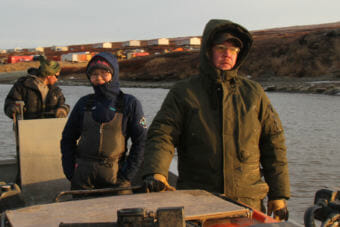
Residents of Newtok return from Mertarvik, seen in the background, the site the village hopes to move to. At right is tribal administrator Andrew John. (Photo by Rachel Waldholz/Alaska's Energy Desk)
Residents of Newtok return from Mertarvik, seen in the background, the site the village hopes to move to. At right is tribal administrator Andrew John. (Photo by Rachel Waldholz/Alaska’s Energy Desk)

The village of Newtok is disappearing, as it loses land to a combination of thawing permafrost and coastal erosion. Newtok’s 400 people have been trying to relocate for years, and for years the main obstacle has been the same: money. Now, they’re almost out of time. And residents and officials say, at this point, moving Newtok may take an act of Congress.

People say Newtok is dealing with “erosion.” But walk along the bank of the Ninglick River, and you realize that word doesn’t do it justice. “Erosion” sounds like something slow and steady, wearing away at the land. What’s happening here is crazier.

Andrew John is Newtok’s tribal administrator. First thing this morning, he says he came out here to the river with his measuring tape.

“I took some measurements and oh my goodness,” he says. “I don’t recognize any of this. In just five weeks!”

That’s because the land here is breaking off in giant chunks. The river is eating away at the permafrost beneath the tundra, undercutting the bank. During a big storm, whole blocks will break off, and the village can lose 10 or 20 feet at a time.

The nearest house is about 40 feet from where we’re standing right now. That means people are living just one or two big storms from the edge.

And that’s why pretty much everyone in Newtok agrees: it’s time to go.

The nearest homes are now just 40 feet from the edge of the Ninglick River. The village could lose that amount of land in just one or two storms. (Photo by Rachel Waldholz/Alaska's Energy Desk)
The nearest homes are now just 40 feet from the edge of the Ninglick River. The village could lose that amount of land in just one or two storms. (Photo by Rachel Waldholz/Alaska’s Energy Desk)

The village wants to relocate to a new site. It’s a twenty-minute boat ride upriver — or, on this frigid November day, a very bumpy half-hour ride into a brutal wind. That doesn’t bother John.

“We’re going to heaven!” he shouts over the sound of the engine. “That’s what it feels like when we’re there. It’s beautiful!”

Heaven is Mertarvik — the new Newtok. It sits across the Ninglick River, on Nelson Island, up on the side of a low mountain. In other words, it’s not about to erode away.

Newtok got this land in an exchange with the federal government in 2003. Since then, they’ve been trying to piece together enough funding to build homes and infrastructure. And over the years, they have managed to get some things built.

As we approach the new site we see what looks like a proto-village. From the water you can see a handful of houses along a makeshift road. There’s the foundation built for the Mertarvik Evacuation Center, which will someday, maybe, be the school. There’s a row of heavy equipment waiting for the next construction season.

As we walk up the hill, John lays out Newtok’s plans for this site: Roughly a hundred homes, gravel roads instead of the sinking boardwalks at the current location and running water, which the current village doesn’t have. That will be a luxury, John says.

“Something as simple as washing your face in the morning,” he says. “Warm water coming out of a faucet!”

But to see the site’s real point of pride, we load into a four-wheeler and head out to the rock quarry. It was just finished this summer. John can hardly restrain himself as we pull up. He stands up in the back of the four-wheeler to get a better view.

“I am so impressed! I am so impressed!” he says. “Because this time last year, all this was, was just a dream.”

Of the rock quarry, Andrew John, Newtok's tribal administrator says, "This time last year, all this was just a dream!" Pictured with his son, Jason, at right, and Dalen Ayuluk, center. (Photo by Rachel Waldholz/Alaska's Energy Desk)
Of the rock quarry, Andrew John, Newtok’s tribal administrator says, “This time last year, all this was just a dream!” Pictured with his son, Jason, at right, and Dalen Ayuluk, center. (Photo by Rachel Waldholz/Alaska’s Energy Desk)

It’s just a pit, gouged out of the hillside. But this is the whole reason for moving to Mertarvik: it’s built on rock, not spongy tundra. The river won’t destroy it. And this quarry can provide the gravel for construction.

From here, you can see for miles. John explains why this view matters.

“It’s a part of who we are,” he says. “This is our land. Upriver from the current village of Newtok are my ancestral roots. Sod houses built by my grandmother’s grandfather, and his father and their fathers before them.”

Newtok is a pretty traditional Yup’ik village — one that relies on hunting and fishing. If the village can relocate to this site, close enough to the old one, they can continue that way of life.

The problem is, it’s not clear this new village will be ready before the old village is destroyed. And that’s just a few years away.

Romy Cadiente is Newtok’s relocation coordinator.

“We don’t have time,” he says.

So far, the village has managed to piece together funding for a handful of houses and a rock quarry at the new site. (Photo by Rachel Waldholz/Alaska's Energy Desk)
So far, the village has managed to piece together funding for a handful of houses and a rock quarry at the new site. (Photo by Rachel Waldholz/Alaska’s Energy Desk)

The construction at the new site has been pieced together bit by bit over the last decade. But Newtok doesn’t have anywhere near enough money to build everything they need: housing, an airstrip, a school, a power plant. The U.S. Army Corps of Engineers has estimated that price tag at $130 million dollars.

In a village where more than 40 percent of the community lives below the poverty line, that money will have to come from outside.

But state and federal agencies have turned down Newtok’s requests for disaster relief and other grants.

If it’s not possible to relocate together, families could simply scatter, to Bethel or Anchorage. Cadiente says, that’s unacceptable.

“We will do whatever we have to, as fast as we have to,” he says. “We will live in yurts, do anything, but we will not [separate]. Because essentially what you’re really talking about is the preservation of the Yup’ik community, its traditional values, its identity.”

Joel Neimeyer heads the Denali Commission, the federal agency most closely involved in Newtok’s relocation efforts. He says this problem is bigger than Newtok.

“We have these examples all across the country where you’re having extreme weather events,” Neimeyer says. “And as a country we haven’t yet resolved the question of how we want to respond to these.”

As the Ninglick River melts the permafrost layer, it undercuts the bank, causing blocks of land to break off during storms. The village of Newtok can lose 10 or 20 feet of land at a time. (Photo by Rachel Waldholz/Alaska's Energy Desk)
As the Ninglick River melts the permafrost layer, it undercuts the bank, causing blocks of land to break off during storms. The village of Newtok can lose 10 or 20 feet of land at a time. (Photo by Rachel Waldholz/Alaska’s Energy Desk)

He says Congress never envisioned relocating whole communities. There’s no agency in charge of it. There’s no pot of money to fund it. And yet, as climate change hits coastal communities around the country with flooding and erosion, it’s a problem we will likely see more and more.

Neimeyer believes Congress needs to make a decision: In these situations, is it U.S. policy to move whole communities? Or just move families? Or do nothing?

“Obviously moving a village is more expensive than moving families,” he says. “But when you move families, you are dispersing a community, you’re dispersing a tribe, you’re dispersing a culture. And you’ll lose that. So that is a very real policy decision Congress needs to grapple with.”

Returning from Mertarvik, the boat pulls up to Newtok’s deteriorating shoreline. From the water, the scene takes your breath away. It’s dusk, and lights are coming on in the houses near the shore. Just steps from those homes, the land is literally crumbling away, the black earth sloughing off into the water. The waves roll over three old snowmachines and the remains of a road, casualties of this fall’s storms.

By this time next year, the water will reach those homes.

Andrew John says he doesn’t understand why this isn’t enough to deserve help.

“We’re Americans, too. And I, as a veteran have fought in the forces to safeguard our country and our way of life,” he says, choking up. “And now I’m home, fighting for my people and our way of life.”

It’s a fight that may ultimately be won or lost nearly 4,000 miles from here, in the halls of Congress.

This story is the second of two parts. The first part looks at what what would be lost if Newtok disappears.

Major climate report warns of rapid change, potential tipping points

Mendenhall Glacier, in Juneau, is retreating. The report says it’s “very likely” that human activities have contributed to sea ice loss, glacier mass loss and the decline of snow extent in the Northern Hemisphere. (Photo by Lisa Phu/KTOO)

Climate change is happening, we’re the cause, and Alaska will feel it first.

Those are some of the conclusions of a sweeping report out Friday from 13 federal agencies and outside climate scientists.

The report was released by the Trump administration, even though it contradicts the position of President Trump and many of his top officials.

Katharine Hayhoe is a climate scientist at Texas Tech University, and a lead author on the report. She said the bottom line is pretty simple.

“This report is a huge, 600-plus page document that can be summarized in just one sentence,” Hayhoe said. “Climate is changing, humans are responsible, the risks are real, and the window of time to fix this thing is narrowing fast.”
The Climate Science Special Report, as it’s called, is part of the Fourth National Climate Assessment, a study looking at impacts across the U.S. and required by law every four years.

Hayhoe said the report confirms, once again, that burning fossil fuels produces carbon dioxide and other emissions that are warming the planet. The report says we are now living through the warmest period “in the history of modern civilization.” And it says it’s “extremely likely” that human activities are the “dominant cause” of that warming – adding “there is no convincing alternative explanation.”

Hayhoe said, if anything, the report suggests things are worse than expected.

“Much of the new science that we’ve seen coming out in the last few years, is suggesting that things are changing faster and to a greater extent than we thought,” she said, pointing to evidence that the ice sheets in Greenland and Antarctica are melting, and sea levels rising, faster than expected.

Hayhoe said one thing in particular keeps her and other scientists up at night: the question of tipping points. They worry that if we cross certain thresholds, it could create viscous cycles, driving more warming and pushing the climate into totally unpredictable territory.

“With these tipping points, we can’t put a number on them, just like you can’t put a specific number on how many cigarettes you can smoke before you develop lung problems,” Hayhoe said. “But what we can say absolutely is, the further and faster we push the earth’s climate away from its natural state, the greater the risk that we will hit one or more of these tipping points.”

The report includes a full chapter on Alaska and the Arctic. It confirms that scientists are confident the region has warmed more than twice as fast as the rest of the planet, and that climate change is melting glaciers, accelerating the loss of sea ice, and thawing permafrost.

The report also suggests that changes in the Arctic could affect weather around the globe. But scientists don’t yet understand those dynamics well enough to make predictions.

Hayhoe said the good news is that there are solutions out there, like the faster-than-expected adoption of renewable energy.

“Things are happening all around the world, we’re moving in the right direction,” she said. “But as a climate scientist, I know that we have to not just keep on moving in that direction, we have to do more and faster to avoid the really serious and even dangerous impacts.”

Ocean acidification threatens Bering Sea crabs. But can they adapt?

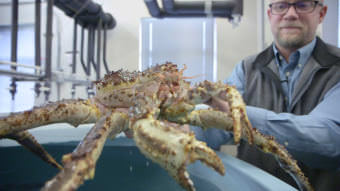
An adult male red king crab in Bob Foy's Kodiak laboratory. (Photo by Eric Keto / Alaska's Energy Desk)
An adult male red king crab in Bob Foy’s Kodiak laboratory. (Photo by Eric Keto / Alaska’s Energy Desk)

Ocean acidification could threaten some of Alaska’s most important fisheries. Researchers warn that populations of red king crab in the Bering Sea – made famous by the show The Deadliest Catch – could collapse by the end of the century.

But it’s possible the crabs might be able to evolve and adapt to the changing oceans. The big question is – will they have enough time?

Robert Foy directs the Alaska Fisheries Science Center's Kodiak Laboratory. (Photo by Eric Keto / Alaska's Energy Desk)
Robert Foy directs the Alaska Fisheries Science Center’s Kodiak Laboratory. (Photo by Eric Keto / Alaska’s Energy Desk)

Biologist Robert Foy reaches into a tank in his Kodiak lab, as about twenty red king crabs move around on the bottom. They are giant. They are spiny. They are… kind of terrifying. But not to Foy. He scoops one out by the back leg.

“As long as you stay away from the first two, the pincers, you’re just fine,” he says.

Foy directs the Alaska Fisheries Science Center’s Kodiak Laboratory. His seawater lab is wall-to-wall crabs, in tanks and re-purposed containers: baby tanner crabs no bigger than a quarter and adult king crabs the size of my torso; crabs in tupperware, crabs in laundry baskets, crabs stacked in what Foy calls the “crab condominium.” A tangle of pipes and wires feed seawater into the different tanks, each one carefully calibrated by temperature and pH.

This lab offers a peek into the future. The tanks represent the oceans around Alaska decades from now. And Foy says that future is alarming.

“The expectation in change in pH over the next five decades in Alaska is fairly dramatic,” he says.

The change in pH is a measure of how acidic the ocean is becoming. In simple terms, the more carbon dioxide is dissolved in the water, the more acidic it becomes.

Ocean acidification is the less-well-understood fellow-traveler to climate change, the other impact of pumping CO2 into the atmosphere. And like climate change, it’s expected to happen faster at high latitudes — like the waters around Alaska — than in the rest of the world.

Eggs in a female red king crab. The laboratory studies the impacts of ocean acidification on crabs from the earliest life stages. (Photo by Eric Keto / Alaska's Energy Desk)
Eggs in a female red king crab. The laboratory studies the impacts of ocean acidification on crabs from the earliest life stages. (Photo by Eric Keto / Alaska’s Energy Desk)

Foy began this work about a decade ago, and his lab has been able to run long-term experiments, over years. It’s some of the first concrete evidence we have of what ocean acidification might mean for marine species.

And his first results are discouraging – at least for red king crabs. Under conditions similar to what researchers are eventually predicting for Alaska, pretty much all the young red king crabs died.

“If the results in the laboratory are accurate, and there’s no acclimation, you would see stock failure about 100 years from now,” Foy says.

That’s in part because it’s harder for many crabs to make and maintain shells in more acidic water: the chemistry isn’t right. But Foy’s team found that a bigger problem may be the sheer energy required for crabs to keep their internal pH right, when the external pH is wrong.

In very acidic water, most red king crabs didn’t make it past their early life stages.

But some did. And that’s giving researchers like Foy hope. Because if the survivors have some trait, something in their genetic make-up that helps them cope with more acidic waters, it’s possible they could pass that on to their offspring and the species could evolve.

But with oceans changing so fast – is there time for that?

“That’s the question,” Foy says. “Even if they could acclimate in a short period of time, or even adapt over a longer period of time, what kind of abilities will they have to do that physiologically if it happens over the scale of 50 years? That’s only a handful of generations for a crab species.”

Crabs are housed in tanks with varying pH and temperature, to mimic the conditions researchers predict will prevail in Alaska waters decades from now. (Photo by Eric Keto / Alaska's Energy Desk)
Crabs are housed in tanks with varying pH and temperature, to mimic the conditions researchers predict will prevail in Alaska waters decades from now. (Photo by Eric Keto / Alaska’s Energy Desk)

This question is something crab fishermen are very aware of.

Edward Poulsen is a partner on two Bering Sea crab vessels. He grew up in the industry; he says his dad was one of its pioneers.

“It’s one of those things where you don’t want to think about it too much,” Poulsen says. “Because if you think about it too much, it’s pretty depressing.”

Poulsen knows the science. So do his fellow vessel-owners. He says everyone is concerned. But the potential problems are far enough in the future, and it’s not clear there’s anything fishermen can do about it.

“A lot of us, this is all we know, this is what we do,” Poulsen says. “And now the government’s telling us, ‘Your future might be at risk.’ I think it’s a little bit like you want to put your head in the sand and ignore what could be coming down the path.”

Poulsen says fishermen basically have two choices: they can try to diversify their business, and branch out into other fisheries.

Or they can hope the crabs adapt.

Gov. Walker announces new climate change task force

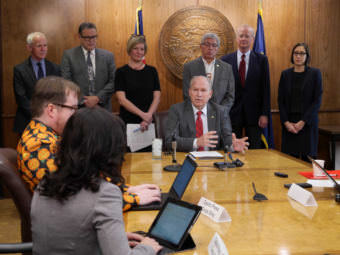
Alaska Gov. Bill Walker fields questions from the Capitol press corps after signing Administrative Order 289 on Oct. 31, 2017. The order establishes the Alaska Climate Change Strategy and Climate Action for Alaska Leadership Team. (Photo by Skip Gray/360 North)

After months of hinting that a new climate change policy was in the works, Gov. Bill Walker on Tuesday signed an administrative order setting out a state climate strategy and creating a task force to recommend specific actions.

The 15-person “Climate Action for Alaska Leadership Team” will be chaired by Lt. Gov. Byron Mallott, and will propose a climate change action plan. Those recommendations are due by September 2018.
But whatever the team ultimately proposes, Walker made clear one thing is not in the cards: cutting back on oil exploration.

As a state “on the front lines of climate change” that’s also dependent on oil development, Walker said, Alaska has to strike a balance.

“We will continue to responsibly develop our resources, our nonrenewable resources, and use that as the bridge funding to do what we need to do,” Walker said, pointing to the cost of relocating coastal villages or investing in renewable energy. “They’re not incompatible in any way. In fact one is necessary for the other.”

Mallott went further in his remarks, suggesting it’s time for the state to start looking beyond oil.

“A significant aspect of Alaska’s involvement…will necessarily revolve around a transition from a petroleum-based economy to a renewable energy economy,” Mallott said. “That will be a critical and necessary focus going forward.”

The “Leadership Team” will be made up of 15 members of the public, representing a cross-section of Alaskan interests. They will be tasked with making recommendations in four main areas: reducing greenhouse gas emissions, adapting to climate impacts, research and education, and responding to near-term threats. Their final recommendations could include regulatory changes or legislation.

The order also directs state agencies to identify actions they can take more immediately.

Polly Carr heads up the Alaska Center in Anchorage. She said she’s pleased the Walker administration is acknowledging the need to respond to climate change.

But, she said,  “What Alaskans do not need, and what Alaskans have said that they don’t want more of, is more talk.”

Carr pointed out that Alaska has done this before. Almost exactly ten years ago, former Gov. Sarah Palin issued her own administrative order, establishing a climate strategy and creating a task force: the climate change sub-cabinet.

That group worked for more than two years and came up with a slew of recommendations, many of which have yet to be adopted.

Carr said it’s important that this time around, the recommendations are followed by action.

“The more quickly that this announcement can move to action and policy, the better off all of us are going to be,” she said.

Kara Moriarty, of the Alaska Oil and Gas Association, greeted the initiative cautiously.

“I think there’s a lot of folks who think we’re going to be the enemy here, and we don’t see our role as that at all,” she said. “We’re certainly not going to shy away from the conversation.”

Moriarty said her members are ready to work with the administration on climate issues. But, she said, when Alaska represents just a fraction of global carbon emissions, it’s important to weigh emissions cuts against the impact to the economy.

“You could turn off every oil spigot, every natural gas pump, turn off every light, shut down every car and I’m not sure it’s going to even make a dent in the overall global emissions picture,” Moriarty said.

While her members would oppose any efforts to discourage oil development, she said, when it comes to adaptation or research, industry believes it has a role to play.

Young Alaskans sue the state, demanding action on climate change

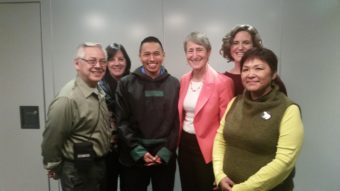
Esau Sinnok, of Shishmaref, is one of 16 young Alaskans suing the state. He’s shown here in 2015, with Interior Secretary Sally Jewell and others at the COP21 climate meeting in Paris. (Photo courtesy Arctic Youth Ambassadors)

Sixteen young Alaskans are suing the state, demanding Gov. Bill Walker’s administration take action on climate change.

It’s the second such legal action in the last six years. In 2014, the Alaska Supreme Court dismissed a similar lawsuit, Kanuk v Alaska, from six young people asking the state to reduce carbon emissions, among other recommendations. The justices ruled then that it’s not for the courts to set climate policy and that those decisions must be made through the political process, by the Legislature and the governor.

The new lawsuit says, essentially, the state has made its choice, and by encouraging oil development and permitting projects that emit greenhouse gases, Alaska is actively making climate change worse. The plaintiffs argue that violates their constitutional rights to, among other things, “a stable climate system that sustains human life and liberty.”

The suit argues it’s time for the courts to intervene.

Andrew Welle is one of the lawyers representing the young plaintiffs. He said they want the state to produce a plan to reduce carbon emissions, including from the state’s major industries.

“There needs to be a way for Alaska to address the emergency that’s being compounded by its government,” Welle said. “If that results in reductions of oil and gas extraction, that could be a component of the plan.”

Welle works for Our Children’s Trust, an Oregon-based nonprofit that has filed similar lawsuits on behalf of young plaintiffs in states around the country and in federal court. Our Children’s Trust also backed the previous suit in Alaska.

The complaint, Sinnok et al v State of Alaska, is named for lead plaintiff Esau Sinnok, 19, who is from the community of Shishmaref on the Chukchi Sea coast. Shishmaref has voted to relocate because of rapid erosion due in part to the loss of sea ice. The lawsuit argues that climate change threatens “the very existence” of Sinnok’s “home village and native culture.”

Seb Kurland, a high school senior in Juneau, is another plaintiff. Kurland, 18, said young Alaskans have a particular stake in how the state handles climate change.

“I think a lot of young people in Alaska are very aware of this issue,” Kurland said. “We’re on the forefront of it, we see the impacts firsthand, we see how they alter the world around us.”

Kurland was one of 19 teenagers with the advocacy group Alaska Youth for Environmental Action who filed a petition with the Department of Environmental Conservation earlier this fall, asking the state to reduce greenhouse gas emissions. The state denied that petition, arguing the request posed “significant consequences for employment and resource development”.

But the Walker administration has promised that some sort of climate plan is in the works.

It’s not clear yet what that plan will include, or when it will be released.

Murkowski’s message at AFN? “Climate change is real.”

Sen. Lisa Murkoski addresses the Alaska Federation of Natives on Oct. 21, 2017. (Photo by Zachariah Hughes / Alaska Public Media)

On stage at the Alaska Federation of Natives convention Saturday, Sen. Lisa Murkowski did not mince words.

“Climate change is real,” she told the audience firmly. “Climate change is real.”

Murkowski wasn’t the only one delivering that message. Climate change was very much on the agenda this year, as delegates passed a resolution asking the federal government to make climate impacts in rural villages eligible for disaster relief.

Murkowski opened her speech Saturday with a discussion of healthcare, but quickly pivoted.

“While healthcare has been the issue that has been dominating our days, it isn’t the issue that is defining our time,” she said. “Our world is changing. The world around us is changing: socially, economically, and ecologically. And we all know that climate change is at the heart of this change.”

Murkoswki said effects are being felt across the state: “Newtok, Kivalina, Shishmaref: these are the names that seem to most make the news,” she said. “But it’s also our Interior communities as well. Almost every village faces similar impact. ”

And, she said, it’s time to take action. As for what that action might look like, Murkowski focused on alternative energy systems being pioneered in remote communities around the state, saying Alaska can lead the way on energy innovation.

“Confronting climate change and adapting to it will take leadership, it will take partnership and attention to social justice if we are to find the strength to tackle the issue together,” she said.

Her focus on climate change puts Murkowski at odds with the Trump administration and many in her own party, including the rest of the Alaska delegation. But she remains one of the oil industry’s strongest supporters in Congress. Just last week, she advanced a resolution that could be the first step in opening the Arctic National Wildlife Refuge to drilling — a victory she did not mention from the AFN stage.

AFN also gave prominent billing Friday to one of the villages most affected by climate change. Newtok Village Council president Paul Charles told the gathering that his community is being destroyed by rapid erosion and thawing permafrost.

“However you want to call it, it is real,” Charles said. “And my village is in trouble. So what’s next? We need funding. Not only for Newtok, but other communities that are going through the same thing.”

On Saturday, AFN delegates passed a resolution introduced by the village of Newtok, calling on the federal government to expand the definition of a major disaster to include the “slow-moving” impacts of climate change, like thawing permafrost.

The Obama administration denied federal disaster requests earlier this year from both Newtok and Kivalina, saying they did not meet the requirements of the Stafford Act, the major law governing disaster assistance in the U.S. That means Alaska villages facing climate-related erosion aren’t eligible for the kind of disaster relief currently going to Houston, Florida and Puerto Rico in the aftermath of major hurricanes.

Former ambassador Mark Brzezinski said the Obama administration was considering changing that definition during its last weeks in office, but ran out of time. Brzezinski led the White House Arctic Executive Steering Committee under Obama. He spoke on a panel at AFN Friday. In an interview afterwards, he called on the Trump administration or Congress to finish that work.

“It would be a great act of leadership on the part of our federal government to take a specific look at changing the definition of what is a disaster to help those towns and cities, as part of a reconciliation between Washington and the federal government and the Alaska Native community,” Brzezinski said.

For her part, Murkowski didn’t directly address the issue of disaster relief for villages. But she said the impacts of climate change will be felt disproportionately in rural Alaska: “Our challenge is to improve the resilience of our communities now, not wait for the disasters to come,” Murkowski said.

At AFN, at least, many would argue the disasters are already here.

Site notifications
Update notification options
Subscribe to notifications