Rachel Waldholz, Alaska’s Energy Desk

State report details potential health impacts of climate change

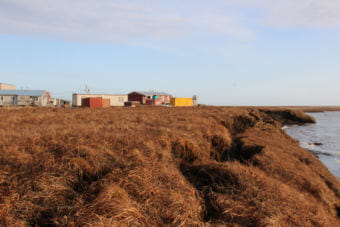
The nearest homes are now just 40 feet from the edge of the Ninglick River. The village could lose that amount of land in just one or two storms. (Photo by Rachel Waldholz/Alaska's Energy Desk)
The village of Newtok can lose ten or twenty feet at a time to erosion. It had to switch drinking water sources, as the river threatens to drain the existing source. (Photo by Rachel Waldholz/Alaska’s Energy Desk)

How will climate change affect health in Alaska? Dangerous travel conditions could cause more accidents, warmer temperatures could spread new diseases and the topsy-turvy weather could worsen mental health.

Those are some conclusions from a new state report, released Monday.

The report, from the Alaska Division of Public Health, tries to predict the health impacts if current climate change forecasts hold true. (It’s based on the predictions for Alaska in the 2014 National Climate Assessment.)

Sarah Yoder is the lead author. She said she was a little taken aback by what they found.

“The surprise was just how broad, exactly, all these potential health impacts are,” Yoder said.

Those impacts range from infrastructure damage to the spread of new diseases. The report notes that thawing permafrost can disrupt water and sewer lines, undermine health clinics, and damage roads, making access to healthcare and basic sanitation more difficult. Extreme weather events could increase floods, mudslides, and avalanches. Thinner sea and river ice can make travel and subsistence hunting more dangerous. More wildfires can worsen air quality. Warmer temperatures could allow the spread of insects carrying Lyme disease or the West Nile Virus.

These are all predictions for the future. But state epidemiologist Joe McLaughlin said the future may already be here.

“We may in fact be already seeing some impacts of climate change here in Alaska, but the challenge is that many of these potential impacts have not been well-studied and definitively linked to climate change,” McLaughlin said.

Then there are the impacts on mental health, including “solastalgia.”

If that word doesn’t ring a bell, you’re not alone. McLaughlin hadn’t heard the term before the research for this report. But he said, when he did stumble across it, he found it kind of perfect.

“When I describe to people in my community, people that I know, I help them put a word to what they’re feeling,” McLaughlin said. “They say, ‘Ah yeah, that’s it, that’s what I feel.'”

The report describes solastalgia as the “sense of loss” people experience because of “unwanted environmental changes” to their homes – disorienting shifts that can lead to anxiety and depression.

“Just talk to some of your friends and neighbors here in Anchorage,” McLaughlin said. “Just ask them, how do they feel about the last several winters?”

That’s solastalgia. On the more severe end, it can define the stress for an entire community facing relocation.

Ultimately, McLaughlin said, climate change is a different kind of public health challenge than something like a mumps outbreak.

“This is going to be a marathon,” he said. “Not a sprint.”

McLaughlin said the impacts of climate change will unfold over decades – but the time to start planning is now.

It’s not just the Arctic. Trump’s offshore drilling plans rattle coastal communities across Alaska.

Shell Polar Pioneer
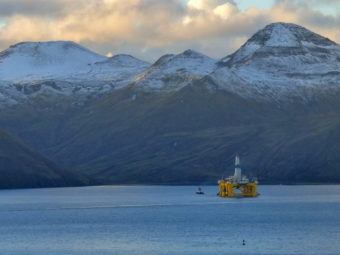
Shell’s Polar Pioneer leaving Dutch Harbor on Oct. 12, 2015, heading for Washington state. (Photo by John Ryan/KUCB)

For years, the debate over offshore drilling in Alaska has focused on the Arctic. But this week, the Trump administration proposed opening almost all Alaska waters to oil and gas leasing, from Southeast to the Bering Strait to the Canadian border.

That includes areas that have never seen drilling, and it’s raising concerns in Alaska’s coastal communities.
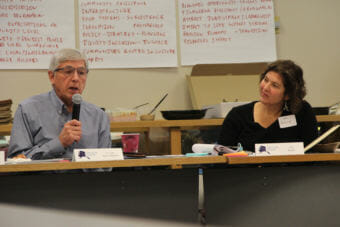
Linda Behnken heads up the Alaska Longline Fishermen’s Association in Sitka. Asked for her reaction when she first heard the Trump administration’s proposal, Behnken took a deep breath.

“I probably better not say that on tape,” she said.

And that pretty much sums up the response in many of Alaska’s coastal communities, where residents worry that oil and gas development could threaten commercial fisheries and subsistence resources.

Behnken said she’s concerned that an oil spill anywhere in the Gulf of Alaska or Bering Sea could affect fish stocks all over the state.

“It’s really deeply disturbing to see a willingness to place at risk…the renewable resources that are the cornerstone of the economy and people’s way of life,” she said.

That’s a feeling echoed by Mark Vinsel, who runs the United Fishermen of Alaska, representing the state’s commercial fisheries. Vinsel said he’s glad the Trump administration excluded the North Aleutian Basin planning area, which borders Bristol Bay.

But, he said, fishermen haven’t forgotten the 1989 Exxon Valdez oil spill. He said one major lesson from the spill was the need for robust community oversight, and if more waters are opened up to oil and gas development, UFA would want local input modeled after the citizens’ advisory councils in Prince William Sound and Cook Inlet.

Ultimately, Vinsel said, the message is pretty simple: “You need to be careful up here, whatever you’re doing.”

“This is really, really dangerous waters,” he said. “Fishermen know that.”

In Unalaska, Mayor Frank Kelty was taken by surprise when he heard the Trump administration wants to open waters surrounding the Aleutians and Pribilofs to oil exploration.

Kelty said he’s not opposed to oil and gas development, but any oil and gas drilling would have to be done right – and it shouldn’t risk Unalaska’s main commodity: fish.

“We’re a community of 5,000 people that are all totally dependent on the seafood industry,” Kelty said. “I think there’s going to be a lot of push-back, from not just the enviro community but from coastal communities such as mine and other fishery-dependent communities across the country.”

Kelty noted that the Trump administration is also proposing to open waters up and down the East and West Coasts, from Maine to Florida and Washington to California.

The proposal also came as a surprise in Nome. Austin Ahmasuk is a marine advocate with Kawerak, which represents tribes across the Bering Strait region.

He said local communities have made it very clear where they stand: they’ve opposed oil and gas development in their waters for decades.

“They’re areas where our people have hunted and commercially fished for quite a long time,” Ahmasuk said. “It’s where we make our living. So we’re quite concerned about the aggressive nature of this draft proposed program.”

The Trump administration has stressed that this proposal is just a draft. The Interior Department can remove areas from the final plan, depending on feedback from communities.

The proposal will be open for public comment starting Monday, Jan. 8. The comment period will last for the next two months.

Climate task force begins work — and push-back begins, too

Lt. Gov. Byron Mallott chaired the inaugural meeting of Gov. Bill Walker's climate change task force on Monday, Dec. 18, 2017. Lisa Busch of the Sitka Sound Science Center is one of 20 people chosen for the commission. (Photo by Rachel Waldholz/Alaska's Energy Desk)
Lt. Gov. Byron Mallott chaired the inaugural meeting of Gov. Bill Walker’s climate change task force on Monday, Dec. 18, 2017. Lisa Busch of the Sitka Sound Science Center is one of 20 people chosen for the commission. (Photo by Rachel Waldholz/Alaska’s Energy Desk)

Gov. Bill Walker’s climate task force met for the first time Monday in downtown Anchorage.

The 20-person team, formed by the governor this fall, is supposed to come up with a list of recommendations for how the state should respond to climate change.

But the team is facing questions before it even begins work.
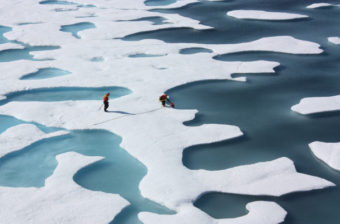
During the day-long meeting, team members expressed a combination of fear and hope: Fear at how fast the natural world is changing, but hope that climate change might turn out to be as much an opportunity as it is a risk.

Isaac Vanderburg, who runs the Anchorage business accelerator Launch Alaska, put it most succinctly.

“Climate change is the one thing that keeps me up at night,” Vanderburg said. But, he added, if Alaska can seize the moment, “this is the greatest wealth-creation opportunity the planet has ever seen. I think in Alaska there’s an enormous opportunity here.”

Ralph Andersen, head of the Bristol Bay Native Association, said the issue that’s gotten his attention is erosion.

“We’re seeing way too many of our villages wash into the sea,” Andersen said. “We’re losing schools, power plants. Basic village infrastructure is either being lost or threatened.”

Former state lawmaker and Northwest Arctic Borough Mayor Reggie Joule encouraged the group to be realistic in its recommendations. He said promises have been made to Alaska communities in the past, especially on issues like village relocation.

This time, Joule said, he’d like a frank discussion of what actions can really be taken, and, most crucially, who will pay for them.

“Or whether or not they can be paid for,” Joule said. “At any level. I’ve seen communities that have been hanging out there, thinking that somebody’s going to pay for their move. Are we really?”

Several team members have been here before — ten years ago, when then-Gov. Sarah Palin created a similar climate change task force.

Molly McCammon, of the Alaska Ocean Observing System, was a part of that effort. She said the last decade has only made things more urgent.

“The difference now is the rapidity of the change,” McCammon said. “I think ten years ago, we thought there was going to be more time to prepare and respond to things. Now, we are really facing some really immediate changes, and it’s just happening so much faster. We need to be able to act faster.”

One big question is whether the team will be able to build support for whatever recommendations they come up with — not least from state lawmakers.

In an indication of how hard that might be, Nikiski Republican Rep. Mike Chenault issued a blistering press release Tuesday complaining that the task force doesn’t include enough representation from business leaders and the resource industries. He said that leaves the team with an “obvious left-leaning foundation.”

The task force includes just one representative from the oil and gas industry — BP Alaska President Janet Weiss — and none from mining or timber.

It does include two representatives from commercial fishing, along with current and former local and tribal officials; representatives from the University of Alaska and other research organizations; several members with experience in renewable energy; and one from an environmental group.

Lt. Gov. Byron Mallott, who is chairing the task force, defended its make-up. He noted that the Walker administration has also taken heat from environmentalists for not moving fast enoughand said the task force would engage the oil industry in “virtually every aspect of our work.”

“The broadest range of voices, of Alaskans being involved and heard is, we believe, crucial to this effort,” Mallott said.

Team members will split into working groups to come up with potential recommendations in four areas: reducing greenhouse gas emissions, adapting to environmental changes, research and immediate actions.

The task force will meet in person just one more time before it must deliver formal proposals to the governor in September 2018.

Scientists warn Arctic “refrigerator” is failing, with global consequences

On July 12, 2011, crew from the U.S. Coast Guard Cutter Healy retrieved a canister dropped by parachute from a C-130, which brought supplies for some mid-mission fixes. The ICESCAPE mission, or "Impacts of Climate on Ecosystems and Chemistry of the Arctic Pacific Environment," is a NASA shipborne investigation to study how changing conditions in the Arctic affect the ocean's chemistry and ecosystems. The bulk of the research took place in the Beaufort and Chukchi seas in summer 2010 and 2011. (photo by Kathryn Hansen/NASA)
On July 12, 2011, crew from the U.S. Coast Guard Cutter Healy retrieved a canister dropped by parachute from a C-130 during the ICESCAPE mission, or “Impacts of Climate on Ecosystems and
Chemistry of the Arctic Pacific Environment.” (photo by Kathryn Hansen/NASA)

Still melting, and melting fast: that’s the basic take-away from the federal government’s annual Arctic Report Card, released Tuesday.

The report, from the National Oceanic and Atmospheric Administration (NOAA), finds that Arctic ocean temperatures are increasing and sea ice is declining at the fastest rate in at least 1,500 years.

The report’s subtitle says it all: “Arctic shows no sign of returning to reliably frozen region of recent past decades.”

Instead, everything is warming: ocean temperatures, air temperatures, permafrost temperatures. Sea ice is shrinking, the tundra is greening, and it’s all happening at a stunning pace. So fast, in fact, that researchers presenting the report kept returning to one word: “unprecedented.”

Jeremy Mathis, with NOAA’s Arctic Research Program put it most succinctly. The Arctic, he said, is now going through “the most unprecedented transition in human history” – and that should concern everyone.

“We want every single American to know the changes happening in the Arctic will not stay in the Arctic,” Mathis said. “These changes will impact all of our lives.”

Mathis compared the Arctic to the planet’s refrigerator.

“But the door to that refrigerator has been left open,” he said. “And the cold is spilling out, cascading throughout the Northern Hemisphere.” 

Impacts outside the region include ripple effects from the melting Greenland ice sheet, a major driver of sea level rise. And researchers increasingly believe that a warming Arctic is contributing to more extreme weather events across North America, though the mechanism isn’t well understood.

One of the more eye-popping statistics came from NOAA’s Emily Osborne. She reported on a review analyzing things like lake sediments and ice cores to reconstruct the past.

“This data set shows that the magnitude and sustained rate of warming and sea ice decline is unprecedented over the last 1,500 years and likely longer,” Osborne said.

Then Vladimir Romanovsky, a permafrost researcher at the University of Alaska, Fairbanks, reported that in 2016, observational sites across the Arctic reported their highest permafrost temperatures on record.

Mathis said the rapid changes taking place in the Arctic now have a momentum of their own: the process called “Arctic amplification” or “Arctic darkening.” As bright sea ice, snow and glaciers are replaced by darker water and land, the Arctic reflects less heat and absorbs more, leading to more warming.

“That great service that the Arctic has done for the planet by reflecting that heat back into space, is now being absorbed and trapped in the environment,” Mathis said.

He added, that trend is only continuing.

To house a village, Newtok looks to unlikely source: army surplus

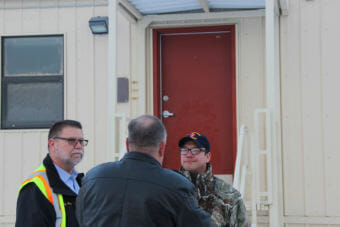
From left, Darryl Parks, chief of operations in civil engineering at JBER; Bob Sherrill of the Defense Logistics Agency; and Newtok Tribal Administrator Andrew John stand in front of one of the barracks units. (Photo by Rachel Waldholz/Alaska's Energy Desk)
From left, Darryl Parks, chief of operations in civil engineering at JBER; Bob Sherrill of the Defense Logistics Agency; and Newtok Tribal Administrator Andrew John stand in front of one of the barracks units. (Photo by Rachel Waldholz/Alaska’s Energy Desk)

For years, as the eroding village of Newtok has tried to relocate, it’s run up against one stubborn challenge: the cost of housing.

Now, village leaders think they might have found a solution. And it comes from an unexpected place: an Anchorage military base.
On a recent November day, Jay Farmwald drove onto Joint Base Elmendorf-Richardson in Anchorage and pointed out several long rows of modular dorms, single-story units attached end to end.

“These are the units right here,” he said.

The temporary barracks housed soldiers at JBEr for about a decade. Now they may go to Newtok. (Photo by Rachel Waldholz/Alaska's Energy Desk)
The temporary barracks housed soldiers at JBEr for about a decade. Now they may go to Newtok. (Photo by Rachel Waldholz/Alaska’s Energy Desk)

Farmwald works for the Denali Commission, the federal agency most involved in trying to relocate Newtok. And these buildings are at the center of a plan hatched by the commission, the Newtok Village Council, the base and the Defense Logistics Agency, which handles excess military equipment.

The units were used for more than a decade as temporary barracks for soldiers, while the base built permanent dormitories. Now, they’re empty, and the military has to get rid of them.

So why not send them to Newtok?

Farmwald said he was skeptical at first. But the plan has some major upsides. Like, cost.

“The big part of the equation that is enticing is the barracks are free,” Farmwald said. “They’re excess to the military [and] they’re in good condition.”

They were also built to be transported, originally built as modules in Seattle and moved to Anchorage. That means they can be disassembled, barged out to Western Alaska, and reassembled at Newtok’s new site.

If that sounds kind of nuts, well, it might be. But the problem Newtok is facing is also kind of nuts.

The village’s current site is rapidly disappearing as the Ninglick River eats away at the land, and there isn’t enough money to move everyone to Mertarvik, the new site residents have chosen up-river.

Government agencies that fund crucial infrastructure like a power plant, airport or school won’t commit money to Mertarvik until there are enough people living there. That means housing. But agencies that fund housing won’t commit money without the promise of infrastructure.

It’s a chicken and egg situation, Farmwald said, and it’s been an obstacle for years.

One major selling point for this new plan is it would get a critical mass of houses to Mertarvik all at once.

“And that might be just enough to get the snowball really rolling down the hill,” Farmwald said.

The barracks themselves are no-nonsense: rows of identical beige siding with identical metal staircases leading up to identical red doors.

Darryl Parks, head of operations for the base’s civil engineering unit, offered a tour. He said, after more than ten years of use, the units have held up well.

“Considering we put soldiers through these things — 19, 20, 21 year old kids — and let them live in here on their own, and they’re not beat up at all,” Parks said. “I think they can handle families.”

Each individual unit has three bedrooms, a small kitchenette and a bathroom. They’re pretty spartan. But Jimmy Charles, Jr., who heads the Newtok Native Corporation, said that’s not a problem.

Charles was visiting the units for the first time.

“It’s a lot better than what they have at the villages,” he said, noting that the current housing in Newtok is so dilapidated and overcrowded that these decade-old temporary barracks would be a major improvement.

“Back home, the living quarters are so small,” Charles said. “Some of the houses have nine people.”

The plan is to put two of these individual units together and renovate them to create single-family homes.

Charles’ wife Katherine, who sits on the Newtok Village Council, said she’s already imagining moving in. The couple’s current home has two bedrooms and eight people. They sleep in the living room.

“I can’t wait to move in here,” she said, laughing. “With my own bedroom!”

There are still several steps before that happens. The military is offering the barracks themselves for free, but they’ll have to be retrofitted, with new heating systems and potentially new roofs and more insulation.

A feasibility study determined that the cost of remodeling the units, disassembling them, barging them to Newtok and reassembling them is still less than building similar-sized homes new — testament to the high cost of construction in rural Alaska.

But it will cost an estimated $4.5 million to get one barge-full, or about thirteen homes, to the new site. The Denali Commission has committed $3.5 million to the project. The village is still working out the rest of the funding.

If all goes according to plan, there could be as many as twenty homes and maybe a hundred people living at the new village site by the end of 2019. It’s perhaps a quarter of the housing they’ll eventually need. But, after more than a decade of trying to develop the new site, it would be something of a miracle for Newtok.

How do you get people to care about climate change? Maybe with a drone.

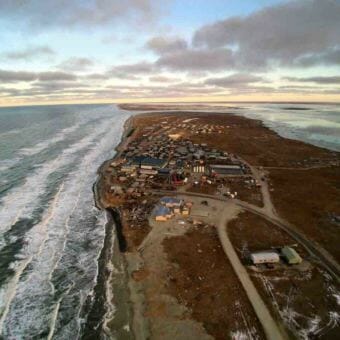
Shishmaref, from above. (Photo courtesy of Dennis Davis.)

Look up Dennis Davis on YouTube and you’ll find gorgeous, sweeping footage of Shishmaref from above: the narrow island covered in snow, its buildings alarmingly close to the water, all of it dazzling in the light of a low-hanging sun.

It’s drone footage, and Davis says it offers a different way to get out the word on climate change.

“It just gives you that different perspective,” Davis said. “I was looking online [at drone footage] and I was like, ‘This would be perfect to show people what’s happening here in Shishmaref.'”

What’s happening in Shishmaref, of course, is a lot of erosion. As protective sea ice diminishes and permafrost deteriorates, the community has become more vulnerable to storm surges, and the thin barrier island in the Chukchi Sea is becoming ever thinner. The village is one of four considered in immediate need of relocation, and last year voted to move.

Davis started using the drone about three years ago to document the changes. People outside don’t always get it, he said.

“I just want to show those people what we’re dealing with on a daily basis,” Davis said. “Each storm is a bad storm…Here in Shishmaref, we’re on this island. There’s nowhere to run.”

Davis is a former police officer who’s maybe best known online as a serious foodie. On Twitter and Instagram – where he goes by the handle @EskimoFixer – breathtaking images of storm damage are interspersed with possibly more breathtaking photos of his culinary creations, like a muktuk and kimchee bowl.

But his big goal is to use striking drone footage and social media to get the word out about what’s happening to his community.

“I feel that if I don’t do this, then we’re basically out of sight, out of mind,” Davis said. “And nobody’s really going to know what’s happening out in Shishmaref.”

Right now, Davis is running a crowdfunding campaign to replace his current drone with one that can fly further and handle high winds. He hopes to use the drone to scout the best route over sea ice for people heading out hunting, and to do Facebook Live broadcasts in the middle of big storms.

Plus he wants to give the world a sense of daily life in Shishmaref outside its status as a climate change symbol.

“When people are out fishing or checking their nets, or out hunting in the ocean,” Davis said. “Just to show people a little glimpse of, this is what’s really happening. This is how life is out in the village.”

Ultimately, he says, it’s a way to connect people outside to what’s happening on the ground. Or in the air.

Site notifications
Update notification options
Subscribe to notifications