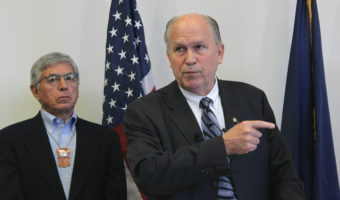
Gov. Bill Walker spoke to reporters on June 29, announcing $1.29 billion in budget vetos, including a $1,000 cap on the PFD. Photo: Rachel Waldholz/APRN
After four credit downgrades in eight months, Alaska received some good news Monday: S&P Global will not lower the state’s credit rating — at least for now.
That announcement came as something of a surprise: S&P warned in June that if lawmakers couldn’t come up with a long-term budget solution, it would likely knock down Alaska’s credit rating within 90 days.
But S&P analyst John Sugden said Gov. Bill Walker’s decision to veto $1.3 billion in spending — including half of residents’ PFD checks — bought the state some breathing room.
“While there isn’t permanent reform, and there’s still a long-term structural imbalance, we feel the actions taken by the governor and the legislature buy Alaska some time while they sort out how they’re going to bring their budget back into balance,” Sugden said in a phone interview.
In its report, S&P noted that with the veto, Alaska will draw about $3.2 billion from savings — about the same amount it would have taken under the long-term fiscal plan proposed by the governor last year.
Alaska still has a negative outlook, which means S&P could downgrade the state within one to two years. A lower credit rating makes it more expensive for the state and communities to borrow money, and it’s a signal to markets about the strength of state finances.
S&P first downgraded Alaska from its highest AAA rating in January. That was followed by downgrades from the two other major rating firms, Moody’s Investors Service and Fitch Ratings.
Alaska still holds a solid AA+ rating from S&P, largely because of its large savings accounts. But in its report, the agency warned that if lawmakers do not agree on some kind of “structural fiscal reform” in the coming session, that rating is likely to drop.
“In our view,” S&P’s analysts wrote, “the future of Alaska’s creditworthiness likely hinges on the willingness and ability of its political leaders to reach agreement on substantive fiscal reforms in the coming months.”
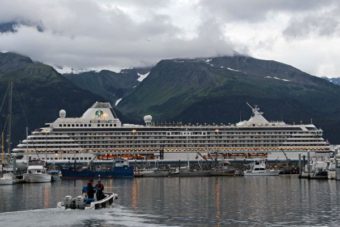
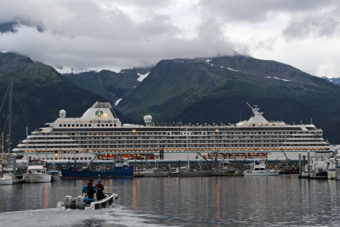
The Crystal Serenity is the largest passenger ship to traverse the Northwest Passage, traveling from Seward to New York City. (Photo by Rachel Waldholz/ Alaska’s Energy Desk)
The luxury liner Crystal Serenity is on its way from Seward to New York City through the Northwest Passage.
It’s the largest cruise ship to navigate the route, which hugs the coasts of Alaska, Canada and Greenland. And it’s attracted international attention, with many wondering if it’s a sign of what’s to come as the Arctic sees increasingly ice-free summers.

The ship has 13 decks, eight restaurants, a casino, and a spa. Staterooms for this trip started at about $20,000 and run as high as $120,000 (with personal butler service).
Sitting in her room, with a deck looking out over the Seward harbor, passenger Moira Somers said for most of the people on board, the ship is as much a destination as the Arctic.
“When you start your cruise, no matter where in the world you are, and you see the ship, it’s goosebump stuff,” she said.
Somers and her husband live in Victoria, B.C. (she’s originally from Namibia). Like the majority of people on board, they’re repeat cruisers – she says this is perhaps her 16th trip with Crystal.
But this time is a little bit different.
“Maybe we’re not so sure what we’re letting ourselves in for?” she said, with a laugh. “But there’s so much, we’ve read so much, we’ve prepared ourselves, and we know it’s a big thing.”
Until about a decade ago, the Northwest Passage was only open to ships with icebreaking capabilities. And while smaller cruise ships have visited the region for years, the Crystal Serenity, with more than 1600 guests and crew, will become the largest passenger ship to traverse the full, winding route across the top of Canada.
It’s a dry run for large-scale tourism in a region that hasn’t seen anything like it before.
But the man in charge is not concerned.
Captain Birger Vorland of the Crystal Serenity has spent 38 years at sea. “Nobody has ever planned a cruise as diligently and as detailed as Crystal Cruises has done for this particular voyage,” he said. (Photo by Rachel Waldholz/ Alaska’s Energy Desk)
Birgir Vorland, the master of the Crystal Serenity, has spent 38 years at sea. Originally from Norway, he says the Northwest Passage has special resonance.
“My countryman Roald Amundsen did the first transit here, between 1903 and 1906,” Vorland said. “He spent three years on this passage. We’re going to do it in 32 days and a lot more comfort.”
Crystal Cruises has spent more than three years planning the trip. Standing on the navigation bridge, Vorland ticked off the special preparations: systems to detect ice, two Canadian ice pilots joining him in Nome, an escort ship in case he runs into trouble.
“We have crossed all the t’s, dotted all the i’s,” he said. “Nobody has ever planned a cruise as diligently and as detailed as Crystal Cruises has done for this particular voyage.”
As the ship prepared to leave Seward, passengers participated in an emergency drill. In the casino, guests wearing life jackets gathered around staff holding signs that read, “Life Boat 6.”
Passengers took part in an emergency drill before the Crystal Serenity left Seward. (Photo by Rachel Waldholz/ Alaska’s Energy Desk)
Despite Vorland’s assurances, plenty of people are worried about what happens if this scenario plays out in real life.
“There’s absolutely no capacity to respond to accidents,” said Elena Agarkova, who tracks shipping for the World Wildlife Fund, a conservation group.
There’s very little search and rescue infrastructure in the region, a major concern for authorities. On August 24th, just as the Crystal Serenity passes through the region, the Coast Guard, U.S. military and Canadian forces will stage a major training exercise in the Bering Strait. Called Arctic Chinook, it will simulate the response to a cruise ship going down with 250 people on board.
The question isn’t just whether the Crystal Serenity is ready for the Arctic, but if the Arctic ready for the Crystal Serenity. Some of the communities it’s visiting in Canada have populations smaller than the ship itself.
Agarkova said Crystal Cruises has done a good job of working with communities and addressing environmental concerns, with plans to forgo heavy fuel oil and exceed standards for discharging wastewater. But, she said, there’s no guarantee those precautions will be taken in the future.
“They’re doing these measures voluntarily,” she said. “So there’s nothing that would require cruise lines or cruise ships that would follow in their steps to adhere to the same kinds of standards.”
Agarkova also pointed out the irony of this new era — when the very changes making the region accessible are also transforming it.
That’s not lost on passenger Moira Somers.
“One kind of feels – I won’t say guilty, but you’re taking advantage of what is happening,” Somers said, adding that she hopes the cruise is raising awareness of climate change.
As for her more immediate goals? “My big dream is to see a polar bear,” she said.
After a moment she added, with a laugh, “And just being able to have a successful trip, I think. Getting through with no hiccups.”
The Crystal Serenity is the largest passenger ship to traverse the Northwest Passage, traveling from Seward to New York City. Photo: Rachel Waldholz, Alaska’s Energy Desk
The luxury liner Crystal Serenity on its way from Seward to New York City through the Northwest Passage.
It’s the largest cruise ship to navigate the route, which hugs the coasts of Alaska, Canada and Greenland. And it’s attracted international attention, with many wondering if it’s a sign of what’s to come as the Arctic sees increasingly ice-free summers.
The ship has 13 decks, eight restaurants, a casino, and a spa. Staterooms for this trip started at about $20,000 and run as high as $120,000 (with personal butler service).
Sitting in her room, with a deck looking out over the Seward harbor, passenger Moira Somers said, for many of the people on board, the ship is as much a destination as the Arctic.
“When you start your cruise, no matter where in the world you are, and you get on the ship, and you see the ship, it’s goosebump stuff,” she said.
Somers and her husband live in Victoria, B.C. (she’s originally from Namibia). Like the majority of people on board, they’re repeat cruisers – she says this is perhaps her 16th trip with Crystal.
But this time is a little bit different.
“Maybe we’re not so sure what we’re letting ourselves in for?” she said with a laugh. “But there’s so much, we’ve read so much, we’ve prepared ourselves, and we know it’s a big thing.”
Until about a decade ago, the Northwest Passage was only open to ships with icebreaking capabilities. And while smaller cruise ships have visited the region for years, the Crystal Serenity, with more than 1600 guests and crew, will become the largest passenger ship to traverse the full, winding route across the top of Canada.
It’s a dry run for large-scale tourism in a region that hasn’t seen anything like it before.
But the man in charge is not concerned.
Captain Birger Vorland of the Crystal Serenity has spent 38 years at sea. “Nobody has ever planned a cruise as diligently and as detailed as Crystal Cruises has done for this particular voyage,” he said. Photo: Rachel Waldholz, Alaska’s Energy Desk
Birgir Vorland, the master of the Crystal Serenity, has spent 38 years at sea. Originally from Norway, he said the Northwest Passage has special resonance.
“My countryman Roald Amundsen did the first transit here, between 1903 and 1906,” Vorland said. “He spent three years on this passage. We’re going to do it in 32 days and a lot more comfort.”
Crystal Cruises has spent more than three years planning the trip. Standing on the navigation bridge, Vorland ticked off the special preparations: systems to detect ice, two Canadian ice pilots joining him in Nome, an escort ship in case he runs into trouble.
“We have crossed all the t’s, dotted all the i’s,” he said. “Nobody has ever planned a cruise as diligently and as detailed as Crystal Cruises has done for this particular voyage.”
As the ship prepared to leave Seward, passengers participated in an emergency drill. In the casino, guests wearing life jackets gathered around staff holding signs that read, “Life Boat 6.”
Passengers took part in an emergency drill before the Crystal Serenity left Seward. Photo: Rachel Waldholz, Alaska’s Energy Desk
Despite Vorland’s assurances, plenty of people are worried about what happens if this scenario plays out in real life.
“There’s absolutely no capacity to respond to accidents,” said Elena Agarkova, who tracks shipping for the World Wildlife Fund, a conservation group.
There’s very little search and rescue infrastructure in the Arctic, and it’s a major concern for authorities. On August 24th, just as the Crystal Serenity passes through the region, the Coast Guard, U.S. military and Canadian forces will stage a major training exercise in the Bering Strait. Called Arctic Chinook, it will simulate the response to a cruise ship going down with 250 people on board.
The question isn’t just whether the Crystal Serenity ready for the Arctic, but if the Arctic ready for the Crystal Serenity. Some of the communities it’s visiting in Canada have populations smaller than the ship itself.
Agarkova said Crystal Cruises has done a good job of working with communities and addressing environmental concerns, with plans to forgo heavy fuel oil and exceed standards for discharging wastewater. But, she said, there’s no guarantee those precautions will be taken in the future.
“They’re doing these measures voluntarily,” she said. “So there’s nothing that would require cruise lines or cruise ships that would follow in their steps to adhere to the same kinds of standards.”
And Agarkova pointed out the irony of this new era — when the very changes making the region accessible are also transforming it.
That’s not lost on passenger Moira Somers.
“One kind of feels – I won’t say guilty, but you’re taking advantage of what is happening,” Somers said, adding that she hopes the cruise is raising awareness of climate change.
As for her more immediate goals? “My big dream is to see a polar bear,” she said.
After a moment she added, with a laugh, “And just being able to have a successful trip, I think. Getting through with no hiccups.”
John Hendrix started work as Gov. Bill Walker’s chief oil and gas adviser in July 2016. Photo: Rachel Waldholz, Alaska’s Energy Desk
When Gov. Bill Walker announced the creation of a new cabinet position — a chief oil and gas adviser — he framed it as a way to improve his administration’s often rocky relationship with the oil and gas industry.
The man he appointed, John Hendrix, has more than 35 years of experience in oil and gas and has been praised by industry officials.
But in an interview, Hendrix told Alaska’s Energy Desk he’s proposing a tough love approach to the state’s oil companies.
Hendrix said he’s been hired to do pretty much one thing: figure out how Alaska can produce more oil.
“There’s no doubt in my mind that there are opportunities…to make more oil with existing infrastructure and existing, producing wells,” he said.
In his newly created role, Hendrix doesn’t have a department to run. Instead, he described his job as finding out what’s standing in the way of oil production — from federal regulations to financing to state policy — and then doing everything he can to remove those barriers.
But, he said, he’s also challenging oil companies to step up. He called it putting “grit in the system.”
“If you have potential and you’re not going after that production potential that’s in the ground, why aren’t you?” he asked.
One example of this approach is the current controversy over Prudhoe Bay. Prudhoe is the state’s largest oil field — and would be the largest source of natural gas, if a pipeline is ever built from the North Slope.
This year, for the first time, the Walker administration requested information from Prudhoe’s leaseholders — BP, ExxonMobil and ConocoPhillips — asking how they plan to market that gas. The companies have so far refused, arguing the request is potentially illegal. In return, the state has rejected the unit’s annual development plan — essentially threatening the companies’ leases if the information isn’t handed over.
Hendrix said the state is well within its rights.
“Let’s go back to grit,” he said, with a laugh. “This is kind of the grit the governor provided to the oil and gas companies. I don’t think they’ve had anybody ask those questions for awhile…so [they were] kind of shell shocked about where the boundaries are, you know, ‘You’re invading my space.'”
But, he said, that’s the whole point.
“This office needs to know, what is the potential of every oil field out there? What are your exploration plays…and why are you not exploring?” he said. “And if you had something you explored, that can be developed, why aren’t you developing it? And I want to know how I can help.”
A Homer High School grad, Hendrix most recently served as the general Mmanager of Alaska operations for Apache, before it pulled out of the state earlier this year.
Before that, he ran Apache’s operations in Egypt and spent 18 years at BP. His job in each case, he said, was often to enter a field and figure out how to make it live up its potential.
Now, he’s one of three new faces at the top of Gov. Walker’s oil and gas team, along with Andy Mack, the new commissioner of Natural Resources, and Keith Meyer, the head of the Alaska Gasline Development Corporation.
As the administration describes it, Meyer is in charge of gas, Mack is focused on wrangling more flexibility out of the federal government — and Hendrix is in charge of oil.
Another gritty issue? Oil and gas tax credits. Walker vetoed about $430 million in payments owed to companies this year. One of Hendrix’s first tasks is reaching out to companies affected by the veto.
He says he supports the governor’s decision – even though Apache received similar credits when it was exploring in the state.
Waldholz: I’m wondering if the John Hendrix who was running Apache a couple years back would have had the same reaction to the governor’s veto?
Hendrix: Oh yeah.
Ultimately, he said, the state can’t spend money it doesn’t have.
Perhaps counterintutively, Hendrix said his real job is building an Alaska that doesn’t rely so heavily on oil. He hopes to use oil and gas as a bridge to that future.
“As a child, and as a young adult, I was always looking up, saying, why aren’t they doing something?” he said. “And now you look back, when you’re 59 years old, and you think, well, maybe it’s time you step forward and help out.”
Walker is hoping Hendrix, and his gritty conversations, can get the state a little closer to that goal.
Dean Westlake is challenging Barrow Rep. Bennie Nageak in the Democratic primary; in 2014, Westlake lost the race by 131 votes. Photo: Rachel Waldholz/Alaska’s Energy Desk
Democrats are hoping to take control of the state House this year. To achieve that, they’re gunning for two lawmakers who run as Democrats but largely vote with the Republicans.
One is Rep. Bennie Nageak, D-Barrow, who represents House District 40, which stretches from Kotzebue to Kaktovik.
Piles of shoes at the entrance to a Democratic fundraiser for Dean Westlake and Zach Fansler, at the home of oil and gas attorney Robin Brena. The fundraiser was co-hosted by nine House Democrats and former U.S. Senator Mark Begich, among other. Photo: Rachel Waldholz/Alaska’s Energy Desk
In early August, a who’s who of Alaska Democrats gathered at the home of oil and gas attorney Robin Brena for a fundraiser. Shoes were piled by the door as guests mingled in their socks with former U.S. Senator Mark Begich, among others, eating hors d’oeuvres and taking in the view.
That show of Democratic solidarity and support? It was aimed at unseating two of their own: incumbent state lawmakers Bob Herron of Bethel and Benjamin Nageak of Barrow.
Both lawmakers caucus with the Republican majority in the state legislature, and their colleagues, it’s clear, are fed up.
“I mean, we had Rep. Pruitt say that one of the best Republican members that they have is Ben Nageak,” said House minority leader Chris Tuck, D-Anchorage, citing Anchorage Republican Lance Pruitt. Tuck was one of nine House Democrats who co-hosted the fundraiser. “I just want to have more Democrats, more true Democrats, in the state House.”
Nageak’s challenger, Dean Westlake of Kotzebue, is director of village economic development for NANA, the regional Native corporation for Northwest Alaska. He said he’s running to make sure rural Alaska has a voice in the capital.
“There are a lot of us dissatisfied because the values that we have are not the ones that we see down in Juneau,” he said in an interview.
Westlake ran against Nageak two years ago, losing by just 131 votes. This time, running with the explicit – and financial – backing of the state Democratic Party, he has high hopes.
Democrats turned out to support Dean Westlake and Zach Fansler, who are challenging incumbent Reps. Bob Herron of Bethel and Bennie Nageak of Barrow. Photo: Rachel Waldholz/Alaska’s Energy Desk
Westlake’s campaign said the fundraiser brought in $6235. (Zach Fansler, who is challenging Herron in House District 38, also raised $5900 at the event.) As of Aug. 9, Westlake’s campaign had brought in a total of $34,864.48, compared with $11,190.11 for Nageak.
If elected, Westlake said, he’d prioritize rural education and community revenue sharing; and he proposed working harder to bring federal money into Alaska villages at a time when state funding for things like water and sewer projects is disappearing.
“One of our values is you always take care of the least of us, and as a representative, that’s what I’d have to do,” Westlake said. “Whoever takes this job, you absolutely have to work with whoever is out there, regardless of party affiliation.”
But the man he’s challenging says the Arctic already has a strong voice in Juneau – his.
“As you probably know, I am a voice that won’t be stopped,” Nageak said in an interview. “And they’re trying to stop me from doing the work I’ve done for the past forty years.”
Nageak, a former North Slope Borough mayor and assembly member, is running for his third term in the state House. He’s co-chair of the House Resources Committee, and he’s known in Juneau for passionate floor speeches, often in defense of resource development and its importance to North Slope communities. In the fight over oil taxes this year, his committee rolled back Governor Bill Walker’s proposal to severely limit tax credits for oil companies.
Rep. Benjamin Nageak, D-Bethel, during debate on the creation of Indigenous Peoples Day, April 1, 2016. (Photo by Skip Gray/360 North)
Nageak is unapologetic about his support for the industry.
“99 percent of the…tax revenues that we get, not only here in the North Slope Borough, but in the state, comes from oil and gas taxes – period.” he said. “So if anything happens to the industry, where are we going to get the money to run the whole state?”
It’s a slight exaggeration: in the years before oil prices fell, up to 90 percent of state general fund spending came from oil revenue
Nageak said he’s disappointed the legislature couldn’t come up with a long-term budget solution this session — and he blamed the gridlock, at least in part, on minority Democrats. But, he said, he’d happily join a Democratic-led majority, if one materializes.
“Who wouldn’t?” he said with a laugh.
The point, he said, is to be in the majority. He pointed to a provision hepassed in 2014 which lifted the cap on how much oil revenue the North Slope Borough could devote to government operations — a longtime goal for the region, which he said he couldn’t have achieved in the minority.
One of Nageak’s allies in that fight? Then-Borough Mayor Charlotte Brower, who has since been recalled over the misuse of public money. Nageak defended her during the recall effort this spring, an issue that might come up with Barrow voters.
With no Republican running in House District 40, the race will be decided in the primary on Aug. 16
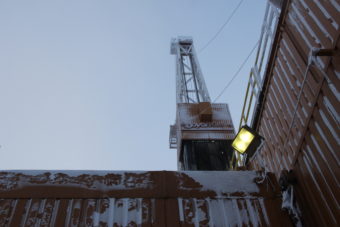
A Doyon drill rig putting in new wells at the ConocoPhillips CD5 drill site on the North Slope. Photo: Rachel Waldholz/APRN
The National Petroleum Reserve Alaska — or NPR-A – was first set aside for oil production nearly a century ago. But it wasn’t until last year that the Reserve produced its first barrels: that’s when ConocoPhillips brought its CD5 unit online.
Now the company is hoping to expand production from the reserve, with a string of new drill sites pushing ever deeper into the NPR-A.
One of those projects — Greater Mooses Tooth 1 — will start construction this winter. And the Bureau of Land Management is launching an environmental review of ConocoPhillips’ most recent proposal — called Greater Mooses Tooth 2.
ConocoPhillips first proposed these drill sites over a decade ago, but the development of CD5 ran into a series of obstacles, including negotiations with the village of Nuiqsut over a road through local subsistence grounds. It took ten years to permit and build, starting production last fall.
Now, ConocoPhillips is hoping it’s full steam ahead.
The projects are like stepping stones, each reaching a little further into the National Petroleum Reserve. CD5 sits on Native corporation land right at the edge of the NPR-A. From there, the company plans to build a road to Greater Mooses Tooth 1 — or GMT-1 — which is scheduled to start construction next year.
“And GMT-2 is the next step-out in development,” said Jim Brodie, ConocoPhillips’ project manager for the NPR-A.
Like GMT-1, the GMT-2 site will be a gravel pad with a maximum of about 30 wells, sending oil by new pipelines back to ConocoPhillips’ Alpine facility – and from there, to the trans-Alaska pipeline.
Brodie said the sites are some of the company’s main priorities these days.
“In terms of new development in Alaska, the NPR-A tend to be the most attractive,” he said.
That doesn’t mean they’re cheap. ConocoPhillips officials joke that a billion dollars doesn’t go as far as it used to. The entire Alpine field was a billion dollar development in 2000. Now each new drill site costs about a billion dollars.
That’s largely because of sheer logistics – the further into the Reserve you move, the further from any existing infrastructure, and the more expensive it is.
But ConocoPhillips has also been frustrated by the pace of the permitting process. In July, Alaska’s congressional delegation sent a letter to the Secretary of the Interior, saying, essentially, get a move on.
On July 25, the Bureau of Land Management announced it would start its environmental review, the next step toward approving the project. The Bureau is currently asking the public for input on what it should study.
Stephanie Rice, the project manager for the BLM, said two areas of focus will be impacts on climate change and ensuring the project doesn’t interrupt Nuiqsut’s access to subsistence resources.
“The main subsistence resource is going to be caribou, and making sure roads and pipelines and air traffic do not interfere with caribou migration,” Rice said.
Meanwhile, some conservationists aren’t thrilled with the project. Marissa Knodel is a climate campaigner with Friends of the Earth, in Washington DC. She said the development doesn’t line up with the Obama administration’s commitments on climate change.
“The bottom line is that any new development for oil and gas, like what is being proposed in the National Petroleum Reserve, moves us completely in the opposite direction of where we need to be going in terms of a safe climate future,” Knodel said.
The state of Alaska takes the opposite view: that new oil and gas development is imperative for economic growth and state revenue. And right now, ConocoPhillips’ developments in the NPR-A are among the few potential sources of new oil for the trans-Alaska pipeline.
The public can submit comments on the proposed project here.
Close
Update notification options
Subscribe to notifications
Subscribe
Get notifications about news related to the topics you care about. You can unsubscribe anytime.