Cabinet members and high-ranking science advisors from 25 governments will convene on the White House today to discuss the Arctic. It’s billed as the first-ever White House Arctic Science Ministerial.
The aim is to pool science resources from around the globe to better understand the rapid changes in the Arctic and also what those changes mean for other regions.
“The Arctic is a foreshadow. It’s an augury. It’s a preview of what is coming our way in the rest of the world,” said Mark Brzezinski, the top White House liaison to the Arctic. “The sooner and the more effectively we get in front of that scientifically, the better off we all will be.”
One of the themes of the meeting is the need for better and more coordinated observation in the Arctic. Brzezinski says that includes traditional knowledge from indigenous people.
“They are the first people of the Arctic. They, more than anyone else, can report on changing patterns, whether flora or fauna or weather or ice,” he said.
Among the attendees are representatives of the Athabaskan, the Gwich’in, the Inuit and the Saami people. Thirty Alaska Native leaders met with U.S. delegation today, to air their concerns and priorities. Former Alaska Lt. Gov. Fran Ulmer, now chair of the U.S. Arctic Research Commission, says countries well beyond the Arctic are sending science ministers to the conference.
“You have countries from Italy and India and China coming, because they’re not only willing to contribute scientists to this work, but understand that what happens in the Arctic
is really impacting them in terms of sea level rise and mid-latitude climate change,” she said.
Documents from the ministerial will be posted after tomorrow’s meeting on Arctic.gov. Ulmer says they’ll include two pages from each country that summarizes the Arctic science they’re conducting.
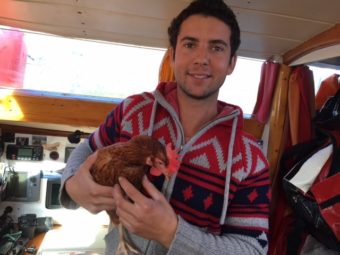
Guirec Soudée and his hen Monique sailed the Northwest Passage together. (Photo by Kayla Desroches/KMXT)
A Frenchman who sailed into Alaska via the Northwest Passage stopped in Kodiak last week. Guirec Soudée’s boat has dents from ice on its side and a portrait of his traveling companion, Monique, on the bow. It’s called Yvinec, after the island in Brittany where Soudée was born.
Monique the chicken climbs onto Soudée’s lap. He says when he was in Greenland, he would speak to her during those long, cold days in the ice when there was nowhere to go and nothing to eat but eggs and rice.
“I said to Monique, OK, today, I try to go fishing so maybe we can eat something else. And it depends, sometimes when I read, I read not in my head, but for Monique too.”
Soudée says he started the journey with the intention of getting a chicken.
“Everybody said to me, yeah, of course you can get a chicken on the boat, but you can’t have any eggs, because of the stress of the chicken, so I was very sad. So, when I left France I was on my own, and when I stopped in the Canary Islands, I met some people there, and someone gave me a chicken, so Monique from the first day she made me one egg. So, we crossed the Atlantic in 28 days and she made me 25 eggs in 28 days.”
On the way to Greenland, they made many pit stops so Soudée could raise money, repair his vessel, and prepare the boat for cold, harsh weather. He says he stopped in various places in the Caribbean and in Canada.
Finally, in August 2015, Soudée arrived in Greenland, a dream he’d had for many years, although he’s not sure where it began. He says he’s wanted to travel the world since he was little.
Soudée, who is now 24, started traveling when he was about 18. He says he was a bad student and instead of pursuing more education, he went to Australia, which is where he learned English. He says he started off without any money and slept in the streets.
He had a number of job and then he worked on a prawn trawler, which is how he made enough money to buy a sailing boat to pursue his dream to be “stuck in the ice” in Greenland.
“I know to do that was a big challenge for me. I just want to be own, to do my own experience, because right now I’m not married, I have no kids, so I can do whatever I want.”
Soon after arriving on Greenland’s west coast in Disko Bay, he received bad news.
“The first day when I arrived in this bay, I got some fishermen come to see me and gave me a message from my family, and I just know my dad died the first day I arrived. I was already very far away. It was very difficult to go back to France. So, for the beginning it was very hard. You need to stay very strong.”
And with the winter months, came the ice. Soudée says he didn’t bring much food.
“Because I was thinking I can catch some fish, and I didn’t catch any fish. So, I lost like 12 kilograms.”
He did try to go ice fishing, but with no luck. At times, it was treacherous to wander away from the vessel, and he says he got lost twice.
“You try to catch some fish, so you go a little bit further of your boat. It’s the wind. Because it’s so windy. And you’ve got the snow flying everywhere, so you can’t see anything. So, after, I put some safety ropes to my boat and to me. In case. Because if you don’t have any protection, you can die very quickly. Because it’s maybe minus 20, minus 30 [degrees Celsius], when you’ve got the wind, it’s minus 60.”
He says his boat suffered a lot of damage from the ice throughout the journey.
“I remember seeing my boat moving from the inside with the pressure of the ice, the compression, and when you see that, you just think in your head, this is it, it’s just finished.”
He says he spent a lot of his time in the vessel reading, writing and planning his next trip, but there were good days outside, too.
“When the weather was good, I went climbing the mountains with my skis and to go down to my boat straight away, yeah, I did many interesting things. Some kite surfing on the ice too.”
But considering all the dangers, Soudée says he’s lucky to be here.
“Because a few times, the ice broke because the waves came under the ice and broke everything and maybe two or three times I was pushed on the coast, so my boat was almost capsized, and you can do nothing. You just need to pray and wait, and I had no communication at all. This is what I [wanted], to be cut off from the world. No phone, no internet, nothing, you’re just on your own.”
Soudée says he wanted to see Greenland for himself, and now he knows he prefers warm weather. After stopping by Seward and some other locations in Alaska, he says he wants to head south, maybe to California and then Mexico. Possibly South America.
His girlfriend flew from Paris to join him in Kodiak and will travel with him for the warmer part of his journey. That means Monique will finally have someone else to talk to.
Editor’s note: Soudée’s quotes have been edited for clarity as English is not his first language.
On Oct. 4, Kotzebue will decide whether or not they want alcohol sold in the city.(Photo by Tyler Stup/KNOM)
Since October 2011, the city-owned Kotzebue Package Store has been selling alcohol.
Come October 4th, local voters will decide the fate of the store, when they’re asked if the city should ban alcohol sales all over again.
Hans Nelson, resident of Kotzebue since 2009, says he led the alcohol ban solo from initial petition through signature collection and onto the ballot.
“I was a lone soldier on the venture,” Nelson said. “There were folks that wanted to volunteer and participate, but it was an opportunity for me to not only hear those who were concerned, but also be able to tell the story.”
Hans started the petition in July and by mid-August had secured the 193 voter signatures needed to put the issue on the ballot. He says it’s a moral issue: “that alcohol in itself has affected many of our homes, in particular to our elders, and it also has affected many of our youth.”
He says the petition appeals to business arguments as well; citing concerning language on the 2015 audit of the Package Store’s revenue. Hans specifically quotes one passage in particular:
“We were unable to perform audit procedures over the package store inventory, and we issue a disclaimer of opinion on the package store major fund. There are no formal procedures for performing a physical inventory count, and no policies and procedures for reconciling a general ledger to the year and inventory listing. Formal policies appear to be in place, but those policies were not followed at year end.”
Kotzebue City Attorney Joe Evans says that the language surrounding the audit isn’t a sign of business mismanagement at all. He adds that is what audits are for in the first place — namely, to identify better business practices — and that this year’s audit has eliminated last year’s problems.
The Package Store was in the black by October 2011. Those profits have bought loaders, a snow blower, a garbage truck, and police vehicles amongst other community improvements and loan payments. Setting its sights toward larger goals, the city borrowed $3.5 million from Wells Fargo Bank and used $2.2 million of that to construct a youth center and approximately $1.3 million to finish the Swan Lake small boat harbor.
As of now, one million of that $3.5 million dollars has been paid off. Current Package Store profits go exclusively towards repaying that debt, in addition to expanding the parks department and providing recreational opportunities for children and elders.
If the city loses alcohol sales, then they will lose an important portion of enterprise revenue.
Without alcohol profits, Evans doesn’t know where the city will make up the lost funds.
He is quick to point out that “municipal government does not operate at a profit, so Public Works, Police, Fire, Parks and Rec, none of them generate revenue.”
“The only enterprise activity the city operates that generates net revenue is the Package Store,” he added.
Without booze revenue, there is no source of money readily available as a substitute. Kotzebue would have to pull funds from sources like taxes or fees. If the city is unable to make the payments, then they will default on the loan.
Petitioner Hans Nelson thinks the city would be fine rearranging funds from other places to pay off any loan debt but adds that “(Kotzebue) should never bank on alcohol and the sale of it.”
This vote could be the second time that Kotzebue votes to ban alcohol.
Before 2011, Kotzebue had been a dry community for 20 years.
A polar bear stands tall during the summer of 2009 in Svalbard, Norway. (Photo by Steven Kazlowski/Barcroft Media via Getty Images)
Five people. Ten bears. One desperate call for help.
On a remote Arctic island, five researchers at a weather station found themselves “besieged” by polar bears over the weekend, Russia’s TASS news agency reports.
Vadim Plotnikov, the head of the weather station on Troynoy Island, told the news agency on Monday that the staff there had seen 10 adult bears around the station, as well as several cubs.
Two weeks ago, a polar bear ate one of the weather station’s two dogs — and hadn’t left the station since.
The female bear had been sleeping under the station’s windows for days, Plotnikov says.
“It’s dangerous to go out as we have run short of any means to scare off the predators,” Plotnikov told TASS. He explained that the station’s stockpile of flares had run out. Polar bear hunting is illegal in Russia, so shooting the bears wasn’t an option.
“We had to stop some of the meteorological observations,” he said. He appealed for a new shipment of flares to be sent, somehow, to the distant outpost.
The next supply ship wasn’t scheduled to visit the island for another month.
The head of the Sevgidromet State Monitoring Network, which owns the station, told TASS it would make sure the supply ship is stocked with new dogs as well as flares, but that it wasn’t sure if it would be possible to send any supplies sooner.
Vassiliy Shevchenko, the network head, also noted the bears would probably leave the island to hunt by the end of October or early November, anyway. He issued a recommendation to the weather station staff: Don’t leave the station unless you absolutely must.
But then salvation arrived on Troynoy Island.
“The flagship of Russia’s research expedition fleet, the Akademik Tryoshnikov, happened to be passing nearby and was able to stop at the island,” The Guardian reports, citing Sevgidromet.
A helicopter took off from the Akademik Tryoshnikov and delivered “three puppies and pyrotechnical devices” to the beleaguered weather station staffers, TASS reports.
The crew of the ship helped chase away the bears, and meteorological observations have resumed, the Russian news network says.
A spokeswoman for Sevgidromet tells the Guardian that the bears’ behavior was unusual, and related to the reduction in sea ice — the bears were trapped when the ice receded rapidly and were stuck on Troynoy instead of the islands where they usually go.
“There’s no food on [Troynoy] island, so they came up to the station,” the spokeswoman told the newspaper.
We work very hard to find out how various words and names, particularly Alaskan Native terms, are properly spoken so that we can pronounce them in our radio and web broadcasts.
Rep. Benjamin Nageak is a Democratic member of the Alaska House of Representatives since 2013. We have heard his last name pronounced several different ways.
KTOO and Alaska Public government reporter Andrew Kitchenman asked Nageak to pronounce his name during a taped phone conversation.
Kitchenman wrote in a staff email: “The key is this ‘g’ in Inupiat is a sound that we don’t really make in English — kind of soft ‘g’ in the back of the throat that we don’t make in English.”
“I’ve stuck with ‘Nah-gee-AK’ as a pronouncer, since I’ve heard him say it this way on the House floor, but (nag-ee-yak) is OK too,” Kitchenman said
An election official feeds ballots into an optical scanner while observers watch on Monday. (Photo by Andrew Kitchenman/KTOO)
Barrow Rep. Benjamin Nageak says he isn’t conceding the Democratic primary to Dean Westlake of Kotzebue.
“I haven’t conceded anything,” he said.
That’s despite the fact that Westlake’s lead doubled Monday from four to eight votes over Nageak in final results in the closely watched recount. District 40 covers the North Slope and Northwest Arctic boroughs, as well as three neighboring precincts in the Unorganized Borough.
What remains to be seen is whether Nageak will challenge the results in court, and — if so — whether that will change the outcome.
But Nageak declined to say whether he’d challenge the results legally, and referred further questions to his attorney, Seattle-based election-law specialist Tim McKeever.
In the recount, Westlake added six votes to his total, reaching 825, while Nageak gained two votes, to reach 817.
Westlake gained two votes from ballots that the computer scanner initially failed to count, while Nageak gained one.
In addition, Westlake gained three votes from questioned ballots from Ambler that were received after the Division of Elections certified the results.
And both candidates gained one vote each from Kivalina, where some voters mistakenly cast ballots in both the Republican primary and in the primary for all other parties.
Nageak caucuses with the Republican House majority.
Republican officials are concerned about the handling of ballots in the village of Shungnak. Voters were wrongly given ballots for both the Republican primary and the primary for all other parties.
Westlake received 47 votes in Shungnak and Nageak received three.
In addition, some Republicans in the North Slope Borough and elsewhere have said election officials didn’t allow them to vote in the Democratic primary, or required them to file questioned ballots.
Nageak said he’s concerned about it.
“I have a lot of Republican friends in the district also, especially here in the North Slope, and I’ve heard they were turned down … with their ballots,” he said.
The Democratic primary is open to all voters.
Katherine Pfeiffer was observing the recount in the elections office in Juneau for the Democratic Party. Amid Division of Elections staff hovering over ballots, optical scanners and printouts, she said she was impressed.
“I think it was very well-organized,” she said. “The election staff was very congenial, very helpful, answered people’s questions: a very transparent process.”
Nageak’s observers deferred comment to Nageak.
Friday is the deadline for an election challenge to be filed in Superior Court.
Close
Update notification options
Subscribe to notifications
Subscribe
Get notifications about news related to the topics you care about. You can unsubscribe anytime.