Arctic

Should Alaskans fear diseases frozen in the permafrost?

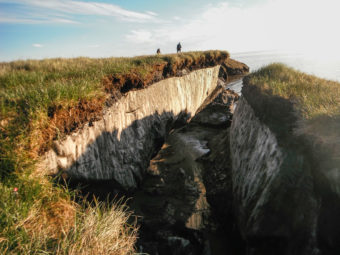
Coastal erosion reveals the extent of ice-rich permafrost underlying active layer in the Teshekpuk Lake special area of Alaska's National Petroleum Reserve . (Photo: Brandt Meixell/USGS)
Coastal erosion reveals the extent of ice-rich permafrost underlying the active layer in the Teshekpuk Lake special area of Alaska’s National Petroleum Reserve. (Photo: Brandt Meixell/USGS)

Russian officials say warming permafrost could be linked to a deadly anthrax outbreak in Siberia this month.

Permafrost can be found almost everywhere in Alaska — from the Arctic coast to Anchorage.

But at least one expert isn’t alarmed about the potential for thawing ground to bring old diseases back to life.

After a Siberian heat wave, anthrax hit the Yamal Peninsula in early August.

The bacterial disease has claimed the life of a child and thousands of reindeer.

Permafrost expert Vladimir Romanovsky of the University of Alaska Fairbanks said melting permafrost and erosion may have worked together to spread anthrax into the water supply.

“Thawing of permafrost can release microorganisms first into the active layer, then into water and air,” Romanovsky said. “They were sequestered there for many, many years — tens of years, even thousands and tens of thousands of years.”

Scientists have talked about the possibility of epidemics caused by thawing permafrost, but until now, it’s only been a theory, Romanovsky said.

If the Siberian anthrax outbreak is traced back to spores in the permafrost, then it would be a troubling development.

“This release of these dangerous microorganisms could actually be spread very easily from the north, because we have lots of birds who are migrating all kind of places in the world,” he said. “So this problem could be not just local problem. It could be global problem.”

More research is needed to tie this anthrax outbreak to warming permafrost, Romanovsky said.

Infectious disease specialist Dr. David Morens, with the National Institutes of Health, isn’t worried about anthrax — or any other disease — surfacing from the ground.

Anthrax is hardy and virtually everywhere, he said.

“Anthrax is sitting in the grass in farms in Texas,” Morens said. “It’s in Asia. It’s in Africa. It’s everywhere. And so the fact that some might be in the permafrost doesn’t really add to whatever the risk is.”

Although anthrax is widespread, the chance of getting sick from it is really small.

The likelihood of contracting anthrax from spores exhumed from the permafrost, is even tinier.

Morens has studied the 1918 Spanish influenza pandemic that decimated rural villages in Alaska. Brevig Mission was hit especially hard.

Spanish flu killed 90 percent of the village over the course of six days.

The remains of victims were buried together.

Researchers have used samples from that mass grave to reconstruct the genetic code of the virus.

But Alaskans shouldn’t be afraid of getting sick as the ground in Brevig Mission thaws, Morens said. Unlike anthrax, Spanish flu is very fragile.

“What came out of the so-called permafrost was just broken pieces of RNA,” Morens said. “Nucleic acid. There was nothing infectious. A ton of it swallowed would have been harmless.”

Freezing and thawing breaks up viruses like Spanish flu, killing them.

“So if we are talking about viruses and deadly things, I would say whatever might be there in the permafrost is not going to be contagious,” he said.

Morens doesn’t fear viruses or bacteria emerging from their cryogenic slumber, but he is concerned about the threat of new diseases.

“All these emerging viruses that are coming on — Zika, chikungunya, severe acute respiratory syndrome (SARS), and all that,” Morens said. “It’s not that they’re being created. It’s not that they’re being dug up from the permafrost. They’re already there. And we human beings do things that invite them to come in, infect us, and cause epidemics.”

Officials in Russia are trying to stop the anthrax outbreak from spreading further. They are incinerating all infected reindeer carcasses and have banned hunting in the region.

Crystal Serenity brought tourists, but little profit for Nome businesses

Last week, the cruise ship Crystal Serenity sailed into Nome and 850 of the cruise ship’s passengers were ferried in from the offshore vessel and took the day to tour the city.

Those passengers accounted for a roughly 25 percent increase in Nome’s population, and for local businesses that meant a hypothetical increase in profits.

Some business owners are saying their expectations for the day weren’t met.

Airport Pizza manager Ayyusue Katchathe said she only saw a handful of cruise ship passengers stop by to eat.

“We had a few customers, a couple pairs, a single, and maybe a group of four,” she said.

Katchathe thinks that most of the cruise ship traffic was directed to the blueberry festival and Front Street.

Planned in conjunction with the arrival of the ship, the Mini Convention Center hosted the blueberry festival, where Nome residents and vendors from around the Norton Sound region sold crafts and displayed local culture.

Nomemade co-business owner Kim Knudsen participated as a vendor at the festival.

Most of her sales came from people in the community despite the cruise ship’s arrival, she said.

“Even with some of the smaller items, I didn’t get the impression people were buying much,” she said. “They could take home smaller items of jams or jellies … but they just weren’t buying as much as the locals were buying.”

The Mini Convention Center was made an official stop for the tour buses shuttling passengers around Nome to encourage commerce.

The tourists came in waves but by afternoon had dwindled, Knudsen said.

Crystal Serenity passenger Marc Sola was a part of the morning peak at the blueberry festival, but he wasn’t really looking to eat at a restaurant here.

“I haven’t had anything to eat here,” he said. “I’d just had breakfast before I came here, so it wasn’t that big a deal to me.”

His plan for the rest of the day was to walk down Front Street and see the sights, he said.

Local businesses will get one more shot at selling their wares next year, however.

The plan for Crystal Cruises is to send an even bigger ship through the Northwest Passage in the late summer of 2017.

Crystal Serenity cruises on amid environmental concerns

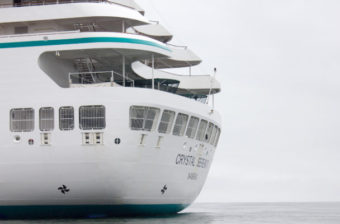
The luxury cruise liner Crystal Serenity arrived off the coast of Nome on Sunday. (Photo by Lauren Frost/KNOM)

The Crystal Serenity cruise ship is making a 32-day voyage from Anchorage to New York City.

The ship is the largest vessel ever to travel the Northwest Passage with about 1,000 passengers aboard.

Meanwhile, the potential environmental impact of a journey of that scope has some worried.

Austin Ahmasuk, a marine advocate at the Kawerak regional non-profit corporation, is nervous about what happens when a floating city moves through a delicate region like the Arctic.

Ahmasuk refers to the Crystal Serenity as “a floating city.”

It certainly contains enough people, and produces enough waste.

“We have some very deep-felt and heartfelt concerns about what is happening in the Arctic,” he said.

Alaska Native communities rely on fish and marine mammals for subsistence.

Ahmasuk worries that cruise ships could damage the ecosystem and threaten that subsistence lifestyle.

What’s more, he does not think the cruise industry is listening.

“Honestly, I don’t know that our concerns are being fully heard,” he said. “I honestly cannot say that with a straight face.”

He’s not alone in his misgivings.

Marcie Keever, who directs the oceans and vessels program at an environmental group called Friends of the Earth, also is worried.

“When a ship like Crystal is going, because of its size, because of the length of time, there’s lots of reasons why a ship like that is a big concern,” Keever said.

In June, Friends of the Earth released their latest cruise ship report card, which grades cruise lines on their commitment to protecting the environment.

What grades did Crystal Cruises get?

Sewage treatment: F. Air pollution reduction: F. Transparency: F. It ranked 17 th out of 17 cruise lines.

Crystal Cruises has spoken out against the report card, and so has the Cruise Lines International Association.

Alaska branch president John Binkley said that people should look to the Coast Guard to regulate the industry, not to environmental groups.

“And similar to our political parties today, I believe that the Friends of the Earth are trying to divide people, really, with radical and unfounded claims,” Binkley said.

While the Crystal Serenity does not meet the standards set by Friends of the Earth, it does comply with all federal regulations.

The ship also has pledged to use cleaner fuel while it’s in Alaskan waters.

Even Keever admits that the Crystal Serenity is not at the heart of the problem.

“Our concern is not necessarily just the Serenity,” she said. “It’s the number and size of cruise ships and other ocean-going vessels that are going up over the top of the world.”

If the Crystal Serenity successfully completes its voyage, then other large ships likely will follow.

The Serenity already plans to return in 2017.

Keever points out that if those ships contribute to climate change in the Arctic, then they are making their own passage just a little bit easier — melted ice means a smoother trip.

“The only reason that this cruise is even possible is due, in small part, to the cruise industry,” Keever said.

The Crystal Serenity is expected to arrive Sunday in Pond Inlet.

Coast Guard wraps up Arctic exercises

The Coast Guard finished up its training exercise in the Arctic on Thursday that simulated a mass maritime rescue operation.

The series of simulated drills was known as the Arctic Chinook exercise and wrapped Thursday morning in Kotzebue, according to a Coast Guard press release.

The activities involved the U.S. Coast Guard, the Alaska National Guard, state agencies, Alaska Native organizations and Canada’s armed forces.

The training is part of an International Maritime Search and Rescue Agreement between the Arctic Council nations — Canada, Denmark, Finland, Iceland, Norway, Russia, Sweden and the United States.

The exercise demanded that participants put their theater skills to use.

According to the press release, drills involved treating people with simulated injuries, and an HC-130 aircraft from Coast Guard Air Station Kodiak dropped a tent fit to shelter 25 people in Kotzebue. The release said some of the tents in these Arctic sustainment packages can accommodate up to 200 people.

Field exercises prepped trainees for rescues, leading people to shelter, and treating patients.

Science and cooking collide to fight botulism

A bearded seal, or ugruk, on the sea ice.
A bearded seal, or ugruk, on sea ice. (Courtesy of Kawerak Subsistence Program)

Food scientists with the help of a botulism expert are trying to combine science and traditional Alaska Native methods to make one prohibited food safe to eat.

Regulated programs under the State of Alaska Food Safety and Sanitation Program are not allowed to accept or distribute seal oil due to the danger of botulism, a potentially fatal disease which is caused by bacteria in contaminated food.

But how or when the neurotoxins enter the rendering process is still a mystery. That’s what researchers want to find out.

Val Kreil describes seal oil as “a little bit like a heavy olive oil.” He’s the administrator of Utuqqanaat Inaat, a long-term care facility in Kotzebue that falls under the Maniilaq Association.

He says elders at the facility identified seal oil as a priority food.

“For them it’s like eating butter. This is just part of their daily diet. This is what they’ve always been eating and, in terms of health, it’s actually healthier than fish oil. So, there’s a lot of benefit to eating seal oil.”

But because the bacteria that causes botulism grows in anaerobic environment – or one without exposure to oxygen – traditional methods using containers like bottles or barrels to render the seal oil can lead to contamination. The challenge is how to prevent the risk of poisoning while working with the traditional techniques.

Kreil says beginning last year; Maniilaq started looking for ways to get a variance approved to distribute seal oil. He says he’s one of a number of Alaskans interested in getting prohibited traditional foods safe and approved for consumption, and he hopes to clear the way for other programs.

The first step in the mission was to turn to regulators.

Lorinda Lhotka, a section manager with the State of Alaska Food Safety and Sanitation Program, says the state was willing to allow organizations to serve the seal oil if they could demonstrate a safe process.

However, she explains Lorinda Lhotka needed to reach out to resources other than the state.

“We do testing, but it’s usually in result of outbreaks of illness, and we don’t do a lot of preventative testing to help evaluate the safety of the product. So, it’s usually just in response to illnesses, and our labs don’t have that capacity.”

So, along the way, Maniilaq got in touch with UAF’s Kodiak Seafood and Marine Science Center, and Dr. Eric Johnson, a botulism specialist and professor of bacteriology at the University of Wisconsin – Madison.

He has a long history in researching botulism and his lab is registered for toxin analysis.

Johnson says he’ll watch the traditional process in action in the community of Kotzebue and, once he understands the preparation, examine samples in his lab.

“My interest is in helping validate the process from a safety perspective – for example, what aspects in this process may contribute to the growth of clostridium botulinum and its formation of toxins and to implement minor changes in the process that will enhance its safety.”

Bacteria that causes botulism.
Bacteria that causes botulism. (Public domain image)

While the Seafood and Marine Science Center is not registered to work with toxins, it does focus on the research of seafood. Associate Professor of Seafood Microbiology Brian Himelbloom explains they can study the other aspects of a seal oil sample, like what it’s composed of and how much water is left in the extract.

“Because that will give us an idea when things go bad maybe that’s because some of that seal oil has some residual water available and that’s where we theorize clostridium botulinum is actually going to operate.”

Himelbloom says, in theory, the preparers of the seal oil can avoid a botulism incident if they pour off 100% oil.

“But in their mixing, if there’s splash over from water or they’re not careful how they’re pouring it off, maybe that’s the situation – because under what we call ambient temperatures, room temperature or outside temperature, that’s probably in the range where this organism can proliferate.”

So far, it’s all speculation. The trick according to Himelbloom and the other researchers is to find the solution while keeping scientific intervention to a minimum.

“We know something about clostridium botulinum and how it acts and how it behaves and where it can be found and how you test for it and how do you assay for the toxin, and so if we can combine those two worlds of traditional knowledge and Western science, we might actually come to the point of oh, now we know how we can most likely guarantee, hopefully, that there won’t be a botulism incident if they follow these particular steps.”

Next, researchers will observe the traditional process, and then, through collaboration with each other, Maniilaq, and other community partners in Kotzebue, they’ll decide on what they should test and how much of it.

Johnson will visit Kotzebue today and Friday to watch how local processors render seal oil.


Westlake widens lead in District 40 primary

The unofficial results of a tight House primary race are in. Dean Westlake of Kotzebue appears to have won the Democratic nomination for House District 40 from incumbent Rep. Benjamin Nageak of Barrow.

Previously Westlake had a lead of only three votes. Absentee and questioned ballots tallied Friday widened Westlake’s lead to 21 votes.

Division of Elections officials have said it will likely take another week to certify the results. But, Westlake’s win might not be definite. Because the race was so close, the state would probably grant a request for a recount.

Nageak or 10 qualified voters would have to file for a recount no later than five days after the state’s final review of District 40’s ballots.

Site notifications
Update notification options
Subscribe to notifications