Arctic

Is the Arctic ready for the Crystal Serenity?

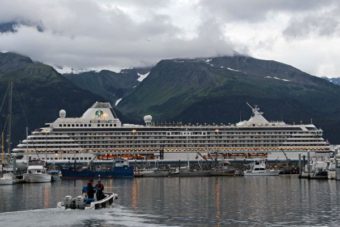
The Crystal Serenity is the largest passenger ship to traverse the Northwest Passage, traveling from Seward to New York City. Photo: Rachel Waldholz, Alaska’s Energy Desk
The Crystal Serenity is the largest passenger ship to traverse the Northwest Passage, traveling from Seward to New York City. (Photo by Rachel Waldholz/ Alaska’s Energy Desk)

The luxury liner Crystal Serenity is on its way from Seward to New York City through the Northwest Passage.

It’s the largest cruise ship to navigate the route, which hugs the coasts of Alaska, Canada and Greenland. And it’s attracted international attention, with many wondering if it’s a sign of what’s to come as the Arctic sees increasingly ice-free summers.

The ship has 13 decks, eight restaurants, a casino, and a spa. Staterooms for this trip started at about $20,000 and run as high as $120,000 (with personal butler service).

Sitting in her room, with a deck looking out over the Seward harbor, passenger Moira Somers said for most of the people on board, the ship is as much a destination as the Arctic.

“When you start your cruise, no matter where in the world you are, and you see the ship, it’s goosebump stuff,” she said.

Somers and her husband live in Victoria, B.C. (she’s originally from Namibia). Like the majority of people on board, they’re repeat cruisers – she says this is perhaps her 16th trip with Crystal.

But this time is a little bit different.

“Maybe we’re not so sure what we’re letting ourselves in for?” she said, with a laugh. “But there’s so much, we’ve read so much, we’ve prepared ourselves, and we know it’s a big thing.”

Until about a decade ago, the Northwest Passage was only open to ships with icebreaking capabilities. And while smaller cruise ships have visited the region for years, the Crystal Serenity, with more than 1600 guests and crew, will become the largest passenger ship to traverse the full, winding route across the top of Canada.

It’s a dry run for large-scale tourism in a region that hasn’t seen anything like it before.

But the man in charge is not concerned.

Captain Birger Vorland of the Crystal Serenity has spent 38 years at sea. “Nobody has ever planned a cruise as diligently and as detailed as Crystal Cruises has done for this particular voyage,” he said. Photo: Rachel Waldholz, Alaska’s Energy Desk
Captain Birger Vorland of the Crystal Serenity has spent 38 years at sea. “Nobody has ever planned a cruise as diligently and as detailed as Crystal Cruises has done for this particular voyage,” he said. (Photo by Rachel Waldholz/ Alaska’s Energy Desk)

Birgir Vorland, the master of the Crystal Serenity, has spent 38 years at sea. Originally from Norway, he says the Northwest Passage has special resonance.

“My countryman Roald Amundsen did the first transit here, between 1903 and 1906,” Vorland said. “He spent three years on this passage. We’re going to do it in 32 days and a lot more comfort.”

Crystal Cruises has spent more than three years planning the trip. Standing on the navigation bridge, Vorland ticked off the special preparations: systems to detect ice, two Canadian ice pilots joining him in Nome, an escort ship in case he runs into trouble.

“We have crossed all the t’s, dotted all the i’s,” he said. “Nobody has ever planned a cruise as diligently and as detailed as Crystal Cruises has done for this particular voyage.”

As the ship prepared to leave Seward, passengers participated in an emergency drill. In the casino, guests wearing life jackets gathered around staff holding signs that read, “Life Boat 6.”

Passengers took part in an emergency drill before the Crystal Serenity left Seward. Photo: Rachel Waldholz, Alaska’s Energy Desk
Passengers took part in an emergency drill before the Crystal Serenity left Seward. (Photo by Rachel Waldholz/ Alaska’s Energy Desk)

Despite Vorland’s assurances, plenty of people are worried about what happens if this scenario plays out in real life.

“There’s absolutely no capacity to respond to accidents,” said Elena Agarkova, who tracks shipping for the World Wildlife Fund, a conservation group.

There’s very little search and rescue infrastructure in the region, a major concern for authorities. On August 24th, just as the Crystal Serenity passes through the region, the Coast Guard, U.S. military and Canadian forces will stage a major training exercise in the Bering Strait. Called Arctic Chinook, it will simulate the response to a cruise ship going down with 250 people on board.

The question isn’t just whether the Crystal Serenity is ready for the Arctic, but if the Arctic ready for the Crystal Serenity. Some of the communities it’s visiting in Canada have populations smaller than the ship itself.

Agarkova said Crystal Cruises has done a good job of working with communities and addressing environmental concerns, with plans to forgo heavy fuel oil and exceed standards for discharging wastewater. But, she said, there’s no guarantee those precautions will be taken in the future.

“They’re doing these measures voluntarily,” she said. “So there’s nothing that would require cruise lines or cruise ships that would follow in their steps to adhere to the same kinds of standards.”

Agarkova also pointed out the irony of this new era — when the very changes making the region accessible are also transforming it.

That’s not lost on passenger Moira Somers.

“One kind of feels – I won’t say guilty, but you’re taking advantage of what is happening,” Somers said, adding that she hopes the cruise is raising awareness of climate change.

As for her more immediate goals? “My big dream is to see a polar bear,” she said.

After a moment she added, with a laugh, “And just being able to have a successful trip, I think. Getting through with no hiccups.”


Voters in one village were allowed to cast ballots in both primaries

Rep. Benjamin Nageak, D-Bethel, during debate on the creation of Indigenous Peoples Day, April 1, 2016. (Photo by Skip Gray/360 North)

The result of Tuesday’s Democratic primary for House District 40 remains in doubt.

There also are concerns over how voters in the Northwest Arctic village of Shungnak were able to cast ballots in both the Republican primary and in the primary for Democrats and others.

According to the Alaska Dispatch News, Shungnak precinct chairwoman Evelyn Woods says she mistakenly allowed 52 voters to cast ballots in both primaries.

Dean Westlake is challenging Barrow Rep. Bennie Nageak in the Democratic primary; in 2014, Westlake lost the race by 131 votes. Photo: Rachel Waldholz/Alaska's Energy Desk
Dean Westlake is challenging Barrow Rep. Bennie Nageak in the Democratic primary; in 2014, Westlake lost the race by 131 votes. (Photo by Rachel Waldholz/Alaska’s Energy Desk)

Dean Westlake is ahead of Benjamin Nageak by five votes in the district, which covers the North Slope and Northwest Arctic boroughs, as well as three precincts in the Unorganized Borough.

Election officials continue to count absentee ballots and will review questioned ballots.

State Division of Elections director Josie Bahnke said a state review will examine the statewide results – particularly those in Shungnak.
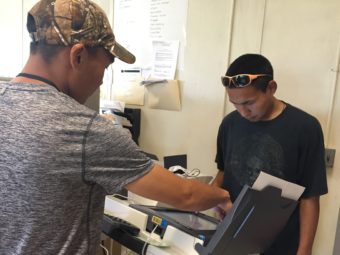
“We’re still getting to the bottom of it,” Bahnke said. “We’re considering this to be a huge training issue for us going into the general, and one we will address meaningfully and promptly.”

Shungnak was one of six precincts in northern and western Alaska that didn’t report their results until well into Wednesday – many hours after they were supposed to be reported under state election procedures.

Bahnke noted that no voter in Shungnak was allowed to vote twice in the Democratic primary. The number of Democratic voters was similar to previous primaries, but there were more than four times as many Republican voters in the village.

Forty-eight Shungnak residents voted for Westlake, while only two voted for Nageak.

It could be at least several weeks before the winner in District 40 is clear.

The deadline for absentee ballots mailed before the election to arrive by mail is Aug. 26. And the Division of Elections anticipates it will take another week to certify the results.

There’s a good chance there will be a recount, since the trailing candidate or a group of voters in an election this close can request a recount paid for by the state.

The recount request deadline is five days after the state review of the results.

Low-turnout primary could lead to five House incumbents losing

A poll watcher helps Newtok resident Bosco John, 27, vote during Tuesday's election. It was the village's first time using a digital machine. (Photo by Mareesa Nicosia, The 74)
A poll watcher helps Newtok resident Bosco John, 27, vote during Tuesday’s election. It was the village’s first time using a digital machine. (Photo by Mareesa Nicosia, The 74)

Alaskans ejected as many as five incumbents from the House in the primary Tuesday. And they also rejected two House members who tried to move up to the Senate.

But not many people showed up to vote: It was the lowest turnout for a primary in state history.

Three Republican incumbents and two Democrats who caucused with the Republicans trailed their opponents in a primary that drew only 15 percent of voters, not counting outstanding absentee ballots.

House Majority Leader Charisse Millett attributed both incumbents’ headwind and the lowest-ever turnout to the same factor – low oil prices that have hurt Alaska’s economy and the state budget.

“When you are in a deficit, I think … it’s depressing,” Millett said. “People want  to get and vote for, you know, candidates that are upbeat, and it’s hard to be upbeat in this environment.”

A lack of highly competitive statewide races also contributed to the low turnout.

Millett, who was unopposed, said it was a tough year to run for re-election.

“People are looking for someone to blame for the falling oil prices and … a sitting legislator is an easy target,” Millett said.

It’s not yet clear how the primary will affect the balance of power in the Legislature.

If the current totals hold up and Republicans continue to hold the majority, then they will have to do so with two fewer Democrats joining them — Bob Herron of Bethel was defeated by Zach Fansler, and Benjamin Nageak of Barrow trails Dean Westlake of Kotzebue (by five votes).

Casey Reynolds, who edits the political blog The Midnight Sun, said this year’s special sessions kept incumbents in Juneau and away from their districts. With the apparent losses of Herron and Nageak, he sees the chances of a bipartisan coalition increasing.

“A bipartisan organization is more likely today than it was before the election,” Reynolds said. “And the general election is going to be very important. It’s really going to be the deciding factor on this one.”

One Republican who showed a willingness to cross party lines lost.

George Rauscher defeated Republican Rep. Jim Colver in a district that sprawls from Valdez through parts of Palmer to Big Delta.

Business groups targeted Colver after he voted to reduce oil and gas tax credits.

Other incumbents who lost include Wes Keller of Wasilla, defeated by David Eastman, and Bob Lynn of Anchorage, defeated by Chris Birch.

Rauscher had said Colver was likely to join a bipartisan coalition with Democrats, though similar comments aimed at other candidates didn’t succeed.

In Palmer, Richard Best lost after making a similar charge against DeLena Johnson. And Homer incumbent Paul Seaton won, despite, he said, being subjected to disturbing and unfounded charges..

“It was the most negative campaign I’ve ever seen on the lower peninsula,” Seaton said.

State Republican Party spokeswoman Suzanne Downing said the party has room for improvement in turning out voters in the November general election.

“Every single district could improve their voter turnout, and I think as a party we’re going to work a lot harder on that for the general,” Seaton said.

Rep. Lora Reinbold won the Republican nomination for her seat. (Photo by Anne Hillman/Alaska Public Media)

The only legislator who isn’t a member of either caucus – Eagle River Rep. Lora Reinbold – was re-elected. The Republican caucus expelled her in 2015 after she refused to support a caucus-backed budget. She says she wants to rejoin the caucus and work with them to set their principles for the next term.

“And alls I’m asking is that we stick with those principles,” Reinbold said. “And that’s why it’s really important, the team that we send down there. And we’re just hoping that we’re lock-in-step and stay under the umbrella of our principles.”

While most competitive races were in the House, the state’s most expensive race was in an Anchorage Senate district, where Natasha Von Imhof defeated Rep. Craig Johnson and Jeff Landfield.

Another representative, Lynn Gattis of Wasilla, was defeated by David Wilson in her attempt to move up to the Senate. Rep. Shelley Hughes succeeded in winning the Republican nomination to succeed Sen. Bill Stoltze.

Tom Begich defeated Ed Wesley to be the Democratic nominee to succeed Sen. Johnny Ellis in his Anchorage district. Forrest McDonald defated Roselynn Cacy for the Democratic nomination to face Von Imhof.

In the House, Jennifer Johnston defeated Ross Bieling, who ran the best-funded House primary campaign, to be the Republican nominee to succeed Rep. Mike Hawker in Anchorage. Gary Knopp defeated three opponents to be the Republican nominee to succeed Rep. Kurt Olson in the Kenai Peninsula. And Don Hadley deated Lisa Vaught to be the Republican nominee to face Democratic Rep. Ivy Spohnholz in Anchorage. Colleen Sullivan-Leonard will be the Republican nominee to succeed Gattis in Wasilla. And incumbent Republican Representatives Dan Saddler, Liz Vazquez, Lance Pruitt, David Talerico and Mark Neuman defeated challengers.

The state Division of Elections still has to count absentee and questioned votes, and the results will remain unofficial until they’re certified in early September.

Anne Hillman of Alaska Public Media and Shahla Farzan of KBBI contributed to this report.

Federal Health Official Praises Kenaitze Programs

A “Łuq’a Nagh Ghilghuzht” sculpture by Joel Isaak depicts traditional Dena’ina life at fish camp outside the Kenaitze Indian Tribe’s new Dena’ina Wellness Center in Old Town Kenai.
A “Łuq’a Nagh Ghilghuzht” sculpture by Joel Isaak depicts traditional Dena’ina life at fish camp outside the Kenaitze Indian Tribe’s new Dena’ina Wellness Center in Old Town Kenai. (Photo by Patrice Kohl/Redoubt Reporter)

Alaska got a glowing report in a checkup from a top federal health care official. Though there are issues that need further treatment and support, communities showed a healthy dose of innovation in delivery and integration of care.

Mary Wakefield, acting deputy secretary for the U.S. Department of Health and Human Services, toured Alaska from Aug. 1 to 4, visiting Barrow, Fairbanks, Circle, Anchorage and Kenai. But she wasn’t bringing a prescription from Washington. Instead, she got ideas for the treatment of health care in rural communities that can be brought to other areas of the country.

“I’ve seen some phenomenal examples of Alaska Native and American Indian communities that are really focused on comprehensive services that are delivered effectively and very efficiently on behalf of their communities. So there’s some wonderful examples to draw from this state and from these communities and try to think about how we might apply some of these examples in other parts of the United States,” Wakefield said.

HHS provides funding for a wide range of community services. A big part of the department’s presence in Alaska is through Indian Health Services, which funds facilities and programs administered through Native tribes throughout the state.

During her visit to Kenai on Aug. 4, Dr. Wakefield toured the Kenaitze Indian Tribe’s Head Start program, elder center, tribal court and Dena’ina Wellness Center, which offers medical and dental care, behavioral health services and a wide variety of general health and wellness programs. The center provides care to Alaska Native and American Indian people. Behavioral health services are available to anyone in the community.

Jaylene Peterson, executive director of the Kenaitze Tribe, says it was an honor to meet with Dr. Wakefield.

“This is an unprecedented visit. It was an amazing time that we were able to share with the deputy secretary, and we were able to show her what we’ve been able to accomplish with funds that have not always met the true need. So we’ve been blessed by this trip. I believe that she has learned much about the Alaskan community and why things are so different and more challenging here in an Alaskan setting,” Peterson said.

Peterson hopes the visit will help remove some stumbling blocks that come with HHS funding. She says that some of the reporting and training requirements can be onerous.

“I don’t disagree that we should be accountable for the funds that we receive, but sometimes it can be a lot more than should be required. So, there are ways that I believe that we can be smarter with our money,” Peterson said.

Primarily, though, the tribe wanted to show its holistic approach to health care.

“It’s just phenomenal. The leadership, the commitment, the approach that is innovative in terms of the integration of a wide range of services on behalf of the people who are served here is absolutely exceptional,” Wakefield said.

Before her trip to Kenai, Wakefield participated in a summit in Wasilla on opioid abuse.

“It is an absolute epidemic in every state the across the country, including right here in Alaska. And there are some pretty serious problems in communities within the state that are really adversely impacting families and putting special burdens on law enforcement, (and) special burdens on health care providers,” Wakefield said.

She says the Obama Administration is focusing efforts on making sure health care providers have the clinical skills necessary when prescribing opioids, closing the gap between people who want treatment and access to that care, and making sure people who have overdosed have immediate access to life-saving medications.

Among its many social services, the Kenaitze Tribe offers a chemical dependency recovery program.

Unlikely allies: U.S. and Russia work together on walrus

(Photo taken during USGS research efforts permitted under US Fish and Wildlife Service Permit No. MA801652­3) Ryan Kingsbery, USGS Public domain
USGS Wildlife Biologist working at a haulout near Point Lay, Alaska. (Photo by Ryan Kingsbery/USGS)

What brought Soviet Russia and the U.S. together during the Cold War? Walruses.

Now a new federal database, created with over a century of information, shows where those animals haul out on both sides of the border. And that’s especially important as sea ice disappears and the animals spend more time on land.

Tony Fischbach says a cacophony of walruses has a lot of bass.

“There’s so many animals there. It really reverberates in your chest, especially when you’re laying in the sand,” he said.

Fischbach is a wildlife biologist with the U.S. Geological Survey. He’s describing listening to more than 10,000 walruses on the beach in Point Lay. When he’s in the field, Fischbach dresses up in an outfit that looks like beach debris to sneak up on the animals to radio tag them.

He says, not too long ago, this spot looked different.

“Well, prior to 2007, we’ve never had large numbers of walruses on the North Western Coast of Alaska,” Fischbach said.

That’s when the sea ice disappeared off the continental shelf of the Chukchi Sea. In the summer, female walruses and their babies spend time offshore hauling out. They float on sea ice to a walrus version of the grocery store, an area full of nutrient-dense food like clams.

But with the melt, they’ve had no choice but to come onshore.

When they’re onshore, if they get moving, they can develop into a panic, and there can be trampling, injuries and deaths,” he said.

Fischbach says he’s encountered over 100 walruses who died like this, mostly babies.

But this isn’t the only time in history biologists have been concerned about the Pacific walruses. In the 1960s, Fischbach says commercial overharvesting — not melting sea ice — was seen as a potential danger. And to get an idea about walrus population, the United States had to team up with an unlikely ally.

Photographer: Anatoly Kochnev, Senior Scientist, Mammals Ecology Lab Institute of Biological Problems of the North Far East Branch, Russian
Anatoly Kochnev observes a large walrus haulout near Cape SerdtseKamen’. (Photo by Anatoly Kochnev/Russian Academy of Sciences.)

“Even the Cold War was not able to stop this work from happening,” said Anatoly Kochnev in Russian.

Kochnev is the coauthor with Fischbach on the Pacific Walrus Coastal Haulout Database, which holds 160 years worth of information. It’s a historical treasure trove — from old ship logs to joint aerial surveys that happened before the fall of the Soviet Union. Our countries go way back on working together on walrus.

“Walruses are not political and do not respect any political boundaries,” he said.

Knowing that, Kochnev says Russian and American scientists agreed to work together. Our countries collected and shared information on walruses that could shape policy decisions today. All of this when Russia was still a ruled by a Community party.

“In the Soviet era, financing was provided to the scientists and that was provided to do the aerial surveys by plane, and the last one of those was in 1990, and that was the last year the Soviet Union funded the surveys,” Kochnev said.

Since then, Kochnev says Russia has been through some tight economic times, and the funding for projects like this has largely dried up. So, I ask, how is he able to spend months at a time in remote parts of Russia studying walruses? My translator, Elisabeth Kruger, responds to his answer with a laugh.

“He says I know myself how he finds money, and that I don’t need to ask him,” Kruger said.

She works for the World Wildlife Fund. The organization helps pay for Kochnev’s research.

Remember Point Lay — the spot where Tony Fischbach observed over 10,000 walruses hauling out? Just across the Bering Strait is Cape Serdtse­Kamen’. Kochnev has documented more than 100,000 walruses hauling out there.

And over the years, he says he’s witnessed the effects of climate change firsthand. Polar bears attacking and killing walruses. Something he says biologists hadn’t observed at the haulout before. Just recently, they’ve seen evidence of walruses eating birds.

“That could be an indication that they are finding it more difficult to find food,” Kochnev said. “And that their normal food source is not enough. The walruses predating on birds happened 30 years ago, but it was very rare. Now we’re starting to see it more often.”

Both Kochnev and Fischbach say they hope the haulout database can help illuminate what’s happening to the Pacific walrus. Next year, the feds will decide if the animal should be on the endangered species list. And the database has already received attention from a private company that advises the industry on oil and gas.

Fischbach says the database couldn’t have happened without decades of scientists working across the Bering Strait.

“Even down to the small details,” Fischbach said. “I was having trouble working with the Russian language, representing the Russian script in the database because it’s in Cyrillic. And I’m using Latin script, and the complexity of that on computer systems is really daunting.”

And a Russian scientist — who wasn’t even working on this project — put in the time to lend a hand.

Map showing Pacific walrus coastal haulout locations reported in the past four decades (1980s– 2010s), with a maximum aggregation size of greater than or equal to 1,000 walruses.
Map showing Pacific walrus coastal haulout locations reported in the past four decades. (Courtesy of USGS.)

Audio: U.S. and Russia work together on walruses

Site notifications
Update notification options
Subscribe to notifications