Quinton Chandler, KTOO

A $60,000 travel bill is normal for high school football in Juneau

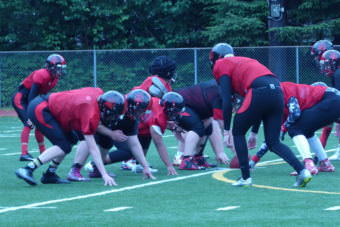
The Crimson Bears offense and defense face off at a summer practice.
The Crimson Bears practice at Adair-Kennedy Memorial Park on July 28. (Photo by Quinton Chandler/KTOO)

A Thunder Mountain High School parent might feel an especially powerful rush when their kid catches the game winning pass because that touchdown was expensive.

Juneau’s high school football teams have to pay thousands of dollars to travel long distances for their games. After the Juneau School District stopped paying for high school football travel, both teams racked up hundreds of thousands of dollars in debt just to play.

Last season, the Falcons paid a total of $66,000 to travel out of town and to bring other teams into Juneau.

That’s why Randy Quinto, the Falcon’s head coach, said the players gave up a day of freedom to work at Juneau’s annual Maritime Festival.

“Basically anything we earn will end up going back to the district,” Quinto said.

A Falcons football player helps carry a pavilion at the Juneau Maritime Festival.
A Falcons football player helps carry a pavilion at the Juneau Maritime Festival. (Photo by Quinton Chandler/KTOO)

The team does a lot of chores, and with help from their boosters, they run fundraisers each summer to pay for their next season.

Last season was actually cheap. The Falcons cut costs by ending their junior varsity program and playing more games close to home. Most of the Falcons’ opponents are in the Interior and Southcentral Alaska.

According to Thunder Mountain staff, their most expensive travel two years ago cost $140,000. Between 2014 and 2016, the team and their boosters raised more than $100,000.

Thunder Mountain Coach Randy Quinto at the Juneau Maritime Festival on Saturday, May 6, 2017.
Thunder Mountain Coach Randy Quinto at the Juneau Maritime Festival on Saturday, May 6, 2017. (Photo by Quinton Chandler/KTOO)

“These last two years we’ve been very fortunate and have gone to the playoffs and that just adds another expense,” Quinto said. “That’s plane tickets for 35 kids, plus coaches and then you’ve got vans and whatnot. With success I guess comes a price as well.”

Once, Juneau’s football teams didn’t have to pay for their travel. Thunder Mountain’s Activities Director Jake Jacoby said a few years ago, the district gradually started cutting the travel budget for high school activities. Then the money stopped.

Kristin Bartlett with the district said the school board made the cuts because costs kept rising but state funding stayed the same.

Now, the district pays for travel and then the teams have to pay it back. Jacoby said the Falcons owe $100,000 but that’s not counting all of this summer’s fundraising.

The JDHS Crimson Bears have fewer players than the Falcons. Their travel budget can cost up to $60,000. Last season was cheaper because the team didn’t make the playoffs.

Lance Fenumiai and Navy Nauer during track practice on May 18, 2017.
Crimson Bears football players Lance Fenumiai, right, and Navy Nauer pose for a photo during track practice on May 18, 2017. (Photo by Quinton Chandler/KTOO)

“(We’ve) got to fundraise about $2,000 in ads and raffle tickets,” Lance Fenumiai said. “That’s also to travel and the other half is to bring teams to come play here.”

Fenumiai siad that’s $2,000 per player. He is a 16-year-old junior on the Bears’ team. He plays running back and linebacker.

Fenumiai said fundraising is hard but worth it.

“We really want to play games and get like, scouted so we do what we can,” he said. “We go do ads and stuff (for) businesses and a lot of them are nice and they want to support us so, it makes it easier and selling raffle tickets, the community pitches in a lot and helps.”

Fenumiai’s coach, Kevin Hamrick, was hired in 2013. He said he inherited a huge debt.

“When I started, it was a negative $105,000. Recently, I believe it’s down to like $5,500,” Hamrick estimated.

Each season Hamrick said individual donors, boosters and local businesses have helped his team raise all of the money for their travel and pay about $25,000 toward their outstanding debt. He expects to be debt free after this season.

“Ninety percent of the businesses in town support both schools and they just keep giving and keep giving for every sport you can think of, every activity you can think of,” Hamrick said.

He chuckles and said the parents and coaches end up doing maybe half of the work.

Kevin Hamrick, right, oversees the Crimson Bears practice on July 28, 2017 at Adair Kennedy field.
Kevin Hamrick, right, oversees the Crimson Bears’ practice at Adair-Kennedy Memorial Park on July 28, 2017 . (Photo by Quinton Chandler/KTOO)

The high travel costs convinced the Falcons and Bears to play two of their last eight season games against each other here in Juneau. They also played two games against nearby Ketchikan.

But, Hamrick said they still come up short.

“We haven’t changed our uniform in a long time,” he said. “I’m getting ready to throw out some shoulder pads because they’ve been around for too long.”

He said their helmets are old, too. They often pay to get old helmets fixed up and ready for reuse.

“We’re within the rule book but we only get three or five brand new helmets a season and right now I am short three large helmets,” he said.

Hamrick said he’ll try to borrow some from the Falcons.

Quinto said his equipment budget is tight too.

Both coaches plan to make do and keep giving their kids an opportunity to play.

Three candidates to run for two Juneau School Board seats

Who is going to decide class sizes and how much money your kids have for activities? You’ll decide in Juneau’s Oct. 3 municipal election.

Two seats are open on the seven-member Juneau School Board. Three candidates had filed to run today by the 4:30 p.m. cutoff. The board president, Brian Holst is running for re-election according to the City and Borough of Juneau, and Jeff Short and Kevin Allen have their eyes on the two seats.

Sean O’Brien, a school board member who has served on and off since 2005 for a total of nine years, will not seek re-election.

“I think it’s really a good time to have others step up and new perspectives,” O’Brien said. “New energy is always good and I think nine years is plenty of time to contribute.”

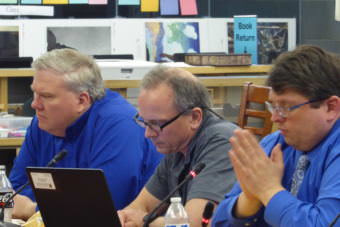
Sean O'Brien sits between Emil Mackey and Dan DeBartolo during a school board meeting in the Thunder Mountain High School Library.
Sean O’Brien, middle, during a school board meeting in the Thunder Mountain High School Library on Tuesday, April 11, 2017.

O’Brien also has plans for more personal and work-related travel.

His advice for the next board member: Be objective.

“When information comes forward, it’s so important to be able to evaluate it for what it is and not come too much with preconceived ideas,” he said. “I think the objective lens that we need to put on to make really good decisions, it just can’t be overstated enough.”

He also said compromise and making the best decisions for all of the district’s kids are key to working on the board.

Brian Holst is a Juneau-Douglas High School graduate. He is director of the Juneau Economic Development Council. He has served three years on the school board and he has been board president for the last two of those years.

Kevin Allen graduated from Thunder Mountain High School in 2016. He was a school board student representative in 2015-2016 and he was a participant in the Alaska Association of School Boards’ Youth Advocacy Institute.

Jeff Short moved to Juneau in 1972. He is a retired researcher for the National Marine Fisheries Service. He has a master’s degree in physical chemistry and a Ph.D. in fisheries biology.

Short said during his time with NOAA, he studied the long-term effects of the Exxon Valdez oil spill and he was consulted for the lawsuit that followed the Deepwater Horizon spill.

Despite king salmon ban, Golden North derby officials report good numbers

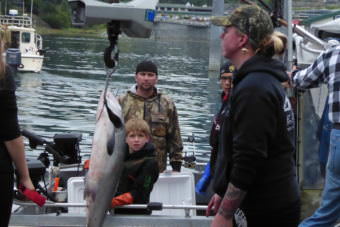
A boy and his father watch from their boat as Kami Bartness weighs their fish on a hanging scale at the Auke Bay harbor.
The Johns family watches as Kami Bartness, right, weighs one of their fish on a float in Auke Bay on Saturday. (Photo by Quinton Chandler/KTOO)

No king salmon allowed!

That Department of Fish and Game announcement doesn’t seem to be hurting boat loads in this year’s Golden North Salmon Derby. Derby officials said contestants are actually catching more fish than last year.

If you can’t have the biggest king, you might as well catch all the silvers your ice box can hold.

Derby workers are hunched over dragging tubs of silver salmon, or Coho, across the bare wood of a float in the Auke Bay harbor. They’re working on filling up super-sized plastic containers with the fish derby contestants are reeling in.

Kami Bartness is in charge of the three stations that weigh fish for the Golden North Salmon Derby. She said even though contestants aren’t allowed to target the prized king salmon, Juneau residents aren’t snubbing the three-day contest.

“I think the first day, from all the weigh stations; we’re probably looking at about 1100 validations, which is pretty comparable to last year,” Bartness said.

Contestants brought in about 16,000 pounds of fish on the first day of the contest, Bartness estimates.

“That’s better already than last year – the first day,” she said.

Last year, the derby landed about 18,000 pounds.

Fish and Game banned king fishing a week before the derby’s start because of record-low fish numbers.

Historically the derby’s heaviest fish have been kings. This year, first place will go to a silver. Derby officials said this is the first silver-only derby in its 71-year history.

But, Bartness said it’s logical that the closure isn’t hurting the contest.

“In August, it’s mostly Coho fishing anyway,” she said. “It’s just the way the species run. King fishing is mostly May and June.”

She said last year, contestants only asked to put 70 king salmon in the running for a prize.

“So about 85 percent of all the proceeds came from Coho anyways,” Bartness said.

Katherine Dimond won first place last year with a 27 and a half pound king salmon. Midway through this year’s derby, the biggest Coho weighed is just under 19 pounds.

Bartness said the good news is many of the fish that don’t have a chance to win are being donated toward the Territorial Sportsmen Scholarship Foundation.

“All the fish that are turned in, weighed and scholarship (fish) get sold to Alaska Glacier Seafoods — the processor here,” she said. “They in turn, give Territorial Sportsmen a check for the sale of that fish.”

Territorial Sportsmen, the derby’s organizer, puts the money into a scholarship fund and each year they give earnings from that fund to several local graduates to use for their next education goals.

According to the derby website, last year’s derby fish were worth slightly more than $24,000.

Derby officials plan to finalize results for the 2017 derby and announce winners on Tuesday.
Do you have $130,000 for an air ambulance ride?

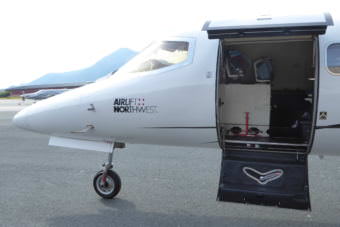
An Airlift Northwest Learjet at the company’s hangar in Juneau on Friday. (Photo by Quinton Chandler/KTOO)

On Feb. 5, Lance McVay was soaring at 39,000 feet on a million dollar private jet with multiple bone fractures.

He spent the night before pinned in his car after he crashed into the woods of Douglas Island.

“I don’t remember doing anything past crossing the bridge. They think it’s related to sleep apnea and narcolepsy,” he said.

The next morning, emergency responders cut McVay free and took him to Bartlett Regional Hospital in Juneau.

“I broke my hip with my femur. (I) broke two vertebrae, my rib, my eye socket and my wrist,” McVay said.

He said the doctors scanned him and within an hour, they decided he needed to be treated in Seattle. The flight cost $135,000.

If you’re in a car accident, have a heart attack or your baby is born prematurely, you may need to get a medical flight to another city. But a medevac out of Southeast Alaska can cost tens of thousands of dollars.

If you’re put in that position, how are you supposed to pay for it?

Bartlett is a Level IV trauma center. That means if a patient with injuries like McVay’s is brought into the emergency department, they can evaluate them, diagnose them, stabilize them and get them ready to travel to another hospital.

Bartlett had 337 people flown out of Juneau last year.

LifeMed Alaska CFO Jared Sherman, left, and LifeMed CEO Scott Kirby stand in front of a Learjet housed in Juneau on Friday, Aug. 11, 2017.
LifeMed Alaska CFO Jared Sherman, left, and LifeMed CEO Scott Kirby stand in front of a Learjet housed in Juneau on Friday. (Photo by Quinton Chandler/KTOO)

Jared Sherman is the chief financial officer for LifeMed Alaska — the newest of three medevac operations in Juneau. They just opened shop in May.

“When the aircraft takes off with a patient on board there’s a set fee and it’s called the liftoff fee,” Sherman explained. “The other fee is a variable fee … and it’s a set dollar amount per mile that the aircraft flies with the patient.”

You add those numbers up to get the total price.  The good news is nobody pays that, Sherman said.

First, if you have private insurance, he said to talk to your insurance company. They’ll send you a letter asking if you have other insurance benefits, like Medicare, that can share the flight cost.

“So make sure you don’t ignore that piece of paper,” Sherman warned. “Complete it, call your insurance carrier, let them know you were transported, you needed to be transported and that Seattle or Anchorage was the closest appropriate facility.”

The three companies that fly patients out of  Southeast Alaska are LifeMed, Airlift Northwest and Guardian Flight. They offer household memberships they say will cut out of pocket costs.

LifeMed’s membership costs $49 per year. Airlift Northwest is $99 per year and Guardian Flight is $125 per year.

“With the membership program, we have now taken all of those membership dollars and used that in lieu of your copay,” Sherman explained. “So you’re actually buying a gap coverage in the event that you’re medevaced. So in that case, you don’t ever see a bill.”

Shelly Deering, the Alaska Regional Manager for Airlift Northwest, said her company’s membership program mostly benefits the patients.

“The membership program is to provide a peace of mind for people and that’s why it’s provided. It is not a big source of revenue or income for us,” Deering said. “The majority of our revenue comes from the transport of patients and billing the insurance companies.”

Shelly Deering the Alaska Regional Manager for Airlift Northwest stands in front of the newest Airlift Northwest plane, a pilatus.
Shelly Deering the Alaska Regional Manager for Airlift Northwest stands in front of the newest Airlift Northwest plane, a pilatus, on Friday. (Photo by Quinton Chandler/KTOO)

Deering said if you have Medicaid, you don’t need a membership. Medicaid will take care of the bill.

The catch with the memberships is that they only work for the company you buy them from. So, you have to make sure doctors know who you want to call if you need a medevac.

“Probably the best thing is family members,” Deering suggested. “If a family member comes in, make sure they mention that as soon as they arrive. … You can have it in your wallet, with your ID, because invariably, if you’re unconscious, they’re going to be looking for that ID. So a sticker on the back might be beneficial.”

Deering and Sherman said the companies have been talking about coordinating their services so each membership can work with all three carriers, but Deering said it’s complicated and right now, they don’t offer that.

If you don’t have insurance, Sherman and Deering said to call because they have a charity program and they will work with you to get your bill resolved. They said just like an emergency room, they won’t turn anyone away because they don’t have insurance.

Lance McVay flew with Airlift Northwest and he didn’t have a membership, but he and his wife are covered by two insurance policies through the state. His $135,000 flight was part of a $300,000 medical bill. His insurance providers decided he should pay $10,000 out of pocket.

Deering advises everyone to make sure their insurance covers medevacs. She estimates Airlift Northwest flies at least one patient out of Southeast every day.

Jacob Resneck contributed to this story. 

Editor’s Note: Lance McVay is a volunteer DJ for KTOO.

Site notifications
Update notification options
Subscribe to notifications