Quinton Chandler, KTOO

Police search downtown house neighbors suspect for criminal activity

“We’re in the middle of a S.W.A.T. team!” Alison Talley said that warning prompted her to look outside Holy Trinity Episcopal Church on Friday. She saw several police officers dressed in body armor and armed with rifles.

In a press release, Juneau Police Department said the officers served a search warrant on a home in the 400 block of Fourth Street.

Officer Jason Van Sickle said the department wouldn’t comment on the search because it’s part of an open investigation.

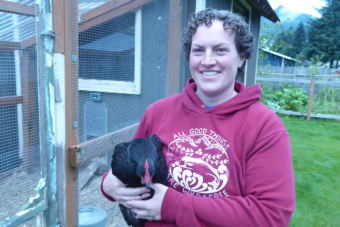
Monica Ritter in her yard on Saturday in downtown Juneau. (Photo by Quinton Chandler/KTOO)

The next day, Monica Ritter stood in her front yard, down the street from the house. She’s co-founder of the Uptown Neighborhood Association. She’s lived in this neighborhood for 24 years and she said over the past four years she’s heard neighbors complain more and more about criminal activity in the area. Lately, they’ve been worried about the house that police searched and one right next door.

“All I know is from what the neighbors see and hear, and the phrase, ‘Those two houses.’ Keeps coming up,” Ritter said. “… The police officer has said at our meetings that they’re working on surveillance and working on the case that involves illegal activity coming and going out of those two houses.”

Ritter said she and Joanie Waller started the Uptown Neighborhood Association in October last year because they wanted to have a closer relationship with their neighbors and the city.

She said there are roughly 100 people on the association’s email list and they’re actively trying to add more neighbors.

“So, we’re hoping that whoever owns the property where all these negative happenings are going on will have to be held accountable and have to clean up their properties – physically and human activity-wise,” she said.

James Barrett lives on Harris Street, across from the two homes. He said he and his mother, Kathleen, own them through Breffni Place Properties, a limited liability company. Barrett said the police search was about stolen property, and he has had some problems with the tenants. He declined to provide further comment.

City records show the Barretts’ company also holds ownership of the Bergmann Hotel, which the city condemned for safety hazards in March. The hotel is less than a block from the house police searched Friday. City residents have complained about criminal activity inside the hotel for years.

With a few weeks to go, Alaska schools are short 245 teachers and special educators

A pencil leaning against an apple sitting on top of a twenty dollar bill.
(Photo illustration by Quinton Chandler/KTOO)

Imagine you’re fresh out of school, broke and hunting for your first teaching job. Then a school district offers you a job paying $70,000 a year. Afterward, you meet Joshua Gill from the Lower Kuskokwim School District in rural Alaska and he offers you a job paying $52,000 a year.

“For a kid coming out of school, that’s an $18,000 difference,” Gill said.

Seventy-thousand dollars a year for a new teacher may be surprising but Gill said that actually happened when he was recruiting in the Lower 48 this spring. He is in charge of hiring people for his district. He said school districts offering more money get to take their pick.

“And then you’ve got to convince somebody to come to bush Alaska where we have some teacher housing that doesn’t have running water,” Gill explained. “They have honey buckets, (a) gray water system and (you’re) trying to convince them to live in a village thousands of miles away from their families.”

But, recruiting is just part of Alaska’s challenge. Toni McFadden said the bigger problem is there are fewer teachers.

“Nationwide our country is facing a severe teaching shortage,” McFadden said.

With only a few weeks to go until the new school year begins, about half of Alaska’s school districts are still looking for a couple hundred teachers and special educators to hire.

McFadden is with Alaska Teacher Placement. She helps connect teachers with Alaska school districts. That partly means holding job fairs. Their biggest one of the year drew between 200 and 250 people.

“And that has been a steady decline. People remember from the ’80s when there were over a thousand people looking for jobs in Alaska.”

Juneau School District Human Resources Manager Cherish Hansen left, and recently retired Human Resources Director Ted VanBronkhorst at the Alaska Teacher Placement Job Fair in Anchorage, March 2017.
Juneau School District Human Resources Manager Cherish Hansen left, and recently retired Human Resources Director Ted VanBronkhorst at the Alaska Teacher Placement Job Fair in Anchorage in March. (Courtesy Juneau School District)

She said Alaska school districts hire about 800 teachers from out of state each year. Close to 200 more come from within the state.

“Fewer people are going into teaching as a career, about 50 percent of teachers leave teaching as a career during the first three to five years,” she said. “Even to the point that some colleges are cutting back on teaching classes because they don’t have the enrollment that they used to have.”

Alaska Teacher Placement counts 155 open teaching positions and 90 special education positions across the state as of August 4.

“We’re looking at weeks before school starts and we have 90 elementary teacher positions that we need,” she said.

According to McFadden about half of the state’s school districts still need teachers. She said that’s similar to last year.

“We’ll have substitutes in classrooms getting the year started with children when it’s so important to have their teacher there establishing routines and getting learning started,” McFadden added.

Another piece of the problem is teacher turnover. Just ask Dayna DeFeo, a researcher with the Center for Alaska Education Policy Research.

“We recently calculated the per teacher cost of turnover in Alaska,” DeFeo said. “We calculated that it is about $20,400 every time a teacher turns over for each position.”

That money comes from things like recruitment costs, hiring, training and teacher productivity.

DeFeo said between 2013 and 2014, out of the 1,095 teachers who left jobs in their districts, 87 percent stopped teaching in Alaska.

She said 80 percent of teachers who leave rural Alaska leave the state education system.

She doesn’t have more recent numbers but said that was a steady trend for five years.

Todd Hess, head of human resources for Anchorage School District, said he knows teachers who claimed they were leaving the state because of uncertainty over Alaska’s education funding.

Earlier this summer, the Anchorage School District sent layoff notices to about 200 teachers while they waited for the Legislature to pass an operating budget and decide how much money Alaska schools would have for the 2017-2018 school year.

When legislators passed the budget days before the start of the new fiscal year, the district canceled the layoff notices, but not before stressing out a lot of educators.

Meanwhile, DeFeo said in the Lower 48, there’s a stronger economy, growing teacher salaries and a short supply of teachers, making a “perfect storm” for teacher recruitment in Alaska.

Summer tips: Save your chickens, stop feeding bears

A chicken eats from a hanging feeder inside Sarah Dolan's chicken run in the Mendenhall Valley on Saturday, July 29, 2017.
A chicken eats from a hanging feeder inside Sarah Dolan’s chicken run in the Mendenhall Valley on Saturday. (Photo by Quinton Chandler/KTOO)

If a bear cornered Sarah Dolan’s chickens inside her chicken run, they would be sitting ducks.

Six birds are strolling aimlessly around the run surrounded by a mesh fencing called hardware cloth. It looks like chicken wire, but Dolan says it’s more solid.

“And I have that screwed into the 4-by-4s and then in the ground with cement pier blocks,” Dolan explained.

She has clear, plastic roofing at the top to protect from aerial hunters such eagles. She just lost two chickens to ravens earlier this summer. She let them free-range and didn’t watch for birds. It’s a mistake she doesn’t plan to make again.

Dolan’s recommendations for a chicken coop

  • Use electric fencing
  • Must be dry
  • Must be well ventilated
  • Needs roosting bars
  • Install a feeder
  • Add nesting boxes (secure them if they can be accessed from outside)
  • Build in 2 to 4 feet per bird
  • Use wood shavings, straw or shredded paper for bedding
  • Install a very secure human door and a small chicken door

Chickens are just one of the attractants Fish and Game is reminding people to protect from hungry bears. The agency recommends chicken owners put electric fencing around their birds.

Dolan said it’s a smart precaution but she doesn’t have any.

“I know that’s a gamble,” she said. “Because I know it’s a gamble, if I were to come out one day and a bear were actively trying to get into my run or coop, I would try to scare it off of course — that’s it. It’s my fault if it gets in.”

But, she’s confident the worst won’t happen because she has a fallback plan.

“It would take a bear a little bit to break (the run) down and in those seconds I would envision my chickens being able to run into the coop,” Dolan explained.

Her coop is overkill for such a small operation. Her husband calls it “Cluckingham Palace.”

It’s a strong wooden shed. You’d need a lot of force to break into it.

A chicken-sized sliding door, like a dog door, leads from the coop into the run. Dolan thinks if a bear attacked, her birds could hide on the other side and the bear would eventually give up.

She didn’t always have a palatial coop, but in the six years she’s been raising chickens, she’s still never lost any to bears.

The fence helps.

“A bear can scale that in a heartbeat if it wanted to, but it can’t see back here,” Dolan pointed out. “The sounds of a chicken isn’t really what’s going to draw it back here, it would be a smell and I don’t have a smell.”

Dolan keeps the chickens’ food in sealed containers inside her coop and she also feeds them inside. Her feeder doesn’t let the chickens spill food on the floor and she has what she calls a poop hammock that hangs underneath the chickens’ roosting bars.

The hammock catches poop and she composts it. She adds leaves and moss when she uses the compost to filter out lingering smells.

She’s not lying. The place really doesn’t stink.

Dolan’s recommendations for a chicken run

  • Use electric fencing
  • Use hardware cloth and sink it into the ground
  • Cover the top with roofing or netting
  • Make a dust bath for the chickens with wood ash or diatomaceous earth
  • Leave a waterer in the run instead of the coop (The coop must stay dry)

Dolan is part of a growing community of Juneau chicken farmers.

Teaching chicken owners how to keep bears out of their coops is one way Stephanie Sell is trying to minimize human-bear encounters.

Sell is the Fish and Game area biologist for northern Southeast Alaska. She is having a bear-crazy summer.

“We’re getting a lot of calls about bears in trash and sometimes we can address those and other times we have more aggressive behavior, like, the bear that we just dealt with, that we need to deal with immediately,” she said.

Biologist Stephanie Sell looks for electric fencing in a closet at the Fish and Game office on Douglas Island.
Biologist Stephanie Sell looks for electric fencing in a closet Friday at the Fish and Game office on Douglas Island. (Photo by Quinton Chandler/KTOO)

Sell and her co-workers recently put down a 470-pound black bear after it broke into a trailer home arctic entry. She said it was probably the biggest black bear she’s ever handled and was a known troublemaker.

She suspects the same bear broke into another home a few days before and she remembers that two years ago it pushed a window out of another home and climbed inside.

“You don’t get to be that big by being stupid so … I can guarantee that this bear has probably been eating trash for a long time,” she said. “(It) has found food sources within arctic entries before, so it basically recognizes that and will go back and try to find those locations again.”

This bear caught public attention because it was really big, but Sell said its misadventures are a symptom of the problem that is taking the steam out of her summer.

Some people in Juneau are breaking the rules for bear attractants.

“Trash, chicken coops, pet food, bird seed, stuff like that,” Sell said. “Food conditioning is a form of habituation. They find humans as being a normal part of their world. When people are saying, ‘Well it’s not afraid of me at all,’ that’s because we’ve been feeding it for years.”

Dolan’s advice for chicken first aid

  • Use black strap molasses to induce diarrhea
  • Add apple cider vinegar to water to reduce bacteria
  • Keep gauze pads, first aid tape, vet wrap, eye droppers and scissors
  • Add electrolytes to water if chickens are sick
  • Use Blu-Kote antibacterial/antifungal spray for wounds
  • Use Vetericyn spray to kill bacteria in cuts and to treat bumblefoot
  • Use coconut oil to prevent frostbite on chicken’s combs
  • Use Kocci Free to cure parasitic infestations like coccidiosis

Sell said don’t leave out pet food; don’t put out a bird feed in the summer. Juneau law says only put trash in bear resistant buildings or containers.

This is common knowledge. Fish and Game has been preaching it for years, but based on the reports she’s getting, Sell thinks too many people are getting complacent.

Sarah Dolan highly recommends new chicken farmers use electric fencing around their coops and runs. She also said to build everything before you get chickens. Otherwise, you might get busy with life and settle for a half-finished home for your birds.

University of Alaska could receive $5 million for capital projects

Five million dollars is coming down the legislative pipe for the state’s university system to spend on major building renovations and repairs.

The Legislature passed its capital budget Thursday and it’s waiting for the governor’s signature.

University of Alaska officials said the Board of Regents will decide how to distribute the money to Alaska universities at its Aug. 9 meeting.

Michael Ciri, vice chancellor for administration at the University of Alaska Southeast, said capital project dollars typically go to major building projects. For example, he said an operating budget would pay for fixing a damaged roof, but a roof replacement is paid for through the university’s capital budget.

He said UAS generally spends money on capital projects to save money on upkeep over time.

Site notifications
Update notification options
Subscribe to notifications