Mendenhall Glacier Visitor Center, Juneau, is pictured in the distance at the top of a hill. (Creative Commons photo courtesy USDA Forest Service Alaska Region)
Officers were investigating a tripped alarm when they heard noises inside the visitor center, according to police. When they tried to setup a perimeter around the building, police said they saw the suspect, identified as Mack Parker, 51,run away into the woods.
A car tied to Parker also was found at the scene.
A ground-level window was broken in the incident and multiple items were reported missing. Police said security camera footage from inside the visitor center appears to show Parker stealing property.
They don’t know the total value of the missing items.
Parker was arrested this afternoon for 2nd-degree burglary when officers found him inside a home near James Boulevard.
Parker is being held without bail at Lemon Creek Correctional Center.
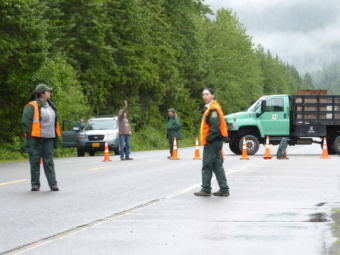
Forest Service employees stand ready to turn visitors away from the Mendenhall Glacier Recreation Area on Sunday. (Photo by Quinton Chandler/KTOO)
Police and Forest Service rangers conducted a search Sunday for Parker after he fled the visitor center. The Forest Service decided to close the road to the Mendenhall Glacier Recreation Area during the investigation.
Forest Service spokesman Paul Robbins Jr. said the district ranger wasn’t sure it was safe to keep the area open because he didn’t know whether the intruder was still in the area.
Robbins estimated about 3,500 visitors could’ve been affected by the closure.
Alexandrium is a genus of dinoflagellates that leads to paralytic shellfish poisoning. This cell was identified by a team of researchers at NOAA’s biotoxin testing lab in Seattle. (Photo courtesy of NOAA).
Those butter clams you just found may not be safe to eat if you harvested them near Juneau’s Auke Recreation Area.
In a new report released Friday, Southeast Alaska Tribal Ocean Research found high levels of biotoxin that causes paralytic shellfish poisoning inside the butter clams.
The organization measures biotoxin in species found in specific sites near Alaskan communities.
The latest report shows that in some Auke rec butter clams, researchers found about three-times the level of toxin accepted by the Food and Drug Administration.
The group doesn’t have recent data for biotoxin levels in Auke Bay, Amalga Harbor and Eagle Beach.
Outside of Juneau, the group didn’t have new data for Haines, Yakutat, Hoonah and Hydaburg.
Researchers did issue a butter clam advisory for Nahku Beach in Skagway and for multiple species in areas of Ketchikan, Wrangell, Metlakatla, Klawok, Craig and Kasaan.
The organization advises you to be careful and get toxin levels tested when harvesting shellfish. You can’t get rid of the toxin that causes PSP by freezing or cooking it.
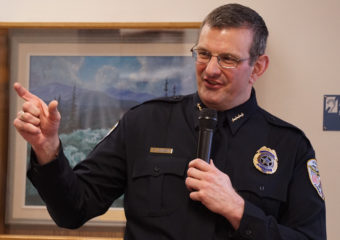
Juneau Police Chief Bryce Johnson fields a question from a Juneau resident during a meeting at City Hall about crime on Jan. 17, 2017. (Photo by Jeremy Hsieh/KTOO)
The City of Idaho Falls has hired Juneau Police Chief Bryce Johnson to replace their own retiring police chief. An Idaho Falls news release announced Johnson’s hire earlier today.
Johnson has been Juneau’s police chief for four years. He said he’s leaving to be close to family. He has kids and grandkids in the Lower 48.
“We’ve got a couple of kids that graduated from Thunder Mountain High School and we’ve just absolutely loved it here,” Johnson said. “As the kids grew older, they moved away and now there’s a couple of grandkids – we would really like our grandkids to know who we are.”
Still, working in Juneau has been one of the highlights of his career, Johnson said, and he’s “a little sad to go.”
When asked about the challenges he’s faced in Juneau with increases in drug addiction, property crime and trying to accommodate a growing homeless population, Johnson said those problems are not unique to Juneau.
“The whole country’s going through an opioid epidemic and you’ve got these issues going on all over the state and all over the country,” Johnson said. “That’s not something you can escape in law enforcement.”
He thinks the state’s criminal justice reform and state budget cuts have added more pressure onto local law enforcement and he said Juneau’s police have stepped up to meet those challenges.
Juneau City Manager Rorie Watt is sad to lose Chief Johnson.
“He integrated himself into the community; he volunteered on nonprofit boards; he had a very public facing presence,” Watt said. “He was (an) incredibly hard worker.”
When Idaho Falls officials asked Watt about Johnson’s job performance, he told them that if he could offer Johnson a raise to persuade the police chief to stay, he would.
Juneau Police Department Deputy Chief Ed Mercer will be acting police chief until Johnson’s replacement is hired, Watt said.
Before coming to Juneau, Johnson served the Salt Lake City Police Department for about 20 years. He also served as a Reserve Intelligence Specialist for the U.S. Naval Reserve. And he taught criminal justice and law enforcement in Salt Lake City high schools.
The University of Alaska Board of Regents met in Anchorage for an executive session in September 2014. (Photo by Josh Edge, APRN)
The University of Alaska’s Board of Regents unanimously agreed on a budget today, a week after the Legislature decided to cut university funding by about $8 million. That cut comes with a $3 million increase in the university’s costs.
To absorb its share, the University of Alaska Southeast is selling property and sweet-talking potential donors.
Rick Caulfield, chancellor of the University of Alaska Southeast, said the University of Alaska’s funding isn’t settled yet.
Gov. Bill Walker could still make adjustments with his veto power, and the Legislature hasn’t passed a capital budget, which Caulfield said could bring more money.
“We’re waiting not only on the operating side, which is the governor’s signature but also on the capital budget,” Caulfield said.
He said UAS will lose $400,000 to $600,000 under the current plan.
“It’s very likely that we’re looking at an additional six or eight positions going away,” Caulfield said. “We try to do that through attrition, but in a couple of cases, it’s been a matter of a layoff.”
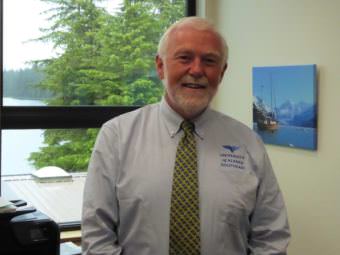
University of Alaska Southeast chancellor Rick Caulfield poses in his office on Monday, June 26, 2017. (Photo by Quinton Chandler/KTOO)
Cutting through attrition means not filling positions when someone quits, retires or is fired.
This is the fourth budget year in a row that the University of Alaska has taken cuts and they’re adding up.
“About (a) 20-21 percent reduction in University of Alaska Southeast general fund dollars,” Caulfield said. “It’s been a real struggle to try to maintain academic quality even as we’re dealing with those kinds of budget cuts.”
The cuts also mean fewer resources for things like marketing, advising and financial aid, he said.
Caulfield isn’t happy about the cuts, but he knows it could be worse. Originally, the Senate proposed close to a $22 million cut.
“An element of relief there,” he said. “Inevitably, we’re still having to deal with the cuts. But, to the extent that having a budget in hand now minimizes disruption, we want students to know that they can still get an education at the University of Alaska.”
According to a university news release, the budget also sets aside $6 million for a few select areas.
Caulfield said the money is going toward things like academic research, improving office efficiencies, driving up enrollment and improving retention.
He said the university wants to increase the number of students pursuing highly demanded jobs like nursing and teaching; that every dollar put into research tends to bring back about $4 in outside investment and research improves knowledge on issues such as climate change and fisheries.
Caulfield is looking for more money to help make up what UAS will lose.
“Many people will be familiar with our administrative services and bookstore building, which is the old Horton’s Hardware building for those who’ve been around for a while in Auke Bay,” he said. “We put that on the market and I believe we have a buyer for that building.”
The school also recently sold a house previously donated by Alaska’s first female attorney general, Grace Schaible. Schaible passed away earlier this month.
Caulfield said the house sold for about $439,000 and UAS put the money into an academic endowment.
The university also is drumming up support from past donors and Caulfield is asking UAS alumni to help out their alma mater.
“Just a few days ago, I was in Seattle and we were visiting with people who’ve already been generous in providing scholarship support for students at UAS,” he said. “We were having meetings with them and encouraging them to remain engaged.”
He said private donations are a modest part of UAS’ budget, partly because the school is young and has a smaller pool of potential donors, but Caulfield hopes that one day those private dollars will help shore up his budget, especially if the cuts continue.
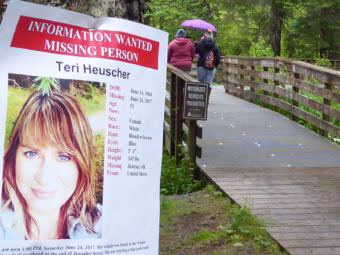
A flyer posted on Monday at the Under Thunder trailhead off Jennifer Drive in the Mendenhall Valley states that Teri Heuscher is missing. The 53-year-old Juneau woman’s vehicle was found there Saturday. (Photo by Quinton Chandler/KTOO)
Alaska State Troopers called off a weekend-long search for a 53-year-old Juneau woman because they didn’t find evidence Teri Heuscher was in the area they were searching.
Trooper spokeswoman Megan Peters said continuing without that proof didn’t make sense.
“We haven’t found anything to indicate that we’re on the right trail or something that would tell us where else she might be,” Peters said. “Without any kind of definitive clues to where she is, we don’t know what else to do and we can’t keep doing the same thing.”
Heuscher’s family found her car at the Under Thunder trailhead on Jennifer Drive on Saturday afternoon. The trail leads up Thunder Mountain in one direction and toward the Mendenhall Glacier in the other. Peters said the family searched on their own first, then reported her missing when they didn’t find her. The troopers got the report around 4 p.m.
“We had approximately 25 to 30 organized searchers that were a part of this,” Peters said. “In addition to the organized searchers, we had about the same number of volunteers that were coming in.”
The organized search continued until Saturday night, resumed Sunday morning and was called off Sunday evening.
Peters said evidence indicating Heuscher’s general location must be found before troopers will organize another search.
“Things have to have an endpoint to it, or they have to have something that keeps directing you, telling you that you’re in the right area.”
Juneau police, Capital City Fire/Rescue and the U.S. Forest Service participated in the search alongside volunteer groups: Juneau Mountain Rescue, SEADOGS and the American Red Cross. A Temsco helicopter searched from above.
Peters said when people go missing it can be difficult to know when to start worrying, but she said it’s best to notify authorities as soon as possible.
Close
Update notification options
Subscribe to notifications
Subscribe
Get notifications about news related to the topics you care about. You can unsubscribe anytime.