The Coast Guard suspended a more than 40-hour search for a young man who disappeared near Hydaburg on Saturday. According to a news release, a helicopter, two Coast Guard cutters and multiple search and rescue boats were deployed to search for Francis Charles of Hydaburg.
Charles was last seen wearing tan chest waders and a blue float coat. He was reported missing after he didn’t return from a fish camp in Eek Point, 6 miles southeast of Hydaburg on Thursday afternoon.
Hydaburg search and rescue personnel found Charles’ skiff near California Island, which is between Hydaburg and Eek Point. They also found a pair of boots in the water near the beach at Round Point on Blanket Island. Blanket Island is 1 nautical mile southwest of Eek point across Sukkwan Strait.
Nicholas Meyer, a Coast Guard Sector Juneau Command duty officer, said rescue crews searched more than 180 square miles.
The state troopers identified him as age 21; the Coast Guard identified him as 20.
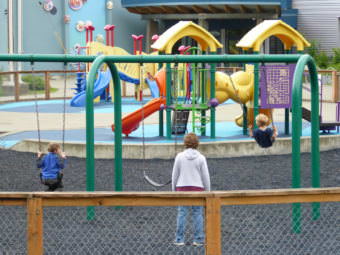
Juneau kids play on the playground in front of Harborview Elementary School on Wednesday. (Photo by Quinton Chandler/KTOO)
Alaska teachers have to be certified by the state before they can teach. So every year, the state Department of Education evaluates thousands of applications for teacher certification. This summer, about 50 of those applications could come from Juneau School District.
Ted VanBronkhorst, head of the district’s human resources department, said they will mostly come from “our teachers who are current employees and are applying for renewals. We have about 30 or so in that category.”
He said the district also has about 20 open positions that they will be hiring teachers for.
Ted VanBronkhorst heads the Juneau School District’s human resources department. (Photo by Quinton Chandler/KTOO)
“If they come from out of state, then they’d need to apply for an Alaska certification,” VanBronkhorst said.
But legislators’ inability to agree on a state budget could make it harder to approve those certifications in time for the first day of class.
Sondra Meredith works in the Department of Education’s Teacher Certification Office. She said it typically takes about six weeks to check a teacher’s credentials.
“The other part of the process that will also be extracted would be the actual background clearance piece, which can take as much as 60 days,” she said.
When teachers apply for a certification, Meredith’s office asks the Department of Public Safety to check their backgrounds against state and FBI records. She said the background check can lengthen the vetting process by a couple of weeks, or even a month.
If lawmakers don’t pass a budget before July 1, state offices will close. That means Meredith won’t go to work, so teachers who have questions about their applications or need to fix mistakes won’t be able to get help with the process, and dozens of applications will get stuck at the worst possible time.
“Summer is the busiest time for our section for processing of applications,” Meredith said.
She said the amount of mail her office received between May 1 and August 31, 2016, was almost half the mail they got in a year’s time. Most of that mail was from teachers applying to be certified.
There is one saving grace.
If there is a shutdown, once a budget is passed and state offices reopen, Meredith said her office can give teachers a temporary certificate. This is often done to get teachers into classrooms when their certifications are taking too long. The applications just have to pass the office’s initial review process. Teachers who send in applications after a shutdown would have a tougher time.
“If we have a lot of applications piled up, we can’t even do that first review of those applications in order to issue even something that’s provisional,” Meredith said.
The temporary certifications make Joshua Gill with the Lower Kuskokwim School District less worried about certifications stalling.
“Even if we do get a state shutdown, hopefully, it won’t last too long and we’ll only be behind for a short period of time,” Gill said.
But, Christine Ermold with Kenai Peninsula Borough School District isn’t as optimistic for some of her teachers. She thinks about 60 teachers who need to get their certificates renewed within the next two months will be fine.
“Because we at least know that they’re eligible for their renewal,” Ermold explained. “The ones that I’m really worried about are our new hires.”
Every year, her district hires 70 to 90 new teachers. She said some of them, especially those from out of state, may not have even applied for their certifications.
On top of that, because the Legislature hasn’t passed a budget, her district has a hiring freeze on about 30 positions.
“Because of that, they haven’t yet been able to pursue a priority processing of their teacher certificate,” Ermold said.
A shutdown could put those teachers in a worse position because they wouldn’t even get a job offer until a budget passes.
Legally, teachers who don’t have their certifications by the first day of school can only teach as substitutes for 19 days until a state certification is approved.
Juneau schools Superintendent Mark Miller is sitting at his computer and he’s about to watch the House Majority Coalition explain why representatives pushed a hurried budget through the House right before the end of the first special session.
The bill would’ve given K-12 schools the same $5,930 per student that they got last year before Gov. Bill Walker’s summer vetoes.
“We’ve been planning all the time that we were going to get full funding or flat funding of education; so we built our budget around that assumption,” Miller said
Juneau schools Superintendent Mark Miller in his office in Juneau on March 15, 2017. (Photo by Jeremy Hsieh/KTOO)
The House bill also increased the amount the Legislature appropriated for student transportation last year by 8 percent.
But the House’s budget didn’t have the Senate’s support. Now, they’re back to square one deciding a budget.
The Senate proposed the same amount of transportation money as the House but unlike the House, senators tried to cut per student funding for Alaska schools by 5.7 percent.
“You know, we make our best guess,” Miller said. “We trust the Legislature will do the right thing and then we don’t get a lot of sleep until it’s all put to bed.”
If the House plan for education passes, Miller said Juneau schools will be in the same boat as last school year.
“We’re not going to be able to add much of course because we don’t have any more money,” he said.
Given Alaska’s money problems, he calls that a good deal. The cuts from the Senate would be much harder on the district.
“It will change our bottom line and if it cuts too deep and we find out that our ending fund balance will be in the red, which it can’t be, then we’ll have to take actions to stem that,” Miller said.
He isn’t sure what those actions would be.
He said the district has money left over from this last school year that can absorb a 1 percent to 2 percent cut like, a buffer.
After that, cutting staff is his last option.
“Nine out of 10 of our dollars are spent on people,” he said. “If you have to really change your bottom line, the only way you can do that is by having less people. There’s no other way.”
Miller can’t lay off teachers because they’ve already been offered contracts. He might have to try a combination of laying off about 20 non-faculty and leaving roughly 20 teaching positions unfilled if the full Senate cut passes.
That means Juneau kids would most likely have larger class sizes.
“Which means less individual attention and less differentiation,” Miller added.
Miller also doubts the district would be able to pay for a planned shift to online, paperless classrooms.
This is the third year in a row that the Legislature has left schools waiting for a budget in the middle of June. Miller says each time he and his staff have had to fly blind and it doesn’t get any easier.
They started putting the district’s $87 million budget together back in January, and they sent it to the Juneau borough in March for approval. Miller said he can’t wait until July to know whether he has the money to pay for that budget.
“The ship has sailed I mean, to use the metaphor, the horse is out of the barn,” Miller said. “All of my teachers have already been given contracts; we’ve set the budget for next year; this is not the time that we can go back to the drawing board and rework budgets.”
The Legislature has until July 1, to pass a budget, or the state government will shut down. Miller will keep waiting and said he’s hoping for the best.
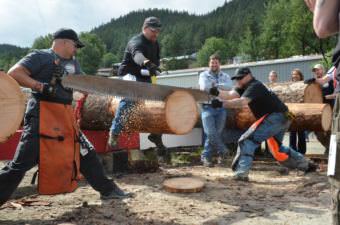
A contestant drives spikes at Juneau Gold Rush Days on Saturday. (Photo by Quinton Chandler/KTOO)
It’s wet and muddy, but that isn’t stopping raincoat-clad Juneau residents from enjoying the 27th annual Gold Rush Days.
The two-day celebration promotes Juneau’s oldest industries: mining and logging. It has labor-intensive competitions like jackleg drilling, spike driving, axe throwing and log bucking. The games and fair atmosphere are part of a larger plan to strengthen relationships between residents and the workers who help build the local economy.
Right now contestants are finishing up the men’s spike driving competition.
It’s pretty much what it sounds like. Each contestant takes his turn hammering in metal spikes with the butt of an axe.
Nicolette Dunlap is sitting under the food pavilion with a friend. She says her favorite thing to watch are the men and women’s speed climbing competitions.
“When they climb the pole or whatever,” Dunlap says. “I don’t know it’s just really cool that someone could do that, because I could never do it.”
Across the way, Jerry Harmon is inside of a tent planting tiny pieces of gold in three plastic containers full of murky water. He is staging a hands-on gold panning exhibit for a herd of little kids waiting outside.
Harmon lifts a bowl out of the dirty water and holds it up for inspection.
“How does that look?” he asks.
Several tiny flecks of gold shine against the rough, worn bowl.
“Everybody finds gold, (I) guarantee it. There’s a lot of gold in there,” Harmon says.
Jerry Harmon has been helping coordinate Juneau Gold Rush Days since the event first started 27 years ago. (Photo by Quinton Chandler/KTOO)
Jerry Harmon holds a bowl he used to pan for a few small gold pieces visible in the center. (Photo by Quinton Chandler/KTOO)
A group of children try their hand at gold panning at Juneau Gold Rush Days on Saturday. (Photo by Quinton Chandler/KTOO)
He has been helping with Gold Rush Days since the very beginning. He says it was originally set up to give Juneau residents a place to come meet their miners and loggers.
“So that they could have friends that were miners and we have a lot friends now that are miners,” Harmon explains. “We have a lot of people who are not miners and not loggers that come out and compete as well.”
Juneau was founded shortly after gold was discovered in the area in 1880. The first strikes drew hundreds of new residents and sparked a need for logging to build the mines and people’s homes.
Harmon points out that today mining is still a big piece of Juneau’s identity.
“The Kensington mine is operating here. The Greens Creek mine is operating here and it’s part of the way of life,” he says. “(It’s) just a way of life!”
Competitor in the men’s hand mucking competition on Saturday. (Photo courtesy Juneau Gold Rush Days)
Two men compete in the hand bucking competition on Sunday. (Photo Courtesy Juneau Gold Rush Days)
Harmon says usually up to 10,000 people come to this two-day event. It’s hard to gauge the crowd size today, but it’s easy to see that people are having a good time.
Kirk Ziegenfuss is a driller and blaster on mostly surface construction jobs. He used to be a miner and he also has been coming since the very first Gold Rush Days. Now, he jokes that he’s gotten too old to compete in most of the games.
“… I used to do all the events in my younger years,” Ziegenfuss says. “The hand mucking where you use a shovel or the spike driving where you’re driving these big spikes with an axe. I’m getting to slow on everything else to even think about those anymore.”
It’s a fun time for Ziegenfuss. It’s a free, family event.
“I kind of like it because I get to hob knob it with some of the miners that I know like, old timers like, this guy and some of the new guys coming up,” he says. “I just show up to give (them) something to shoot for. And they’re passing me up now.”
Kirk Ziegenfuss at Juneau Gold Rush Days, Saturday. (Photo by Quinton Chandler/KTOO)
But, he also likes that the party helps connect people in the community who work and live in very different environments.
He smiles and says, “Some people actually have to get in there and get dirty and wear their bodies out. It kind of brings everybody together and gives them something to … especially in Southeast Alaska, everybody likes a good fair.”
Gold Rush Days is sponsored by over 40 Juneau businesses including the Hecla Greens Creek Mining Company and the Kensington Mine. Jerry Harmon says local residents generally donate about $30,000 each year.

Hoonah City Schools kids show off frogs they colored in January 2017. (Photo by Quinton Chandler/KTOO)
In the state Capitol building, legislators are in a stalemate arguing over two spending bills, while almost 40 miles to the west PJ Ford Slack is hammering out a final report to the local school board.
Hoonah City Schools Superintendent PJ Ford Slack finishes a school board report on Friday, June 9, 2017. Photo by Quinton Chandler/KTOO)
Ford Slack is the outgoing superintendent for Hoonah City Schools — a remote district on Chichagof Island that expects to serve 106 kids next year.
Ford Slack calls Hoonah the “canary in the coal mine” for rural Alaska schools – a metaphor that references an old warning system for miners.
“They used to send the canaries down to see if there was gas and if the canaries died, then that wasn’t a safe place to go,” Ford Slack said.
Thanks to budget tightening, the district lost three teachers in three years. Last year, they laid off the music teacher.
“That’s a 50-year-old music program. Southeast is really big on music and that was a really strong program. We lost a teacher before that; we lost a special ed teacher this year,” Ford Slack said.
Hoonah and other public schools face three budget possibilities for next year: flat funding in the House budget, a 5 percent cut in the Senate budget, or something between those two.
So I asked Ford Slack, “What would flat funding under the House bill look like for Hoonah?”
“Well, it isn’t really flat funding. I mean I realize that I would probably vote for that, rather than the Senate bill,” Ford Slack said.
She said flat funding under the House bill is more like a 1 to 2 percent cut because costs always go up.
The district whittled its budget down from $800,000 in the red to a deficit of about $197,000. Then to make it balance, Ford Slack said they made cuts.
“So we cut custodial positions, we’ve cut a teacher’s position, we’ve reduced our paras to six hours,” she said.
Paraeducators work with Hoonah’s special needs students – more than a third of the student body.
They eventually had to use transportation funding in a savings account to fill the deficit. Ford Slack doesn’t think the state will give them that money again.
The district also didn’t buy all of the curriculum materials it needs. They’re shifting their 34 high school students into more online courses. They cut a community breakfast program. They can’t feed students over the summer anymore, and they’re only offering summer school to special education students because it’s federally required.
Hoonah high school students participate in a special training focusing on happiness in January 2017. (Photo by Quinton Chandler/KTOO)
Hoonah will also ask Principal Ralph Watkins to do his job and Ford Slack’s job at the same time. Ford Slack doesn’t like that.
“It’s a lot of work,” she said. “(It) doesn’t matter how small your district is. You have all the same reports, all the same needs and legislative needs, and then you have the principal’s role, which is curriculum, evaluations of staff, all your activities and of course paying attention to kids.”
She said she’s not worried about herself. She already retired before she came to Hoonah two years ago and her position here was supposed to be temporary.
Hoonah City Schools Principal Ralph Watkins at KTOO on Friday. (Photo by Quinton Chandler/KTOO)
Ralph Watkins is frustrated but said he’s up to the challenge.
“It’s … doing more with less, doing more with less so it’s a little scary that way,” Watkins said.
Like Ford Slack, Watkins thinks flat funding is already stretching the district too thin.
“We’re combining more grade levels together than we probably would have in previous years,” he said. “A lot more online courses, doing some hybrid courses, working with other districts in Southeast Alaska to share resources.”
It’s not surprising that he’s rooting against the Senate bill.
“A 5 percent cut to Hoonah is devastating. It’s about $117,000 to $120,000,” Watkins said. “We only have a $3 million budget and 80 percent of that is payroll … staff. $117,000 for us is a teacher. We just … we can’t afford that.”
Ford Slack is worried rural schools will suffer if the funding trend continues.
“If you lose a Hoonah, if you lose a Yakutat, if you lose a Kake or a Klawock, or a Craig – and I’m not saying we’re losing them – if the subtleties become so much that the cuts are so deep, then all the sudden somebody is going to go, ‘What happened to that school district?’”
But, Ford Slack and Watkins don’t think this is the beginning of the end. They say it’s a new normal and Hoonah will have to adapt – something Ford Slack points out that the people here have done throughout their history.
Close
Update notification options
Subscribe to notifications
Subscribe
Get notifications about news related to the topics you care about. You can unsubscribe anytime.