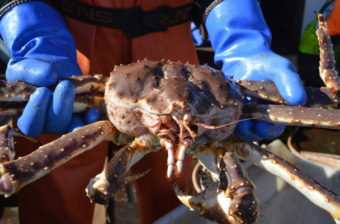
It’s been six years since it was legal to haul a pot full of red or blue king crab up out of Juneau area waters and take them home for a crab dinner.
The Department of Fish and Game said in a Friday news release that the summer personal use red and blue king crab fishery will open for five days: Thursday, July 27, through Monday, July 31. The order is for Section 11-A, which includes Gastineau Channel, Stephens Passage and part of Lynn Canal.
The agency is opening the fishery at a reduced harvest level. It will allow each household to take only two male crab total for those five days. The daily limit is also two males per household permit.
Corey Mahar is thinking about going crabbing.
“Well yeah, it’s fun getting out in the water no matter what,” Mahar said. “But anytime you can bring something as amazing as king crab home, I mean it’s a delicacy – especially since we don’t get it as often now.”
Corey Mahar outside Western Auto Marine in Juneau on Saturday. (Photo by Quinton Chandler/KTOO)
Mahar said he was a little boy on the water with his family last time he caught king crab about 15 years ago. He remembers good times bringing the boat back in and cooking crab right away.
“Cleaning the boat off while you’re cooking the crab up and have the butter and garlic melted up,” he recalled. “Crack that open, some scissors and go to town.”
Mike Wiley is more disappointed in the two-crab restriction.
“Yeah, it’s a pretty pathetic bag limit,” Wiley said.
He said he’ll probably go crabbing further north in a different management area because the reduced Juneau area harvest isn’t worth the effort.
“Well not if you’re just going to fish one area and two crab is all you’re going to get for the whole season,” he explained. “I’d rather get one per day in a different area.”
Corey Mahar is excited for the chance to relive some childhood memories.
“Looking over the side and seeing that red pot coming up, there’s no other feeling like that,” Mahar said nostalgically.
But, he too hopes that sometime soon managers will say it’s OK to get more than just two crabs.
If you’re going crabbing next week, Fish and Game said you need to pick up a summer king crab permit from their office on Douglas Island. You’ll also need a resident sport fishing license if you’re 18 or older.
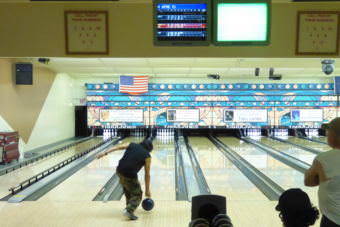
Wayne Fu Smallwood bowls at Taku Lanes on Saturday. (Photo by Quinton Chandler/KTOO)
Last weekend, it was the Street versus the Beat at the Taku Lanes bowling alley. Both teams celebrate strikes and laugh at occasional gutter balls. But all but one of the seven people bowling against the police are homeless or in some kind of unstable housing.
Wayne Fu Smallwood is 67 and lives in a cabin in the woods.
“I just got a wood stove and candles, but I’m happy,” Smallwood said.
Homeless Juneau residents and local police competed on equal terms to draw donations to the Glory Hole homeless shelter. The same people who use the shelter’s services helped raise over $3,000 worth of donations.
Smallwood said he doesn’t have bad interactions with the police. But, he said a lot of people living on the street try to avoid cops.
“When you’re on the street, you’re on the sidewalk,” he said. “You want to stay away from the cops. When they come around, then you have to move on.”
He’s referring to a sore subject in Juneau. Often property owners call the police to stop homeless people from sleeping in downtown Juneau doorways.
Smallwood thinks it’s good for the two teams to play each other.
“I think it could probably open some doors,” he said. “People that are on the street could come to the cops with their problems, instead of trying to deal with it themselves.”
This night, Officer Ken Colon said everyone has the same goal.
Juneau police Officer Ken Colon watches the Street vs. the Beat game from his seat at Taku Lanes on Saturday. (Photo by Quinton Chandler/KTOO)
“Just to have fun. Get out here and have fun (and) be individuals,” Colon said. “(It’s) more of a personal side, a human side.”
Colon walks the downtown beat and comes face to face with Juneau’s homeless every day.
“I know a lot of stories that they are intimate with me about and have a better understanding with them, however, tonight, we’re all equal,” Colon said. “Tonight feels like we’re all equal and we’re just having fun and kick back (and) relax. That’s pretty much how I feel and think everyone else feels the same way.”
Rebecca Service organized the event. She said her goal is to bring Juneau’s homeless and police closer.
“Instead of separating people into categories and just kind of meeting on the same lane,” Service said.
She moved to Juneau two months ago from San Francisco and right now, she sleeps in her van. She was going to do this same event before she left San Francisco. She was inspired when she saw several cops wearing gray bowling shirts.
She asked them, “‘Hey, are you guys in a bowling league?'”
They responded with a question. “‘What do you mean?'”
“‘Well you’re wearing all bowling shirts right?’ And they got grumpy and walked off,” Service said. “But, then the next cop I saw, I’m like, ‘Hey do you bowl?’ He’s like, ‘I bowl a 220, what do you bowl?’ ‘I’m awful at bowling, but would you bowl me if I set it up?’ He was like, ‘If you set it up, I’ll show up to it.’”
Eventually, more cops signed onto the idea, but finding the space to play was impossible in the big city. Now that Service lives in Juneau, that isn’t a problem.
“Anywhere you go, you should leave it better than you found it,” she said. “I came here and I kind of put that idea out there and I got a good response. It’s an amazing community here. It’s very supportive of each other.”
Wayne Fu Smallwood, left, and Rebecca Service pose for a photo after bowling on Saturday at Taku Lanes. (Photo by Quinton Chandler/KTOO)
The game ends.
“Technically the Streets won,” Service said. “Our average is a little bit higher than the police officers’. I think it was really great. I’ve never seen so many happy homeless people next to so many happy cops at the same time.”
Officer Colon seconds that. He said his bowling game was “below marginal,” but you can’t tell from his face.
“Smiling and playing is good therapy. That’s pretty much what I can come up with. It’s great therapy,” he said.
Service said the event raised $3,325 from food sales, a silent auction and donations. All of the gifts will go to the Glory Hole shelter.
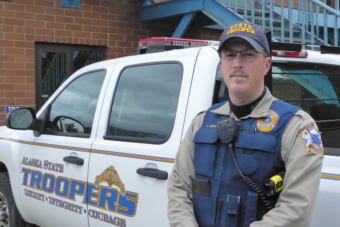
Alaska Wildlife Trooper Jake Abbott stands in front of the Alaska State Trooper post in Juneau on Saturday. (Photo by Quinton Chandler/KTOO)
It’s hard to get ahold of Trooper Jake Abbott during the summer. He’s just back from a two-week boat patrol between Juneau and Ketchikan.
When he did pick up the phone, he said his investigation report on the seven-man hunting spree was nearly 20 pages.
He said they’re generally closer to two.
“This is definitely one of the most lengthy investigations that I have conducted as far as wildlife investigations go,” Abbott said. “(A) couple of different agencies assisted us as well as several different units within our department.”
It took more than a year but in May, wildlife troopers based in Juneau finally charged seven men with Juneau ties who they suspected for a slew of hunting crimes and one fishing crime.
Abusive hunters undermine management of the state’s wildlife resources, Abbott said, and that investigating and prosecuting more complex cases sends a message that it’s not OK.
In February last year, the wildlife troopers heard a tip that during the 2015 deer hunting season, a group of friends took hunting trips south of Juneau into Stephens Passage near Admiralty Island and to the west into Cross Sound near Elfin Cove.
The source said they killed a lot of deer and broke a lot of laws in the process.
These aren’t people crimes. But, Abbott said they’re important because they hurt the state’s efforts to protect its living resources, and the rules give hunters and fishermen a level playing field.
The troopers looked for digital media evidence: text messages and ritual, post-hunt pictures. They looked for leftover animal carcasses and antlers, and they held a lot of interviews.
The more they learned, the bigger the case got, Abbott said. He compared it to a tree.
“You start at the roots and then as the case grows, it starts branching out and all these other violations for other things start getting found,” he said.
One big problem was the group shot deer from a boat, Abbott said, which is easier than tracking an animal on land.
It’s also illegal, except for hunters with special permits for disabilities.
“People shooting deer from the boat tends to lead to what we call higher wounding loss,” Abbott said. “Which means an animal gets wounded, the hunter either made a poor shot or didn’t realize they hit it and the deer runs off.”
The deer might run into the woods, die out of sight, and the meat is wasted.
Abbott said you’re also not giving the animal a fair chance.
Many times, he said the deer doesn’t realize it’s in danger. He said other hunters who follow the rules don’t have a lot of love for people who do this.
Some of the hunters also abused the proxy hunting system, Abbott said. Proxy hunters can stand in for elderly or disabled Alaskans.
“For example you (are) an elderly person,” Abbott said. “You could designate me as your proxy hunter; you could go fill out a form (and) I would have to sign it with you. You could then give me your hunting license and your deer tags and in addition to harvesting my deer — my four deer that I’d be allowed depending on where I’m at — I could also go harvest your deer.”
Both people have to be residents.
In this case, Abbott said a resident who was proxy hunting wanted to help his nonresident friend kill more deer without paying for them. Abbott said when the nonresident killed deer, the friends reported they were harvested by proxy.
Nonresidents can take four deer in the areas the group hunted. They have to buy small wire tags to fix on each deer they kill.
In 2015, Abbott said nonresident deer tags cost $150 each.
“You’d be looking at $600 in addition to your nonresident hunting license that you’d have to purchase,” he said.
If every hunter avoided paying for those tags, Abbott believes there would be a ripple effect.
“Number one, we’re not getting accurate harvest data back to Fish and Game on who harvested what, where and when,” he said.
Abbott said the second problem is the Department of Fish and Game gets federal matching dollars from selling tags and hunting licenses under the Pittman-Robertson Act.
“What that act does is for every license, tag and other items that are purchased … that purchase gets multiplied by three and the Department of Fish and Game receives those funds for management of the resource,” Abbott said.
Troopers also charged individuals in the hunting party with unlawful possession of game, making false hunting reports, taking too many deer and illegally catching a halibut. It’s unclear how many deer the group killed.
Abbott said most of the offenses are misdemeanors.
Benjamin Olson, Mckenzie Wilson and Wyatt Weimer, all of Juneau, pleaded no contest.
They have to pay fines and restitution ranging from $650 to more than $1,000.
Grantley Moore, Tyler Mathews and Anies Sadeghi, all from Juneau, pleaded not guilty. Their trials are scheduled for Sept. 19.
Moore’s lawyer decided not to comment. Sadeghi could not be reached for comment.
Tyler Mathews’ lawyer, Nicholas Polasky, said he would not comment because the wildlife troopers had not turned over any reports or information about their investigation.
Daniel Collins of Oklahoma didn’t make his court appearance and the court issued a $500 warrant for his arrest.
Abbott said members of this group may also temporarily lose their hunting privileges.
The Juneau Community Charter School. (Photo by Lisa Phu/KTOO)
Juneau’s charter school, run mostly by parents and teachers for almost 20 years, has hired its first principal. The school has roughly 100 students in multi-grade classrooms for grades K-8. It provides project-based, interdisciplinary instruction.
Ryan Stanley, an outgoing member of the committee that manages Juneau Community Charter School, said Caron Smith, a principal in Madras, Oregon, will handle administrative duties that have grown with the school over the years.
“It started with just one or two grades and they added grades over the years,” Stanley explained. “They added busing service which brought in students from all over town; they added the free and reduced lunch program; they added a middle school.”
The school also has to comply with agreements made between the district and its teachers’ union, Stanley said.
He said, a few years ago the board created a lead teacher position to shoulder those duties. Now they’re shifting to a principal.
“When it first started, maybe you had a lot more parents who were able to spend time there and over the years that has lessened,” Stanley said. “So you have a greater need for that kind of administrative position in the building.”
But the school isn’t moving away from the values that it started with, he stressed. It’s still a small school where parents have more direct control over their children’s educations. The elected managing committee is made of mostly parents.
Stanley said the school has to continue to adapt as the world changes.
According to Juneau School District, Caron Smith is currently principal of Bridges Career and Technical High School in Madras, Oregon. She has 30 years of education experience and once was a teacher in the Anchorage School District.
She has a master’s degree in educational administration and a bachelor’s degree in physical education.
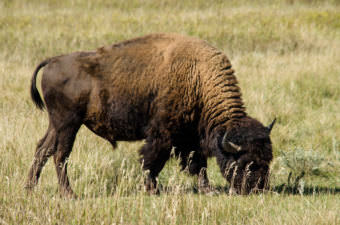
A bison grazes at Theodore Roosevelt National Park in North Dakota. (Creative Commons photo by Christa R.)
Before losing consciousness, a 65-year-old Juneau man remembers taking photos of a bison in Theodore Roosevelt National Park then the animal turned toward him and charged.
According to a park news release, Michael Turk took a late evening hike on the Buckhorn Trail in the park’s north unit on June 30. Turk planned to take photos of the sunset.
Park officials said he gave a bison he encountered a wide berth on his way to the photo location. On his way back to a campground, Turk stopped to photograph another bison, which then charged him.
He woke with a large cut on his left inner thigh and other cuts and bruises. The park said he was able to hike to the trailhead where he saw a third bison. He climbed uphill and called for help.
Seven campers responded to Turk’s calls. When they arrived at the trailhead, they saw a bison between them and Turk who was about 50 yards away. The campers couldn’t scare the bison away until one person fired a handgun into the ground. That convinced the animal to leave.
The campers helped Turk to the trailhead, dressed his wound and drove him toward the park entrance. An ambulance took him to a hospital where he was treated and released.
A sign at Theodore Roosevelt National Park in North Dakota warns against approaching wildlife. (Creative Commons photo by Bill Walsh)
The park stressed that bison are “large, powerful and fast-moving.” It said that even though the animals may look docile, they are wild animals that can be startled by humans, especially after dark.
The park’s regulations require visitors to stay at least 25 yards away from large animals like bison, elk, deer and horses.
The release added that it’s legal for visitors to carry a firearm under certain conditions, but it is illegal to fire one in a national park.
Michael Turk couldn’t be reached for comment.
Close
Update notification options
Subscribe to notifications
Subscribe
Get notifications about news related to the topics you care about. You can unsubscribe anytime.