Arctic

Warming landscape triggers northward habitat shift

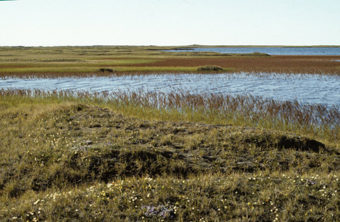
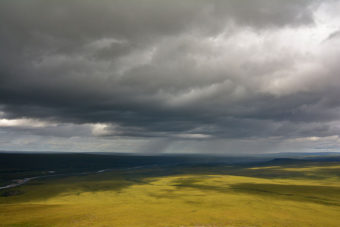
 Much of the North Slope of Alaska is characterized by low, sweeping tundra hills, and a complete absence of trees. (Creative Commons photo by Paxson Woelber)
Much of the North Slope of Alaska is characterized by low, sweeping tundra hills, and a complete absence of trees. (Creative Commons photo by Paxson Woelber)

For years scientists have documented changes in Alaska’s vegetation caused by a warmer climate. Researchers are now seeing animals establish new habitats on the North Slope in response to the altered landscape.
Ken Tape is an Arctic ecologist at the University of Alaska Fairbanks. He says his research often takes him to the North Slope. He’s reported on how shrubs in the region have responded to warmer temperatures and longer summers. They’re thriving — growing taller and moving across the landscape along rivers. It occurred to him those conditions favor moose and, as it turns out, hares. He says that got him thinking.

“’If this change is as dramatic as we think it is, if we look back in the past, maybe there won’t be any moose in these shrub patches.’ And, as it turns out, that’s exactly what I found when I started looking through the literature: A century ago they weren’t there,” Tape said.

Tape says his research, which appears in the journal Global Change Biology, focused on the hares because hunting presents complications when modeling moose populations.

Nevertheless, it’s clear where there were few or no animals in the region before, now they have clearly established habitats. Complete with predators, says Tape, since lynx seem to have followed the hares.

“We sometimes use the phrase ‘formerly boreal wildlife’ expanding along these riparian corridors, because, up until recently, it’s true …. Snowshoe hare, moose … those were strictly boreal species,” he said.

Tape said it’s remarkable how quickly the new habitats were developed. He says it will interesting to see what happens over longer time scales.

Arctic Council looks to Alaska citizen science network

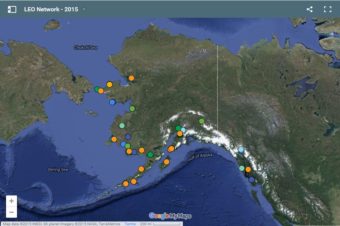
A tribal citizen science network that got its start in Alaska is being touted as a model for tracking climate change in the Arctic. The eight-nation Arctic Council plans to expand the Local Environmental Observer Network to other Arctic nations.
Alaska’s 120 or so Local Environmental Observers document the rare, unusual or unprecedented. A brown bear foraging for food in January in Port Heiden, lightning during a snowstorm in Nome, erosion, flooding, droughts, invasive plants and animal die-offs – anything that could affect food or water security or community health.

At the Alaska Native Tribal Health Consortium, Mike Brubaker is director of the Center for Climate and Health, which created LEO. He said most of the LEO observers are tribal environmental experts who have lived 10, 20 or more years in their community, and have knowledge handed down through the generations. He said LEO also has experts who can share other perspectives and sometimes answer questions – what caused an animal die-off, or whether a species is far outside its normal range.

“There’s also people that are topic experts both locally and around the state, at universities, or at agencies, or at different organizations,” said Brubaker.”And we depend heavily on those members of the LEO network, who are maybe not on the observation side but they’re in sort of the ground-truthing and providing technical assistance side.”

If you go to the LEO website, you’ll see an interactive map created by Geographer Moses Tcheripanoff. He said there are several ways to access information.

“In the dialogue box it has the observation, the title of the observation, as well as the community where the observations occurred, the date, as well as the category,” said Tcheripanoff.

Program assistant Mary Mullan also posts data, and works with the observers, who are not paid by the LEO network – most add the observations to their other duties working for a tribe. She said their motivation is to get the information out, and get answers.

“For these guys to get, to have a place to get questions and concerns out there with some sort of consult coming back is very positive,” said Mullan. “Because eventually with these things, they’re going to have to learn, if things continue to change, they’re going to have to figure out ways to change their lifestyles to still live there.”

Local Environmental Observer Wilson Justin agrees the LEO network will help people adapt to the changes associated with climate change.

“Number one, you want to understand the speed of change,” said Justin. “If you never observe anything, change always amazes you when it happens. It falls on you like a truck hits you. But if you’re constantly observing and making notes you begin to accommodate speed and you begin to think about not only are the changes happening on a calendar basis, but then the next thought is if this keeps up we’re going to have change in a very short period of time, what do I have to do to adapt to those changes and the potential impact?”

In addition to the observers in Alaska, LEO has a few in Canada. The Arctic Council, which is made up of representatives of circumpolar nations, has adopted a recommendation to create a Circumpolar Local Environmental Organization, using LEO as a model.

Statoil will exit Alaska, following Shell

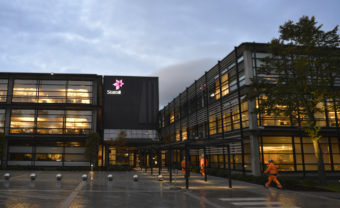
Statoil headquarters - Forus East
Statoil’s head office in Stavanger, Norway. (Photo by Harald Pettersen/Statoil)

Another major oil company has announced it will exit Alaska’s Arctic waters.

Norwegian oil company Statoil said Tuesday it will end exploration efforts in the Chukchi Sea and close its Anchorage office. The decision comes just two months after Shell ended its quest to drill in the Arctic Ocean, citing disappointing results at its first well.

Statoil Spokesman Peter Symons said the Chukchi just didn’t stack up against the company’s other options worldwide: “Based on a number of different criteria, the leases in the Chukchi were considered not competitive within the global context.”

That’s in part because of the Arctic’s difficult environment and high cost at a time of plunging oil prices, Symons said. But Shell’s exit also influenced the decision. Shell would have been an anchor tenant for the region, building out infrastructure that other companies could piggyback on.

“That certainly would have enhanced the commerciality of our leases,” Symons said. “So it certainly played a role.”

Statoil owned 16 leases in the Chukchi Sea, and shared ownership with ConocoPhillips on 50 others. It bought the leases for about $75 million in 2008 — the same year Shell bought its leases. Shell was the only company to actually drill in the region, but Symons said Statoil conducted seismic and other studies.

Statoil’s leases in the Chukchi Sea. (Map courtesy Statoil)

The leases expire in 2020, and earlier this fall, the Obama administration declined both Shell and Statoil’s requests to extend them, saying the companies had presented no concrete plans for exploration.

Sens. Lisa Murkowski and Dan Sullivan both issued statements blaming federal regulators for Statoil’s decision. But Symons said that wasn’t the main issue.

“The regulatory framework certainly has influenced (Statoil), but it’s not a primary driver,” he said. “This is a commercial decision first and foremost.”

Symons said the company has only two employees in its Anchorage office. Besides the Chukchi leases, the company has no other holdings in Alaska.

Statoil still has active leases in Arctic waters off Russia and Greenland, and is producing oil from an offshore site in Norway’s Barents Sea.

Study: Carbon emissions from northern fires likely underestimated

Alaska has seen record-breaking wildfire seasons in recent years. (Photo courtesy of the Alaska Division of Forestry)

A recent study indicates fires in the Yukon Flat region of Alaska are releasing more carbon into the atmosphere than previously thought.

The study by University of Alaska Fairbanks scientists overturns old assumptions and paints a troubling portrait of future climate change.

When you set out to model an ecosystem, it’s important to have data, a lot of data. That’s why UAF researchers Dave McGuire and Helene Genet were excited about a study in the Yukon Flats looking at charcoal deposits in lakebed sediments. It gave them 1,200 years’ worth of data.

Genet, McGuire and their colleagues wanted to model fire regimes in the region and how they affected the carbon cycle. The sediment data, McGuire says, were revealing.

“Fire frequency has been greater in the last few decades than it’s been over the last 1,200 years. That suggest things are changing quite dramatically now.”

Carbon is a key ingredient in global climate change. In nature, plants take up carbon dioxide and store it. Some of it is respired back to the atmosphere, but much of finds its way into soils.

In the Arctic and subarctic, that carbon is often locked up for longer periods because of permafrost.

Fires moving across the landscape can release a lot of carbon. And researchers assumed released carbon spurred more plant growth, balancing the books. That assumption might be revised now.

By modeling the effect of long-term fire history on the ecosystem, Genet says it looks like more carbon is being released than captured.

“The way we have spun up the model before leads to an underestimation of the carbon loss in Interior Alaska or at least in regions that are exposed to fire regimes.”

Genet and McGuire’s study just looks at the Yukon Flats. But if the same conditions occur in similar Arctic and sub-Arctic boreal forests, where roughly a third of the Earth’s terrestrial carbon is stored, the implications to climate change could be dire.


Shell’s Q3 results reflect Arctic hit

Shell rig leaving Dutch Harbor in October 2015. (Photo by John Ryan/KUCB)

Royal Dutch Shell has announced its quarterly financial results. They’re not good, and Shell’s dry hole in the Chukchi Sea is just one factor.

“Shell’s current-cost-of-supply earnings for the quarter were a loss of $6 billion,” Shell CFO Simon Henry said at the top of a video summarizing the third quarter. The reported losses for shareholders exceed $7 billion.

For its canceled Arctic project, Shell wrote off $2.6 billion this quarter.  That’s significantly smaller than the write-off Shell took due to lower expectations for oil and gas prices. In all, Shell’s write-offs come to $8 billion.

CEO Ben Van Beurden, in a conference call with reporters, repeated the reasons Shell halted work on its Arctic leases after drilling a single dry hole.

“Due to the high cost and the challenging and unpredictable regulatory environment, we have decided to just cease further exploratory activity offshore Alaska for the foreseeable future,” he said.

The CEO called it “probably the most regulated and high-profile oil province in the world.”

“Of course, we are of the view that the U.S. Government should simplify and modernize the permit processes there if there are any ambition to develop oil and gas in the offshore of Alaska.”

Interior Secretary Sally Jewell has said the government was holding Shell to the highest standards to ensure safety.

Climate change progress at Arctic Council’s first meeting with US chair

Arctic Council Gavel
The gavel the chairman of Senior Arctic Officials at Arctic Council meetings uses. The gavel was presented at a dinner to celebrate Canada’s second chairmanship of the Arctic Council, 2013 to 2015. (Photo by Linnea Nordström/Arctic Council Secretariat)

During the three-day meeting of the international Arctic Council that wrapped last week in Anchorage, officials made the most headway on an effort to mitigate the impacts of black carbon and methane in the Arctic. State Department deputy secretary David Balton chairs the Council’s most senior officials.

“These short-lived pollutants — black carbon and methane — cause particular climate-related problems in the Arctic,” he said.

Black carbon is particulate waste from fossil fuel combustion. Unsurprisingly, it’s black. So when it lands on snow and ice, it has a warming effect.

Surprisingly, the council’s observer states showed a strong interest in the problem — more than half submitted assessment reports of their own emissions. These are nations who do not border the Arctic, but the week’s meeting made it clear that some certainly want a stronger voice on the council.

“We did something, I believe, that has never been attempted in the history of the Arctic Council,” Balton said. “We spent a half-day with the observers at the table, hearing from them. A lot of them have been wanting to have greater engagement, greater input.”

Arctic Council Flags
The flags of the eight Arctic Council member states and six indigenous permanent participant organizations. (Photo by Linnea Nordström/Arctic Council Secretariat)

The topics they were most interested in, Balton said, were the black carbon initiative and migratory bird fly-ways.

And speaking of bigger voices on the Council, where does Alaska fit in?

There are four voices on the Council that represent indigenous peoples of Alaska. But most of the delegates representing U.S. interests are on State Department payroll in Washington, D.C.

“The federal government recognizes that we are an Arctic nation because of Alaska,” Balton said. “And we wanted to be in partnership with the state and the people of Alaska in carrying out our chairmanship.”

Before the U.S. assumed chairmanship of the Arctic Council in April, David Balton and colleagues made several trips to Alaska — sort of like scouting trips — to hear from Alaskans on what interests they had for chairmanship.

The three key objectives the U.S. decided to focus on during its Council chairmanship are improving the well-being of Arctic communities, bolstering marine stewardship in the Arctic Ocean, and addressing the impacts of climate change.

That’s a tall order.

“Everything still needs to be worked on,” Balton said. “This is a two-year process. We’re still in the early stages of it.”

Other notable outcomes of the meeting were:

The council reconvenes in six months in Fairbanks.

Site notifications
Update notification options
Subscribe to notifications