Arctic

Ishmael Hope recrafts a family tale in “Never Alone” follow-up

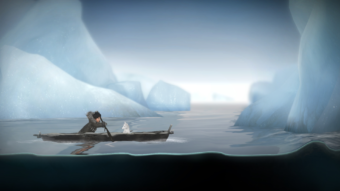
In "Never Alone: Foxtales," Nuna and Fox navigate on an umiak. They start in the Kotzebue area and eventually find themselves on the Noatak River. (Image courtesy Upper One Games)
In “Never Alone: Foxtales,” Nuna and Fox navigate on an umiak. They start in the Kotzebue area and eventually find themselves on the Noatak River. (Image courtesy Upper One Games)

With “Never Alone,” Cook Inlet Tribal Council and game developers combined indigenous storytelling with video gaming in a way that appealed to mass markets.

Its success has led to the follow up “Never Alone: Foxtales,” released on July 28. Juneau writer Ishmael Hope relied on his uncles, Alaska Native elders from Kotzebue, to write the game’s narrative.
Willie Goodwin Jr. narrates the videogame Foxtales. In Iñupiaq, he tells the story of two friends who emerge from their sod homes after a long winter.

“At springtime,” Goodwin says, “everything comes alive.”

Goodwin is an elder from Kotzebue. He’s also the uncle of Ishmael Hope, the game’s writer.

Hope says the two friends, Nuna and Fox, start chasing a little mouse.

“And then suddenly, in the middle of their chase, they’re stranded out in the ocean. They find themselves in an old umiak, a boat. They’re just out, and then they have to navigate their way all the way through,” Hope says.

In Nuna and Fox’s journey, “They get a little too exuberant, like young people will,” Hope says. “They’ll make little mistakes, but then they have to learn a lesson about how to respect all things, the values of being Inuit, Iñupiaq. It’s something that they had to learn.”

Ishmael Hope is the writer of "Never Alone: Foxtales." (Photo by Lisa Phu/KTOO)
Ishmael Hope wrote “Never Alone: Foxtales.” (Photo by Lisa Phu/KTOO)

Foxtales is based on a story told by Hope’s late grandfather, Willie Panik Goodwin. It’s a story about fighting a giant mouse. Goodwin told the story “The Two Coastal Brothers” during an archaeological trip with a team of scholars, including Wanni Anderson who transcribed it in a short story collection, “Dall Sheep Dinner Guest.”

Hope used a lot of his grandfather’s direct words when writing the game’s script. He also collaborated extensively with his uncles who live in Kotzebue, where Foxtales begins.

The game, like its predecessor “Never Alone,” is narrated in Iñupiaq with English subtitles.

“Even if people are absorbed in the game, there’s something really special about the elder’s voice, them speaking in the language. So even if you’re not following everything, you’re getting a sense of that world and that spirit,” Hope says.

Hope says it’s that spirit that gives identity. Hope is Iñupiaq and Tlingit. He says his uncles Elmer Goodwin, Willie Goodwin Jr. and John Goodwin taught him a lot about Iñupiaq culture. Hope says working with them was key to making Foxtales.

“They know how to hunt, they know how to fish, they know how to be in the land. They have so many stories of survival, of reading the landscape, observing the landscape, sensing the spirits and the life of everything around us. They have that knowledge and they were able to impart that a little bit with us,” Hope says.


Foxtales is a celebration of Iñupiaq culture, something Hope thinks young people playing the game need.

“It’s one instance where they get a positive image of themselves reflected back on them. And when you’re in pop culture and you have almost no images or it’s all horrible stereotype, it’s really nice to kind of break through just a little bit,” Hope says.

Videogames have been seen as separating the young generation from the old, but Hope wants Foxtales to do the opposite.

“For young people everywhere, it allows them to create the bridge to their mom and their dad and their uncles, their aunties and their grandparents who may tell them, ‘Oh you know I know a story just like that, so let’s sit down and let me tell it to you,'” Hope says.

Hope doesn’t know if Nuna and Fox will go on any more adventures, but he says with the title Foxtales, there’s a possibility for more.

“Never Alone: Foxtales” is available for the Xbox One, PS4 and PC and Mac. It requires the original “Never Alone” to play.

Shell begins exploratory drilling in the Chukchi Sea

The Polar Pioneer drill rig arrives in Dutch Harbor. (Photo by Emily Schwing/KUCB)

Arctic drilling is under way.

Shell Oil confirmed Thursday that its Polar Pioneer rig sent a drill bit spinning into the floor of the Chukchi Sea about 5 p.m. Alaska time.

It came at the end of one of the most eventful days in the company’s eight-year effort to find oil in the Arctic Ocean.

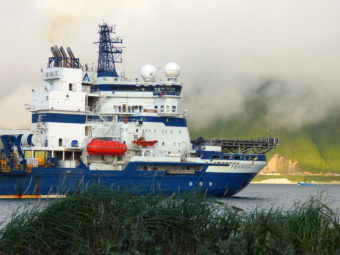
More than 2,000 miles away, just a few minutes before the drill bit hit the sea floor, the company’s icebreaker Fennica managed to free itself from a blockade of protesters in Portland, Oregon.

Protesters had suspended themselves from a bridge across the Willamette River.

Others had taken to kayaks to block the exit of the Fennica.

Thursday morning, the Fennica approached the bridge, then turned around after a 15-minute standoff.

A federal judge in Anchorage slapped Greenpeace with a $2,500 fine for every hour its activists blocked the Fennica.

By late afternoon, local police and the U.S. Coast Guard had disbanded the protesters. The Fennica set sail past the bridge and headed for Alaska.

Greenpeace called delaying the icebreaker for 36 hours a victory.

Activists say climate change and the risk of an oil spill make drilling in the Arctic Ocean a dangerous mistake.
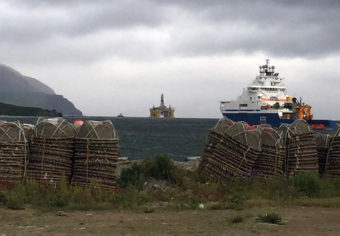
Shell has begun drilling a 40-foot-deep cellar for housing a blowout preventer.

It can only begin drilling into oil-bearing layers beneath the seafloor after the Fennica arrives at the drill site in the Chukchi Sea.

Interior Department officials say they expect to approve the deeper drilling quickly once the Fennica has returned to the Arctic.

As subsistence foods become scarce, Kivalina celebrates a new store

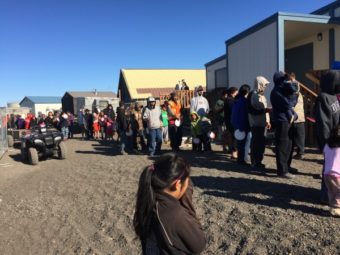
Kivalina’s new store, owned by Seattle-based Alaska Native Industries Cooperative Association, celebrated its grand opening with hot dogs and hamburgers for the community. (Photo by Janet Mitchell)

It’s been a festive day in the Northwest Arctic community of Kivalina as residents celebrate the grand opening of a new store. It’s an end to eight months of struggle with limited supplies after Kivalina’s store burned to the ground Dec. 5.

Janet Mitchell is Kivalina’s city administrator. She says the village doesn’t have firefighting equipment so men cut a hole in the ice of the local lagoon and pumped water on the fire, mainly to keep it from spreading to nearby teacher housing. Mitchell says a temporary store was established but it was a very small space.

“They ran out of things very quick and that posed a difficulty for young babies or young families, families that need formula,” Mitchell says.

She says eggs cost more than $8 per dozen and pilot bread $7 because of limited supplies. Mitchell says the temporary store was in a storage structure built in the early 1900s and mainly sold staples of eggs, flour and rice.

Seattle-based Alaska Native Industries Cooperative Association, or ANICA, owns the store. The new store is two or three times bigger than the old structure, she says, and on Tuesday company officials flew in for the grand opening.

Kivalina’s population of 468 includes a high percentage of young people. Mitchell says close to half are 18-years-old or younger and many of them don’t care for traditional foods. Subsistence resources are also harder to get in a changing climate. Mitchell says the ice went out in early June and with it went the subsistence mainstay, ugruk, also known as bearded seal.

“It’s our winter food (and) we didn’t have an opportunity to hunt the bearded seal. So it’s going to be a very, very lean year in terms of Native foods,” she says.

Mitchell says her large extended family normally harvests between 15 and 20 large adult seals. This year they got one small seal. She says fewer than 20 have been harvested by the entire community and they haven’t seen many caribou either. She says even older Kivalina residents who normally rely heavily on subsistence hunting will have to include more Western food in their diet.

“The store is going to be very important to have if we don’t have the capability of hunting the foods we normally do.”

Although she prefers Native food, Mitchell says she buys supplies at places like Costco when she can get to Anchorage.

“But we have families that (include) up to 20 (people) in one household, so that can be quite a challenge to keep them fed, especially when they don’t hunt,” she says.

Mitchell says her community continues to fight development to protect subsistence food, but that the store will be increasingly important in the future.

Port commission discusses Nome’s role in the future of Arctic shipping

Construction of the Port of Nome’s Middle Dock continues to progress. (Photo by Matthew Smith, KNOM)

Nome’s role in the future of Arctic shipping was the main topic of discussion at the most recent meeting of the Nome Port Commission. With the summer shipping season in full swing, harbormaster Lucas Stotts said the port had a busy July, emphasizing that, “both docks are completely jam-packed full until August 2.”

And vessel traffic is only expected to rise. A report published by the US Army Corps of Engineers in March of this year tentatively selected Nome as the site of a proposed deep-draft port, the first Arctic port of its kind in the country. The project is estimated to cost nearly $211 million in total, with the city on the hook for a possible $113 million.

City officials say much depends on the Port’s capacity to attract funding partners who have a vested interest in Arctic development. But securing those potential partners is easier said than done. With ongoing plans to drill in the Chukchi Sea, petroleum giant Shell Oil would have been an attractive partner for Nome, though the company took its business elsewhere this summer.

“It struck me right in the face that Shell Oil is doing logistics out of Kotzebue and not Nome,” said Commissioner Charlie Lean.

Lean was disappointed that Shell passed over Nome in its planning for this year’s drilling season. He cited Nome’s transportation infrastructure and longer shipping season as major selling points for the port and urged the city to market itself more aggressively in the future.

Port project manager Joy Baker said, despite this year’s disappointment, the door with Shell isn’t shut completely. “We’re still on their radar,” Baker stressed, “but they’re going to run their small crew changes out of Kotzebue… taking advantage of the closer airport to their working location.”

Meanwhile, the Port of Nome is focusing its energy on expanding local services, with construction of the Middle Dock already underway. The project will add another 200-foot dock, allowing the port to accommodate two to three additional mid-sized vessels.

Baker updated the commission at the recent meeting, explaining that, “things are going real well, real smooth, mother nature’s been very cooperative.” She said progress overall is rapid, adding the look of the dock “changes every day, considerably.”

Baker also introduced plans for a possible boatlift at the mouth of the Snake River. Because Nome does not currently have the capacity to remove larger vessels from the water, they’re forced to travel south to ice-free harbors such as Juneau or Seattle for the winter. Baker debuted two concept drawings for a possible lift, with initial bids ranging from $4.3 to $4.5 million. While she emphasized that the concept is still abstract, she said it’s never too early to think about Nome’s future.

“I think it’s another piece of infrastructure that is on the horizon for Nome,” suggested Baker, “I just don’t know when that magical time is to build it.”

When it comes to future planning, outgoing commissioner Iura Leahu commended Baker for keeping her “eye to the future.” In his final comments, Leahu thanked his fellow commissioners for their continuing work and expressed his hope of seeing those efforts pay off down the road. “I think that there is a future here for the city of Nome,” Leahu insisted, “and I think we might be able see a port here that is going to make a difference in this region.”

Much of this hope rests on the US Army Corps of Engineers’ decision to move forward with a deep-draft Arctic port in Nome. After reviewing all inter-agency and public comments on the “tentatively selected” plan, a final decision is anticipated by December 2015.

Sikuliaq docks in Nome, previews upcoming research missions

The research vessel Sikuliaq will work in the Chukchi and Beaufort Seas through November. (Photo by Emily Russell/KNOM.)

The research vessel Sikuliaq docked in Nome July 21 and opened its doors to local visitors. While touring the ice-capable ship — owned by the National Science Foundation and operated by the University of Alaska Fairbanks — visitors asked questions of the crew and learned about their upcoming missions.

The Sikuliaq will be working in the Chukchi and Beaufort Seas through November on three different research assignments, according to the vessel’s master, Capt. Mike Hoshlyk. He explained the Sikuliaq’s water sampling system, which can measure the properties of water as deep as 10-thousand meters.

Just how deep is that?

“The height of Everest. Deeper than Everest,” said Hoshlyk. “You could go to the Marianas Trench.”

Peter Worcester is the chief scientist on one of the upcoming missions. He won’t be researching the world’s deepest trench, but he will use the Sikuliaq to gather data on ocean acoustics, which could shed light on the changing conditions of Arctic waters and sea ice.

“The basic idea is very simple,” said Worcester. “If you have a sound source here and a receiver here, and you measure very accurately how long the sound takes to travel that distance, that’s a very good measure of the average temperature.”

Faster sound means warmer waters — and valuable information on how ocean temperatures are changing. Several visitors were curious about climate change, including how the Sikuliaq itself may contribute. One visitor asked, “With the disruptions up there is [the Sikuliaq] contributing to the climate change?”

Those “disruptions” referred to oil exploration and drilling — two things the Sikuliaq doesn’t do. While the research vessel can cut though roughly 3 feet of ice, Joan Braddock says it’s not an icebreaker. Braddock is the Dean of the School of Fisheries and Ocean Sciences at UAF and says the Sikuliaq only works in seasonal ice, which is less invasive.

“I think the impact — at least at this point – of research vessels is pretty minimal. But you’re right. As there are more and more ships, there’s going to need to be thoughtfulness,” said Braddock. “We’re certainly going to be a part of the discussion to make sure we’re doing things right with this ship — so that we’re answering questions that are important to Alaskans but not causing problems.”

The Sikuliaq shipped out Thursday to tackle those questions. But the vessel will be back in Nome for the U.S. Arctic Research Commission meeting during late August.

Shell ship Fennica heads to Oregon for repairs

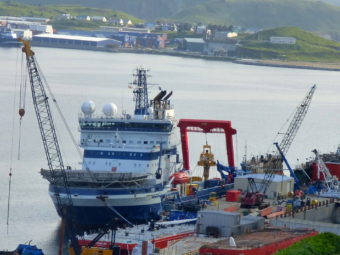
The Fennica leaving Dutch Harbor for Oregon on Sunday. (Photo by Pipa Escalante/KUCB)

A key ship in Shell Oil’s Arctic drilling fleet left Alaska on Sunday.

The icebreaker is headed south to Oregon for repairs after a three-foot gash was discovered in its hull.

The icebreaker, called the Fennica, hit an uncharted rock as it was leaving Dutch Harbor for the Chukchi Sea.

It had to return to port for temporary repairs. That was two weeks ago.

Now, the Fennica is making a week-long journey to Portland, Oregon, for a more permanent fix.

Shell wouldn’t say how long those repairs could take.

The company can only drill during the brief Arctic summer, and it cannot drill for oil without an oil well capping device that’s on board the Fennica.

Two Shell oil rigs are already on their way to the drill site in the Chukchi Sea.

U.S. officials have not said whether the missing icebreaker will influence their decision on two final permits that Shell needs to begin drilling.

Site notifications
Update notification options
Subscribe to notifications