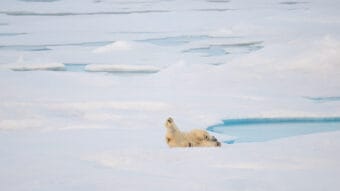
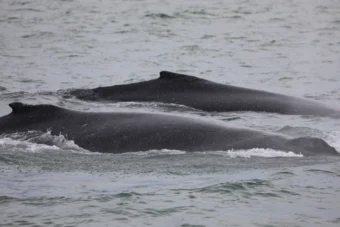
Two humpback whales feed in Beaufort Sea, northeast of Point Barrow. (Kate Stafford)
Catching salmon in the North Slope village of Kaktovik was unheard of not too long ago. But resident Robert Thompson says some fishermen now see salmon more regularly. About five years ago, he caught a dozen salmon – a small but noticeable number.
“Before it was unusual, and people would talk about it, that somebody got a salmon,” Thompson said. “Now it’s fairly common.”
Fishermen, hunters and researchers gathered at the Alaska Marine Science Symposium in Anchorage in January to discuss how several fish species and marine animals are changing their migration patterns in the warming climate. That includes humpbacks gaining new ground up north, bowheads expanding their diet and salmon observed in the Arctic.
Salmon are spawning in the Arctic
Elizabeth Mik’aq Lindley is a graduate student from Bethel who grew up fishing for salmon. Now she studies Pacific salmon in the Arctic.
In 2023, she and other researchers installed temperature loggers at the depth of salmon nests in several rivers – including the Anaktuvuk River, which runs through Gates of the Arctic National Park and Preserve.
“If it gets too cold, the stream can freeze straight through to the bottom, into these nests, and embryos will freeze and die,” Lindley said.
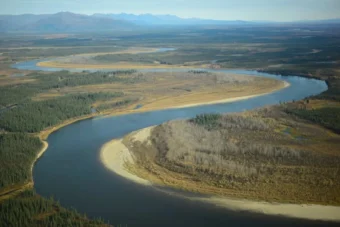
Anaktuvuk River is seen from above On Sept. 14, 2023. (Peter Westley)
Temperature also influences incubation and when embryos will hatch and start making their way to the ocean.
But in a year of tracking the water temperature, the researchers never saw it get below freezing. They also estimated that salmon emerged around August. That’s later than in other parts of the state, but it’s the optimal time for the Arctic. While more data is needed to see if salmon populations are growing in Arctic rivers, the conditions seem survivable.
“Salmon are spawning in the Arctic,” Lindley said, “and it does seem like it’s thermally survivable, thermally possible and plausible that they can incubate and emerge at the right time, given these temperatures.”
Bowheads are expanding their foraging grounds
The warming environment has also been affecting bowhead whales.
Traditionally, bowheads travel south to spend their winters feeding on krill in the Bering Sea. But with ice conditions reshaping the zooplankton community, the animals have been delaying that migration — or even staying in the Chukchi and Beaufort Seas all winter.
Marine ecologist Clarissa Ribeiro Teixeira looked at the whales’ baleen plates to better understand the change. Elements that make up baleen plates – stable isotopes of nitrogen and carbon – can offer a window into an animal’s diet and movements. Each plate grows continuously and has information from about 20 years of the whale’s life, she said.
Marine ecologist Clarissa Ribeiro Teixeira speaks during the Alaska Marine Science Symposium on Jan. 30, 2025. (Alena Naiden)
Teixeira and her colleagues sampled baleen sections from 11 whales harvested on the North Slope over two decades. They also looked at the ice conditions during those years. What they discovered was that after 2016, when there was very little ice, bowheads shifted their behavior.
“The reduction in the sea ice cover may have influenced the prey availability distribution for these animals, motivating bowhead whales to explore new foraging habitats or include a wider composition of their prey sources into their diet,” she said. “That’s amazing, because it shows how resilient these individuals are, right?”
Humpbacks are frequenting the Arctic
Less ice might also mean new territory for humpback whales.
Kate Stafford, who is an oceanographer and a professor at the Marine Mammal Institute at Oregon State University, studies bowheads in the Arctic. But in 2021, she and her late colleague Craig George saw a whale that, to their surprise, turned out to be a humpback – a species that was once rare in the Utqiaġvik area.
“You just never know what you’re going to find,” she said. “We all need to take our eyes off of our phones and watch the water.”
Birds surround a humpback whale in Beaufort Sea. (Kate Stafford)
Stafford says data from local whalers and aerial surveys points to more humpbacks visiting the area.
In Utqiagvik, humpbacks were sighted only twice before 2021 and two or three times in years after that. Then, last fall, researchers saw more than 25 whales feeding close together for two days in a row.
“We came across what I would call Humpback Palooza,” Stafford said. “Just dozens of humpback whales, which was crazy.”
Young humpbacks usually follow the migration patterns they learn from their mothers, Stafford said. Because researchers observed multiple mother-calf pairs, the whales might return to the area.
“This does suggest, at least to me, that humpbacks are here to stay near Utqiaġvik, at least so long as there’s something to eat,” she said.
Kate Stafford speaks during the Alaska Marine Science Symposium on Jan. 30, 2025. (Alena Naiden)
Utqiaġvik whaler Michael Donovan said he did not witness Humpback Palooza, but he has seen a few humpbacks during his fall hunts. He said that he and other whalers are worried the humpback whales might be competing with bowheads — a staple subsistence resource for his community — for krill and copepods.
“They’re an invasive species, you know. They come in and eat the same food that our bowheads eat,” Donovan said.
Donovan and other hunters say they support scientists studying species that are growing their presence in the Arctic’s warming waters. Meanwhile, Stafford said scientists rely on people like Donovan for their research.
“The hunters and whalers, they’re really good naturalists, they’re really good observers and biologists,” she said. “They need to understand the seasonality of animals, the behavior of animals, how the environment impacts animals.”
Stafford says that local hunters contribute so much to her research, she’s grateful when her work can help them, too.
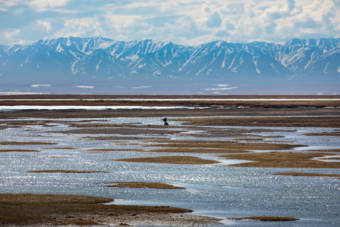
The Kobuk River runs through the Ambler Mining District, where a new road would be built to connect the Northwest Arctic with the Dalton Highway to Fairbanks. (Berett Wilber/Alaska Public Media)
Last June, the Biden administration rejected the Ambler Road Project, a proposed 211-mile road that would branch west from the Dalton Highway to a mining district. But the Pentagon did not give the Army Corps of Engineers a directive to revoke the road’s permitting until five days before President Donald Trump’s inauguration. Now it appears that the permits – and the project – may not be dead, but in limbo.
Major development projects need dozens of environmental permits from multiple agencies to move forward. It’s federal law. And for nearly a decade, permitting for the Ambler Road project has been a back-and-forth between presidential administrations.
Several tribes and conservation organizations say the road would cause irreparable harm to the land and subsistence resources. Mining companies and development supporters, including Gov. Mike Dunleavy and Alaska’s congressional delegation, say the road is necessary to access a region that mining companies say could contain valuable deposits of copper, zinc, lead, silver and gold.
Delayed Action?
The first Trump administration greenlit the project. Then multiple lawsuits challenged it. After a lengthy review process, the Biden administration rejected part of the project in June 2024, which canceled the entire thing.
But it wasn’t until Jan. 15 that then-President Joe Biden’s Pentagon ordered the Army Corps of Engineers to kill one set of permits that are critical to the road megaproject — the 404 permits. 404 permitting is part of the Clean Water Act. When developers need to dredge or fill wetlands, they require 404 permits from the Army Corps of Engineers.
The Ambler Road project has these permits to cover the entire length of the road corridor — which includes around 1,431 acres of wetlands, including a half-acre of open water. Corps spokesperson John Budnik confirmed in an email the timeline and the directive to revoke the 404 permits. And he confirmed that the permits instead remain suspended — not quite dead.
Rob Rosenfeld, a consultant for several tribes that oppose the project, believes the Corps dragged its feet and should have killed the 404 permitting after the Biden administration rejected the project in June. Rosenfeld said the Corps’ inaction went against the wishes of 88 tribal governments that oppose the project.
“The intent for the tribes was to have that revoked,” he said. “Finally, in the 11th hour, on Jan. 15, the assistant secretary of the Army issued the order to revoke.”
Rosenfeld said it is uncommon for a commander or his staff to ignore orders issued by a superior officer.
“It was either done intentionally or accidentally,” said Rosenfeld. “The chain of command in the Department of Defense is something that is typically unbreakable. I don’t know if I’ve ever heard of it.”
An uncertain future
On his first day in office, Trump ordered that the Biden administration’s decision on the road be thrown out and replaced with Trump’s own pro-development decision. The 404 permitting remains in limbo.
Budnik shared an official statement from the Corps:
“With the change of administrations and the new Executive Order regarding this project, we are currently pending updated guidance and will have more information as soon as it is available,” it read.
Representatives of multiple pro-road interests, including the Alaska Industrial Development and Export Authority, the state-backed economic development corporation, and three mining companies with stakes in the region, could not be reached for comment.
But the project still faces major obstacles. Nana Regional Corporation, a landowner along the road’s route, has withdrawn from the project, for now. A representative from Doyon, Limited, noted that while it is a major stakeholder for the project, Doyon does not support or oppose the road. According to Rosenfeld, permitting that was revoked under the Biden administration, like the National Historic Preservation Act Programmatic Agreement, would have to be rewritten, which could take at least a year.
“Nothing will happen quickly,” said Rosenfeld. “I can say the collective we — the environmental organizations, the tribes and those Alaskans that don’t want that road — are going to fight it in the courts.”
Bridget Psarianos is the senior staff attorney for Trustees of Alaska, an environmental law firm based in Anchorage. She said the Army Corps could still revoke the 404 permits, reinstate them or modify them.
In the meantime, though, Psarianos said the permitting is “sort of paused.”
Correction: This article has been updated to reflect that Doyon, Limited, a stakeholder for the Ambler Road, has maintained a neutral stance on the project.
A view of the northeastern National Petroleum Reserve in Alaska. (Bob Wick/Bureau of Land Management)
WASHINGTON — The Biden administration has issued interim management instructions aimed at protecting subsistence resources in the National Petroleum Reserve Alaska.
It’s not clear anything in the guidelines from the Interior Department will survive the transition to the Trump administration.
Acting Deputy Interior Secretary Laura Daniel-Davis said Thursday that the new measures stem from more than 80,000 public comments the department received about the reserve, which she referred to as the Western Arctic.
Daniel-Davis says no matter what happens next, it was the right thing to do.
“We know we’re in these seats for a few more days, and the next team may have a different perspective on how we manage public lands, including in the Western Arctic,” she said. “But I think really, we all have to agree that we must undertake activities in this incredible area with due consideration as to how they may impact subsistence resources, and that we are today identifying as a significant resource value.”
The department is also proposing to expand the inventory of special areas in the reserve by about 3 million acres.
The National Petroleum Reserve is a tract of federal land as large as the state of Indiana. It includes important habitat for migratory birds and wildlife. It also has substantial oil and gas potential. The Biden administration approved a major ConocoPhillips project there called Willow, to the dismay of environmental groups and some subsistence users. But a long list of North Slope governments and Indigenous groups support development of Willow and want more drilling in the reserve.
Sen. Lisa Murkowski says the Biden administration has burdened the reserve with too many restrictions and she’s counting the days until the department is in new hands.
She had the opportunity Thursday to question the person nominated to be the next secretary of Interior.
Doug Burgum said at his confirmation hearing that he wants to be Alaska’s partner in resource development.
“I would view Alaska as the one of the biggest assets this country has, and one of the biggest responsibilities of Interior and look forward to working with you,” he said.
“That’s exactly what I was hoping you would say,” Murkowski responded.
Burgum appears to have enough Senate votes for confirmation. He is a former governor of North Dakota. He has some familiarity with the 49th state. He said at a 2017 press conference that in 1976 he hitchhiked to Alaska.
Workers aboard a barge transfer materials to a Quintillion-operated ship. (Courtesy Quintillion)
Just 100 feet under the surface of the Bering Sea, a thin 2-inch-wide cable silently pulses on the seafloor. A flurry of ones and zeroes flash through the cable at near-lightspeed, carrying with it social media posts, Zoom meetings and medical records.
This is Quintillion’s Arctic fiber network, which stretches north from Nome all the way to Prudhoe Bay. There, it meets up with a landline that runs down to Fairbanks and on to the Lower 48. But for coastal communities south of Nome, there’s nothing like it.
Quintillion’s director of operations, Art Paul, said the telecommunications company is taking steps toward changing that.
Map of Quintillion’s future fiber ring around Alaska. (Courtesy Quintillion)
“So Nome, Kotzebue, everywhere north of them gets to use that fiber pathway. We recognize there’s more customers to serve, of course, in the southwest,” Paul said.
For all the good subsea fiber brings – blazing fast speeds and low latency – it comes with its own challenges. The thin armored cables span hundreds of miles on the seafloor, where they’re susceptible to line breaks.
So what happens if a cable does break?
In June 2023, a cable scoured by sea ice 34 miles offshore of the North Slope took Quintillion’s entire Arctic fiber network down. Utqiaġvik, Wainwright, Kotzebue and Nome were all taken offline.
Paul said that this new project will complete a ring around Alaska, giving Quintillion the ability to simply send traffic the opposite direction should another line break occur.
“In the future if there’s an ice scour event or a boat anchor event, we can reroute traffic the other direction,” Paul said. “So never again will those communities be stuck while our ship mobilizes from the Lower 48 to replace that fiber break.”
The new route will stretch from Nome to Homer, where five subsea cables already convene. Paul said Homer’s established infrastructure and port makes it an ideal end point for the new, 950-mile-long cable.
“It’s an ice free port, so it’s a pretty easy place to to do business. But primarily it’s because the other cables land there, it’s kind of a hub for fiber in Alaska,” Paul said.
Quintillion plans to begin construction this summer with help from its new partner, Xtera Inc. The Texas-based company signed a $77 million agreement last November to provide procurement and expertise for the network.
Quintillion said it expects to invest $61 million of its own capital for the project and estimate the total cost to be around $150 million. Construction of the Nome to Homer Express is expected to wrap up by late 2026, with the network operational by early 2027.
Cottongrass wafts over the tundra in the Arctic National Wildlife Refuge on Sept. 2, 2006. (S. Hillebrand/U.S. Fish and Wildlife Service)
No bids were received in the second congressionally managed oil and gas lease sale in the Arctic National Wildlife Refuge, the Department of the Interior announced on Wednesday.
Had any been received, bids were scheduled to be opened on Friday by the U.S. Bureau of Land Management. That Interior agency was charged with managing the refuge leasing program created through a 2017 tax bill passed by a Republican-controlled Congress and signed by President Donald Trump in his first term.
The absence of bids this time, after very few bids were received in the first lease sale held four years ago, backs up Biden administration officials’ beliefs that drilling in the refuge is bad policy, said a statement released by the Interior Department.
“The lack of interest from oil companies in development in the Arctic National Wildlife Refuge reflects what we and they have known all along – there are some places too special and sacred to put at risk with oil and gas drilling. This proposal was misguided in 2017, and it’s misguided now,” Acting Interior Secretary Laura Daniel-David said in the statement. “The BLM has followed the law and held two lease sales that have exposed the false promises made in the Tax Act. The oil and gas industry is sitting on millions of acres of undeveloped leases elsewhere; we’d suggest that’s a prudent place to start, rather than engage further in speculative leasing in one of the most spectacular places in the world.”
This week’s lease sale follows one held on Jan. 6, 2021, that drew little bidding, and none from large oil companies. Most bids in that sale were from the Alaska Industrial Development and Export Authority, an Alaska state development agency. AIDEA’s head disclosed Wednesday that the agency and the Biden administration have reached an agreement to ensure that the leases acquired in that first sale will not be resold to other parties.
Supporters of oil development in the refuge blamed the Biden administration for the lack of bids this time, saying it put too many restrictions on oil development in the refuge, sometimes referred to as ANWR.
“This is no surprise. From Day 1, Joe Biden and (Interior Secretary) Deb Haaland have sought to illegally shut down any chance of developing ANWR and have said as much. They and their eco-colonialist allies have made every effort to delay, and ultimately kill, any chance of successful ANWR lease sales and have canceled the voices of the Iñupiat Native people of Alaska in the process,” U.S. Sen. Dan Sullivan, R-Alaska, said in a statement.
Sullivan’s statement referred to the pro-drilling stance of many of the North Slope’s Iñupiat people. He said the second lease sale was structured “to circumvent the federal law Congress passed and President Trump signed” by closing off nearly three-quarters of the coastal plain to new leasing.
“The good news is we will soon be working with the Trump administration which, unlike Biden-Harris, has a proven track record of responsible Alaska resource development, faithfully implementing the laws passed by Congress, and respecting the voices of the Iñupiat people of the North Slope who strongly support the ANWR leasing program. January 20th can’t come soon enough,” Sullivan added.
Trump, who won another term in office, has argued for oil drilling in the refuge. He has claimed, falsely, that it could hold more oil than is in Saudi Arabia.
The Canning River, seen here in 2018, flows from the Brooks Range into the Beaufort Sea along the western edge of the Arctic National Wildlife Refuge. The sole tract that Regenerate Alaska acquired in the 2021 lease sale — and has now relinquished, lies along the Canning River. (Photo by Lisa Hupp/U.S. Fish and Wildlife Service)
The incoming Trump administration has multiple avenues to pursue oil development in the refuge, though future attempts might be met with more litigation. Republican-led efforts to open the coastal plain to drilling in past decades were blocked, either by Congress or by a veto issued by then-President Bill Clinton. Along with Clinton, past Democratic presidents have consistently opposed opening the refuge to oil development.
Clashing Gwich’in, Iñupiat views
The debate over oil development in the Arctic National Wildlife Refuge has divided Alaska Natives.
North Slope Iñupiat organizations argue that refuge development offers important economic opportunities, including the possibility of drilling on Native-owned land within the refuge boundaries. Iñupiat organizations have opposed Biden administration Arctic policies, and in the 2024 presidential election, voters on the mostly Iñupiat North Slope favored Trump over Vice President Kamala Harris by about 10 percentage points, a contrast to past patterns of Alaska Indigenous support for Democratic presidential candidates.
In a statement, Nagruk Harcharek, president of the advocacy organization Voice of the Arctic Iñupiat, called the Department of Interior statements Wednesday “deeply insulting” to the people of the North Slope. Voice of the Voice of the Arctic Iñupiat has supported North Slope oil development and opposed Biden administration policies.
In his statement, Harcharek reiterated that criticism of the Biden administration.
“This last-gasp salvo by a departing administration is no way to create durable policy affecting Indigenous lands, and we urge the Trump-Vance administration to take a different, more inclusive approach when it assumes office in less than two weeks from today, hopefully resulting in more durable policy for the North Slope, the State of Alaska and the nation,” Harcharek said in his statement.
However, some of the staunchest opposition to oil development comes from the Gwich’in Athabascan people of northeastern Alaska and neighboring parts of Canada. The Gwich’in have long been high-profile opponents of Arctic refuge oil development, citing their dependence on and cultural ties to the Porcupine Caribou Herd that uses the refuge’s coastal plain for giving birth to calves.
“A second failed lease sale in the Arctic Refuge also clearly demonstrates that even oil companies recognize what we have known all along: drilling in the Arctic Refuge is not worth the economic risk and liability that results from development on sacred lands without the consent of Indigenous Peoples,” said a statement issued by the Gwich’in Steering Committee, a coalition of Gwich’in tribal members in Alaska and nearby areas of Canada.
“Today marks a significant success in protecting the Arctic Refuge,” Curtis Gilbert, first chief of the Arctic Village Council, a Gwich’in Tribal government. “The total failure of the second lease sale demonstrates the overwhelming public opposition to oil and gas drilling in the Refuge. We continue to maintain our unrelenting opposition to any development on these sacred lands– grounds that are not only central to our cultural and spiritual identity, but fundamental to the subsistence way of life that has sustained our people for countless generations.”
Environmentalists who have fought against refuge drilling for decades joined the Gwich’in in celebrating the lack of bids in the lease sale.
“The oil industry’s glaring lack of interest in this sale – combined with the undeniable realities of climate change and massive public opposition to drilling in the Arctic Refuge – should make it obvious to everyone that there is no legitimate reason for the federal government to have a leasing program for the sacred land of the coastal plain,” Meda DeWitt, Alaska senior manager for The Wilderness Society, said in a statement. DeWitt is Alaska Native, though neither Gwich’in nor Inupiat.
“This charade of lease sales in the Arctic Refuge would be comical if drilling weren’t so dangerous to one of our planet’s most spectacular ecosystems,” Cooper Freeman, Alaska director at the Center for Biological Diversity, said in a statement. “While Trump raves about turning the Arctic Refuge into Saudi Arabia, even the most unscrupulous oil companies and banks have stayed clear of the refuge’s precious coastal plain. It’s time to put the Arctic Refuge oil fantasy to bed and stop fleecing American taxpayers.”
In contrast, the state government of Alaska and most Alaska politicians have long supported drilling in the refuge. The first refuge lease sale was held on Jan. 6, 2021, with AIDEA as the main bidder.
AIDEA wound up with seven leases in the refuge coastal plain, but those were later canceled by the Interior Department. The department, which had been sued by Gwich’in and environmental groups for holding the first lease sale, concluded that environmental studies conducted by the previous Trump administration were inadequate. As a result, the department eventually canceled the leases. It conducted a new environmental study that resulted in a set of new environmental protections attached to this second lease sale.
The only two other leases sold in 2021, to a small oil company and to an Anchorage real estate investor, were voluntarily relinquished by those bidders.
AIDEA continues planning for development
The state and AIDEA, its development organization, are engaged in legal battles against the Biden administration over what they say are unfair and illegal restrictions on oil development.
AIDEA has filed multiple lawsuits against the Biden administration over its policies in the refuge, with actions in 2021, 2023 and 2024. The 2021 complaint was dismissed in 2023 by U.S. District Court Judge Sharon Gleason.
AIDEA’s board in November approved spending up to $750,000 to continue to press its legal claims concerning Arctic refuge oil drilling and another controversial development, the Ambler Access Project, which would put a road over 200 miles through the Brooks Range foothills to an isolated mining district.
Randy Ruaro, AIDEA’s executive director, said the organization had two reasons for declining to bid this time.
One is that Interior’s new terms make bidding unattractive, not just to AIDEA but to other entities, he said.
“The lack of bidding is no surprise to us, because the terms and conditions imposed by the Department of Interior are so onerous and so strict that we don’t believe development can occur,” he said.
Another reason for declining to bid is the newly struck agreement with the Biden administration that ensures that AIDEA’s seven refuge leases will not be sold off, Ruaro said.
“AIDEA will be protected. Its lease rights will be protected from being sold again to someone else,” he said.
That agreement was reached just in the past few days, Ruaro said.
Whatever legal limbo may exist for the leases, AIDEA believes they remain valid and valuable, he said.
“We think there’s billions of barrels of recoverable oil on our leases and in the 1002 area,” he said, referring to a legal name for the refuge’s coastal plain. “They’re economically worth recovering, can be economically developed. And so we’re hopeful that the Trump administration will correct the errors and mistakes of the Biden administration and follow the statute and hold a sale that has terms and conditions that allow for the development of ANWR.”
The state of Alaska has also sued to overturn Biden Arctic refuge policies. A complaint filed on Monday in U.S. District Court in Anchorage seeks to overturn the environmental stipulations applied to the second lease sale, which the state contends make oil development there economically impossible.
Gov. Mike Dunleavy, in a statement about the lawsuit released on Tuesday, blasted what he said was the Biden administration’s “continued and irrational opposition” to Arctic oil development – and, like Ruaro, said he looked forward to a reversal under a new Trump administration.
“We have already heard comments from the incoming president that his administration will thankfully take a different tack and open up those areas that are meant to be developed. But unfortunately, we can’t wait for that—we have to challenge this unlawful action now,” Dunleavy, a longtime Trump supporter, said in the statement.
The state in July filed a different lawsuit against the Biden administration that sought billions of dollars in compensation for alleged losses incurred after refuge leases were canceled.
Sea ice in the Beaufort Sea, with the 1002 Area of the Arctic Refuge coastal plain, and the Brooks Range mountains, in the background to the south. (USFWS Photo)
Attorneys for the state of Alaska filed a lawsuit Monday to try to invalidate a federal lease sale for oil and gas drilling in the Arctic National Wildlife Refuge. The lawsuit says the Biden administration is offering so little land for lease and has put so many restrictions on it that the lease sale doesn’t comply with the law.
So the state, a stalwart supporter of drilling in the refuge, is asking a judge not to let the federal government issue leases to oil companies. The role reversal is the latest wrinkle in a long saga over what to do with the coastal plain of the refuge, in the northeast corner of Alaska.
After decades of hot debate in Congress, Sen. Lisa Murkowski championed a provision in a 2017 tax law mandating two lease sales, of at least 400,000 acres each, on the coastal plain of the refuge.
The first was held in 2021, in the final days of the Trump administration. As a measure of industry interest, it was a dud. None of the big oil companies offered a bid. Two private firms won leases but then relinquished them. The main bidder was the state-owned Alaska Industrial Development and Export Authority.
In 2023, the Biden administration cancelled the leases, saying the process was flawed.
The state, citing an earlier congressional estimate, said it was in line to get more than $1 billion in lease revenues, plus royalty payments and the indirect economic benefits that come with more industrial activity.
Bids for the second sale were due Monday, and they’re scheduled to be unsealed Friday. The state lawsuit notes that this time, the government made only a third of the coastal plain available for bidding.
“Worse,” the legal complaint says, “it makes the lands available for lease impossible or impracticable to develop by significantly restricting surface use and occupancy. In essence, the [lease sale conditions] are designed to inhibit and deter, rather than promote, development of the Coastal Plain’s mineral resources.”
The Biden administration says its restrictions are the best way to balance all of the laws it has to follow. Before the 2017 law ordering lease sales, Congress set other goals for the Arctic Refuge, including conserving birds and wildlife, and protecting subsistence hunting and fishing opportunities.
If the lawsuit succeeds the Trump administration could get a do-over to offer more land for lease and under terms that would facilitate drilling.
Close
Update notification options
Subscribe to notifications
Subscribe
Get notifications about news related to the topics you care about. You can unsubscribe anytime.