Nathaniel Herz, Northern Journal

Alaska’s top conservative writer explains why she left the website she founded

Much Suzanne Downing’s writing focused on state politics and the Alaska Capitol. She left her position writing for the website she founded, Must Read Alaska, last weekend. (Nathaniel Herz/Northern Journal)

Suzanne Downing, the founder of conservative news website Must Read Alaska, is one of the most influential media figures in the state.

Which is why her sudden departure last weekend from the site came as big news in Alaska’s political circles. As reported by the Alaska Landmine — another news site for political junkies founded after Must Read Alaska — Downing resigned after she was pressured to take down a story by Jon Faulkner.

Faulkner, a longtime player in Republican politics, is one of the investors who purchased the site from Downing in 2023; she has continued writing for Must Read Alaska since then.

The story in question focused on Treg Taylor, who resigned his job as attorney general last month and is widely speculated to be planning a bid for governor in the already hotly contested Republican Party primary.

As reported by Downing, Taylor had asked the state’s campaign finance and disclosure agency, the Alaska Public Offices Commission, for an exemption to a requirement that high-level executive branch officials report sources of income from rental properties.

I reached Downing to discuss her resignation from the site, where she’d worked on contract since it was acquired in 2023. We spoke about what happened, her future plans, her journalistic focus on Taylor and her approach to reporting and ethics. A transcript of the interview, with edits and trims for clarity, is below.

Reached by phone, Faulkner, the investor whom Downing alleges asked her to take her story down, declined to comment on her assertions, saying he would address them in a statement on Must Read Alaska later this week.

Taylor sent a statement about Downing’s departure to the Anchorage Daily News saying he learned about it from the Landmine website “like everyone else.”

“I had nothing to do with … her leaving,” he told reporter Iris Samuels.

Here’s the interview.

Nathaniel Herz: What happened?

Suzanne Downing: You might have seen my story on Treg Taylor. I thought that was a legit, fair story. It wasn’t an attack at all. It’s unusual to have an attorney general making a request of an agency that he represents — to have an exemption for a process that a lot of people don’t get exemptions for. I put the documentation in there. People can read it themselves and make up their own minds about whether that’s even appropriate.

Faulkner was very insistent that I take the story down. And this is how this rolls in this world: As soon as people find out how to get stories taken down, there is really no end of complaints in this business. People will say, ‘Why did you take the story down?’ Well, now, if you get a person who’s ethical, you have to tell the truth: ‘I took the story down because the owner told me to take it down.’ That’s not good either, right? So, you know, I’m not going to be subject to censorship, because that’s not how I roll, and I’m not going to be subject to bullying, because that’s not how I roll. And you know me, I’m going to be me. So, it’s pretty easy. No bad guys in this. It’s just time to move on.

NH: What you heard from Jon Faulkner, exactly, was—

SD: ‘Take the story down.’ Just, ‘Take the story down.’ There was no ‘or else’ in it.

NH: You were just, like, ‘I’m going to step away and do something else.’

SD: I don’t have time for this kind of stuff. So, it’s time for me to go. Because he could find somebody else to take the story down.

NH: Will you continue to do what you do, in another way? Is that your plan?

SD: I don’t know that I can really share what my plans are right now. But I will say that an intelligent person would not be doing this without having thought things through, right? And you can call me a lot of things, but I’m not unintelligent.

NH: You were the original founder and sole owner of Must Read Alaska, and you sold the business to Faulkner and company in 2023. Could I say that was a deal in the six-figure range?

SD: Well, I’m not comfortable stating what the range is at all. When you sell something like this, there is no way to value it. So, I felt pretty good about what I was able to do, because I was able to go to Skagway (in Southeast Alaska), and buy a house,

NH: And since 2023, you’ve worked on contract?

SD: Yup.

NH: And you’re living in Skagway, where you have a grandkid?

SD: Yeah. I bought a little house here, so that I could just be present in somebody’s life. That was important.

NH: What I really find to be interesting about this situation is that I heard from one of my conservative sources a few weeks ago that there’s a perception that Suzanne Downing is biased toward one of the Republican gubernatorial candidates, Bernadette Wilson, as opposed to Taylor or the many others. And I did notice that you had done two recent stories focusing on Treg.

Can you speak to the idea that you have a favorite in the Republican primary, and how you’d respond if other candidates or their allies allege that you are not being a totally fair broker?

SD: You’re talking too much. Listen. When Nick Begich (III) ran (for U.S. House), I backed Nick Begich. When Mike Dunleavy ran (for governor), I backed Mike Dunleavy. When Kelly Tshibaka ran (for U.S. Senate), I backed Kelly Tshibaka. And nobody was confused about my position. Nobody should ever be confused about my position. I’m always very up-front about it.

I’m not going to be coy and not say that I don’t have a friendship with Bernadette. I do. I do have a friendship with (former Alaska revenue commissioner and now Republican gubernatorial candidate) Adam Crum. I do have a friendship with (Republican state Sen. and gubernatorial candidate) Shelley Hughes. I also really have a lot of admiration for Treg Taylor. However, it has become more than apparent, in my view, and in many people’s views, that over the past several months, he has been increasing his visibility, with the intention that he was going to run. And I like transparency. I like people to be forthright.

Let’s not play games. I don’t want a governor who says, ‘Oh, I know where the ethical line is, and I’m just going to dance right up to it.’ So, (my first story on Taylor) was a warning shot over the bow. ‘Don’t do that. Don’t go there. You’re better than that. I expect better than that. And the public deserves better than that.’

NH: Is Must Read Alaska going to survive without Suzanne Downing?

SD: Sure. Nobody’s indispensable. Come on, you aren’t, either. Nobody’s indispensable. The world goes on without us, man. It does. I’ve got proof.

NH: As a story, I find it fascinating. I don’t really care, I have no dog in the fight —

SD: You hate me. It’s okay. Here’s the deal. You just need to be advised, if stuff like this happens to you, that you take a lesson from it. It’s hard to sell a news blog to people who aren’t in the news business. Now, I’m not a journalist any more. I write for a cause, the conservative cause. But at the same time, you know, there are aspects that are journalistic about it. And if you ever decide you want to sell, just nail it down.

NH: Is it fair to say that one of the reasons that this is worth leaving this job over is, from your perspective, there isn’t anything inaccurate about the story?

SD: All the documents are in the story. Here’s the documents. Here’s the link.

That was a story I did yesterday. I also did a story saying, ‘Hey, the finalists for the University of Alaska Anchorage chancellor are coming.’ That’s not worth a story either, right? Nothing’s worth a story. It’s all judgment. I’m paid for my judgment. And I haven’t grown this site to be what it is by relying on lily-livered judgment. I’m just bold.

We’re done. I have logged out of their Facebook account. I’ve logged out of their Twitter account. The only reason I haven’t logged out of their WordPress account is because I want to be real careful not to accidentally take down the whole site somehow.

NH: But the story’s still up.

SD: And it’s up to them to take it down. But I’ve got a copy of it. Because if they take it down, you know, that will be of interest.

Conservation group lawsuit seeks to speed listing of Alaska king salmon under Endangered Species Act

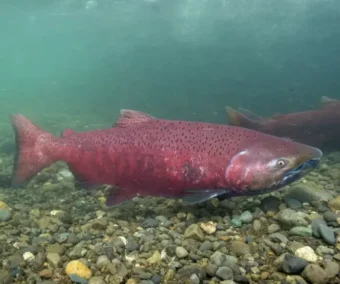
A bright red salmon swims underwater
A chinook salmon. (Ryan Hagerty/U.S. Fish and Wildlife Service)

A Washington state-based conservation group filed a lawsuit this week in an effort to speed up the federal government’s review of a proposal to list king salmon as threatened or endangered across the Gulf of Alaska.

The Wild Fish Conservancy filed its lawsuit Thursday in U.S. District Court in Washington, D.C., saying that the National Marine Fisheries Service had missed a 12-month deadline under the Endangered Species Act to decide on the conservancy’s proposal to list Gulf of Alaska king salmon.

The conservancy, in its 17-page complaint, said it formally asked the service to list the king salmon in a petition Jan. 11, 2024, which gave the agency until Jan. 11, 2025, to respond. The lawsuit asks a judge to order the service to “promptly issue” its decision on the petition by a specific date.

“With the crisis facing Alaskan chinook, we are out of time and options,” Emma Helverson, Wild Fish Conservancy’s executive director, said in a prepared statement, using another name for king salmon. She added: “The Endangered Species Act sets clear deadlines for a reason, to evaluate the risk of extinction and trigger action while recovery is still possible.”

The conservancy’s press release announcing the lawsuit points to other listing proposals that the fisheries service had failed to act on within 12 months and described “systemic dysfunction” at the agency.

A top Alaska official at the fisheries service, Jon Kurland, said in a brief email Friday that the agency is “continuing to review the petition and to develop the required 12-month finding.”

The lawsuit to force action from the fisheries service is “fairly routine,” said Doug Vincent-Lang, fish and game commissioner for the state of Alaska, which has opposed the conservancy’s proposal and numerous other efforts to list species as endangered in Alaska.

Vincent-Lang said that the fisheries service is “working through the process” — if, perhaps, slowed by the change in presidential administrations — and that two state scientists have been given access to a team reviewing the petition, though they’re not voting members.

“I understand they’re getting closer to a decision,” he said. “I’d much rather have them take their time and have a deliberative process than to rush to a decision because of a statutory timeline.”

The conservancy has taken multiple actions in Alaska in recent years that have drawn sharp rebukes from the state’s elected officials and commercial fishermen.

Another lawsuit filed by the group with the intent of preserving salmon as prey for endangered Pacific Northwest orca whale populations threatened to close down Southeast Alaska’s small-boat troll fishery.

And Vincent-Lang has expressed concerns that, if the Endangered Species Act listing of Gulf of Alaska king salmon is approved, it could lead to sharp restrictions on harvests of the fish, as well as in other salmon fisheries that accidentally hook or harvest kings.

The conservancy says that Alaska king salmon are threatened by accidental harvest in trawl fisheries, and by fish hatcheries, habitat destruction, climate change and overfishing.

Alaska’s attorney general flew to South Africa and France. A corporate-funded group paid.

Alaska Attorney General Treg Taylor poses for a photo in his office last month. (Photo by Nathaniel Herz/Northern Journal)

In the state of Alaska’s published travel report for top administration officials, the Department of Law disclosed spending $650 to send Attorney General Treg Taylor to a two-day conference in Colorado last year.

Not mentioned in that report, however: at least $20,000 that a corporate-funded group spent on a trip for Taylor and his wife, Jodi, to the Normandy region of France last summer.

Attendees stayed at a five-star hotel favored by Hollywood stars and polo players and dined at Le Côté Royal, where patrons can spend 38 euros on braised pork cheeks, according to a schedule obtained by a watchdog group.

Roughly half of the country’s attorneys general participated, according to the Associated Press. Their schedule called for four hours of business meetings and more than two days of ceremonies and sightseeing, including guided tours of World War II battlegrounds and a centuries-old abbey.

Taylor ultimately did report that trip in an unpublished financial disclosure he filed in March that’s only released from state regulators upon request.

The disclosure also reported a 2023 trip to South Africa, where attorneys general were scheduled to take an “educational tour” of wine estates and a daylong trip to a game reserve that offers viewing of lions, leopards, rhinos, elephants and buffalo. Participants were accompanied by corporate officials from firms like Uber, TikTok and Albertsons, the parent company of the Safeway grocery store chain, according to reporting by CNN.

Taylor’s participation underscores watchdogs’ growing concerns about the group that paid for the trips, the Attorney General Alliance, or AGA, which has raised millions of dollars from corporations — including some that have had legal disputes with states.

Taylor recently assumed the alliance’s chairmanship, his department announced earlier this year, and he is holding a cybersecurity-focused meeting for the group in Alaska in August.

The alliance, created in 2019, has come under increasing criticism, including from the former head of the century-old National Association of Attorneys General, who said in his retirement letter that the alliance, a competing group, is “overwhelmingly dependent on corporate and lobbyist money” and creates pathways for attorneys general to have their travel paid by entities they are “investigating or suing.”

“The simple fact is they are a lobbyist access group with some programming to cover for it,” said Tom Jones, head of the American Accountability Foundation, a conservative group that’s used public records requests to expose some of the alliance’s corporate links and sponsored trips.

Taylor’s office describes the alliance as a nonpartisan forum where attorneys general “work in cooperation to share ideas, educate on emerging issues, build relationships and foster enforcement through meetings, panels, working groups, and social activities.”

In an interview at his downtown Anchorage office, Taylor said he took vacation time for his trips to South Africa and France, on which he flew business class.

And he vehemently defended AGA’s value. In addition to trips, he said, it also provides trainings for state attorneys on subjects like organized retail crime, online gaming and artificial intelligence.

Taylor said that AGA-sponsored trips contain substantive panels and discussions — such as, in South Africa, sessions on intellectual property rights and cybersecurity.

And he added that the relationships he’s developed with experts and corporate officials on trips have helped him and other attorneys general resolve problems without the need for “long, nasty and expensive” litigation.

But he also rejected the idea that those relationships make it more difficult for attorneys general to hold corporations accountable: He noted that states have sued and litigated against major sponsors of AGA like Amazon and Pfizer.

“The only benefit they have is that I do know who they are. And they do know who I am, and they can reach out,” he said. “But that doesn’t stop us from doing our jobs as AGs, as we’ve proven over and over again.”

Taylor is a former top attorney for a large, Indigenous-owned oil and gas contracting business, and he began his tenure in state government in 2018 as deputy attorney general in charge of the civil division at the Alaska Department of Law.

Republican Gov. Mike Dunleavy appointed him attorney general in 2021.

The AGA was created in 2019 by a group of Western attorneys general and has grown to include more than 40 states and territories, according to its website.

Alaska pays some $10,000 in yearly membership fees. But Taylor acknowledged that a “very, very low percentage” of the AGA’s budget comes from those dues and that the rest comes from sponsors.

CNN reported that the group collected nearly $27 million in sponsorships between 2019 and 2023 — and allows companies, depending upon the size of their contributions, to suggest “speakers, panelists, working groups, white papers and events.”

Jones, from the conservative advocacy group, said one problem with the corporate participation in the trips to foreign countries is that “the other side of that conversation” is not happening there.

People who would advocate for tougher legal scrutiny of corporations, he said, “don’t have the tens of thousands of dollars a year to pay into associations to buy time in Normandy with the attorneys general.”

Taylor said he understands criticism that traveling internationally for AGA programming isn’t necessary in the Zoom era, which, he added, “is why I take personal time for those trips.”

He also said that he paid for his six children and one of their spouses to accompany him on the trip to Normandy, which they followed with a weeklong stay at an Airbnb on southern France’s Mediterranean coast to explore the Pyrenees, “since I’m already there.”

Amid a spate of negative press coverage and public records requests about the alliance, though, Taylor acknowledged that the group has room for improvement and will consider potential changes.

“AGA is a worthless organization if AGs can’t take advantage of the things that they offer,” he said. “And if they can’t take advantage of the things that they offer because of the types of trips that are occurring, then we need to change those types of trips.”

Detailed documentation of Taylor’s alliance-paid trips — including travel confirmations and receipts for plane tickets — is not public because expenses covered by a third party do not need to be recorded, said Alan Birnbaum, a state attorney and public records specialist who handled a Northern Journal request to the Department of Law.

[Read the Department of Law’s response to Northern Journal’s records request]

Birnbaum cited a state administrative manual that says that if travel is “immaterial” to an agency travel budget, related transactions don’t need to be “recorded as an expenditure and a revenue.”

At Taylor’s direction, Birnbaum later released some general itineraries for the trips, though more detailed documentation was still withheld.

Taylor said he did not know whether he’d deleted the requested records, but, he added: “I cull my email all the time.” He also said that state law aims to define what he described as “the limits of a public record.”

“Any time we start to diminish what a public record is, that’s something that I worry about, because that is a slippery slope: ‘Well, you did it in this case. Why, now, won’t you release the memo that you wrote the governor on this issue? Do you have something to hide?’” Taylor said. “That’s just one of those roads that I’ve just made a policy decision, we’re not going to go around.”

Nathaniel Herz welcomes tips at natherz@gmail.com or (907) 793-0312. This article was originally published in Northern Journal, a newsletter from Herz. Subscribe at this link.

Why a surge in gold prices won’t solve Alaska’s budget woes

Lawmakers at the Alaska State Capitol would have to approve any changes to mining taxes. (Photo by Nathaniel Herz/Northern Journal)

When oil prices rise, the state of Alaska gets a windfall in taxes and royalties.

When gold prices rise — as they have, in dramatic fashion, this spring — state revenue barely ticks up.

Industry critics often draw this comparison, arguing that the huge mining corporations that operate in Alaska aren’t compensating the state enough for the minerals they produce.

Those minerals yielded just $28.5 million from Alaska’s mining license tax, on average, during each of the past four fiscal years.

In that same period, the state’s oil and gas industry paid an average of roughly $1.2 billion each year in production taxes, according to state figures.

“Essentially, Alaska is subsidizing a huge giveaway of its public resources,” an economist wrote in a 2022 report commissioned by the mining watchdog group SalmonState.

Mining boosters and some economists say simply comparing state revenue from oil production and that from mining can be misleading, given the huge scale and high profit margins of the petroleum industry. They also note that the value of Alaska’s oil and gas pumped from state land, where production is subject to royalties, dwarfs that of minerals mined from state land.

“Our world class oil fields — Prudhoe Bay, Kuparuk — are in fundamentally a different category,” said Dan Stickel, chief economist at the state’s revenue department.

Dan Stickel of the Alaska Department of Revenue testifies in front of the Alaska Senate Finance Committee on Friday, Jan. 20, 2023, at the Alaska State Capitol in Juneau, Alaska. (Photo by James Brooks/Alaska Beacon)

The market value of all the minerals produced in the state last year was roughly $4 billion, according to state estimates — though mining advocates say that number overstates actual value because mines sell the concentrate they produce at lower prices than pure metals. The total market value of oil produced on the North Slope was about $14 billion.

Even if the state raised taxes on mining companies, economists have long said the industry isn’t large or lucrative enough to make up for Alaska’s decades-long decline in oil revenue.

But the recurring question of whether miners should pay more has bubbled up again recently, with calls from newspaper publishers and environmental advocates to tweak the state’s mining tax and royalty policies to generate more income for Alaskans.

These suggestions have not translated into any formal proposals from elected officials. But they come as record gold prices promise to boost some of Alaska’s biggest mines, as more businesses apply for permits to mine in Alaska and as the state government navigates an ominous financial outlook.

The state uses a few tools to generate income from mining.

It levies a severance tax on minerals, called the mining license tax. It takes 3% in royalties from mining profits on state land. It rents mineral claims and leases. And, like other businesses, mining companies pay corporate income tax.

State agencies brought in an average of $90 million from those sources and various other taxes and fees, such as tolls on a state-owned ore haul road, each year between 2016 and 2021, according to state data.

That’s a fraction of the more than $2.5 billion in annual revenue that mining companies averaged during that period, according to state estimates.

Last year, the Red Dog zinc mine in Northwest Alaska reported more than $600 million in gross profits; Fort Knox, the state’s biggest gold mine, reported more than $300 million in profits after deducting operating expenses, according to corporate financial disclosures.

Proposals to generate more state revenue have focused on raising production royalties and overhauling the mining license tax — a maximum 7% levy on profits that hasn’t changed since 1955.

For large mines, the license tax is currently a $4,000 payment, plus 7% of net income over $100,000. New mines get a 3.5-year exemption.

By contrast, the state taxes oil at a base rate of 35% of net production value — the value of the oil produced minus certain capital and operating expenses — with tax credits that increase when oil prices fall.

Without knowing the taxable income of each mine and oil operation and exactly how much each owes in taxes — numbers that aren’t disclosed publicly — it’s difficult to compare the effective tax rate across each industry. The effective rate is the percentage of a company’s profits that it pays in taxes, and it’s a figure that economists often use to describe a company’s tax burden.

recent report on mining policy commissioned by the Alaska Conservation Foundation recommended restructuring the mining license tax so that it applies to a company’s overall income rather than being tied to profitability.

“We’re just giving away these precious metals and allowing these multinational corporations to dig them up,” said Dan Cannon, senior public lands coordinator at the Anchorage-based conservation organization. “What does the average Alaskan get from this? Not much.”

If the state kept the maximum rate at 7%, but taxed gross instead of net income, that would be a “very large tax increase,” according to Stickel, the state economist.

The state’s most recent revenue forecast assumes about $3.6 billion in gross mining income during the next fiscal year. Its forecast of $36.7 million in revenue from the existing, profit-based tax structure, would be similar, roughly speaking, to a tax on gross income at around 1%, Stickel said.

Even if revenue stayed steady, a gross income tax “would be more regressive – with tax due even when a mine is unprofitable and with a lower tax burden when there is higher income,” Stickel wrote. “What impact this structure would have on production and company decisionmaking is difficult to say.”

Industry representatives say raising taxes would make Alaska less attractive to miners and would thwart investment, potentially leading to decreased revenue in the long term.

“Alaska’s mining record does not show that we are a jurisdiction widely viewed as a low-tax environment where industry is flocking to invest,” trade group Alaska Metal Mines wrote in a recent paper responding to the report commissioned by the conservation foundation. “This is not a record that supports a significant increase in revenue obligations for the industry.”

A tax hike could make new mines too expensive to build and operating mines too costly to expand and keep in production, said Karen Matthias, director of Alaska Metal Mines. Costs are already higher in Alaska than other states because of its remoteness and lack of infrastructure, she added.

Kinross’s Fort Knox mine outside of Fairbanks. (Kinross photo)

In the past four years, Alaska’s annual mining license tax revenue ranged from more than $50 million to a loss of about $1 million. That loss, reported during the 2024 fiscal year, was caused by a shift in the timing of one-time tax filings and refunds, as well as by low base metal prices and high operating costs caused by inflation, according to Stickel.

Rents and royalties are a smaller fraction of Alaska’s mining related income and have recently amounted to just over $15 million in yearly revenue. Corporate income tax paid to the state by mining companies has averaged some $7 million over each of the past five years.

In all, mining accounted for just 0.2% of the state’s total revenue last year — a proportion that state officials expect to double this year.

With gold prices soaring, the revenue department forecasts mining license tax revenue to see a modest boost from the recent average of $28.5 million — reaching about $33 million this fiscal year and $36 million the following year.

The state won’t see a bigger bump because costs have gone up across the industry and not all metal prices are rising like gold’s, Stickel said.

Zinc prices, for instance, have fallen about 8% this year, potentially cutting into profits at Red Dog mine, a pillar of the state’s industry.

That mine also is often cited by industry supporters as an example of how mining stands out more for its impact on local and regional economies than on the state government.

Red Dog accounts for more than 80% of the Northwest Arctic Borough’s revenue through payments similar to taxes. It has also generated billions of dollars for shareholders of the Alaska Native corporation that owns the land where the mine sits, which receives a 40% royalty share of net profits.

Similarly, large mines are the biggest property taxpayers in the Juneau and Fairbanks areas.

“Where mining truly makes a difference in Alaska is regionally,” Matthias said. “Red Dog is to the Northwest Arctic Borough what the entire oil industry is to the state.”

Northern Journal contributor Max Graham can be reached at max@northernjournal.com. He’s interested in any and all mining related stories, as well as introductory meetings with people in and around the industry.

This article was originally published in Northern Journal, a newsletter from Nathaniel Herz. Subscribe at this link.

As Trump eyes Greenland and Arctic resources, America’s ambassadorship for the region goes unfilled

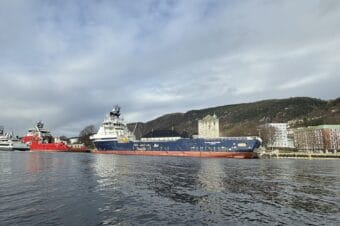
Offshore oilfield service vessels sit docked in the city of Bergen in Norway, an Arctic nation that collaborates with the U.S. on military and other matters. (Photo by Nathaniel Herz/Northern Journal)

Five weeks before Election Day, at an evening ceremony at the office of the U.S. Department of State, America’s first-ever Arctic ambassador was sworn into his new job.

Barely 100 days later, on Jan. 20, Mike Sfraga resigned — departing his post, like other ambassadors, as Donald Trump took power.

Now, Sfraga’s position remains unfilled. And Alaskans and others tracking America’s stance toward the Arctic are waiting to see when, or if, the new administration will offer a clear vision or plans for the region that the U.S., its allies and rivals are increasingly eying as a zone for commerce and military activity.

“It’s feeling very quiet,” said Diane Hirshberg, who leads a research institute at University of Alaska Anchorage and is academic vice president at an international network of schools called University of the Arctic. “We’re just in this weird land of uncertainty.”

At a recent working group meeting of an international commission called the Arctic Council, Hirshberg said, the American government representative shared nothing, “other than that the U.S. reserves the right to comment at a later date.”

Experts say that Trump’s outspoken desire to annex Greenland makes clear that he’s aware of the Arctic’s growing strategic value. But they also say that his distrust of traditional European alliances and his targeting of research institutions risk undermining the nation’s interests in the region.

Mike Sfraga discusses Arctic issues during a Juneau World Affairs Council presentation at KTOO in Juneau on Feb. 6, 2020.
Mike Sfraga discusses Arctic issues during a Juneau World Affairs Council presentation at KTOO in Juneau on Feb. 6, 2020. Sfraga directs the Wilson Center’s Polar Institute. (Photo by Jeremy Hsieh/KTOO)

“There are other nations questioning us,” Sfraga said at an Alaska legislative hearing this month. “Every one of our allies in the North and elsewhere, they’re questioning how committed we are.”

Republican U.S. Sen. Lisa Murkowski, who’s long prodded the federal government to develop its Arctic policy, said she thinks the new administration appreciates the significance of the region for its natural resources and importance to American national security.

But she said she’s pushing for that awareness to be backed up with qualified personnel — new appointees to Arctic-focused positions like the ambassador job.

“At some of these Arctic conferences, I’m there,” she said in an interview. “But the U.S. delegation has to be more than just Lisa Murkowski.”

Former President Joe Biden created the Arctic ambassador position through an executive action, and it’s not set out in law — a fact that Murkowski, via legislation she introduced earlier this year, hopes to change.

U.S. Sen. Lisa Murkowski dances at a cultural festival in the northern Alaska community of Utqiagvik, above the Arctic Circle. (Photo by Nathaniel Herz/Northern Journal)

She said she’s also submitted names to the Trump administration to consider for the post and is concerned that if the decision is delayed, the new ambassador nominee could end up being a campaign donor chosen “as, kind of, a political favor.”

Murkowski said she’d love to see Sfraga reappointed to the position.

Biden originally nominated Sfraga, an Alaskan geographer who’d worked at a think tank and in Alaska’s university system, to the ambassadorship in early 2023.

Murkowski recommended Sfraga for the post and lobbied for his confirmation.

But it took more than 18 months for the U.S. Senate to take an up or down vote. Some Republican senators, led by Idaho Republican James Risch, criticized Sfraga’s relationships with officials and institutions from China and Russia.

Sfraga said in an email that filling his old post is in America’s best interest.

“The United States requires a Senate-confirmed ambassador so we can inform, influence and appropriately lead Arctic-related issues and policies throughout the region, clearly articulate U.S. Arctic goals and objectives, and ensure our policies and efforts are coordinated and advanced at home,” he said.

Asked whether he’d take the job back if chosen by Trump — as suggested by Murkowski — Sfraga thanked the senator for her “unwavering support.”

“It is now time to consider other opportunities to advance U.S. and allied partners’ interests in the Arctic, and Alaska’s unique role in the region’s future,” he said.

Alaska’s sole member of the U.S. House, Republican Nick Begich III, said in an emailed statement that an Arctic ambassador supports a strong presence in the region, “which is vital for national security.”

“I will continue to work with the executive branch and members of the Alaska delegation to advocate for an Arctic policy that includes leadership staffing as a component of our national security strategy,” Begich said.

The State Department, in an emailed statement to Northern Journal, did not directly answer a question about if and when the new administration plans to replace Sfraga. But it did say that the Office of the Ambassador-at-Large for Arctic Affairs “remains funded and operational.”

That’s in contrast to the Wilson Center — a 55-year-old think tank that once employed Sfraga when he was the founding director of the center’s Polar Institute.

The center, which focuses on foreign policy, has been almost entirely shut down by the new administration, with more than 100 employees placed on leave and just a handful of congressionally mandated positions remaining, according to the New York Times. The Polar Institute’s current director did not respond to a request for comment.

At the U.S. Department of Defense, meanwhile, the administration has filled one top Arctic-focused position. Last month, Steven Schleien, a longtime department official, was named deputy assistant secretary for Arctic and global resilience — with responsibilities that include Arctic security, ocean issues and critical minerals.

One other person that experts see as a potentially influential voice on the administration’s Arctic policy is Julia Nesheiwat.

Nesheiwat currently has no formal role in the administration. But she’s a former homeland security adviser to Trump and a former member of the U.S. Arctic Research Commission, and her husband, Mike Waltz, is Trump’s national security advisor.

Nesheiwat recently traveled with Waltz, Vice President J.D. Vance and other top administration officials to Greenland. She also held a meeting with Republican Alaska Gov. Mike Dunleavy at an energy conference in Texas last month.

Murkowski said she’s spoken about Arctic policy with Marco Rubio, the secretary of state and her former U.S. Senate colleague.

She also sent the president and other top administration officials a letter last month outlining her Arctic-related priorities — including the appointment of a special presidential assistant focused on the region, and the creation of a new deputy assistant secretary for Arctic affairs at the State Department.

Murkowski, who’s publicly clashed with Trump at times, acknowledged that some in the new administration “would love to deep-six anything that I might suggest.”

“But I know that you have people who are genuinely interested in advancing good policy,” she said. “I think they’re looking for suggestions.”

Nathaniel Herz welcomes tips at natherz@gmail.com or (907) 793-0312. This article was originally published in Northern Journal, a newsletter from Herz. Subscribe at this link.

Alaska’s governor flew to Taiwan to sell LNG. China’s not happy.

Gov. Mike Dunleavy and other state of Alaska officials pose for a photo with Taiwan President Lai Ching-te, center, and other government officials during Dunleavy's trip to Taiwan last month.
Gov. Mike Dunleavy and other state of Alaska officials pose for a photo with Taiwan President Lai Ching-te, center, and other government officials during Dunleavy’s trip to Taiwan last month. (Taiwan Office of the President photo)

JUNEAU — Republican Gov. Mike Dunleavy flew to Taiwan last month to pitch business and government leaders on Alaska’s state-sponsored liquefied natural gas export project.

The same day Dunleavy and other Alaska officials arrived in Taipei on the unannounced trip, his office received an email from China’s vice consul in San Francisco, Ba Yanfeng. The consulate was aware that Dunleavy was leading a trip to the “province” of Taiwan, and Chinese government officials wanted a meeting with his chief of staff, Ba said.

Dunleavy had stepped into a simmering geopolitical conflict — an issue that China’s government describes as the most important and sensitive in its relationship with the U.S.

China claims Taiwan as its own territory and regularly conducts military drills nearby — including some that have simulated blockades and involved firing missiles over the island.

The U.S. doesn’t officially recognize Taiwan’s independence. But it’s a longtime ally, sells arms to the government and has committed in legislation to support the island’s defense.

Taipei is Taiwan's largest city.
Taipei is Taiwan’s largest city. (Nathaniel Herz | Northern Journal)

In a formal follow-up note, the Chinese government said Dunleavy’s trip “sends a very wrong signal to the ‘Taiwan independence’ separatist forces,” and it urged the governor “to correct such mistakes and avoid their recurrence.”

But Dunleavy, in an interview, said he was undeterred.

“I don’t allow myself to get pushed around by too many entities or people,” he said.

Alaska does significant trade with China, namely in seafood products, though that’s diminished since President Donald Trump began levying tariffs during his first term. Still, Alaska exports more than $500 million in seafood products to China each year.

But amid China’s broader, ongoing trade war with America, experts said it’s unlikely that the country will target Alaska with retaliatory action even if the LNG project moves forward with Taiwanese partnership.

“I think this is probably fairly low on China’s list of priorities. They have a lot on their plate,” said David Sacks, an expert on Taiwan and China and a fellow for Asia studies at the Council on Foreign Relations.

Sacks described the Chinese correspondence with Dunleavy’s office as “pretty pro forma,” even if it sounds strident. He also said there’s nothing unusual about an American governor or legislator traveling to Taiwan — and he noted that other states, like Arizona, have done robust business with Taiwanese firms without prompting a backlash from China.

“I think it would be fairly unprecedented for the Chinese to take aggressive action here that specifically targets Alaska,” he said.

Dunleavy’s trip to Taiwan last month came amid a new push by his administration to recruit investment in the $44 billion LNG development. Top Trump administration officials have also been touting the project to Asian allies, and a private firm, Glenfarne, has taken over leadership of the development from a state agency.

Dunleavy’s trip also included stops in Thailand, South Korea and Japan, where he met with politicians and corporate executives.

But his Taiwan visit garnered the most headlines. In Taipei, Dunleavy met for an hour with President Lai Ching-te and held a lunch with the vice president, according to his schedule. He also met with officials from Taipower, the country’s primary electric utility, and from the state-owned oil and gas company, CPC.

Alaska Gov. Mike Dunleavy shakes hands with Taiwan's president, Lai Ching-te.
Alaska Gov. Mike Dunleavy shakes hands with Taiwan’s president, Lai Ching-te. (Taiwan Office of the President photo)

CPC has signed a nonbinding letter of intent to buy one-third of the LNG produced by the Alaska project, and the letter also contemplates investment in the development, according to a description by officials from the state’s gas pipeline agency. The letter itself is confidential, according to the agency.

Promoters of Alaska’s LNG project, including Dunleavy and Republican U.S. Sen. Dan Sullivan, say that investment in and purchases of gas from the development can provide Asian allies with a secure source of fuel — with a shorter transit time than shipments from the Middle East. Importing Alaska gas would also lower Taiwan’s trade deficit with the U.S., which could curry favor with Trump.

But it’s still far from certain that the project will be built. Alaska’s government has spent decades studying construction of a gas line, and the current iteration of the project has been dogged by projected high costs.

Taiwanese investment in the project, and any American engagement with the island’s government, also risk pushback from China.

In a prepared statement to Northern Journal, the spokesman for China’s embassy in Washington, D.C., Liu Pengyu, called Taiwan “an inalienable part of China’s territory” and urged “the relevant U.S. side” to cease all forms of official contact with Taiwan.

“China firmly opposes any form of official interaction between the United States and Taiwan, under any pretext or in any capacity,” the statement said.

Dunleavy, in the interview, said he did not know how the Chinese government became aware of his visit to the island.

They “wanted me to abort the trip, apparently,” he said.

Dunleavy would not directly say whether he recognizes Taiwan’s sovereignty, calling that “the biggest loaded question.”

“These are human beings, 23 million people. They would like to have a great relationship with the United States,” he said. “We want to sell energy. They want energy. I’d love to partner.”

Alaska has a long history of trade with Taiwan, and other state officials have traveled there in recent years, including two state senators in 2024. Former Gov. Frank Murkowski has visited more than a dozen times, including as an observer of one of Taiwan’s presidential elections.

The Chinese response to Dunleavy’s trip, first reported by conservative news site Must Read Alaska, is “pretty boilerplate,” said Sacks, the expert from the Council of Foreign Relations.

But its “ominous” language could also be an attempt by the Chinese to ward off business dealings in Taiwan by an American official who’s not well-versed in the island’s tense political dynamics, Sacks added, in comments that were echoed by a statement from the U.S. Department of State.

“Around the world, including in the United States, the Chinese Communist Party attempts to leverage economic and diplomatic pressure to try to prevent officials from interacting with Taiwan,” the statement said. “Robust cooperative activities with Taiwan, including by state leaders, are consistent with U.S. policy.”

The statement added that the letter of intent from CPC “is another example of the longstanding, deep, and growing trade and investment ties between the United States and Taiwan, which create American jobs and mutual prosperity.”

Sacks said he sees the LNG project as being in America’s interests — both because of its potential to reduce Taiwan’s trade deficit and to give its people a more reliable supply of energy.

But while Sacks described the risk of repercussions to Alaska as low, he also wouldn’t completely rule them out. He pointed to a recent move by China instructing the nation’s airlines to stop accepting deliveries of jets made by Boeing.

“The context might change now, because the Chinese are looking for ways — in a way that they weren’t before — to punish the Trump administration for the tariffs,” Sacks said. “I wouldn’t foreclose that.”

Nathaniel Herz welcomes tips at natherz@gmail.com or (907) 793-0312. This article was originally published in Northern Journal, a newsletter from Herz. Subscribe at this link.

Site notifications
Update notification options
Subscribe to notifications