The Arctic is on the front lines of climate change. Alaska is warming at twice as fast as the rest of the planet. Some of the most visible impacts are in Native communities located on barrier islands in Northwest Alaska. These communities are facing a future without the ice that used to protect them from storms that threatened to wipe them away. A group called Alaska Common Ground hosted an all-day forum in Anchorage over the weekend to answer the question, “What are we doing about it?”
The answer: not much, yet.
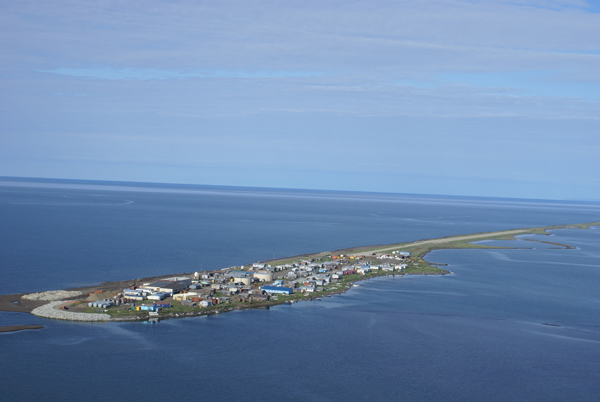
The community of Kivalina, Alaska. (Photo by Coast Guard Lt. Cdr. Micheal McNeil)
Studies recommended relocating villages like Newtok, Kivalina and Shishmaref. But more than 10 years later they are still there, with waves getting higher and storms getting stronger. Part of the reason is that emergency programs don’t finance this kind of ongoing situation and erosion.
That’s left people like Mike Black with the Alaska Native Tribal Health Consortium trying to engineer patches to keep communities functioning as the ground turns to jelly or melts out from under them.
One of the solutions is to cool the foundations. That used to be done with passive systems developed for the pipeline, which enables cold air from the surface to sink down into the ground to keep the permafrost frozen. Now that air is too warm to do the job and engineers are forced to use energy to refrigerate the foundations.
“Refrigeration can work in the summertime extremely well when you’re using solar panels because we have constant sun. So in that way it’s kind of an elegant solution. But the reality is you can only protect some relatively limited spots the rest of the community often times will have to suffer from the melting of that permafrost,” Black said.
To cope with heaving ground, engineers are also abandoning metal pipes for flexible plastic ones to take water and sewage away from village homes. Black sees this as a stopgap measure. He and others want to design more mobile structures and systems that will allow small Alaska communities to move as the water rises and ground sinks in the warming Arctic.
One solution to slow the warming is to reduce methane and carbon dioxide emissions. That’s where taxing carbon comes in making oil and other fossil fuels more expensive to use. Many west coast governments are working to reduce emissions and have imposed various kinds of carbon taxes. Alaska remains a holdout.
Former Department of Environmental Conservation commissioner Bill Ross says Alaska needs to adopt some type of emissions tax because it will be good for the economy as well as the planet. He points to the economic impact of the places that have adopted carbon taxes.
“The number of green jobs is growing twice as fast as regular jobs in those economies. So even though they are moving aggressively to reduce carbon emission their economies are thriving compared to anyone else that is their peers,” Ross said.
He suggests using the Permanent Fund to pave the transition away from oil. A lot would need to change in the state to make that happen… including Alaskans’ attitudes toward taxes. But even simple things remain undone… like removing regulations that make it hard for state departments to borrow money to make buildings tighter and more energy efficient.
Larry Merculieff with the Alaska Native Science Commission says there is no time to waste. Native elders he works with say there’s no climate change, but instead a climate crisis. They say everything will warm up much faster than anyone predicts and that people need to act now.
“The elders certainly are unanimous about this in all the regions and I’m talking about not just older people. I’m talking about elders who are tradition bearers and have wisdom recognized by the community,” Merculieff said.
To underscore the magnitude of change that needs to be made, Merculieff quoted Albert Einstein, who said you can’t solve the problems that face humanity with the same consciousness that created those problems.
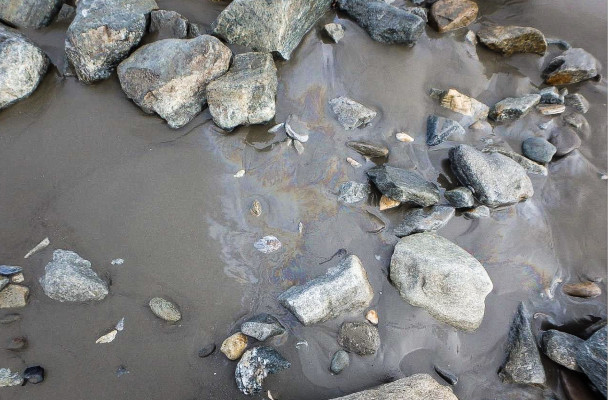
A gasoline sheen along the Shishmaref shoreline. (Photo courtesy Alaska Department of Environmental Conservation)
A leaking gas line in Shishmaref has finally been fixed about a year and half after a village public safety officer first discovered an oily sheen along the northern coast of Sarichef Island. Officials with the Alaska Department of Environmental Conservation said the leak came from a tank farm fuel line owned by the Shishmaref Native Store.
While responders from the DEC and U.S. Coast Guard could not identify the substance during the first round of cleanup last summer, they eventually tracked down the source after testing samples when the sheen reappeared last December and then again in May. Lab results revealed the substance to be gasoline, which pointed agencies toward the origin of the leak — the community’s sole gas line.
George Kakoona works at the Shishmaref Native Store. He said they used pressure testing to locate holes in the line this fall, before setting a repair weld.
“We had to get a guy to do the hydrostatic test on the line. We saw we had a couple leaks on there,” said Kakoona. “It took us a while, but it’s fixed. We checked it. After we got done with it, we did the hydrostatic test again and it holds pressure. The pipe and everything is all good.”
The cause of the leak is unknown. But with the gas line fixed and suitable for fuel transfers, the DEC closed their investigation Nov. 3.
There have been no reports of impacted wildlife, which Kakoona credits to early efforts aimed at containing the spill.
“It looks good because most of (the gas) washed up while we were doing cleaning,” said Kakoona. “When the Cost Guard came up here, they showed me how to put pads and booms down there and wait until it soaked out of the ground.”
That resulted in about 100 gallons of recovered fuel and 30 hazmat bags of oily waste, which were removed last summer. Still, officials said it’s unclear how much gas spilled in total, given how long the leak lingered.
For the same reason, Jessica Starsman — an environmental protection specialist with the DEC — said there’s still cleanup to be done.
“Because that leak was there and we had gasoline continually leaking out over time, we do have contaminated soils that will need to be addressed,” said Starsman.
But with ice and snow settling in, Tom DeRuyter said further cleanup is on hold until spring. DeRuyter is a state on-scene coordinator with the DEC. He said the department will oversee the Shishmaref Native Store as it continues cleanup efforts come breakup.
“We’ll continue to work with them,” said DeRuyter. “We’ll need to a get a cleanup plan from the Native Store on how they wish to address this area of contamination, and we’ll review their plans for adequacy.”
DeRuyter said it’s unclear how much residual cleanup will cost, but the Native Store will cover the expenses as the owner of the gas line and the responsible party.
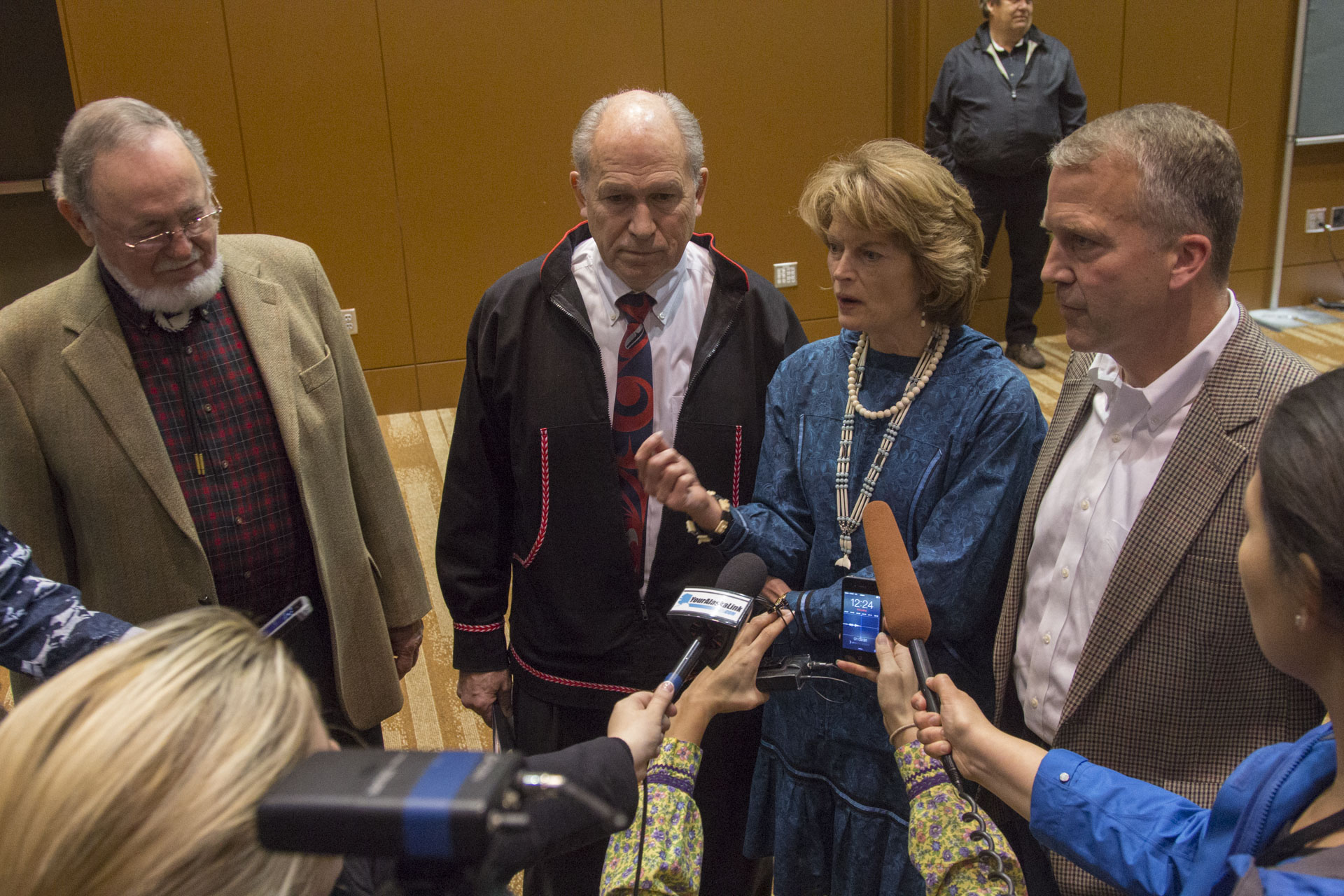
Alaska’s congressional delegation and governor gather with press after the Department of the Interior’s surprise announcement of the cancellation of off-shore drilling leases. (Photo by Mikko Wilson/KTOO)
The Obama administration announced Friday that it is canceling plans to open up more of the Arctic Ocean to oil and gas drilling, citing lack of industry interest in the region.
The Interior Department won’t auction off drilling rights in the Chukchi and Beaufort Seas in the next two years. The auctions would have been the first in the Arctic Ocean since 2008, and the first under President Barack Obama.
The announcement comes just weeks after Shell suspended its controversial quest to drill in the Arctic Ocean, after disappointing results this summer. The Department also rejected requests from Shell and the Norwegian company Statoil to extend their leases in the region, which will expire by 2020.
Gov. Bill Walker reacted to the news with frustration.
“As we struggle with funding on education and costs of energy, I can’t tell you how disappointed I am in this decision,” he said.
The Walker administration had high hopes for offshore drilling, at a time when plunging oil prices and declining production have decimated state revenues. Walker said it’s like that door has been shut in Alaska’s face — and said he’ll work with the congressional delegation to formulate a response.
“This hits us at our lowest time,” he said. “And it’s time we stepped up and said lets be Alaskans again. Let’s be more aggressive on this issue.”
But the Interior Department said there simply isn’t enough industry interest to justify the lease sales. At least nine companies already hold more than 500 active leases in U.S. portions of the Arctic Ocean. But since Shell pulled out, there is only one near-shore project under development – Hilcorp’s Liberty unit.
In a written statement, Interior Secretary Sally Jewell cited Shell’s decision, the amount of acreage already leased, and “current market conditions” as reasons to hold off on sales for at least the next year and a half. The Interior Department has not ruled out future lease sales after 2017.
And the department said Shell and Statoil had not laid out specific plans for exploration under their existing leases, a requirement for extending them.
In an emailed statement, Shell spokesperson Megan Baldino wrote, “When it comes to frontier exploration in Alaska, one size does not fit all. We continue to believe the 10-year primary lease term needs to be extended.”
Environmental groups cheered the decisions. Michael LeVine, of Oceana, said given the challenges of working safely in the Arctic and the lack of exploration happening now, “There is no reason to extend existing leases, and no reason to sell new leases.”
“The right course of action is to wipe the slate clean,” he said. “Let’s get rid of the poorly planned and justified decisions to sell leases in the 2000s, and the unwise investments made by companies.”
Meanwhile, Alaska’s elected officials expressed outrage. Speaking with reporters at the Alaska Federation of Natives Convention in Anchorage, Congressman Don Young said he has a plan. Step 1 is a lawsuit. Step 2 is, essentially, siphon the feds’ oil tank in the Arctic.
“We ought to go right up next to ANWR and go 3 miles off shore. We’ll rent a rig … and we’ll drill in state land, and run the doggone horizontal drilling out 15 miles, which is possible. And we’ll take their oil. See how long that’ll last. That’s my idea. It’s a positive step forward.”
Gov. Walker suggested it’s an idea that’s occurred to him, too: “You been reading my email, buddy?”
More and more Inuit women are getting face tattoos.
The traditional practice dates back centuries but was banned by 19th and 20th-century missionaries. Now it’s coming back. Though the techniques and customs were nearly lost, a new generation is using tattoos to reclaim what it means to be a Native woman in the 21st century.
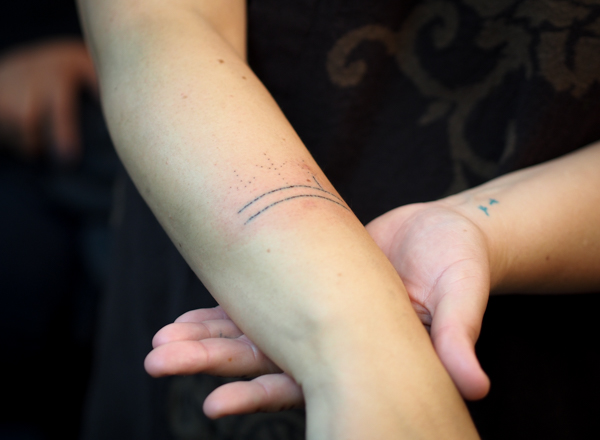
In the backroom of a small Anchorage tattoo parlor, Maya Sialuk Jacobsen uses a thin needle to pull an inky thread through the skin on her friend’s wrist.
“I use the exit hole as the entrance for the next stitch,” Jacobsen explained, bent over her work as a small crowd observed.
The friend is Holly Mititquq Nordlum, organizer of a weeklong series of tattoo-related events called Tupik-Mi. Compared to the sting of a tattoo gun, the stitches hardly register, and Norldum looks unfazed, greeting and bantering with observers cycling in and out of the cramped room.
“It’s loose,” Nordlum said, nodding at the flesh on her arm. “I put on a few pounds so she’d have something to work with.”
“Her skin is so much better than my husband’s skin,” Jacobsen laughed. “She has really lovely skin to tattoo.”
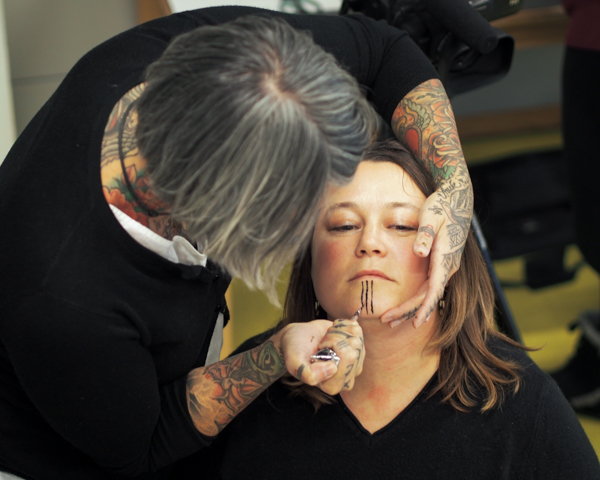
Maya Sialuk Jacobsen of Greenland gives a henna tattoo to a friend’s chin during an event at the Anchorage Museum, part of the Polar Lab’s Tupik-Mi series on traditional tattoos. (Photo by Zachariah Hughes/KSKA)
Jacobsen is one of the few Inuit women who knows how to give tattoos through traditional methods like sewing and poking in dabs of dye. She’s candid about the fact that the equipment has changed. Instead of whale sinew, she uses cotton thread; rather than coloring with soot, she uses tattoo ink. But much like rifle hunting compared to harpooning, she sees her modern tools simply as superior means towards traditional ends: inscribing the skin with meaningful marks.
Jacobsen has spent years cobbling together a body of knowledge about what the practice meant before Danish colonization in her native Greenland almost three centuries ago.
“There is no short answer,” Jacobsen says, adding, “it’s also a very Western, academic way of thinking.”
Jacobsen’s son Benjamin came with her from Greenland, and shows off self-administered henna designs made of different traditional patterns, but reconfigured. (Photo by Zachariah Hughes/ KSKA)
Outsiders have looked at Inuit tattoos as having legible meanings embedded within stable rituals, like clear markers signifying marriage or adulthood. But not only did those cultural foreigners import concepts of their own–like marriage–but also a sense of fixity to a practice Jacobsen says was much more fluid and interpretive. “I can’t tell you a triangle means an iceberg,” she explained dryly. That’s partly because the historical record is unreliable, but also because symbols were not nearly so firm.”
You can’t understand tattooing, she believes, without understanding the lives of Inuit women.
While working as a tattoo artist in Europe, Jacobsen was diagnosed with fibromyalgia, which made it difficult to wield the heavy, vibrating drill that is the trade’s standard instrument. So she started poking, and from there stitching. But as she tried learning more about how Inuit women had traditionally been marked, the few historical accounts all came from European adventurers and missionaries.
“I assure you, they did not really know what tattooing was,” Jacobsen says with a wry smile.
But then came the mummies. A group of 15th century Inuit women discovered during 1972 at the Qilakitsoq (“little sky”) grave-site in Greenland, preserved tattoos and all. Jacobsen found a book about them, studied the designs, and realized the marks on their foreheads, cheeks, and chins were similar to the tight stitches she’d learned as a girl. It was her first primary source.
“I have, like, literature, and then I have, what I call ‘from the horse’s mouth,’” Jacobsen says, “and that is the mummies.”
Tupik-Mi, Jacobson and Norldum’s project, is part of an effort within the Urban Interventions series in the Anchorage Museum’s Polar Lab.
“Tupik means tattoo,” explained Nordlum, who is Inupiaq, “and then ‘mi’ is a shortened version of muit, which means ‘people.’ In Kotzebue, we say ‘Qikiqtaġrumuit’ which means, ‘We’re the people from Kotzebue.’”
Nordlum was introduced to Jacobsen over Facebook after she couldn’t find anyone to give her a traditional tattoo in Alaska. A friendship blossomed, and they arranged the first in what they hope will be yearly Tupik-Mi events.
In addition to a lecture and live tattooing demonstration, the women also hosted a light explanation of traditional tattoos for high schoolers before letting them apply tube after tube of henna to their appendages.
Nordlum squeezed a tight formation of dots and lines onto the back of an 11th grader’s wrist.
“She’s making my initials with the Inuit designs,” says Ben Hunter-Francis.
The West High junior says he has plenty of time to decide whether or not he’ll get a tattoo. But if he does, he’d like it to be attached to his Yup’ik roots in the Lower-Yukon community of Marshall.
“Just to make my heritage proud, and make my family proud,” Hunter-Francis says, “that I’m connected with my heritage in some way.”
Traditionally, tattooing was the province of women. They were the ones who wore them, and exclusively the ones to administer them. But as Nordlum finished Hunter-Francis’s wrist, she explained that the practice isn’t bound in place by history.
“In modern culture, men getting tattoos is not a rarity. We are contemporary people working in modern times, so although it was a rarity traditionally, now it isn’t,” Nordlum says, not letting up her hold on Hunter-Francis’s arm.
“Culture is not a set thing, it is a living breathing thing that changes as time goes, and we’re just adapting … like skin.”
Holly Mititquq Nordlum shows off her partially complete tattoo during a live demonstration at Anchorage’s Above The Rest studio. Each horizontal line is 40 individual stitch marks through the first layer of skin. Before starting the stitches, Jacobsen poked the basic design of three bird feet rising from the lines. Nordlum’s Inupiaq name, Mititquq, means ‘a place where birds land,’ and she celebrates big life goals with bird feet tattoos, like the two on her opposite wrist, done with a tattoo gun. (Photo by Zachariah Hughes/ KSKA)
If plans go ahead, Tupik-Mi will expand next year to train a handful of Alaskans in traditional tattooing methods. By the third year, the hope is to hold workshops in Canada and Greenland, growing tattooing capacity across the high north.
“The idea,” Nordlum explains, “is for Iñupiaq, Inuit, Yup’ik women to feel proud of who they are. To feel strong. To create a sisterhood. To belong to something bigger than yourself, so that you’re safe and you’re supported by all these other women.”
Nordlum was a few days away from getting lines tattooed on her chin, one of the most visible and common styles across a wide array of indigenous Arctic communities. She says more women in Alaska are opting for chin tattoos, to the point where she brushed off the suggestion it was a bold decision to get one
“I don’t feel very brave here because there’s so many of us,” Nordlum says.
Permanence is part of why tattoos carry so much weight, and Nordlum sees the resurgence in women’s chin tattoos as putting forward a permanent, proud Native identity for all to see.
Jacobsen had her own chin lines laid down by her partner just two months ago. Soon after the process began, she felt a visit from her late mother.
“My mind was just wrapped around all of these thousands of fore-mothers I must have had that had tattoos,” Jacobsen says, her words growing softer. “My heart was beating so hard, and I cried, and I was shaking.”
Four thin lines that would have normally taken a few minutes took hours. “It was definitely very, very emotional,” she says.
Jacobsen is sharing that intimate experience with Nordlum, dot-by-dot, as she pokes a tattoo into her friend’s chin.
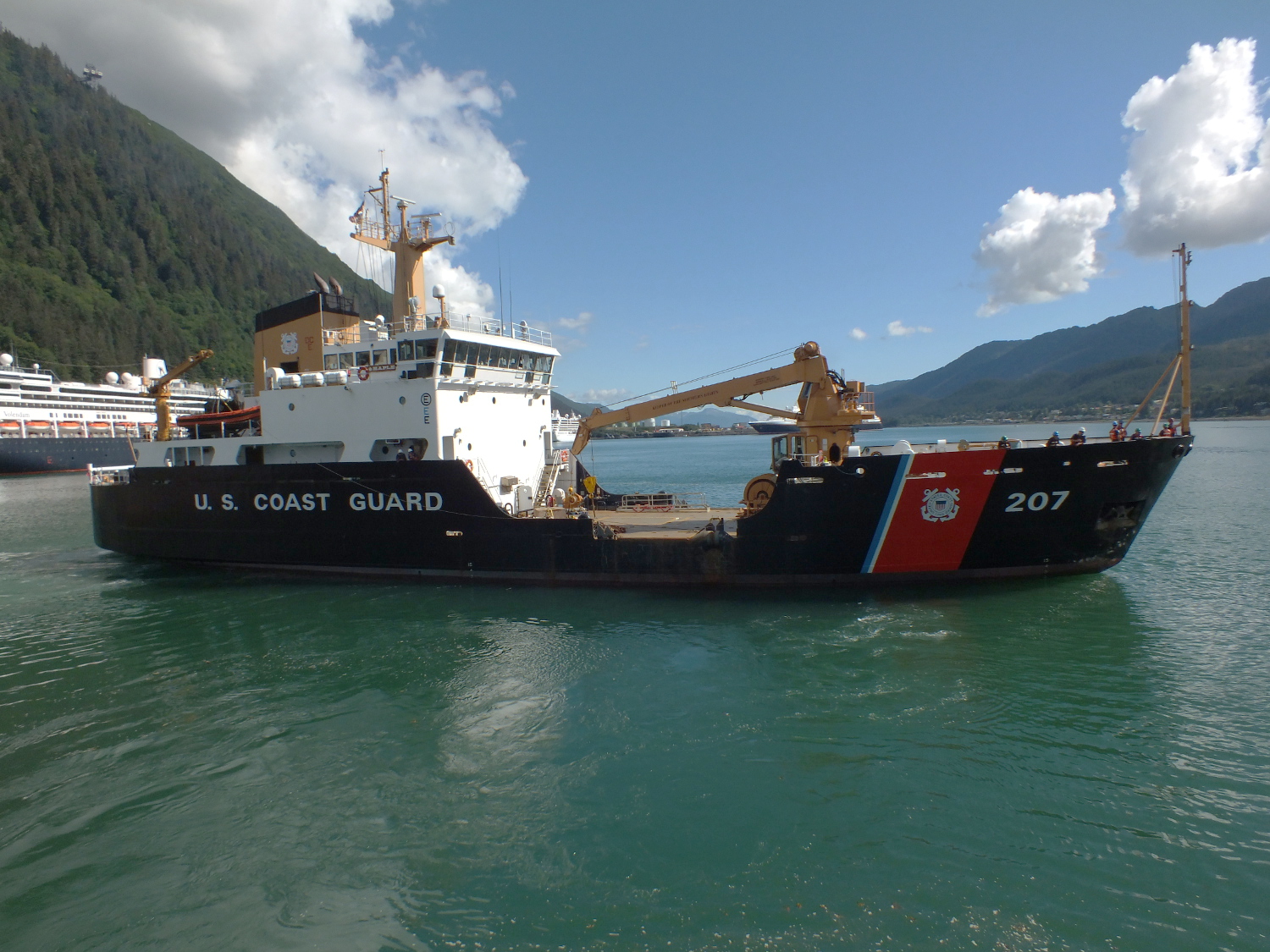
U.S. and Canadian Coast Guard crews recently conducted a joint training exercise with the Emergency Towing System. Deployed to eight communities in coastal Alaska, the ETS can be used when tugs aren’t available to assist large vessels like disabled freighters and cruise ships that are in danger of running aground.
During the exercise that occurred during the annual Buoy Tender Roundup in Juneau earlier this month, the ETS was loaded aboard the USCGC Maple before it left Station Juneau. Earlier plans called for a Coast Guard H-60 helicopter to lower the towing system by sling to the Maple’s deck, but the helicopter was called away just before the training exercise.
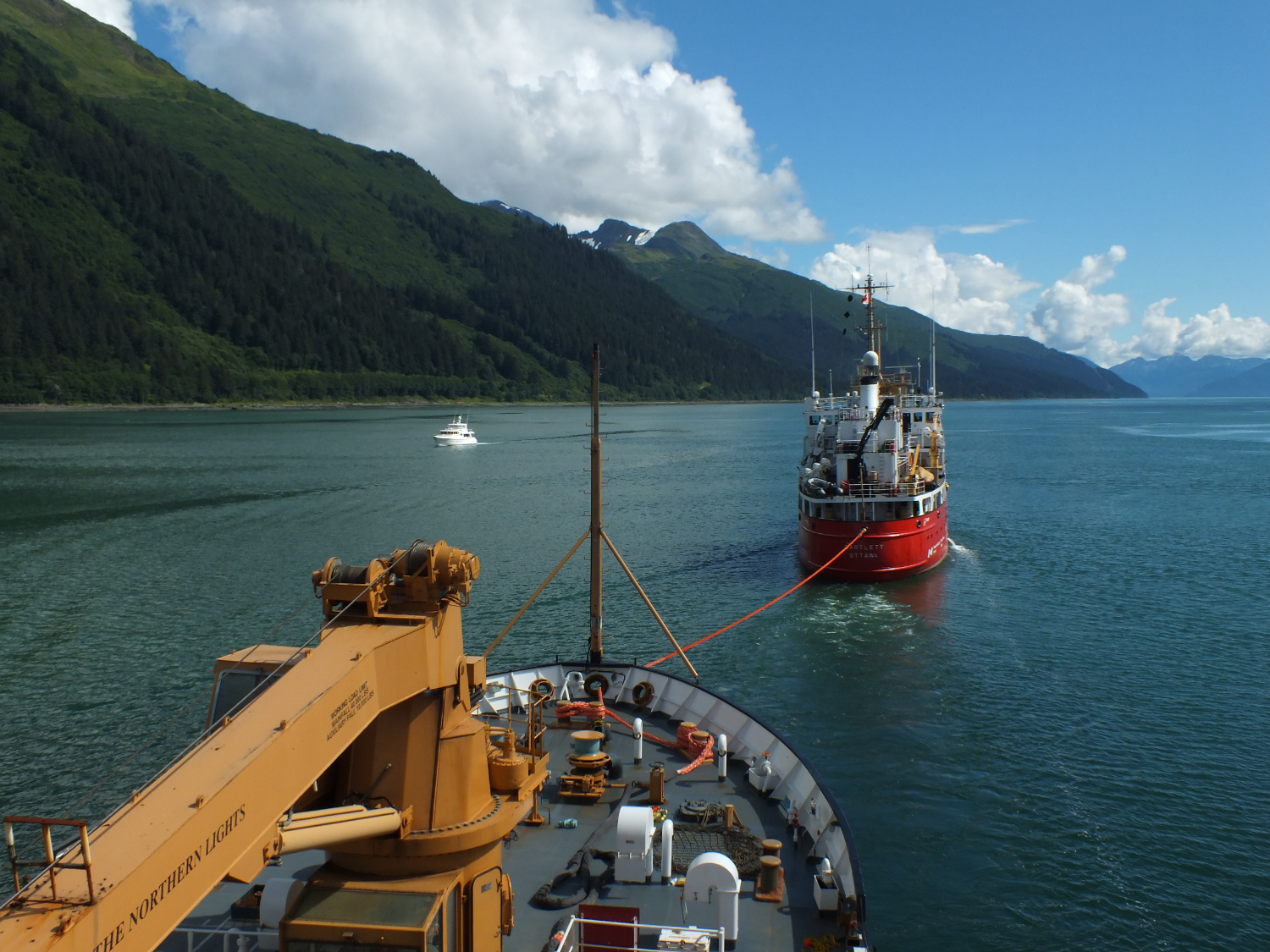
Once out in the middle of Gastineau Channel, the Maple’s engines were disengaged while deck crews worked to unpack the package and extend lines to the Canadian Coast Guard vessel Bartlett.
Canadian Coast Guard vessel Bartlett takes a powered-down USCGC Maple in tow during a recent transit of Gastineau Channel. (Photo by Matt Miller/KTOO)
The ETS that was used in the Juneau exercise is normally stationed in Sitka and can be used to tow over 50,000 deadweight tons.
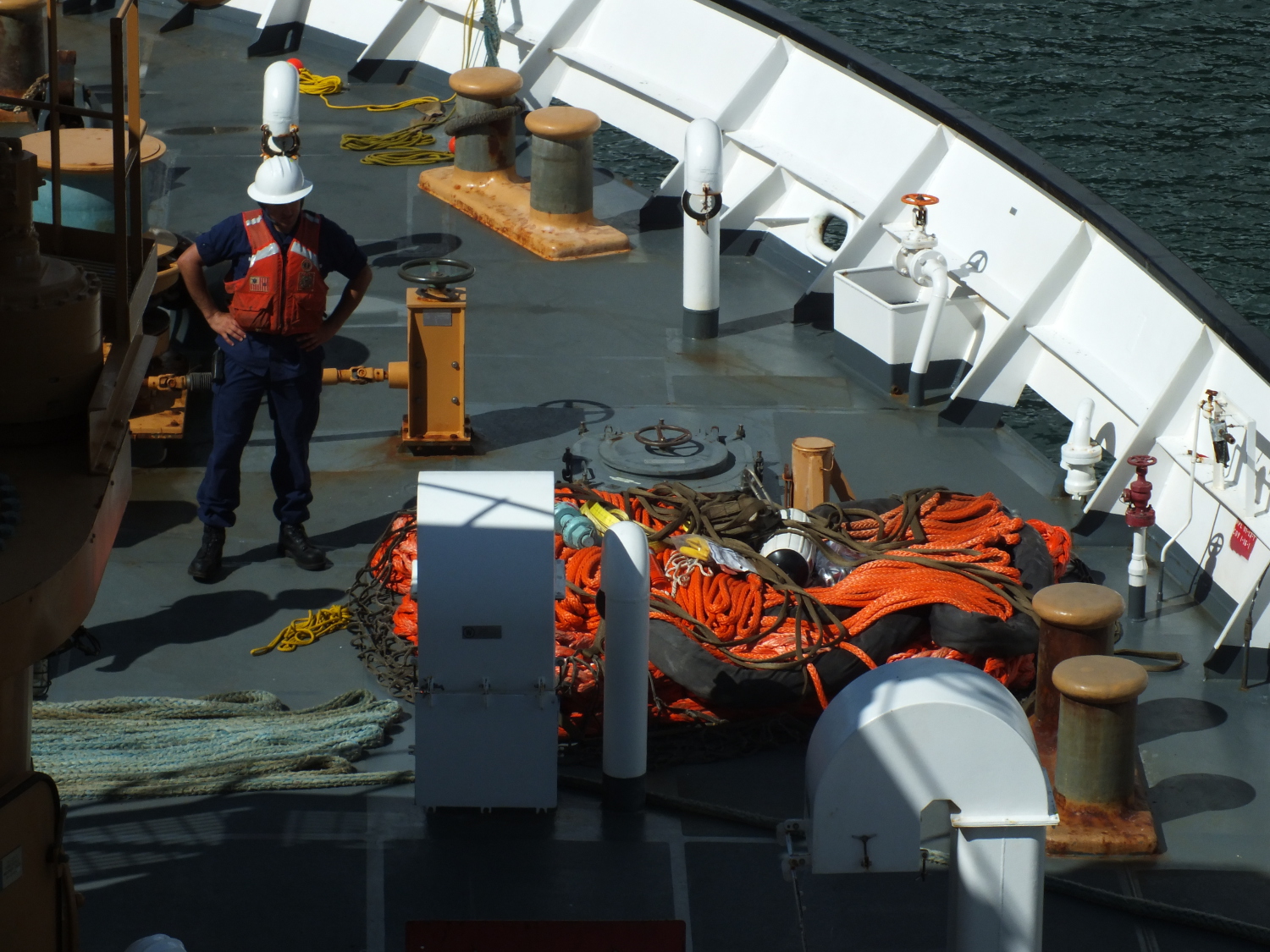
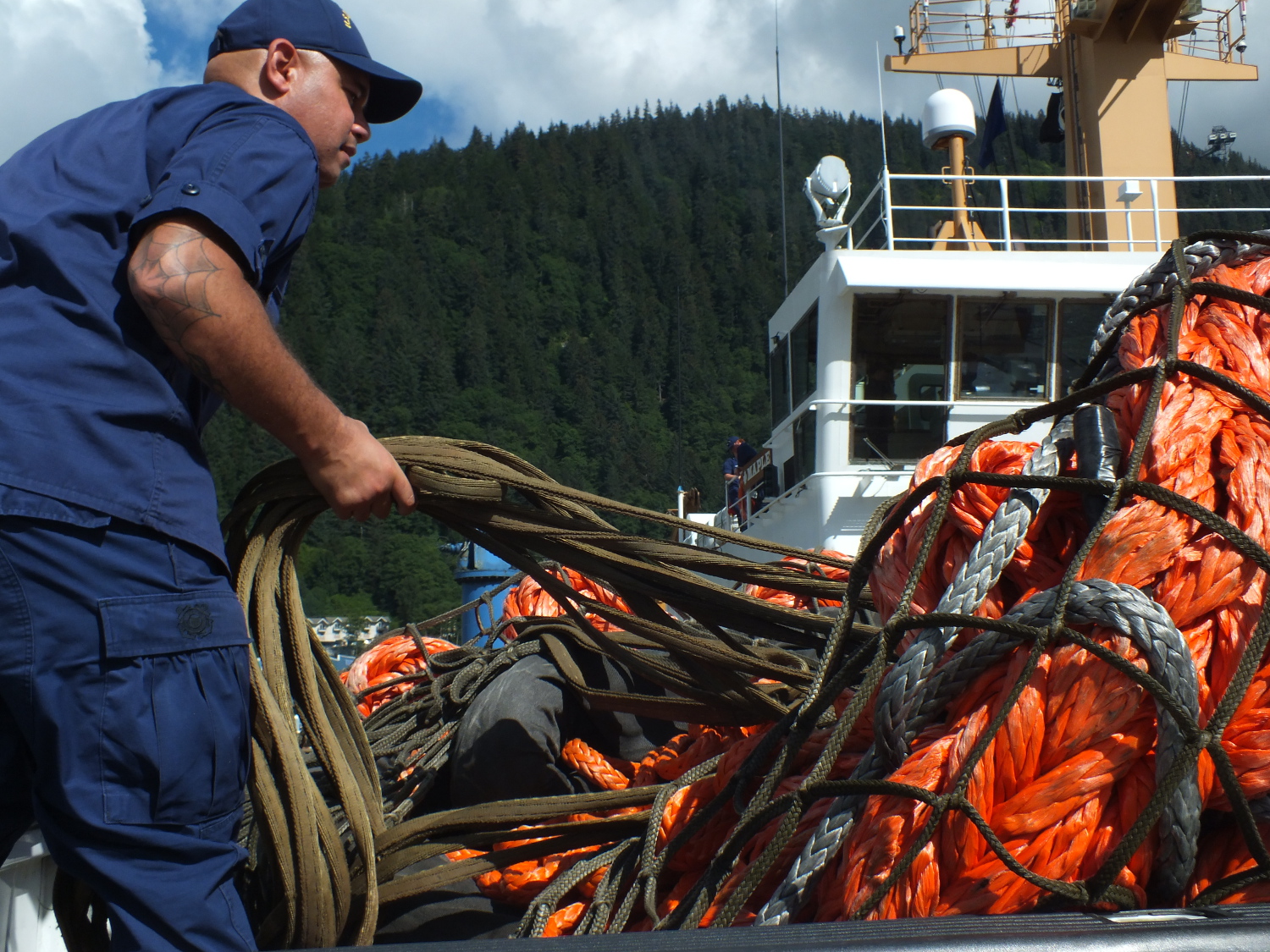
The Emergency Towing System consists of a messenger line, 10-inch main tow line, and a set of buoys in a package that can lowered to any vessel by crane or helicopter. (Photo by Matt Miller/KTOO)
After use, the components of this Emergency Towing System will be dried out and repackaged for redeployment in Sitka. (Photo by Matt Miller/KTOO)
USCGC Maple pulls away from Coast Guard Station Juneau. (Photo by Matt Miller/KTOO)
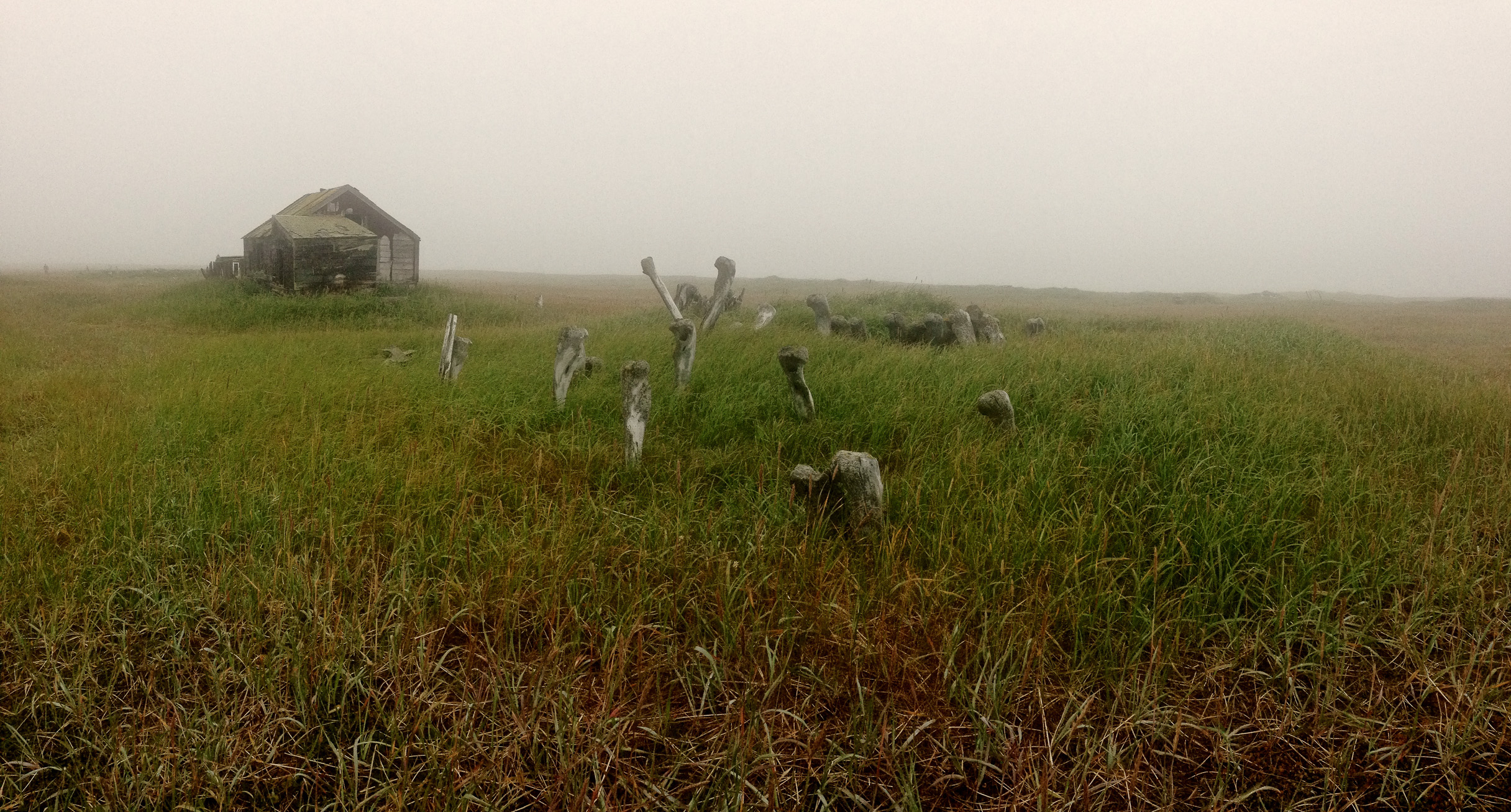
Point Hope’s old townsite. (Photo by Emily Russell/KNOM)
Walking amongst the old sod and whalebone houses on the edge of the Bering Sea, it’s easy to let the world around you fade away. We’ve come to Point Hope, Alaska, one of the oldest continuously inhabited communities in North America, 200 miles north of the Arctic Circle.
The barrier between the old abandoned town site and the new community is the airport, which sees multiple small-plane departures and arrivals each day, though today is a bit different. Today a pearly white plane is parked on the runway. On the side it reads “United States of America,” which feels like a million miles away from where we are.
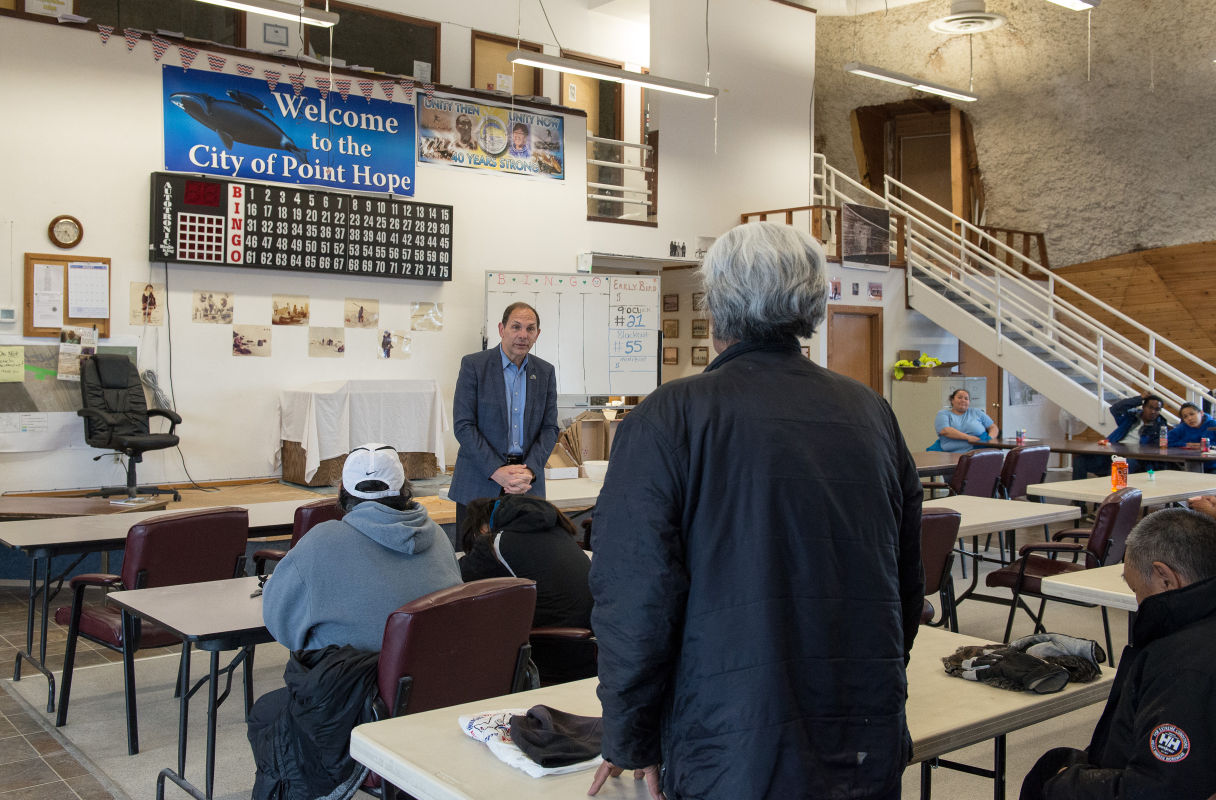
McDonald at a listening session in Point Hope. (Photo by Mitch Borden/KNOM)
The official aircraft came all the way from Washington DC to made good on a request from local. Leonard Barger, Transportation Director of the Native Village of Point Hope, wrote to the Secretary of Veterans Affairs, Robert McDonald, last year requesting a visit to honor the community’s veterans.
Barger explained the importance of McDonald’s visit to the 49thstate. With the highest number of veterans per capita in the country, even the most remote communities throughout Alaska have vets. Along with Point Hope, Barger acknowledged the veterans in communities like Barrow, Point Lay, and Unalakleet. “All these people in Alaska, they’re going to Afghanistan,” Barger said, “they’re leaving their family, but they’re serving their country, they’re sacrificing their lives for us.”
Along with visiting Point Hope, McDonald also held a listening session that day in Kotzebue. It took Walter Sampson, a Vietnam vet living in Kotzebue, 11 years to get serviced by the VA in Anchorage, a 500-mile journey and a $600 plane ticket away from home. Sampson made sure to remind McDonald of the unique challenges that many of Alaska’s vets face in accessing the benefits they’ve earned.
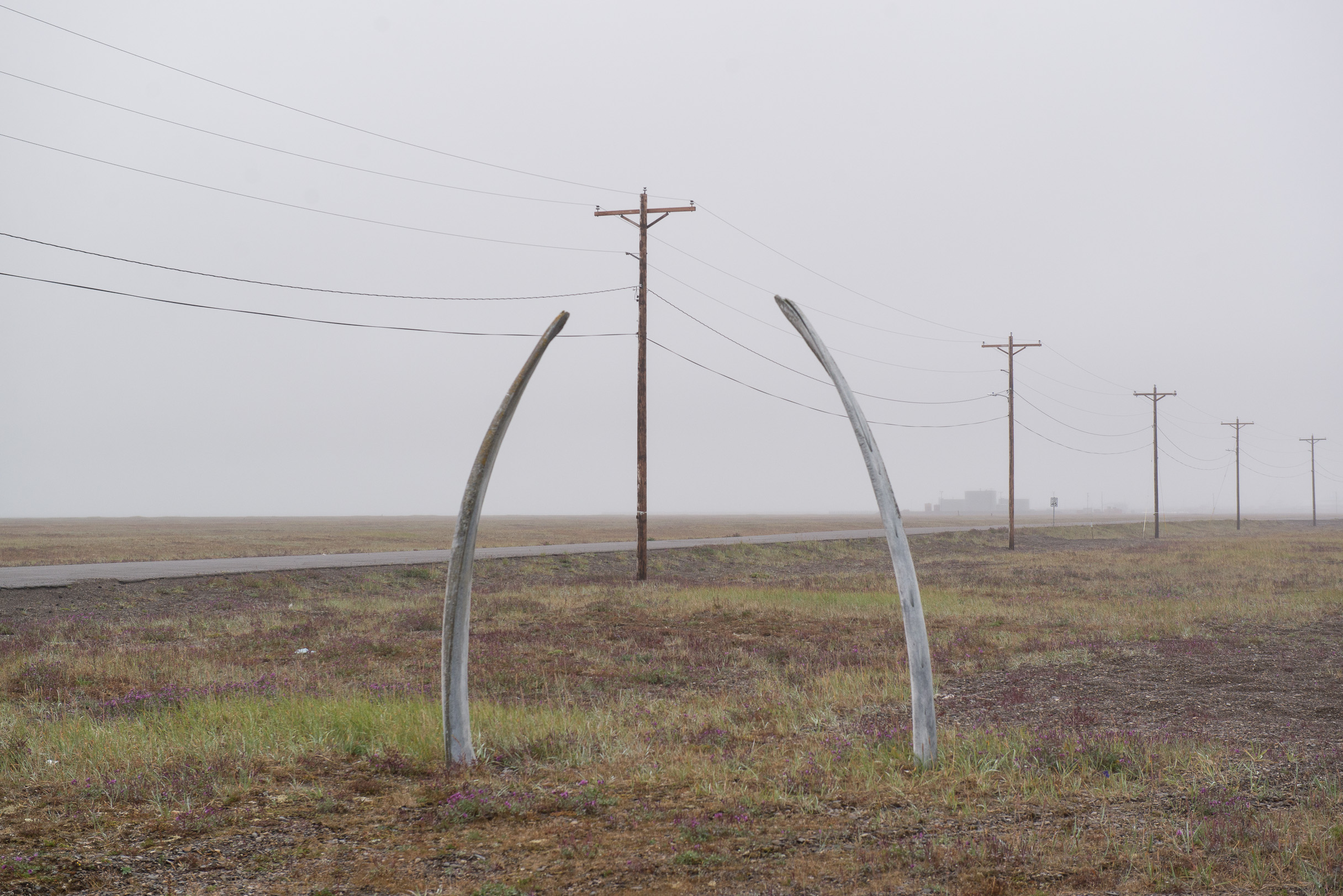
Whalebones welcome visitors to Point Hope. (Photo by Mitch Borden/KNOM)
“Remember that we’re in bush Alaska,” Sampson said, “We’re in roadless communities.” While Fairbanks and Anchorage have the clinics, the VA officers, and the hospitals, he stressed that, “for bush Alaska we’ve got nothing at all.”
Without the VA facilities and representatives, information has a hard time reaching vets in bush Alaska. Sampson expressed a feeling that many vets seemed to share. “As a veteran, do I really know who [the] VA is?” Sampson asked himself. “What benefits does it have for me?
Sampson is frustrated by the convoluted nature of the VA support system, which often requires multiple phone calls, website logins, and, in the end a system too complex for its own good. McDonald was quick to acknowledge those inefficiencies.
“Walter’s right,” McDonald admitted, “we’ve got too many 1-800 numbers, it’s too confusing.” With over 900 1-800 numbers and 14 websites that require different usernames and passwords, many vets get lost in the system before they ever get help. “We’re going to go to one 1-800 number, we’re going to go to one website,” McDonald promised, “it’s just too complex, we’ve got to simplify it, that’s what we’re working to do.”
But a simplified system is only one step towards getting vets throughout Alaska the benefits they deserve. With McDonald gone and many questions left unanswered, the support system that seems the most promising comes from within the state.
Chester Ballot, another Vietnam vet in Kotzebue, was trained in Anchorage as a tribal veteran representative and now works to sign up fellow vets to the VA. The Alaska VA also sent two representatives to both Point Hope and Kotzebue to sign up and inform vets of their benefits. So far the Alaska VA has sent representatives to 39 of the state’s nearly 300 villages.
Although McDonald is back in DC, Leonard Barger hopes this will not be his last visit to Point Hope. Barger and other community members encouraged him to return in the spring to take part in a whale hunt, one of the many benefits of living on the edge of the Bering Sea.
Close
Update notification options
Subscribe to notifications
Subscribe
Get notifications about news related to the topics you care about. You can unsubscribe anytime.