Northwest

Newtok Awaits Relocation Funding, More Than 30 Years After Flood Risk was Documented

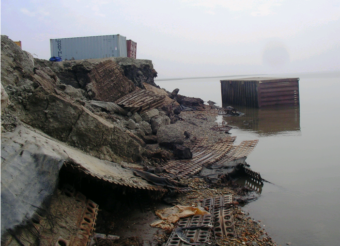
A steel storage container slid into the water after erosion chewed away at this bank in Newtok.
(Public Domain, Courtesy State of Alaska)

“I was scared, cause it looked so close … And you could just see these huge waves just come at you,” says Sabrina Warner, describing her fear of floodwaters sweeping over her home in the Alaskan coastal village of Newtok.

Warner says the Ninglick River had eroded so much land around her village of Newtok three years ago that she now fears powerful storms that hit Alaska’s western coast in the fall will flood the community. That’s why many say the people of Newtok could become Alaska’s first climate-change refugees. And it’s why Warner’s partner, Nathan Tom, told a reporter in 2013 he’s anxious to move his family to higher ground, up and out of the flood zone.

Nathan Tom talks with a reporter while his partner, Sabrina Warner, plays with a dog.
Nathan Tom talks with a reporter while his partner, Sabrina Warner, plays with a dog. (Courtesy NPR)

“I just can’t wait to move the houses or build our house,” she said.

Three years later, Warner, Tom and most of the other 350 people of Newtok are still waiting for federal and state help move the villagers to nearby Mertarvik – more than 30 years after the problem was first outlined in a 1984 study.

“I believe that within four years, Newtok will no longer be a viable community,” says Joel Niemayer the federal co-chair of the Denali Commission, the agency President Obama tapped to coordinate a response to the threat that climate change-driven flooding poses to Newtok and several other villages along Alaska’s coasts and rivers.

“Within four years, the river will be right next to the school,” Niemeyer said. “It’ll have already have gobbled up the community water source. And then not far behind, it’s the airport.”

He couldn’t say whether the agencies will be able to pull off this funding in time to build a new community before the river claims the land on which Newtok was built in 1958. That’s when the U.S. Bureau of Indian Affairs established the community on that site because it was as far up the Newtok River as the barge carrying materials to build a new school could go.

A 2007 map shows the steady erosion of land around Newtok, based on U.S. Geological Survey data, and projects the progression of the erosion toward the village. Credit State of Alaska

A 2007 map shows the steady erosion of land around Newtok, based on U.S. Geological Survey data, and projects the progression of the erosion toward the village.
(Public Domain, Courtesy State of Alaska)

“Relocation is very involved,” said Sally Cox, a planner with the state Division of Community and Regional Affairs. “And there are a lot of different things that have to happen.”

Cox has been involved in the Newtok relocation effort for years. She, like Niemeyer, both described a lengthy process that begins with a community deciding whether to move and if so where; then proceeds through years of planning, public interaction – and finally, getting funding.

“It’s a very slow process,” Cox said, “and government is very slow about responding to that need, especially because it costs so much money.”

How much money, neither Cox nor Niemeyer could say. Some estimate each relocation could cost hundreds of millions of dollars.


Arctic broadband brings concerns about changing culture

A Quintillion spokesperson says the company should be able to offer broadband to five coastal Alaska communities by early next year. (Image courtesy of Quintillion)

The biggest local internet-service provider in northern Alaska expects high demand for the broadband connections. It’ll be offering the service early next year.
“Everybody is enthusiastic about this project that is a heavy user of broadband – the schools, libraries, clinics,” said Jens Laipeneks who directs operations for Arctic Slope Telephone Association Cooperative. “All of those are anchor institutions.”

Laipeneks said ASTAC has been upgrading its system over the past year or so to transition from the satellite-based system it now uses to provide internet and wireless service to one that uses a subsea fiber-optic cable that Anchorage-based Quintillion Networks will be laying off the coast of northern Alaska this year.

“The capacity that we’re going to have access to is much, much greater than everything that was done over the satellite,” he said.

Laipeneks said that’s good news to residential customers who’ve had to deal with the slow, bulky and expensive internet connections for such bandwidth-hogging uses as streaming video.

“Netflix, gaming – things that require very quick response times.”

He said the fiber optic cable is more dependable and less expensive to maintain, enabling ASTAC to offer its 1,000 or so customers twice as much bandwidth for about the same price they’re paying today.

It’ll also no doubt be good news to ASTAC’s newest customers in five coastal communities that have never had real broadband before, including Nome, Kotzebue, Point Hope, Wainwright and Barrow.

But it’s also troubling news for Steve Oomittuk, a lifelong resident of Point Hope.

Steve Oomittuk, who was born and raised in Point Hope, hopes broadband won't aggravate the problem of Western culture overwhelming Native culture – especially among youth. (Image courtesy of Jiri Rezak/Greenpeace)
Steve Oomittuk, who was born and raised in Point Hope, hopes broadband won’t aggravate the problem of Western culture overwhelming Native culture – especially among youth. (Photo by Jiri Rezak/Courtesy Greenpeace)

“I just feel that high technology is good, but there’s a time and place that it should be used,” he said.

Oomittuk, an Inupiat whale hunter-turned schoolteacher, said he’s concerned that all that expanded internet access will distract young people in the villages, and further erode their cultural identity that’s already being overwhelmed by Western culture.

“I try to let the younger generation understand that they have an identity that should never be forgotten,” he said. “And (they) have a rich history, a rich culture, and should never forget their identity as a people.”

Oomittuk said pretty much all the young people in the village, like their counterparts in just about anywhere else in the world, already are constantly glued to their cellphones. He’s concerned those mobile devices combined with broadband will widen the gap between Native and Western culture.

Legislators turn down $7M request for rural school

Kivalina
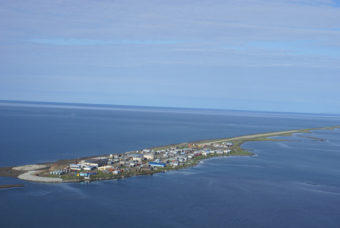
Kivalina in August 2009. It’s a community of 400 with half of the community under the age of 18.(Creative Commons photo by Lt. Cmdr. Micheal McNeil/U.S. Coast Guard )

The Senate Finance Committee on Thursday voted against adding $7.2 million to funding for replacing the school in Kivalina. Gov. Bill Walker’s administration requested the additional funds.

The committee approved the capital budget for the coming year. The legislature would appropriate $77.5 million under the plan. The federal government would provide $1.3 billion.

But Golovin Democratic Sen. Donnie Olson was unsuccessful in adding more money for the school.

Olson said the money would settle an education lawsuit known as the Kasayulie case. The plaintiffs argued the legislature didn’t treat rural schools equally and the state wasn’t fulfilling its obligation.

“If there’s not a remedy to what goes on … the issue will only grow more complex and expensive,” Olson said. “It will become messy. It will become difficult to go and handle.”

The state initially planned to pay to renovate the school. But instead the state later agreed to pay for a new school in a different location. This would take the school away from the erosion that’s affecting Kivalina, which is on a barrier island near Kotzebue.

The administration and lawmakers differ over the right amount for the school. The legislature appropriated $43 million last year.  Eagle River Republican Sen. Anna MacKinnon said this satisfies the state’s obligation.

“For the last decade that we’ve argued about this issue – the adults have argued about the issue – the children of Kivalina have been in conditions that they should not be in,” MacKinnon said.

The committee passed an amendment proposed by MacKinnon saying that the legislature has met its obligation.

But the administration said the state should pay $7.2 million more.

State budget director Pat Pitney said that without the money, the state could be back in court.

“The highest risk the state faces is a lawsuit, and a reopening of all of the rural school funding inequality issues,” Pitney said.

The committee voted 4 to 1 against Olson’s amendment to add the additional Kivalina school money. It voted by the same margin in favor of MacKinnon’s amendment saying the legislature met its obligation.

The capital budget includes $12.5 million to purchase the Wells Fargo Bank building in Anchorage’s Spenard neighborhood to serve as a legislative information office. The state faces a potential lawsuit over leaving the downtown LIO.

Solar to help power diesel dependent Northwest Arctic

Solar panels in the Northwest Arctic village of Shugnak. (Photo courtesy of Ingemar Mathiasson/NWAB)

Solar panels will soon help power three communities in the Alaskan Arctic. The Department of Energy awarded federal funding to install panels in Kotzebue, Buckland and Deering, but decreasing the region’s dependency on diesel is easier said than done.
Energy costs are notoriously high in rural Alaska, where diesel is often barged up to remote communities. Sonny Adams is the Director of Alternative Energy for NANA, the regional corporation for the Northwest Arctic Borough. Adams was born and raised in Kotzebue.

“The cost of living in our region is 60% higher than it is in Anchorage,” Adams explained. “Our people have to make tough choices between putting food on the table or heating their home.”

While the price of diesel has dropped in recent years, Adams said climate change has made fuel deliveries more expensive.

“We’re not seeing the snowfall that we used to in the past,” Adams said. “Whenever that happens, you’re not getting the high river levels that you’re used to barge up the fuel.”

The low water levels are forcing some up-river communities like Kobuk and Ambler to fly in fuel at a much higher cost. That’s one of the reasons Adams is looking towards renewable energy sources like wind and solar.

NANA Corporation was recently awarded $1 million from the Department of Energy to partially fund solar panel installations in Kotzebue and two nearby communities—Buckland and Deering. Adams said all three already have wind turbines that help offset the high cost of energy.

“So solar is just the next viable option,” explained Adams.

Ingemar Mathiasson couldn’t agree more. He’s the Energy Manager for the Northwest Arctic Borough based in Kotzebue.

“There’s no reason for us to just sit and just wait for more oil to come down the pipeline,” Mathiasson said. “In some respects, that’s a pipe dream.”

Originally from Sweden, Mathiasson moved to the Alaskan Arctic in the late 80s. He’s been living off the grid and on solar power for decades, but he said those indigenous to the region have been doing it for far longer.

“Pre-contact, the people in Alaska were the most energy efficient people anywhere, being able to live in the Arctic on almost nothing, with very energy efficient houses and energy-efficient living,” Mathiasson explained.

But oil changed all that. Mathiasson pointed towards far-off places like Saudi Arabia that now supply diesel to remote communities like Selawik and Shungnak. With funding from the Department of Energy, both Mathiasson and Sonny Adams hope to power communities in the Northwest Arctic from more local sources.

Doug MacCourt from the Department of Energy said community-driven projects like the one Adams is spearheading is just what rural Alaska needs.

“Solutions that work are solutions that come from Alaska, solutions that are designed and thought of and conceived and really baked in the communities,” MacCourt insisted.

That’s easier said than done said David Nicol. Nicol works for an energy consulting firm based in Washington state. He helps plan and implement solar projects in rural Alaska. Nicol said when companies don’t shop around for the best deals, costs can soar.

“Companies here need to figure out how to install it for cheaper,” Nicol said. “It is possible, but we need to stop trying to reinvent the wheel.”

Nicol said training locals on installation and upkeep is the key to solar’s success. Right now, he explained the lack of institutional knowledge in the state is keeping costs high.

“If I could have one wish right now it would be that every single time somebody in Alaska encounters a problem with solar, whether it’s legislative, insurance, financing, building, just go, ‘Okay, this problem has been encountered before by others. Let’s go find out how they solved it,’” Nicol urged.

Because of all the obstacles, Nicol said powering communities solely by solar power is a still a long way off.

“Realistically, rural Alaska is not going to completely get away from diesel for a long time,” Nicol said. “It’ll come eventually, but it’s not going to be anytime soon.”

In the meantime, Sonny Adams is keeping his focus on solar. He’s working to finalize the finances of the solar project. Adams said rural Alaska has to keep pushing forward.

“We know that we cannot promote economic development with high energy costs,” Adams insisted. “We have got to get off this diesel fuel.”

Construction on the new solar panels in Kotzebue, Buckland, and Deering is set to begin in the spring of 2018.

Federal board closes caribou hunting to non-locals in the Northwest Arctic

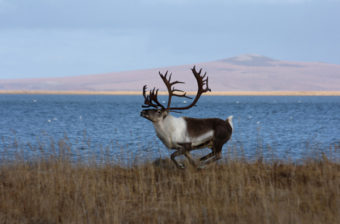
Male caribou running near Kiwalik, Alaska. (Photo by Jim Dau/ADF&G)

In the Northwest Arctic, caribou hunting has been contentious for years. Alaska’s largest herd continues to decline while tensions have emerged between rural subsistence users and outside hunters.

Last week, the Federal Subsistence Board voted to close the vast area to all but local caribou hunters. The closure will last for one year, but biologists aren’t sure it will make much difference.

From Kotzebue to Kobuk, from the Chukchi Sea coast to the northern Seward Peninsula, Game Management Unit 23 covers thousands of acres of federal public lands. Earlier this year, the Northwest Arctic Subsistence Regional Advisory Council called on the Federal Subsistence Board to close them to all non-federally qualified caribou hunters.

The Council argued the closure was necessary to conserve the dwindling Western Arctic Caribou Herd and to stop outside interference with subsistence.

“There’s a long history of user conflicts in Unit 23,” said Chris McKee, the Wildlife Division Chief at the Office of Subsistence Management (OSM). “We hear repeatedly from federal subsistence users: Outside hunters camping on traditional hunting grounds and a lot of other issues surrounding perceptions of wasting meat. It’s something we’ve heard about for many, many years.”

McKee oversees the team of biologists in charge of analyzing potential changes to federal wildlife regulations. The Board takes their analysis into consideration when approving or rejecting proposals.

“But this is a case where the Board actually went against our recommendation,” he said. “OSM’s recommendation was to oppose the closure.”

That’s because McKee and his biologists don’t think the closure will help conserve the herd. Hunters harvest about 13,000 caribou in Unit 23 each year, with local residents accounting for approximately 94 percent of the total take. That means outsiders only harvest about 600 animals on average.

“You’re looking at 5 percent or less of the entire harvest in the unit,” said McKee. “From a biological perspective, eliminating that 500 or 600 animal harvest is going to do nothing to change the trajectory of the herd.”

Currently, biologists estimate the Western Arctic Caribou Herd has about 200,000 animals. That’s less than half the population of 10 or 15 years ago. Biologists aren’t exactly sure what has caused the decline, but they say natural aging, decreased calf survival and climate change are likely contributors.

Meanwhile, McKee said some rural residents blame outside hunters for flying over the herd and changing its migration patterns. Biologists aren’t sure if that’s true. But even if it were, McKee said closing federal lands wouldn’t stop that problem because people can still fly to hunt other species or sightsee.

Still, the Board voted 5 to 3 in favor of the closure because of support from the regional advisory council and public testimony. In their analysis, OSM biologists wrote that at a February hearing in Kotzebue, the “vast majority of those present … were in support of the special action request.”

McKee said another factor was that the Board can only close Unit 23 to outsiders for one regulatory year. The council would have to propose another special action request to close it again next year.

“I think that was another consideration that played in the board’s mind, like, ‘Well, let’s see if it helps this one year and re-evaluate,” he said.

McKee said he has been fielding frustrated calls from outside hunters who have already booked their trips and are now out of luck. The closure will also bar caribou hunting by Alaskans from urban areas and rural Alaskans who have since moved away. The closure will be in effect from July 1 to June 30, 2017.

Committee to work out differences on bill drawing from rural power fund

The state House and Senate are trying to work out their differences over a bill that would draw money from the Power Cost Equalization Endowment Fund.

The $900 million fund subsidizes the high cost of electricity in rural areas. Because the state government has a $4 billion deficit, some lawmakers have suggested drawing money from the fund to pay for other state costs.

Sen. Lyman Hoffman, D-Bethel, speaks in support of Senate Bill 196 on April 13 in this screenshot from the Gavel archive.

Bethel Democratic Sen. Lyman Hoffman crafted a bill that would limit the draw from the PCE fund to years when the fund earnings are more than what’s needed for the power cost equalization program. This program costs about $40 million per year.

The Senate unanimously passed the measure, Senate Bill 196.

But the House made changes to the bill. These changes made it less likely that excess fund earnings would be redirected back into the fund.

Those changes concern Hoffman. When it was time for the Senate to decide Wednesday whether it would agree with the House’s changes, Hoffman spoke up.

“They changed the formula on how the excessive earnings will be distributed,” Hoffman said. “And I believe that that formula will potentially put the fund in jeopardy and want to go back and revisit the differences between what the Senate has done, which is a more sound approach to the fund.”

As a result, there will be a conference committee to rewrite the bill so that both houses can agree to it.

Hoffman will be the Senate chairman of the committee, which will also have Eagle River Republican Sen. Anna MacKinnon and Fairbanks Republican Sen. Click Bishop. The House members will be chairman Dillingham Democrat Bryce Edgmon, Eagle River Republican Dan Saddler and Fairbanks Democrat Scott Kawasaki.

The Legislature formed the conference committee on what was an otherwise quiet day in the Capitol.

Site notifications
Update notification options
Subscribe to notifications