Northwest

On final day of organized search, no clues of missing hiker in Nome

Members of the final day’s search crew for missing hiker Joseph Balderas review a map of the area in Nome in July 2016. (Photo: by Emily Russell/KNOM)

It’s been a week and a half since Joseph Balderas, who had ties to Juneau, went missing in the foothills outside of Nome.

Alaska State Troopers suspended their search for the 36-year-old man on Monday, but his family, friends, and even those that never knew Balderas continued on.

It takes nearly an hour to get to mile 44 on the Nome-Council Highway. That’s where Joseph Balderas’s truck has been parked since he was reported missing June 27.

Joseph Balderas was reported missing in the Nome area on June 27, 2016. (Photo courtesy Finding Joseph)

On a clear day, you’d see the Bering Sea to your right and the mountains on your left, but today, it’s raining.

It’s day 9 of the search, and the rain feels a reflection of the increasingly somber mood. Salina Hargis is Balderas’s sister. She flew in from her home in Hawaii and has been out searching everyday since Friday.

“I mean, it’s hard, because you come out here, and I don’t know if he’s hurt or where he is, if he’s cold, if he’s hungry, if he’s sick,” Hargis said. “We just don’t know.”

That’s been the most frustrating part for a lot of people — not knowing. What they do know is that Balderas talked about going running or fishing in the area. Hargis describes her brother as “very adventurous.”

“He was always adventuresome and outdoorsy,” added Elvio Sadun. “He’s from west Texas, but said that he had thought that maybe he would end up spending time in Alaska.”

Sadun went to law school with Balderas at the University of Minnesota. He flew up from Los Angeles with two friends to join the search.

They’ve helped make up what many are calling the largest search and rescue effort Nome has seen in decades. Early on, the Coast Guard sent a Jayhawk helicopter from Kotzebue, which joined a Wildlife Trooper helicopter, as well as chartered and private, fixed-wing planes.

The biggest wave of support has come from community members. Every day, dozens of locals fill up their trucks and ATVs with gas that costs $5 per gallon. Sadun said they’ve tried it all.

“We’ve had to form and then ultimately reject a lot of different narratives,” Sadun explained.

“I think each time we’re kind of optimistic, like, ‘Let’s recreate a run he might have done or let’s recreate a fishing excursion or a hike or whatever.’ And then each of these times we try that and exhaust it and then we have to come up with a different idea, different theory,” Sadun said.

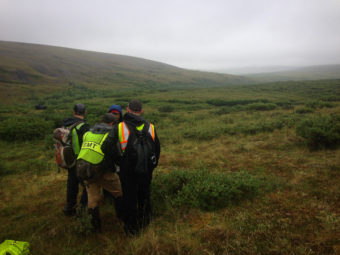
Joseph Balderas searchers in Nome take a break in the middle of the day in July 2016. (Photo by Emily Russell/KNOM)

Today’s theory is one of desperation. We stuck to creeks and riverbeds, thinking that if Balderas is still alive, he’d try to reach a water source. We walked north on the tundra above a creek and eventually turned back, walking through the water. There was no sign of Balderas.

The rain let up halfway through the day. Snacking on trail mix and bags of chips, people shed layers and hang them up to dry for a few minutes.

The plan was to spend the last hour scanning the riverbed near his truck for a four-piece fishing rod he is thought to have taken with him.

It’s an eerie feeling, walking for the whole day and not seeing any sign of him. You think he’s going to be around somewhere, or at least his fishing pole, and you just don’t see anything.

The feeling of failure sank in on the drive back to Nome. Balderas’s three law school friends were leaving on the evening flight, and one of them, Cyrus Jamnejad, stared out the window in defeat.

“As we have one hour before we fly out of here, it doesn’t feel good at all. It feels awful,” Jamnejad said, “and knowing that the family is going to still stay here and we didn’t find him like we had hoped we would, it’s terrible.”

The Nome-Council Highway in July 2016. (Photo by Emily Russell/KNOM)
The stretch of Nome-Council Highway where Balderas left his truck. The search team waded through the riverbed looking for Balderas’s fishing rod. (Photo by Emily Russell/KNOM)

Balderas met a lot of people during the last year and a half he worked in Nome as a court clerk. Many of his friends in town showed up to search, but even people that never met Balderas came out day after day.

Jamnejad said that’s what impressed him the most.

“It’s been amazing how many people didn’t know him, but came out of a sense of kindness or responsibility or duty,” Jamnejad said. “One kid who heard that someone went trail running and was missing — he goes trail running and says, ‘That’s what you do for those people in that situation.’”

Day 9 was the last day of organized search, but his friends and family say they’ll never stop searching on every run, every fishing trip, every hike through the mountains, because, they say, Joseph Balderas would have done the same.

Correction: The spelling of Salina Hargis first name has been corrected.

New California law could jeopardize Alaska’s ivory market

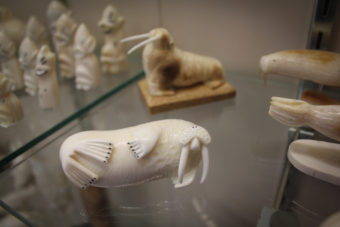
ivory walrus at Maruskiya's
An ivory walrus carving on display at Maruskiya’s in Nome. (Photo by Emily Russell/KNOM)

The ivory market in America just got a lot smaller, or at least that’s how it seems. A new law went into effect Friday in California that bans the sale of all ivory products, including walrus ivory.

Alaska Natives are protected under a federal law, but confusion and inconsistency between state and federal legislation has many concerned.

John Kokuluk Sr. is sitting at his carving booth at the King Island Native Community building. He’s an ivory carver and has the hands to prove it.

“I try to make a little bit of everything: masks, polar bears, wolves. I’ve carved quite a few walrus teeth,” Kokuluk explains.

He’s working on one of those teeth today. Dust flies through the air as he drills tiny holes into the two-inch piece of ivory that he’ll later fill in with baleen.

Kokuluk was born and raised in Nome, but his family is from King Island. When members of the Inupiat community were forced to relocate to the mainland in the 1960s, they brought the longstanding tradition of ivory carving with them.

“It’s in our culture. It was passed down long before my time,” Kokuluk explains. “I feel fortunate to have this talent.”

Just like Kokuluk, Susie Silook has been carving for decades. She’s originally from the St. Lawrence Island community of Gambell.

“I love it. I love ivory carving,” Silook said. “We get to say whatever we want with our work.”

It’s that love of carving that led Silook to start an online petition opposing California’s new law that bans the sale of all ivory.

Section 2 of Assembly Bill 96 defines ivory as “a tooth or tusk from a species of elephant, hippopotamus, mammoth, walrus, whale or narwhal.”

“So this is creating this confusion out there that all the materials listed in these laws (are) illegal now,” Silook said.

But they’re not. The Marine Mammal Protection Act of 1972 makes the interstate sale of walrus ivory legal through its definition of authentic native handicrafts.

Gay Sheffield is a biologist with the Alaska Sea Grant Marine Advisory Program in Nome.

“Authentic native handicrafts are defined as items that are produced, decorated, or fashioned in the exercise of traditional Native handicrafts,” Sheffield explained.

Sheffield said the handicraft definition includes, but is not limited to, weaving, carving, stitching, sewing, lacing, beading, drawing and painting.

Sheffield said she understands the effort to protect elephant and other tusked animals in Africa from poachers, but they’re not one and the same with the marine mammals she studies in the Bering Strait region.

“The general public thinks ivory, elephant, dead elephant rotting in the sun, beautiful elephant with (a) little baby because it’s always on the TV on the documentaries,” Sheffield said. “What they don’t see is walrus ivory, legal harvest, food on the table, economic benefit to rural Alaskans.”

It’s that economic benefit that has many worried.

Carver Susie Silook said ivory brings much-needed cash into rural communities like Gambell. She remembers a buyer from Southeast Alaska traveling to the St. Lawrence Island community in the mid-1990s.

“Within three days, he had purchased $20,000 worth of arts and crafts from the people in just one village, and this is just one buyer,” Silook explains.

But now, buyers are reacting to California’s new legislation. Robert James manages Maruskiya’s, a well-known Native art shop on Nome’s Front Street. He buys from carvers like John Kokuluk Sr. and sells their crafts in town and on the road.

James had planned to stop at this year’s American Indian Art Show outside of San Francisco.

“Because of the legislation that passed, I don’t think we’ll ever be back there,” James said. “So, we might have to find a different show.”

Back at the King Island carving room, John Kokuluk Sr. continues to drill tiny holes in the walrus tooth he holds in one hand.

He worries about the confusion the new California law will create for buyers, but Kokuluk said that won’t stop him from carrying on the tradition his ancestors have been practicing for centuries.

“I feel I’ll be doing this, regardless of what happens, probably till the day I’m gone,” Kokuluk said.

New caribou restrictions stir controversy in the Arctic

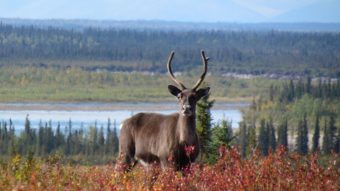
Thousands of caribou like this one traditionally cross the Kobuk River near Onion Portage in the fall. People have been harvesting caribou near this spot for about 9000 years. (Public Domain photo by the National Park Service)
(Public Domain photo by the National Park Service)

For the first time ever, hunters who live outside the Northwest Arctic will not be allowed to hunt caribou on federal lands. The Federal Subsistence Board has closed Game Management Unit 23 starting July 1 in an effort to conserve Alaska’s largest herd and protect subsistence.
But the yearlong ban has created some controversy and confusion surrounding the hunt. Just last week, the State of Alaska petitioned U.S. Secretary of the Interior Sally Jewell to intervene in the decision.

It’s breakfast, and Victor Karmun is having biscuits and gravy at one of his favorite spots in Kotzebue. With fall fast approaching, though, he said he has been thinking a lot lately about another favorite food.

“Caribou: One of the most used animals in the region,” he said. “Been controversial ever since I got back.”

Karmun’s originally from the village of Deering, but he has lived in Kotzebue since 1979. That’s when he returned to Alaska after serving in the military. That’s also when he started noticing the region was a little busier when he boated up the Noatak River each season to hunt caribou.

“All of a sudden, the transporters and outfitters found out about this region,” he said. “We’ve been really locking horns with them for about 20 years or better.”

Some locals say outside hunters are disrespectful, wasting meat or leaving trash at their camps. Others claim that outsiders have an unfair advantage because they can afford to fly and land near the herd, while local families pool their money for boat fuel and wait for caribou to cross the rivers.

No matter whom you talk to, though, Karmun said one thing is clear: It has gotten harder for people to fill their freezers each fall. The Northwest Arctic Caribou Herd has shrunk by half in the last 10 or 15 years, and the animals have stopped following many of their traditional migratory routes.

Outside hunters may not be to blame, but Karmun said taking them out of the equation for one year is certainly worth a try.

“Right now, we’ve got a little breathing room,” he said. “Maybe the village of Noatak will get a little reprieve and get some animals this fall. Who knows?”

But that attitude is frustrating for outside hunters — and the bush pilots and guides who rely on their business.

Jared Cummings owns Golden Eagle Outfitters, a transporter service that has operated out of Kotzebue for nearly 10 years. Since the closure was announced in April, he says the company has lost around $250,000, refunding money to caribou clients who had booked trips this season.

That’s a big chunk of his business, but Cummings said it’s not really about the money.

“It’s about what’s right or wrong,” he said. “These people are United States citizens. They want to come up here and shoot one caribou. They should be allowed to.”

Cummings points to population estimates from the Alaska Department of Fish and Game. The state hasn’t finished a full caribou survey since 2013, but a recent rough estimate puts the herd at 206,000 animals.

That number would indicate the herd is stabilizing after years of decline. And if that’s true, Cummings said “conservation” may be masking the real motive behind the closure.

“It’s not biological at all, and I think everybody knows what that means,” he said.

Namely, prejudice against outside hunters — which some say is unfounded. According to guides and transporters, outside hunters don’t waste meat or mess up migration routes by flying in. Instead, they argue that outsiders donate extra meat to elders and that caribou are changing their own patterns in response to a changing climate.

So for many of those who work with outsiders, it really boils down to one thing.

“They resent people coming in with new Cabelas camo on,” said Jake Jacobson. He has been a hunting guide since the 1970s, and now he splits his time between Kodiak and a camp north of Kotzebue.

“They just resent outsiders coming in that way, and I can understand that,” he said. “That’s territorialism, and I think that’s part of human nature. But that’s just something that if we live in a civil society, we have to accept.”

Jacobson said his business will take a big financial hit this season. He has lost six clients, who won’t make the trip if they can’t hunt caribou. But he said his main concern is that the closure will set a dangerous precedent for future restrictions.

“This is an unnecessary infringement of public access to a public resource on public lands,” he said.

The problem with that thinking is that the resource has a very different significance for local hunters than it does for outsiders. At least, that’s how Pete Schaeffer sees it.

“Caribou is still the mainstay of our diet, so it’s pretty much a no-brainer,” he said. “We have to be able to gather the animal and use it.”

Schaeffer is from Kotzebue, and he has hunted caribou since he was a teenager, primarily on the Kobuk and Selawik Rivers. Unlike outside hunters, he said most local families don’t have an easy grocery alternative if their hunts don’t pan out.

“When you go to a village where a bag of precooked chicken is upward of $20 and then you go to Anchorage where it’s $4.99, you can better understand what I’m talking about,” he said.

So as caribou have gotten harder to hunt, regardless of the reason and how the herd may rebound, Schaeffer said the closure makes sense right now. He says hopefully, it’ll take some pressure off local hunters and give them a better chance at gathering a major diet staple.

“To [outside hunters], it’s a recreational need,” he said. “In some cases, they use the meat. But it inadvertently raises the question as to whether people who hunt for sport have just as much right as people who have a critical need for the meat.”

Back at breakfast, Victor Karmun said someday, he thinks locals and outsiders could coexist.

“If it was managed correctly, there are enough animals to go around,” he said. “I don’t know if that will ever happen.”

And until Fish and Game surveys the whole herd again, no one’s really sure that there are enough caribou. If the survey attempt this fall is successful, there’ll be a brand-new population estimate by December — something that could reinforce the need for closures and conservation or bring the complicated conversation right back to where it started.

Evidence of ancient trade with Asia uncovered in Northwest Alaska

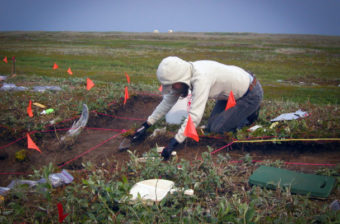
An excavator works at what was once an ancient settlement at Cape Espenberg. (Photo courtesy of Bering Land Bridge National Preserve)

There’s new evidence that metal goods from central Asia made their way to Alaska long before contact with Europeans.
That’s according to a study published this month in the Journal of Archaeological Science, but there’s still a lot unknown about one artifact in particular.

“The buckle is about three centimeters in length and maybe two to three centimeters wide,” explained Kory Cooper, an archeologist at Purdue University and one of the authors of the study. He’s been working for the past few years with Owen Mason, who was there when the buckle was discovered.

“Near the end of the season, as it always is, one of our excavators came across (a) metal object,” Mason explained.

Mason spends almost every summer at Cape Espenberg in northwest Alaska—one of the oldest inhabited settlements in North America. Mason’s team, also led by archaeologist John Hoffecker, has found a handful of other metal artifacts over the years, but he said he knew right away the buckle was unique.

he metal buckle found at Cape Espenberg. (Photo courtesy of the University of Colorado, Boulder)

“Cast bronze, which is a very elaborate type of technology, had really never been seen before, so immediately, this piece stood out.”

To cast or to mold metal requires very high temperatures, and, according to Mason, there’s never been any evidence of that in Alaska’s prehistoric settlements.

To be sure, Mason sent the buckle down to Kory Cooper’s lab in Indiana, where Cooper used x-ray technology to confirm traces of tin and lead in the buckle.

“So this is the first time that anybody has found this kind of object that is definitely something that was made by metal-producing cultures,” Cooper said, “most likely somewhere in Eurasia.”

Cooper was also able to confirm the buckle dates back to at least 800 A.D. when Cape Espenberg was still a village, but Owen Mason says a lot of questions remain unanswered.

“There’s still a lot of mystery here,” Mason said. “How did something get manufactured in Manchuria or Korea, and how long did it take to make its way to Alaska?”

Mason and his colleagues are still working on those answers. Their efforts are part of a larger project funded by the National Science Foundation’s Office of Polar Programs.

Mason said archeological work at ancient sites like Cape Espenberg is more urgent than ever.

“With the thawing of permafrost, with global change, with climate change, the sites are being subject to thawing and degradation,” Mason explained.

Mason is on his way back up to Cape Espenberg for what he hopes will be another groundbreaker season in the field.

Woman dies in boating accident near Elfin Cove

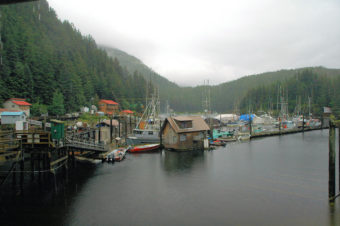
Elfin Cove
Elfin Cove, Sept. 6, 2006. (Creative Commons photo by Jim Liestman)

An Elfin Cove woman is dead after a small boat struck a piling near the community late Wednesday night.

Alaska State Troopers identified the victim as 44-year-old Elizabeth Eskelin. She was wearing a life jacket.

“It appears to be something pretty straightforward,” said troopers spokeswoman Megan Peters. “The information we have is two adults and three juveniles were in the boat together driving around. And it appears a piling was struck, which caused the boat to wreck and resulted in the fatality.”

Peters said a piece of the metal from the 16-foot skiff was lodged in the piling.

“Most other people involved received relatively minor injuries,” she said. “One of the juveniles, however, did sustain serious injuries but it doesn’t appear that those are life threatening.”

The Coast Guard said it got a call about the incident at about 10 p.m. Wednesday. A helicopter out of Sitka was on scene by about 11 p.m. It landed on the beach nearby and flew the other four people to Juneau for medical treatment.

The death is under investigation. Troopers do not suspect foul play.

Eskelin’s professional website lists Elfin Cove as her summer home. She taught kindergarten in Selawik for the Northwest Arctic Borough School District since 2014. She also spent time in Juneau, Sitka and the Kenai Peninsula in recent years.
Authorities are not naming the youths. The other adult was Dolly Mitchell, 33. (Peters was unable to confirm the spelling of her name.)

The weather on scene was reported as calm and clear, with 1-foot waves and 11 mph winds.

Despite Federal Changes, ‘Eskimo’ Still in Use in Western Alaska

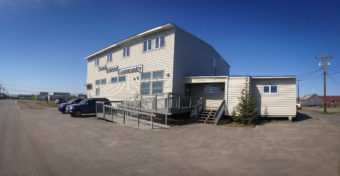
Nome Eskimo Community
Nome Eskimo Community. (Photo by Emily Russell/KNOM)

The term “Eskimo” is divisive across much of the Arctic, but it’s still being used in western Alaska. Some identify with it, while others want to see change.

President Barack Obama recently removed the words “Eskimo” and “Aleut” from two pieces of federal legislation, but it may take another generation for it to fade out of Alaska’s Arctic.

“It wasn’t until I went to graduate school in Montreal at McGill University for English as a second language when I got in trouble for using that word in one of my classes, ” confessed Yaayuk Alvanna-Stimpfle.

The word Alvanna-Stimpfle is referring to is “Eskimo.”

“We all identify with that word ‘Eskimo,’ as to who we are,” she explained, adding “my generation, we grew up speaking our native language as well.”

Alvanna-Stimpfle is a retired teacher from Nome Public Schools, where she taught her native language, Inupiaq, along with English as a second language. She’s now in her fifth year directing Kawerak’s Eskimo Heritage Program.

“It was a folklorist — an anthropologist — that thought of the title ‘Eskimo Heritage Program’ because it is about our history,” she said.

In some cases, the word Eskimo doesn’t bother Alvanna-Stimpfle. She grew up around it, but she said others are more resistant to it.

“Through education and awareness, our younger generations try not to use that word Eskimo or try not to identify with it because that was just a name that was given to categorize our people.”

Hattie Keller is 25 years old. Her family is from Shishmaref, but she was born and raised in Nome.

“Atiġa Iviilik. Kigiqtaamiuguzruŋa. My name is Hattie Keller,” Keller translates. “My Eskimo name is Iviilik and I am from Shishmaref.”

Keller describes ‘Iviilik’ as her Eskimo name, but she’s quick to clarify.

I see myself as an Inupiaq, so when people do ask me what is my ethnicity, instead of saying Eskimo, I do say Inupiaq,” Keller explained.

She’s working towards an associate’s degree in tribal management and her bachelor’s in Alaska Native studies and rural development through UAF’s Northwest Campus.

Keller traveled to Fairbanks earlier this year for tribal management classes. She said even there she had to clarify her ethnicity to other Alaska Natives.

I met with people and they were from a different culture, they were Athabascan, and I was the only quote-unquote Eskimo in the room,” Keller explained. “They asked me, ‘What do you prefer to be called, and what do your people prefer?’ And I told them it’s a personal preference.”

Keller said this happened after the Alaska Airlines “Meet our Eskimo” campaign, which, after public outcry, the company replaced with “Meet the Eskimo.”

Keller said she doesn’t get offended when people use the term Eskimo, unless it’s meant to be derogatory. She’s a member of Nome Eskimo Community, a federally recognized tribe from the Nome area.

Along with Nome Eskimo Community and the Eskimo Heritage Program, western Alaska is also home to the Eskimo Walrus Commission and the Alaska Eskimo Whaling Commission.

Arnold Brower is the executive director of the Alaska Eskimo Whaling Commission.

“I think ‘Eskimo’ covers it all for the broader range of representation for our subsistence way of life,” Brower said.

He considers himself Eskimo, and he said it’s a useful term for the commission.

“To be inclusive of Yup’ik whalers and Canadian whalers and Alaskan whalers, (the name) just came out naturally as Alaska Eskimo Whaling Commission,” explained Brower.

But Yaayuk Alvanna-Stimpfle doesn’t think the term will be around forever. She started brainstorming a few years back about how to remove the word from the Eskimo Heritage Program. It hasn’t changed yet, but she thinks her program and others like it will give in to generational shifts.

“Whether it’s economics, culture or language, yeah, I think it will fade away,” Alvanna-Stimpfle said.

With the terms Eskimo and Aleut removed from two pieces of federal legislation, it’s already fading from the Washington bureaucracy.

Site notifications
Update notification options
Subscribe to notifications