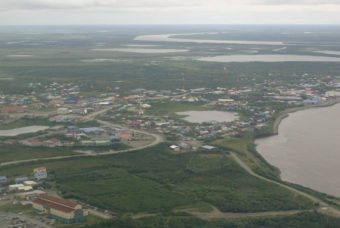
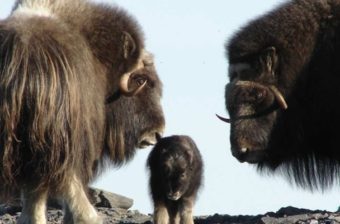
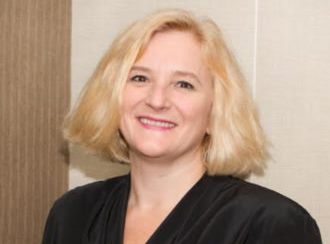
Dean Westlake is challenging Barrow Rep. Bennie Nageak in the Democratic primary; in 2014, Westlake lost the race by 131 votes. Westlake is winning by five votes, but that state election officials say they still have absentee and questioned ballots to count. (Photo by Rachel Waldholz/Alaska’s Energy Desk)
As votes continue to trickle in, a hotly contested race in the North Slope and Northwest Arctic Borough has two bush Democrats within five votes of each other.
Rep. Benjamin Nageak raises his fist in solidarity with the effort to reduce domestic violence in Alaska at the Choose Respect rally on the Capitol steps, March 27, 2014. (Photo by Skip Gray/KTOO)
Incumbent Rep. Ben Nageak is slightly behind in his race against newcomer Dean Westlake. All precincts in that district have been counted, but the state Division of Elections still has absentee and questioned ballots to count.
Westlake ran against Nageak two years ago and lost by 131 votes.
Nageak declined to comment and Westlake is out of reach at his fish camp.
Nageak is one of two rural Democrats targeted by members of their own party for caucusing with the Republican-led majority in the state House.
House Democrats are hoping to build a bipartisan coalition next year.
A challenger to Democrat Rep. Bob Herron is winning the race for House District 38. Zach Fansler has clinched his lead over Herron with nearly 57 percent of the vote. There is one district left to report in that race. It covers Bethel, the lower Kuskokwim River and several coastal villages.
Herron did not respond to multiple requests for comment, Fansler also has not responded. His campaign manager Mitchel Forbes said they won’t talk about results until every vote has been counted.
Zach Fansler and Bob Herron meet outside of KYUK for an August 2, 2016 campaign debate in Bethel. (Photo by Geraldine Brink/KYUK)
That district had the largest voter turnout in the state with 21 percent of the registered voters casting a ballot.
With no Republicans in either race, neither candidate will have a general election challenger.
After almost two weeks, the boil water notice has been lifted from Bethel’s Trailer Court neighborhood. Last month a routine sample revealed E. coli present in the pipes of one home. Cliff Lindroth is the manager at the neighborhood’s water processing plant.
“We got the green light from the Department of Environmental Conservation. They came out here on Tuesday, we got the results back from the YK lab, all tests came back negative,” Lindroth said.
The tests confirm what Lindroth has said for the last week – the containment was isolated to one home and not a system wide problem.
“I apologize to people for the concern and inconvenience they’ve had during this period of reacting to what was kind of a false turd in the punch bowl,” said Lindroth.
Lindroth blames unorthodox piping systems inside the contaminated home for the scare.
“It’s not uncommon for somebody to just put a piece of hose in there and clamp it on with some hose clamps. And maybe that was the same hose that was lying out in the yard. The same hose that’s been lying in the bottom of somebody’s boat,” he said.
City workers volunteered their time to help identify the problem. The Trailer Court water system is independent from the city’s system.
Lindroth says that as a result of the scare, the plant will be doing more regular testing to make sure everything is normal moving forward.
Muskox, near Nome. (Public Domain photo by Jason Gablaski/National Park Service)
For the past seven years, Stephen Lias has been visiting wild places to inspire him in writing musical compositions. His latest wilderness muse is Alaska’s Bering Land Bridge National Preserve.
The self-proclaimed adventure composer will be traveling this week with local music teacher Ron Horner to tour the park. To write a good piece, he says he’ll keep himself open to every experience the preserve offers him.“I like to get dirty and maybe a little scared,” Lias says, “and get myself out of my comfort zone so the park reveals to me a certain experience.”
Lias plans to see the granite tors and Serpentine Hot Springs during his time in the preserve. After his visit, he won’t even begin to write until he’s back in his home studio. The composer says he’ll take thousands of pictures and journal entries and jot down some musical ideas there. Then, he’ll take all of that back to his Texas studio and surround himself with those images. After that, he’ll recreate the experience mentally until musical ideas start to germinate.
Lias says the time between the studio and the trip ensures the strongest memories stand out to him. Using those memories and themes, he’ll begin to write a musical composition. If he hikes, the piece may have a walking pace. If he sees a soaring hawk, trumpets may have sweeping melodic runs. Everything from the weather to his emotions can be used as lenses that will affect the sound of the final product.
“What does that bear sound like, or what does that falcon sound like?” wonders Lias. “But my audience isn’t falcons. My audience is human beings. And so, it’s much more interesting to me as a composer to ask myself, ‘how do I feel’?”
If everything goes according to plan, Lias hopes the piece will be ready by this coming May. After his time at the Bering Land Bridge National Preserve, he will be going to Homer for the Wild Shore Festival for New Music, August 7-14.
A male caribou runs near Kiwalik, Alaska. (Photo by Jim Dau)
Kotzebue residents expressed concerns last week that data used by the Alaska Department of Fish and Game to overturn the sport hunter ban in Unit 23 may be incomplete and misleading. Unit 23, around 25 miles north of Kotzebue, is home to the Western Arctic Caribou Herd, which many use for subsistence and sport hunting. The Federal Subsistence Board held the meeting to collect opinions regarding the special action to overturn the exclusion of non-resident caribou hunters in Unit 23.
During the July 18th public comment session, tensions were palpable in the Northwest Arctic Borough (NWAB). Walter Sampson, a Kotzebue subsistence hunter, was the first to take the microphone for public comment.
“I apologize for taking time, but I am addressing my way of life,” he said. “Putting food on the table for my family is important. I’m not worried about bureaucracy.”
The main issues raised were challenges to the data and arguments surrounding potential increased user conflict, as well as concerns about the size and health of the herd.
Kotzebue resident Lance Kramer, with support of other subsistence hunters, questioned the new data’s significance and completeness. During their comment period at the meeting, Fish and Game stated that the newly gathered information was “sufficient” for passing the special action to allow sport hunting. Kramer thinks the term “sufficient” is too generous a description, however, and says he isn’t the only one to think so.
“I even talked to the biologist who put this together, and he said that that word (‘sufficient’) is subjective,” said Kramer.
As an NWAB subsistence mapper, Kramer is skeptical about the accuracy of the calf survival rate in particular. The 82% calf survival rate being cited to repeal the subsistence board’s decision comes from tracking 31 collared calves migrating from Onion Portage to their winter resting grounds.
The survival rate comes from how many calves survive that journey. Kramer argues that starting at Onion Portage skips a lot of the migration that caribou undergo.
Larry Bartlett of Fairbanks, wearing a dress shirt and hunting gear, makes his case for passing the special action to allow sport hunting in Unit 23. (Photo by Tyler Stup/KNOM)
“The problem is that’s not where the calves are declining. The calves are declining in their summer grounds through their migration route,” said Kramer.
His second contention is with Fish and Game’s caribou population count. Kramer emphasizes this number is just an estimate and notes the official population count won’t come until sometime this fall. The latest caribou count is estimated at 206,000.
The Western Arctic Caribou Herd Working Group, which Fish and Game is a part of, stipulates at 200,000 caribou non-subsistence hunters must be banned from Unit 23. As non-resident hunter Larry Bartlett put it, “Getting to the edge of the cliff can be scary, but it’s not the same as falling over the edge,” said Bartlett.
Kramer thinks that nearing the 200,000 edge is enough reason for concern. He says that if the herd is declining, even in a slower or more leveled-off way, the state should still be concerned about the herd.
The last issue raised at the meeting last week was the possibility of increased user conflict. Some people at the meeting believe if the special action goes through, then there will be more tension between sport and subsistence hunters. Kramer thinks both groups won’t share the same territories because caribou migrated to lands sport hunters couldn’t access if banned from Unit 23.
The Federal Subsistence Board will make their decision on whether the exclusion of non-subsistence hunters is permanent sometime this fall.
State Democratic Party officials are backing challengers to two Democrats who caucus with the Republican-led House majority. The challengers and party officials say this will increase the chances for a bipartisan coalition.
There’s a long history of rural legislators joining majority caucuses, regardless of the party. In the House, four Democrats from northern and Western Alaska have joined the Republican caucus since 2009.
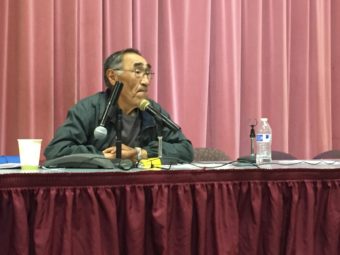
This year, Benjamin Nageak of Barrow and Bob Herron of Bethel are facing challengers backed by other Democratic House members and state party officials.
Democratic Party Chairwoman Casey Steinau (Photo courtesy Alaska Democratic Party)
Party Chairwoman Casey Steinau said electing Dean Westlake of Kotzebue, who’s challenging Nageak, and Herron’s challenger Zach Fansler of Bethel would increase the chance of a bipartisan coalition in the House.
“That’s how things get done and how we work together,” Steinau said. “Being who you are, but still, reaching across the aisle and doing it as a group, as the coalitions do in Juneau. I think that the bipartisan coalition that was there for years was very effective in getting legislation passed, and I’d like to see that happen again.”
While both legislative majorities have members from both parties, they generally don’t describe themselves as bipartisan coalitions, and only include rural Democrats.
The Senate was led by a bipartisan coalition that included substantial numbers of both Democrats and Republicans from 2007 to 2012.
Gov. Bill Walker has been unable to get most of his fiscal plan through the Legislature, despite support from some minority-caucus Democrats and moderate Republicans. Now Democratic leaders want to grow this grouping into a majority. A fundraiser for Westlake and Fansler on Monday in Anchorage will be co-hosted by former U.S. Sen. Mark Begich, as well as nine House members, among others.
Westlake said the public sees the Legislature acting in an increasingly partisan way, and this hasn’t benefited rural voters.
At one time, the Bush Caucus was strongest, and probably the best thing for Alaska. The caucus wasn’t split on party lines, instead Alaskans took the party mantle off, and working together for the betterment of state as a whole.
But Nageak sees the work he’s done as co-chairman of the House Resources Committee as being in the tradition of powerful rural legislators of the past, such as Al Adams.
“I think what they’re trying to do is minimize what we – the Bush Caucus – are doing with the majority,” Nageak said.
Nageak said an oil and gas tax bill, House Bill 247, that he supported was scrutinized more than any other bill in recent years. And he said it will benefit the residents he represents. This is the second straight election in which Westlake is challenging Nageak. Nageak won in 2014 by 131 votes of more than 2,000 cast.
Herron said Democratic leaders have focused on the times when he voted with the majority, rather than the issues where he opposed the Republican leadership. He cited his bucking the majority on the last major overhaul of oil and gas taxes in 2013, and his opposition to ending the last special session after a week.
But Herron said rural legislators have served their constituents well by staying in the majority. He said this year is the first time he’s aware of that any party is backing primary opponents to incumbents who followed this tradition.
“Urban Democrats want this guy (Fansler) to win so that they can take care of their constituents – and he’s helping them,” Fansler said. “That’s where I have an issue with this whole thing.”
But Democratic Chairwoman Steinau said the official party organization plan since at least 2014 has said the party won’t support legislators who don’t caucus with the party.
And Fansler said Herron has continued to support the majority caucus at a time when rural Alaska isn’t benefiting from the policies it’s pursuing.
“If you look at the incumbent’s voting record, it’s pretty much lockstep with what the majority kind of votes and, you know, I personally think the agenda that they’re pushing is not an agenda that’s helpful to my district,” Fansler said.
The possibility of a new bipartisan coalition in the House may become clearer on the primary day, Aug. 16.
Newly appointed meeting Chair Ivan M. Ivan at the Yupiit Piciryarait Cultural Center in Bethel. (Photo by Charles Enoch/KYUK)
Tribal delegates in Bethel this week tried to hold an emergency meeting of the Association of Village Council Presidents.
They want the AVCP administration and executive board to provide answers on financial matters and respond to what some delegates see as a mismanagement of power and lack of transparency within the organization.
AVCP administration and executive board members did not attend nor sanction the meeting, which began Tuesday and ended Wednesday.
Only 13 tribes sent delegates; 38 were needed to constitute an official meeting under AVCP bylaws. For lack of quorum, the delegates are pushing their questions and demands to the October annual meeting.
AVCP acting president and legal counsel did not respond to KYUK’s emails seeking comment on the meeting.
Close
Update notification options
Subscribe to notifications
Subscribe
Get notifications about news related to the topics you care about. You can unsubscribe anytime.