Northwest

Science and cooking collide to fight botulism

A bearded seal, or ugruk, on the sea ice.
A bearded seal, or ugruk, on sea ice. (Courtesy of Kawerak Subsistence Program)

Food scientists with the help of a botulism expert are trying to combine science and traditional Alaska Native methods to make one prohibited food safe to eat.

Regulated programs under the State of Alaska Food Safety and Sanitation Program are not allowed to accept or distribute seal oil due to the danger of botulism, a potentially fatal disease which is caused by bacteria in contaminated food.

But how or when the neurotoxins enter the rendering process is still a mystery. That’s what researchers want to find out.

Val Kreil describes seal oil as “a little bit like a heavy olive oil.” He’s the administrator of Utuqqanaat Inaat, a long-term care facility in Kotzebue that falls under the Maniilaq Association.

He says elders at the facility identified seal oil as a priority food.

“For them it’s like eating butter. This is just part of their daily diet. This is what they’ve always been eating and, in terms of health, it’s actually healthier than fish oil. So, there’s a lot of benefit to eating seal oil.”

But because the bacteria that causes botulism grows in anaerobic environment – or one without exposure to oxygen – traditional methods using containers like bottles or barrels to render the seal oil can lead to contamination. The challenge is how to prevent the risk of poisoning while working with the traditional techniques.

Kreil says beginning last year; Maniilaq started looking for ways to get a variance approved to distribute seal oil. He says he’s one of a number of Alaskans interested in getting prohibited traditional foods safe and approved for consumption, and he hopes to clear the way for other programs.

The first step in the mission was to turn to regulators.

Lorinda Lhotka, a section manager with the State of Alaska Food Safety and Sanitation Program, says the state was willing to allow organizations to serve the seal oil if they could demonstrate a safe process.

However, she explains Lorinda Lhotka needed to reach out to resources other than the state.

“We do testing, but it’s usually in result of outbreaks of illness, and we don’t do a lot of preventative testing to help evaluate the safety of the product. So, it’s usually just in response to illnesses, and our labs don’t have that capacity.”

So, along the way, Maniilaq got in touch with UAF’s Kodiak Seafood and Marine Science Center, and Dr. Eric Johnson, a botulism specialist and professor of bacteriology at the University of Wisconsin – Madison.

He has a long history in researching botulism and his lab is registered for toxin analysis.

Johnson says he’ll watch the traditional process in action in the community of Kotzebue and, once he understands the preparation, examine samples in his lab.

“My interest is in helping validate the process from a safety perspective – for example, what aspects in this process may contribute to the growth of clostridium botulinum and its formation of toxins and to implement minor changes in the process that will enhance its safety.”

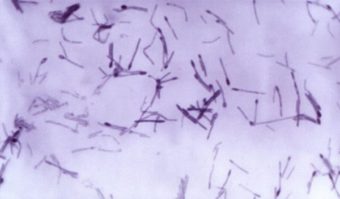
Bacteria that causes botulism.
Bacteria that causes botulism. (Public domain image)

While the Seafood and Marine Science Center is not registered to work with toxins, it does focus on the research of seafood. Associate Professor of Seafood Microbiology Brian Himelbloom explains they can study the other aspects of a seal oil sample, like what it’s composed of and how much water is left in the extract.

“Because that will give us an idea when things go bad maybe that’s because some of that seal oil has some residual water available and that’s where we theorize clostridium botulinum is actually going to operate.”

Himelbloom says, in theory, the preparers of the seal oil can avoid a botulism incident if they pour off 100% oil.

“But in their mixing, if there’s splash over from water or they’re not careful how they’re pouring it off, maybe that’s the situation – because under what we call ambient temperatures, room temperature or outside temperature, that’s probably in the range where this organism can proliferate.”

So far, it’s all speculation. The trick according to Himelbloom and the other researchers is to find the solution while keeping scientific intervention to a minimum.

“We know something about clostridium botulinum and how it acts and how it behaves and where it can be found and how you test for it and how do you assay for the toxin, and so if we can combine those two worlds of traditional knowledge and Western science, we might actually come to the point of oh, now we know how we can most likely guarantee, hopefully, that there won’t be a botulism incident if they follow these particular steps.”

Next, researchers will observe the traditional process, and then, through collaboration with each other, Maniilaq, and other community partners in Kotzebue, they’ll decide on what they should test and how much of it.

Johnson will visit Kotzebue today and Friday to watch how local processors render seal oil.


Westlake widens lead in District 40 primary

The unofficial results of a tight House primary race are in. Dean Westlake of Kotzebue appears to have won the Democratic nomination for House District 40 from incumbent Rep. Benjamin Nageak of Barrow.

Previously Westlake had a lead of only three votes. Absentee and questioned ballots tallied Friday widened Westlake’s lead to 21 votes.

Division of Elections officials have said it will likely take another week to certify the results. But, Westlake’s win might not be definite. Because the race was so close, the state would probably grant a request for a recount.

Nageak or 10 qualified voters would have to file for a recount no later than five days after the state’s final review of District 40’s ballots.

Voters in one village were allowed to cast ballots in both primaries

Rep. Benjamin Nageak, D-Bethel, during debate on the creation of Indigenous Peoples Day, April 1, 2016. (Photo by Skip Gray/360 North)

The result of Tuesday’s Democratic primary for House District 40 remains in doubt.

There also are concerns over how voters in the Northwest Arctic village of Shungnak were able to cast ballots in both the Republican primary and in the primary for Democrats and others.

According to the Alaska Dispatch News, Shungnak precinct chairwoman Evelyn Woods says she mistakenly allowed 52 voters to cast ballots in both primaries.

Dean Westlake is challenging Barrow Rep. Bennie Nageak in the Democratic primary; in 2014, Westlake lost the race by 131 votes. Photo: Rachel Waldholz/Alaska's Energy Desk
Dean Westlake is challenging Barrow Rep. Bennie Nageak in the Democratic primary; in 2014, Westlake lost the race by 131 votes. (Photo by Rachel Waldholz/Alaska’s Energy Desk)

Dean Westlake is ahead of Benjamin Nageak by five votes in the district, which covers the North Slope and Northwest Arctic boroughs, as well as three precincts in the Unorganized Borough.

Election officials continue to count absentee ballots and will review questioned ballots.

State Division of Elections director Josie Bahnke said a state review will examine the statewide results – particularly those in Shungnak.
“We’re still getting to the bottom of it,” Bahnke said. “We’re considering this to be a huge training issue for us going into the general, and one we will address meaningfully and promptly.”

Shungnak was one of six precincts in northern and western Alaska that didn’t report their results until well into Wednesday – many hours after they were supposed to be reported under state election procedures.

Bahnke noted that no voter in Shungnak was allowed to vote twice in the Democratic primary. The number of Democratic voters was similar to previous primaries, but there were more than four times as many Republican voters in the village.

Forty-eight Shungnak residents voted for Westlake, while only two voted for Nageak.

It could be at least several weeks before the winner in District 40 is clear.

The deadline for absentee ballots mailed before the election to arrive by mail is Aug. 26. And the Division of Elections anticipates it will take another week to certify the results.

There’s a good chance there will be a recount, since the trailing candidate or a group of voters in an election this close can request a recount paid for by the state.

The recount request deadline is five days after the state review of the results.

Threatened by rising seas, an Alaskan village decides to relocate

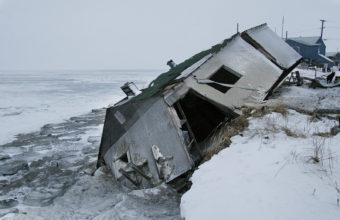
An abandoned house at the west end of Shishmaref, Alaska, sits on the beach after sliding off during a fall storm in 2005. (Photo by Diana Haecker/Associated Press)

Rising sea levels have eroded an Inupiat Eskimo village for decades. Now, residents of Shishmaref, Alaska have officially voted to relocate.

The island community, located near the Bering Strait, opted to move rather than remain in place with added safety measures to protect against the rising waters. The city clerk’s office told NPR that 94 votes favored relocating and 78 votes wanted to protect in place.

Now, according to the clerk’s office, the city council will meet to discuss the options for where to relocate. A recent feasibility study assessed four possible sites, and the clerk says those options have been narrowed down to two.

Esau Sinnok, an Arctic Youth ambassador from Shishmaref, wrote in a recent blog post that the community has “lost 2,500 to 3,000 feet of land to coastal erosion” over the past 35 years. He said his family has moved 13 houses in 15 years, “from one end of the island to the other because of this loss of land.”

On All Things Considered, Sinnok explained that he supports relocating the village “so we’ll have a community called Shishmaref for future generations.” Here’s more:

“Shishmaref will be underwater within the next three decades, and if we do not do anything, we’ll be forced to move to another city like Nome or Kotzebue or Fairbanks or Anchorage, and not many people will move to the same place. So that means our unique community of Shishmaref will soon die out because we have our unique dialect of Inupiat Eskimo language, our unique Eskimo dancing, our unique gospel singing translated in Inubiat. All that will soon die out if we do not move as a community.”

It’s a community that relies on hunting and fishing, he said. “A majority of our diet comes from the land and the sea. We hunt for caribou, moose, musk ox, bearded seal, walrus and gather traditional berries like the cloud berry, blueberries, blackberries.”

Tribal coordinator Jane Stevenson recently told The Associated Press that “she is leaning toward remaining at the current site because it’s closer to subsistence foods such as fish seal and walrus that people rely on for much of their diet.”

Sinnock said that some of those who want to stay belong to an older generation, who say “they want to stay in place because they’ve lived there all their lives and that’s where their parents and grandparents grew up too.”

The town’s mayor, Howard Weyiouanna, also argued that staying at the current location would be the most cost-effective, according to the AP. As the wire service reported, “either scenario selected in the Aug. 16 vote would cost millions – money the community of nearly 600 doesn’t have.”

Shishmaref is one of at least 31 Alaska Native villages where erosion due to climate change poses an imminent threat, according to a 2009 report from the Government Accountability Office. Twelve of those villages were exploring relocation options.

According to the Thomson Reuters Foundation, “scientists attribute coastal erosion in Shishmaref to global warming that has thawed sea ice that once shielded the island from storm surges.” It added that the village’s “permafrost, the layer of permanently frozen soil on which it is built, is melting as well.”

This is not the first time the community has voted on whether to relocate – Shishmaref voters decided to relocate in a 2002 poll, but that never happened due to a lack of resources. But Sinnock told NPR that he thinks such a decision would be handled differently now:

“I think that we learned a lot more than we did 14 years ago. I think the momentum we have now will lead to finding the available resources, and I really hope that this story, our story, goes out to the federal government, like to President Barack Obama, so that they can really know what effects of climate change are in Alaska.”

He added: “It’s crazy to know that your only home will soon be underwater if the federal government doesn’t do anything to help you out.”

Copyright 2016 NPR. To see more, visit http://www.npr.org/.

Lab identifies remains of Selawik man missing since 2013

KOTZEBUE — The remains of a Selawik man missing since 2013 have been positively identified.

The remains Clifford Greist, 32, were identified by specialists in Texas, Alaska State Troopers said.
Greist and Shellain Adams, 22, of Noorvik in May 2013 left Kotzebue on a snowmobile for Noorvik and were not seen again.

More than 150 volunteers and aircraft from multiple agencies searched unsuccessfully.

The body of Adams was found on July 4, 2013, in surf 10 miles south of Point Hope.

On Sept. 10, 2015, a survey crew working along a beach 60 miles south of Kotzebue found human remains in water near surf.

The Alaska State Medical Examiner sent the remains to the University of North Texas Center for Human Identification. A DNA analysis confirmed the identification of Greist.

Low-turnout primary could lead to five House incumbents losing

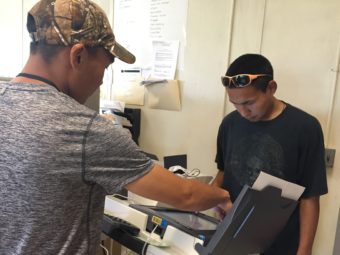
A poll watcher helps Newtok resident Bosco John, 27, vote during Tuesday's election. It was the village's first time using a digital machine. (Photo by Mareesa Nicosia, The 74)
A poll watcher helps Newtok resident Bosco John, 27, vote during Tuesday’s election. It was the village’s first time using a digital machine. (Photo by Mareesa Nicosia, The 74)

Alaskans ejected as many as five incumbents from the House in the primary Tuesday. And they also rejected two House members who tried to move up to the Senate.

But not many people showed up to vote: It was the lowest turnout for a primary in state history.

Three Republican incumbents and two Democrats who caucused with the Republicans trailed their opponents in a primary that drew only 15 percent of voters, not counting outstanding absentee ballots.

House Majority Leader Charisse Millett attributed both incumbents’ headwind and the lowest-ever turnout to the same factor – low oil prices that have hurt Alaska’s economy and the state budget.

“When you are in a deficit, I think … it’s depressing,” Millett said. “People want  to get and vote for, you know, candidates that are upbeat, and it’s hard to be upbeat in this environment.”

A lack of highly competitive statewide races also contributed to the low turnout.

Millett, who was unopposed, said it was a tough year to run for re-election.

“People are looking for someone to blame for the falling oil prices and … a sitting legislator is an easy target,” Millett said.

It’s not yet clear how the primary will affect the balance of power in the Legislature.

If the current totals hold up and Republicans continue to hold the majority, then they will have to do so with two fewer Democrats joining them — Bob Herron of Bethel was defeated by Zach Fansler, and Benjamin Nageak of Barrow trails Dean Westlake of Kotzebue (by five votes).

Casey Reynolds, who edits the political blog The Midnight Sun, said this year’s special sessions kept incumbents in Juneau and away from their districts. With the apparent losses of Herron and Nageak, he sees the chances of a bipartisan coalition increasing.

“A bipartisan organization is more likely today than it was before the election,” Reynolds said. “And the general election is going to be very important. It’s really going to be the deciding factor on this one.”

One Republican who showed a willingness to cross party lines lost.

George Rauscher defeated Republican Rep. Jim Colver in a district that sprawls from Valdez through parts of Palmer to Big Delta.

Business groups targeted Colver after he voted to reduce oil and gas tax credits.

Other incumbents who lost include Wes Keller of Wasilla, defeated by David Eastman, and Bob Lynn of Anchorage, defeated by Chris Birch.

Rauscher had said Colver was likely to join a bipartisan coalition with Democrats, though similar comments aimed at other candidates didn’t succeed.

In Palmer, Richard Best lost after making a similar charge against DeLena Johnson. And Homer incumbent Paul Seaton won, despite, he said, being subjected to disturbing and unfounded charges..

“It was the most negative campaign I’ve ever seen on the lower peninsula,” Seaton said.

State Republican Party spokeswoman Suzanne Downing said the party has room for improvement in turning out voters in the November general election.

“Every single district could improve their voter turnout, and I think as a party we’re going to work a lot harder on that for the general,” Seaton said.

Rep. Lora Reinbold won the Republican nomination for her seat. (Photo by Anne Hillman/Alaska Public Media)

The only legislator who isn’t a member of either caucus – Eagle River Rep. Lora Reinbold – was re-elected. The Republican caucus expelled her in 2015 after she refused to support a caucus-backed budget. She says she wants to rejoin the caucus and work with them to set their principles for the next term.

“And alls I’m asking is that we stick with those principles,” Reinbold said. “And that’s why it’s really important, the team that we send down there. And we’re just hoping that we’re lock-in-step and stay under the umbrella of our principles.”

While most competitive races were in the House, the state’s most expensive race was in an Anchorage Senate district, where Natasha Von Imhof defeated Rep. Craig Johnson and Jeff Landfield.

Another representative, Lynn Gattis of Wasilla, was defeated by David Wilson in her attempt to move up to the Senate. Rep. Shelley Hughes succeeded in winning the Republican nomination to succeed Sen. Bill Stoltze.

Tom Begich defeated Ed Wesley to be the Democratic nominee to succeed Sen. Johnny Ellis in his Anchorage district. Forrest McDonald defated Roselynn Cacy for the Democratic nomination to face Von Imhof.

In the House, Jennifer Johnston defeated Ross Bieling, who ran the best-funded House primary campaign, to be the Republican nominee to succeed Rep. Mike Hawker in Anchorage. Gary Knopp defeated three opponents to be the Republican nominee to succeed Rep. Kurt Olson in the Kenai Peninsula. And Don Hadley deated Lisa Vaught to be the Republican nominee to face Democratic Rep. Ivy Spohnholz in Anchorage. Colleen Sullivan-Leonard will be the Republican nominee to succeed Gattis in Wasilla. And incumbent Republican Representatives Dan Saddler, Liz Vazquez, Lance Pruitt, David Talerico and Mark Neuman defeated challengers.

The state Division of Elections still has to count absentee and questioned votes, and the results will remain unofficial until they’re certified in early September.

Anne Hillman of Alaska Public Media and Shahla Farzan of KBBI contributed to this report.

Site notifications
Update notification options
Subscribe to notifications