Northwest

In Kotzebue, revenue doubts loom as alcohol returns to the ballot

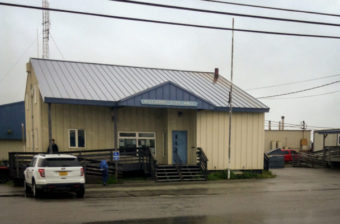
On October 4th, Kotzebue will decide whether or not they want alcohol sold in the city.(Photo by Tyler Stup/KNOM)
On Oct. 4, Kotzebue will decide whether or not they want alcohol sold in the city.(Photo by Tyler Stup/KNOM)

Since October 2011, the city-owned Kotzebue Package Store has been selling alcohol.

Come October 4th, local voters will decide the fate of the store, when they’re asked if the city should ban alcohol sales all over again.

Hans Nelson, resident of Kotzebue since 2009, says he led the alcohol ban solo from initial petition through signature collection and onto the ballot.

“I was a lone soldier on the venture,” Nelson said. “There were folks that wanted to volunteer and participate, but it was an opportunity for me to not only hear those who were concerned, but also be able to tell the story.”

Hans started the petition in July and by mid-August had secured the 193 voter signatures needed to put the issue on the ballot. He says it’s a moral issue: “that alcohol in itself has affected many of our homes, in particular to our elders, and it also has affected many of our youth.”

He says the petition appeals to business arguments as well; citing concerning language on the 2015 audit of the Package Store’s revenue. Hans specifically quotes one passage in particular:

“We were unable to perform audit procedures over the package store inventory, and we issue a disclaimer of opinion on the package store major fund. There are no formal procedures for performing a physical inventory count, and no policies and procedures for reconciling a general ledger to the year and inventory listing. Formal policies appear to be in place, but those policies were not followed at year end.”

Kotzebue City Attorney Joe Evans says that the language surrounding the audit isn’t a sign of business mismanagement at all. He adds that is what audits are for in the first place — namely, to identify better business practices — and that this year’s audit has eliminated last year’s problems.

The Package Store was in the black by October 2011. Those profits have bought loaders, a snow blower, a garbage truck, and police vehicles amongst other community improvements and loan payments. Setting its sights toward larger goals, the city borrowed $3.5 million from Wells Fargo Bank and used $2.2 million of that to construct a youth center and approximately $1.3 million to finish the Swan Lake small boat harbor.

As of now, one million of that $3.5 million dollars has been paid off. Current Package Store profits go exclusively towards repaying that debt, in addition to expanding the parks department and providing recreational opportunities for children and elders.

If the city loses alcohol sales, then they will lose an important portion of enterprise revenue.

Without alcohol profits, Evans doesn’t know where the city will make up the lost funds.

He is quick to point out that “municipal government does not operate at a profit, so Public Works, Police, Fire, Parks and Rec, none of them generate revenue.”

“The only enterprise activity the city operates that generates net revenue is the Package Store,” he added.

Without booze revenue, there is no source of money readily available as a substitute. Kotzebue would have to pull funds from sources like taxes or fees. If the city is unable to make the payments, then they will default on the loan.

Petitioner Hans Nelson thinks the city would be fine rearranging funds from other places to pay off any loan debt but adds that “(Kotzebue) should never bank on alcohol and the sale of it.”

This vote could be the second time that Kotzebue votes to ban alcohol.

Before 2011, Kotzebue had been a dry community for 20 years.

Police investigate weekend theft in Emmonak

EMMONAK– An investigation is underway for a local theft that occurred in the community of Emmonak on September 18th.

Alaska State Troopers received a report that fiber optic equipment, a generator, and other gear were stolen from a Hammer Environmental Services truck parked in the community. The estimated value of the stolen equipment totals more than 46-thousand-dollars.

As the investigation continues, Troopers in Emmonak are asking for assistance with any leads in the case.

City Council approves zoning changes for five Nome blocks


The Nome Planning Commission passed an ordinance Aug. 30 to rezone portions of blocks 109, 110, 125, 126, and 127 from general use to commercial use.

The ordinance then passed to the city council, who allowed for a public hearing on this piece of business during their regular meeting.

All of the public comments came from the Council and City Manager Tom Moran, who explained that spot rezoning is illegal, so the Planning Commission had to include additional blocks other than Sen. Donny Olson and G-O Development’s property.

The vote was all in favor, except for Councilman Tom Sparks, who expressed his concerns about not knowing Olson’s intentions for the property.

“It would seem that the only reason Mr. Olson approached us was that he saw it as a liability on a proposed sale, and he had no idea about what he actually might do on that property, and I’m concerned about that,” Sparks said. “I think that is not what we ought to address our zoning changes about; I think if he had a legitimate business interest in front of us, then I might be much more in favor of that.”

Another piece of business on the agenda was an ordinance in its first reading phase to prohibit the sale of liquor products in containers smaller than 750ml at all locations south of 3rd Avenue.

Since no discussion is currently allowed during first readings, the vote was taken quickly and resulted in four councilmen saying no to moving the ordinance forward.

In other council action Monday, Nome city employees can be paid for their jobs and for elected or appointed positions, such as being a city councilman.

The ordinance was read for the second time, opened up to public comment, and passed all during the City Council meeting on Monday night.

City Manager Tom Moran points out that this ordinance will not include “fringe benefits, retirement or insurance packages, etc.”

“It really is just saying that if somebody is going to serve on the planning commission and be an employee — or the port commission and be an employee — they can get their regular employee salary for showing up and doing a 9-to-5 and then their $40 a month for giving up their evenings to work on the port commission,” he said.

There was discussion around the councilmen’s table regarding conflicts of interest for potential councilmen.

Mayor Beneville said he wouldn’t have been able to be mayor and run his city tour business unless this ordinance was passed.

Councilman Matt Culley stated future conflicts of interest and legitimate concerns that come up can be addressed thanks to this ordinance.

“So I wouldn’t see them double dipping, now we can all sit here and nod and say of course not, but those are things that if a legitimate concern is brought up then I would expect they would be addressed, and if there is information to say that you forced them in a direction, you’d handle it,” Culley said.

All six councilmen voted yes to pass the ordinance.

Nome’s City Council will convene again Sept. 26 for their next regularly scheduled meeting.

Search continues for missing 18-year-old from Shageluk

Search efforts are still underway to find a man who went missing last week in the community of Shageluk.

Alfred Hamilton, 18, of Shageluk has been reported missing since midnight Sept. 7, after consuming alcohol with friends and refusing to return home.
Aniak State Troopers were notified of the disappearance on Sept. 8 after family members could not locate him.

An active search for Hamilton by Bethel Search and Rescue and well as by volunteers from the communities of Grayling, Holy Cross and Shageluk has continued into this week.

Aerial searches have been conducted by State Troopers.

Two search dog teams from MATSAR also assisted over the weekend.

As efforts continue, State Troopers in Aniak are seeking any information or leads regarding Hamilton’s whereabouts.

No concesssion from Nageak as recount boosts Westlake’s lead

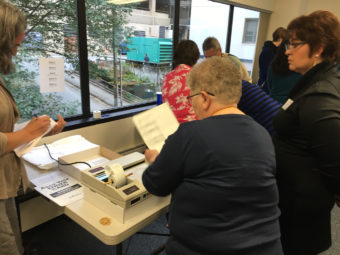
An election official feeds ballots into an optical scanner, while observers watch. Sept. 12, 2016. (By Andrew Kitchenman/KTOO)
An election official feeds ballots into an optical scanner while observers watch on Monday. (Photo by Andrew Kitchenman/KTOO)

Barrow Rep. Benjamin Nageak says he isn’t conceding the Democratic primary to Dean Westlake of Kotzebue.

“I haven’t conceded anything,” he said.

That’s despite the fact that Westlake’s lead doubled Monday from four to eight votes over Nageak in final results in the closely watched recount. District 40 covers the North Slope and Northwest Arctic boroughs, as well as three neighboring precincts in the Unorganized Borough.

What remains to be seen is whether Nageak will challenge the results in court, and — if so — whether that will change the outcome.

But Nageak declined to say whether he’d challenge the results legally, and referred further questions to his attorney, Seattle-based election-law specialist Tim McKeever.

In the recount, Westlake added six votes to his total, reaching 825, while Nageak gained two votes, to reach 817.

Westlake gained two votes from ballots that the computer scanner initially failed to count, while Nageak gained one.

In addition, Westlake gained three votes from questioned ballots from Ambler that were received after the Division of Elections certified the results.

And both candidates gained one vote each from Kivalina, where some voters mistakenly cast ballots in both the Republican primary and in the primary for all other parties.

Nageak caucuses with the Republican House majority.

Republican officials are concerned about the handling of ballots in the village of Shungnak. Voters were wrongly given ballots for both the Republican primary and the primary for all other parties.

Westlake received 47 votes in Shungnak and Nageak received three.

In addition, some Republicans in the North Slope Borough and elsewhere have said election officials didn’t allow them to vote in the Democratic primary, or required them to file questioned ballots.

Nageak said he’s concerned about it.

“I have a lot of Republican friends in the district also, especially here in the North Slope, and I’ve heard they were turned down … with their ballots,” he said.

The Democratic primary is open to all voters.

Katherine Pfeiffer was observing the recount in the elections office in Juneau for the Democratic Party. Amid Division of Elections staff hovering over ballots, optical scanners and printouts, she said she was impressed.

“I think it was very well-organized,” she said. “The election staff was very congenial, very helpful, answered people’s questions: a very transparent process.”

Nageak’s observers deferred comment to Nageak.

Friday is the deadline for an election challenge to be filed in Superior Court.

Walker vetoes bill that would guarantee university board seats to regions

The University of Alaska Board of Regents meets in Anchorage June 3, 2016. (Photo by Josh Edge/APRN)
The University of Alaska Board of Regents meets in June in Anchorage. (Photo by Josh Edge/APRN)

Gov. Bill Walker vetoed a bill today that would have set aside University of Alaska board seats for residents from different geographic areas.

The governor will continue to be able to appoint the 11 Board of Regents members without geographic limits on where they live.

Supporters of House Bill 107 said the bill would increase the representation of Matanuska-Susitna and Kenai boroughs, as well as residents who live off of the road system.

Walker said in a letter to House Speaker Mike Chenault that there’s no evidence that some areas are unheard, and that it’s important for board members to respect each area.

He also opposed a provision that required residents to live in an area for two years before joining the board, saying it isn’t consistent with Alaska’s embrace of personal freedom.

Bill sponsor Wasilla Republican Lynn Gattis said she doesn’t agree with Walker’s reasoning.

“Boy, that’s a lot of BS, and you could go ahead and put that on the radio,” Gattis said. “Because I think the bottom line is, the fact that we do have very different regions. That’s why we elect representatives from those different regions. They bring a different flavor to the table.”

It’s Walker’s fifth veto as governor, other than budget line-item vetoes.

Site notifications
Update notification options
Subscribe to notifications