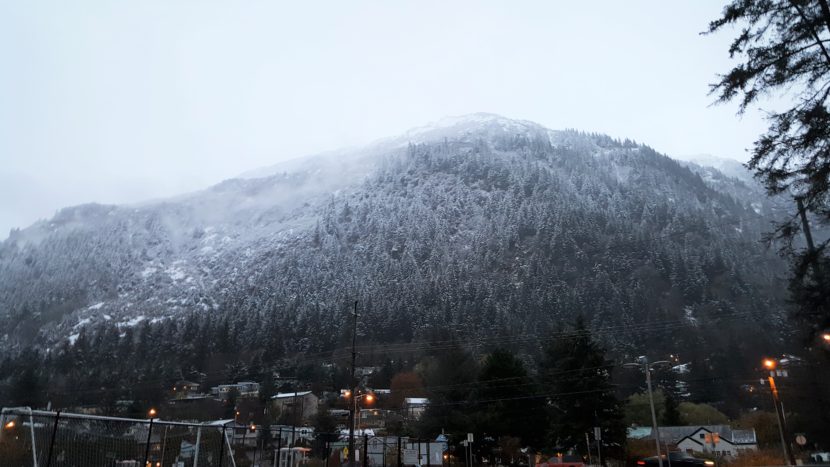
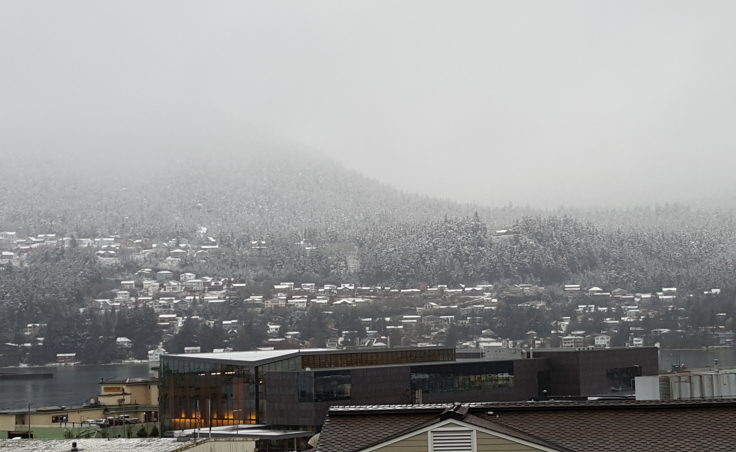
Snow covers Mount Juneau, Sunday, Oct. 16. (Photo by Tripp Crouse/KTOO)
National Weather Service meteorologist Edward Liske said this season is the first-time Juneau has seen measurable snowfall before Fairbanks since about 1940.
The National Weather Service reported Sunday that Juneau is one of the first communities in the state to see measurable snowfall this year.
“Fairbanks has not seen any snow yet so far this season, neither has Anchorage. Nome has had zero. Kotzebue has had zero,” Liske said. “The only place that really has had measurable snow this season has been Barrow with a tenth of an inch so far.”
The incredible October continues! Juneau has not seen measurable snow before Fairbanks since 1940! #akwxpic.twitter.com/Ap5nosquur
Liske said Juneau has seen snow earlier in the past. In 1974 and again in 2000, Juneau saw its earliest snowfalls on Oct. 2.
This year, Liske said Juneau saw 2 inches of snow in downtown Sunday, 5 inches near the airport and 8-9 inches at the National Weather Service Forecast Office in the Mendenhall Valley.
The precipitation started as a sudden mix of rain and snow that hit Juneau on Saturday, interrupting what Liske called unusually warm conditions.
“As we started getting heavier and heavier rain, or heavier and heavier (precipitation), it just made the surface temperatures colder and colder to the point that the rain changed over to snow during Saturday evening,” Liske explained.
But, he said the snowy weather was short-lived. It was already reverting to rain Sunday evening.
He predicted Juneau will continue to see warmer and rainier weather through the rest of the week, and the snow will most likely melt.
Before the early snowfall, Liske said an area of high pressure called a ridge surrounded much of Interior Alaska and the Gulf of Alaska giving Juneau uncharacteristically dry October weather.
“That ridge has actually been deflecting a lot of our storm systems that we usually see farther south,” Liske said.
Liske also said this entire year has been much warmer than usual for Juneau.
That plus this month’s earlier dry weather, and this most recent early-season snowstorm, has led him to conclude: this year has been “odd to say the least.”
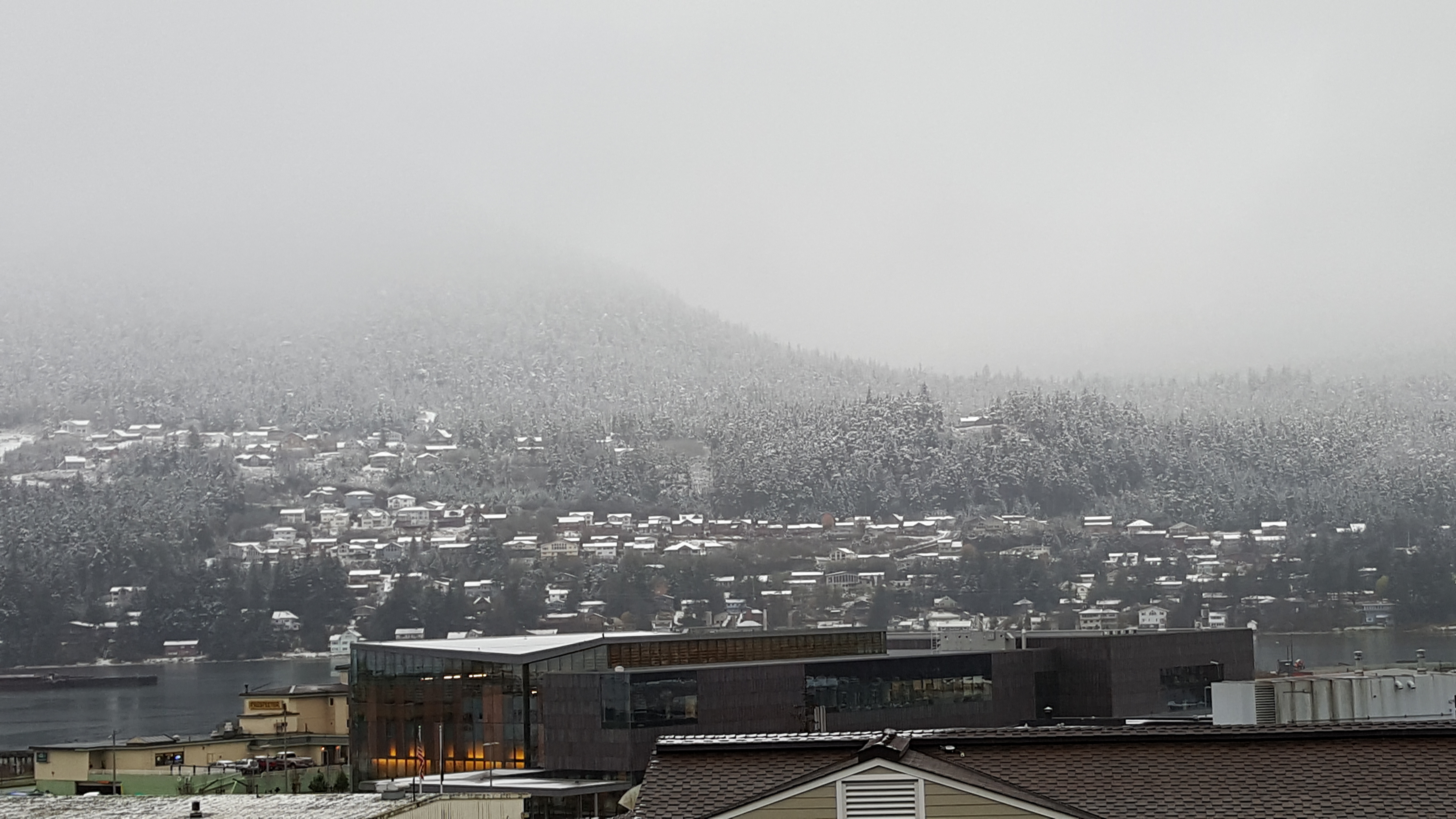
A view of Douglas Island from Downtown Juneau on Sunday. (Photo by Tripp Crouse/KTOO)
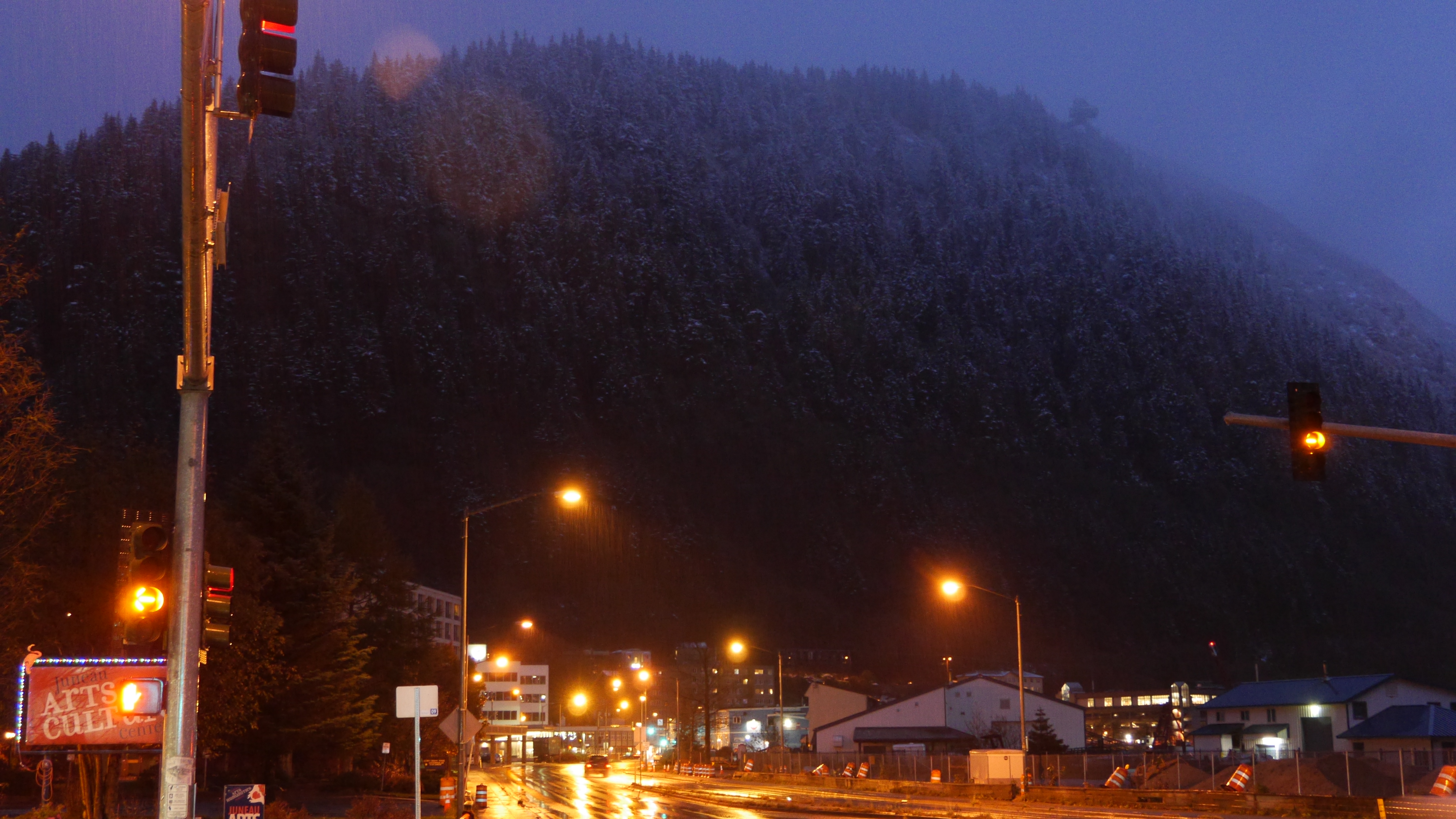
Mt. Roberts from Downtown Juneau on Sunday night. (Photo by Quinton Chandler/KTOO)
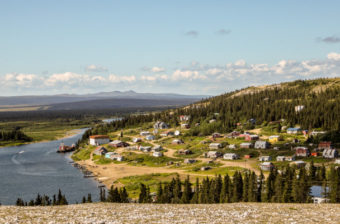
White Mountain’s oil drum storage area is one contaminated site out of 338 sites on ANCSA land that is still in the clean-up process. (Photo by Laura Kraegel/KNOM)
The Alaska Department of Environmental Conservation (ADEC) is coordinating the clean-up process of contaminated lands throughout the region and all over the State.
White Mountain’s oil drum storage area is one of nearly 1 thousand sites transferred from federal entities to Alaska Native Corporations under ANCSA. The Bureau of Land Management deems 338 of these sites to be contaminated lands still in need of cleanup, including White Mountain’s oil drum storage area.
Based on a preliminary assessment report done in 1999 by the Ecology and Environment company for the United States Environmental Protection Agency (USEPA), White Mountain’s oil drum site has relatively minor petroleum contamination, up to 540 ppm (parts per million) across a 4-acre site.
As of right now, the contaminated lands have already been designated and surveyed by the Bureau of Land Management, then organized into an online interactive database. Since this database was finished, the BLM’s role in the cleanup process has been very limited.
BLM Project Manager Paul Krabacher says, legally, the BLM can’t do anything, including cleaning up the lands, since the lands have already been conveyed and are no longer managed by the BLM. But, as the clean-up process continues, ADEC focuses on high priority sites, helps negotiate agreements between parties, and examines orphan sites.
John Halverson, the Environmental Program Manager for ADEC’s Contaminated Sites program, defines orphan sites as, “those sites where there’s either known or suspected contamination and there’s not a agency or another party that’s already either working on the site to characterize it and clean it up or planning to do so in the foreseeable future,” explained Halverson.
One example of an orphaned site is White Mountain’s oil drum storage area near the old BIA school. Halverson says the level of contamination and the amount of diesel range organics (DRO) present determines the priority of the site. DROs are a mixture of petroleum hydrocarbons found in diesel fuel.
“We have different clean-up levels based upon the site’s circumstances; even our most conservative clean-up levels are typically based on the contaminants’ potential to migrate to ground water,” stated Halverson. “So, for DRO, our default clean-up level is 250ppm; that’s kind of the starting point, and then people can propose alternative clean-up levels that are higher based on the site’s specific circumstances and information that they collect.”
According to APRN, Daniel Cheyette, Legal Counsel from the Bristol Bay Native Corporation, voiced his concerns about Alaska’s contaminated lands back in August.
“As the landowners, as participants in ANCSA who believed that the land grants were in satisfaction of their land claims, it’s really frustrating that, so many decades later, we still have contaminated sites. And the federal government (is) really moving very slowly in terms of correcting the problems that it created. It’s a step, it’s a start, but it’s taking way too long, and it’s very frustrating for the landowner,” said Cheyette.
According to a DEC report from March 2011 on the White Mountain oil drum storage area, the community’s previous Indian General Assistance Program (IGAP) coordinator indicated that whatever was left of the original 1,000 oil drums would either be transported to Nome’s drum crusher or be reused by the community. Current White Mountain IGAP environmental coordinator Jay Adams says there are still about 60 fifty-five-gallon drums left at the site, less than a mile away from the BIA school building.
Even though the community of White Mountain has removed some of those oil drums on their own, it is not their responsibility to clean up the site. The DEC deemed The Bureau of Indian Affairs as the entity responsible for the cleanup of this site. After repeated attempts to contact the Bureau of Indian Affairs, they could not be reached for comment.
There is no set timeline for the rest of the cleanup at this White Mountain site, or for the other orphaned sites in the region, including the Marshall Fish processing plant and Emmonak’s tank farms.
After being chased by Alaska State Troopers in the air and on the ground, a man with two warrants for his arrest has been caught.
Alexie Morris Jr. of Nome was wanted for two alleged incidents of felony assault and had been avoiding criminal service for nearly a month.
According to a Troopers dispatch posted Thursday morning, troopers in Nome received credible information regarding Morris’ whereabouts on Wednesday.
Morris was seen on the beach near mile 14 of the Nome-Council highway.
The 42-year-old drove his ATV out onto the tundra behind Cape Nome, where he was pursued by aircraft until Morris’s four-wheeler became lodged in the terrain.
Morris was arrested on the ground and transported to AMCC.
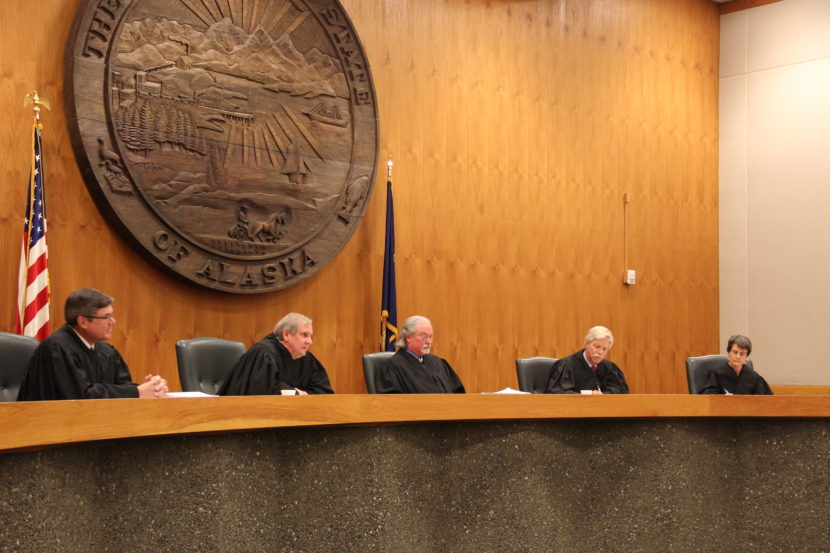
Members of the Alaska Supreme Court today reversed the lower court’s decision and reinstated Dean Westlake as the winner of the Democratic primary in House District 40. (Photo by Rachel Waldholz/Alaska’s Energy Desk)
The Alaska Supreme Court is sending Dean Westlake to Juneau.
In a decision late Wednesday afternoon, the court reinstated Westlake as the winner of the Democratic primary in House District 40, which covers the North Slope and Northwest Arctic.
It reversed a lower court ruling last week which had tipped the election to the incumbent representative, Benjamin Nageak of Barrow.
Reached by cell phone in Kotzebue just after the order was issued, Westlake said he was “absolutely ecstatic.”
“When I got the news, I just had to go for a ride,” Westlake said, laughing. “I was sitting in my office, and I thought, this is wonderful, that people that go to vote understand that absolutely no one is going to take that right away from you.”
Nageak could not immediately be reached.
The Supreme Court heard arguments this morning in the disputed primary election.
The arguments centered on events in the village of Shungnak, where poll workers let all 50 voters cast ballots in both Democratic and Republican primary races in August, instead of requiring them to choose.
The state admitted that was a mistake. But Assistant Attorney General Laura Fox, representing the Division of Elections, argued those votes should still count. Democratic primaries are open to anyone, so all the voters were eligible to participate, and it was only possible to vote once in this race, Fox said.
“They all only got one vote in this race, and this is the only race that’s been challenged, and the only race that the court has to look at here,” Fox said.
Nageak’s lawyers argued that if poll workers had followed the rules, at least a few of those voters would have chosen the Republican ballot and never voted in the Democratic primary at all — possibly changing the outcome. Westlake won 47 of 50 votes in Shungnak, and he won the race over all by just 8 votes.
Last week, the lower court agreed with Nageak and threw out 12 votes in Shungnak — and two in Kivalina — giving Nageak the win.
The lower court based that number on testimony from former Alaska Republican Party chair Randy Ruedrich, who calculated the average number of voters who chose the Republican-only ballot in the last four elections.
The Alaska Republican Party has supported Nageak’s challenge. Although he’s a Democrat, Nageak caucuses with the Republican majority in the state House.
In its appeal, the state called Ruedrich’s calculation “nonsensical.” Fox pointed out that Ruedrich used raw numbers without adjusting for voter turn-out, and the state’s brief suggested he chose to include only those past elections that favored his conclusion
The justices seemed to agree.
“Is that really a matter for expert testimony? It’s just math,” Justice Joel Bolger said to Nageak’s attorney, Stacey Stone.
Bolger noted that Ruedrich’s math only included elections back to 2008, even though the attorney’s brief included numbers going back to 2006.
“Is there anything in the record that shows why the 2006 results were neglected?” he asked.
“No, your honor, the only reason those results were neglected is because of the speed at which this trial happened,” Stone replied.
“But it only takes a moment to calculate these averages,” Bolger said.
Meanwhile, Chief Justice Craig Stowers seemed troubled that nobody had actually asked anyone in Shungnak how they meant to vote. He said no amount of math could tell the court which ballots voters would have chosen, especially when there was a hotly contested race on the Democratic ballot, and not on the Republican one.
“Could not these villagers, who knew a lot about these candidates, and were very interested in this particular election, have decided to choose all, or substantially all, of the ballots from the ADL?” he asked. The ADL ballot included the Democratic Party, Alaska Independence Party and Libertarian Party primaries.
The five justices arrived at their decision within hours. In a two-paragraph order issued Wednesday afternoon, they reversed the lower court’s decision, upholding the original election results.
Only Justice Daniel Winfree dissented, arguing the entire election should be voided and held again.
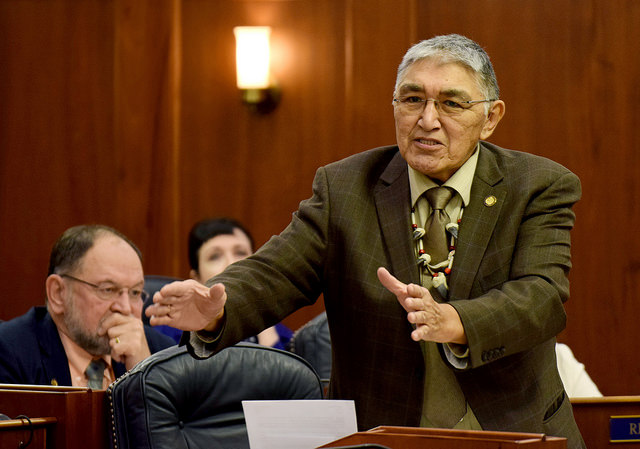
Rep. Benjamin Nageak, D-Barrow, speaks in the Alaska House of Representatives during debate on House Bill 123 to establish a marijuana control board in Alaska, April 14, 2015. (Photo by Skip Gray/360 North)
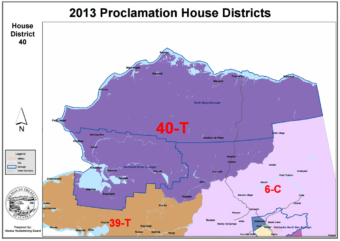
The Alaska Supreme Court will hear arguments Wednesday in a lawsuit over the Democratic primary in House District 40, which stretches from Kotzebue to Kaktovik.
House District 40, the state’s northernmost, includes the North Slope and Northwest Arctic. (Image courtesy Division of Elections)
The outcome could determine the balance of power in the state legislature next year.
The Division of Elections originally declared Dean Westlake of Kotzebue the winner, beating incumbent Rep. Benjamin Nageak of Barrow, by eight votes.
But Nageak challenged those results, pointing to voting irregularities in several precincts. Last week, a Superior Court judge threw out 12 votes from the village of Shungnak and two from Kivalina, giving Nageak a narrow, two-vote win.
The state appealed that decision to the Alaska Supreme Court.
With no other candidates running in the general election, whoever wins the primary will head to Juneau in January, and the decision could tip control of the House. Though both candidates are Democrats, Nageak caucuses with the Republican majority, while Westlake has said he will join other Democrats.
Oral arguments will begin at 10 a.m. Wednesday in the Boney Courthouse in downtown Anchorage. The justices are expected to rule by Friday, Oct. 14 — that’s the deadline for the state to begin mailing out ballots for the general election in November.
Close
Update notification options
Subscribe to notifications
Subscribe
Get notifications about news related to the topics you care about. You can unsubscribe anytime.