Northwest

Q&A: Teen White House honoree from Shishmaref talks climate change

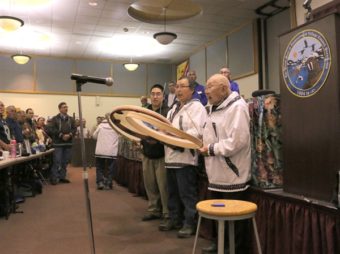
Esau Sinnok (second from the left) talked at the White House aout “Climate Equity” (Photo courtesy of the Department of Interior)
Esau Sinnok, second from the left, talked at the White House about climate equity. (Photo courtesy Department of Interior)

A 19-year-old from western Alaska was honored last week at the White House for his work advocating on behalf of communities experiencing climate change first hand. Esau Sinnok spoke to me from his cousin’s house in Nome on his way back home to Shishmaref. He was in Washington advocating for climate equity.


ESAU: Climate equity, to me, means we’ll have available resources so that Shishmaref will have the available resources to either relocate or adapt to climate change so that our future generations can have fun and experience the lifestyle that I had the privilege. So that our future generations can live the traditional lifestyle that ancestors have been living for the past 4,000 years on Shishmaref.

HUGHES: In your own life, have you seen changes to the climate?

ESAU: Yeah, ever since I was born in 1997, we had to move about three dozen houses from one side of the island to the other because of big storm surges that happened in Shishmaref so that they don’t topple over and go into the ocean. It affects me personally because I lost a loved one. He fell through the ice when him and my dad and a few others went out to the mainland on their snowmachines on the ice to go duck hunting. And on their way back, he fell through the ice and he thought that the ice would be frozen like in previous years, but for some reason it wasn’t frozen all the way so he fell through and lost his life.

HUGHES: What’s one of the messages from Alaska that you’ve tried to bring to the attention of other influencers and other leaders?

ESAU: I always tell other people, wherever I go and whoever I meet, that the youth voice is very powerful. That they are the future leaders of tomorrow. It’s very important for us youth to have a voice in all these types of movements and all these types of issues. Because the future that we’re going to inherit is being decided right now and affecting my hometown of Shishmaref greatly, affecting 223 communities all across Alaska greatly. And not just in Alaska but in the Gulf Coast, in the Lower 48 like in Louisiana and Florida, those states.

HUGHES: And can you tell me what it was like at the White House?

ESAU: It was like a once in a lifetime opportunity at the White House. I had my goosebumps and my heart was beating every time I was there. It was like I couldn’t believe I was there. I’m just a rural village Native kid, and to experience that … it felt like a once in a lifetime opportunity for me. And I would love to get other youth involved to share the same experience. To share what I felt when I was there.

HUGHES: My last question for you is, what your next step is?

ESAU: I’m currently studying at the University of Alaska Fairbanks in tribal management and hopefully continue with a rural development degree so that I can go back to Shishmaref and run as city mayor and to experience how to lead our community. Hopefully one day I could run for governor of Alaska by the year 2030 to represent, not only the big cities like Anchorage and Fairbanks and Juneau, but also the rural communities. I wanna make a change and try to make a positive and better future so that our future generations can live in a safe environment and don’t have the problems that I’m seeing every time I’m back at the community.

AVCP delegates call emergency meeting

Leaders from around the state gathered in Bethel for the 50th Annual Association of Village Council Presidents Convention Tuesday, October 7, 2014. (Photo by Dean Swope.)
Leaders from around the state gathered in Bethel for the 50th Annual Association of Village Council Presidents Convention. Photo by Dean Swope.

Next Tuesday will mark the beginning of a two-day “emergency meeting” of Association of Village Council Presidents’ board of directors in Bethel, called by the Akiak Native Community.

Mike Williams Sr., an AVCP board member from Akiak, distributed the invitation to other board members and says he hopes tribes will attend the meeting to, in his words, “take hold of AVCP.”

“We’re not after anybody, but it is up to the 56 leaders to decide the future of our own organization,” Williams said.

Williams claims that AVCP is operating illegally by shutting board members out of the decision-making process.

Akiak Native Community’s invitation comes a month after some board members raised concerns that AVCP was in financial trouble, and that the executive board had concealed the information from the larger body.

“I think the overall goal is to resolve these issues, put them behind us, and move forward,” Williams said.

The agenda included in the invitation calls for a vote on the removal of the board chairman, the president, and the executive board.

According to AVCP’s by-laws, it would require two-thirds of all board members present, or 38 delegates, to establish a quorum and make votes count.

A similar meeting was held earlier this year in April, but a quorum was not met.

AVCP did not recognize the last meeting as legitimate and Williams says he suspects the same may happen next week.

Telephone calls and e-mails sent by KYUK to AVCP seeking comment on both its by-laws and the meeting were not responded to. AVCP also received a copy of this story before it was published, which it did not comment on.


As internet gets faster, Stebbins elders worry about subsistence

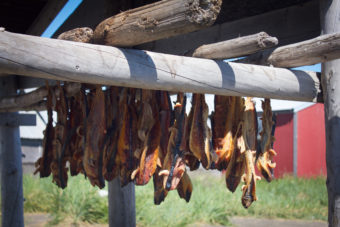
Salmon drying in Stebbins. (Photo by Emily Russell/KNOM)

From policymakers to Pokeman Go players, high-speed internet is the hot topic in Western Alaska this summer.

The Arctic Broadband Summit just wrapped up in Barrow this week. Crews are busy off the coast of Nome this month laying fiber optic cable, and GCI recently announced plans to bring high-speed internet to ten more communities in the region this year.

The village of Stebbins is on that list, and while many are excited for faster service, some fear their subsistence lifestyle could suffer. 

It’s a spectacular summer day in Stebbins. Fish racks are filling up, berries are blooming, and Bernard Abouchuk is sitting on the beach with a rifle under his arm.

“Elders wanted seal meat and a seal just happened to pop up on (the) beach and now we’re just waiting for it to come back,” Abouchuk explains.

Bernard Abouchuk sits on the beach in Stebbins waiting for a seal. (Photo by Emily Russell/KNOM)

Those elders are farther up on the beach, with their eyes glued to the horizon. Many of them were around before villages like Stebbins had stores that sold pre-packaged meals. They had to watch the horizon for seals, scan the tundra for berries, and travel long distances by dogsled for caribou.

“We lived with the seasons,” explains Charlie Kitka. “We had spring camp, summer camp, fall camp, and we lived off the land.”

Kitka grew up in Marshall, a village on the Yukon River about 100 miles south of Stebbins.

“Nowadays nobody goes out into the country anymore. Very few people do that,” Kitka explains.

Kitka says more and more people across the region aren’t learning subsistence skills like net mending and fish processing. Instead, he says, they’re turning to modern conveniences to put food on the table.

Our younger generation, all they know how to do is go to the store and get something quick that they can put into the microwave to eat.”

Morris Nashoanak says a lot of that has to do with modern distractions.

“We’ve got more kids into iPads and iPods,” Nashoanak explains.

Nashoanak is the mayor of Stebbins. Like many other village elders, he worries technology is tempting kids away from their traditional roots.

He says kids from his village would rather be home playing video games than out gathering greens.

“They’re spending nine to 12 hours per day with (them),” Nashoanak says. “We’d like to encourage the younger generation to be more active in subsistence gathering and hunting.”

That may get even harder, though, in the months to come. GCI is promising to bring high-speed internet to Stebbins by the end of this year.

Doreen Tom thinks that’s a good thing.

“Right now we have GCI over here at the (city) office and it’s really slow,” Tom says.

Tom is the city clerk for Stebbins. Internet in the city office will cut out for hours sometimes, which Tom says is a real problem when she’s under a tight deadline.

Tom isn’t just excited for faster internet at work. While she admits kids aren’t as involved in subsistence as she was growing up in Stebbins, Tom says she doesn’t mind the distraction in her own house.

“They get to stay home more if they have internet on the phone,” Tom explains. “I like it when the kids are home because I know where they’re at.”

That’s understandable in a village where bootlegging leads to binge-drinking and often violence.

On a day like today, though, it seems like nothing could keep kids inside.

Back on the beach, Bernard Abouchuk’s nephew, who can’t be more than 7 or 8 years old, comes up next to him with a toy gun in his hand.

His nephew and a few friends were pretending to be hunting seals on the beach when a real seal popped its head above the water. Abouchuk laughs as the boy pretends to load and unload the toy gun.

“It was just so funny, because they were playing ‘hunting seals’ and then a live seal came up in front of them and they just got an adrenaline rush and happy,” Abouchuk says.

It’s that happiness and rush of adrenaline that Abouchuk says can’t be conveyed over the internet, no matter how high-speed it is.

GCI to expand internet service in rural Alaska

Telecommunications provider GCI says it aims to further access to high-speed internet in Western Alaska in the near future. By the end of 2016, the company says, their TERRA network will expand to ten more communities in Norton Sound and the Northwest Arctic Borough.

TERRA is an acronym for “Terrestrial for Every Rural Region in Alaska.” GCI’s fiber-optic and microwave network project started in 2010 and currently services 72 communities, extending from Southwest Alaska through Kotzebue. The towers and antennas will connect ten more local communities to what’s referred to as the “backbone” of TERRA, eventually linking back to Anchorage.

GCI TERRA Network 2016-2017 Construction Map. (Courtesy of GCI)

Heather Handyside is with GCI. She says the best way to describe this expansion is “the ability to do video conferencing and rich streaming of data.”

GCI says it will focus first on working with local schools and hospitals, with the stated goal of allowing greater access for students and providing more opportunities for training and connection to medical specialists in larger hubs like Nome and further south to Anchorage. Handyside says, “There will be no delays. There will be vivid, vibrant colors, and it will be immediate, interactive sharing of data and information back and forth between people, such as someone in a community like White Mountain and a doctor in an emergency room in Anchorage. It will be seamless and it will be immediate.”

Handyside says contracts with GCI will vary per hospital and school, but there will not be any caps to the streaming capacity. As far as personal streaming for consumers – that’s something that will happen in the near future. “The good news is this is really the first step. Once we have these anchor tenants in place, we can use the same infrastructure to deliver services to consumers and businesses in the area.”

Work has already begun in Koyuk for a tower and its foundation. Handyside says technicians have also been working in Golovin and Elim to add additional antennas on nearby towers.

Ericsson technology will continue to partner with GCI to provide this new TERRA-network expansion. In addition to Koyuk, Golovin, and Elim, the communities of Buckland, Kiana, Noorvik, Selawik, White Mountain, Stebbins, and St. Michael are said to be receiving GCI’s high-speed internet access by the end of the year.


Kotzebue fire chief on leave after DUI charge

The Kotzebue fire chief is on paid administrative leave after being charged with driving under the influence.

KTVA reports Sean Ralston was accused of driving a city vehicle while intoxicated on July 2.

Kotzebue police say in a statement that an officer smelled alcohol on Ralston’s breath and saw one empty beer can and a half full can in Ralston’s marked city vehicle.

Tests indicated Ralston had a blood-alcohol content level of .167, more than twice the legal limit of .08.

City attorney Joe Evans says Ralston is on paid leave. Fire department Capt. Kelly Marcus is the acting chief.
A message left with Ralston’s Anchorage attorney on Friday morning wasn’t immediately returned to The Associated Press. A pre-trial conference was scheduled for Aug. 25.

Kotzebue fire chief arrested for DUI in city vehicle

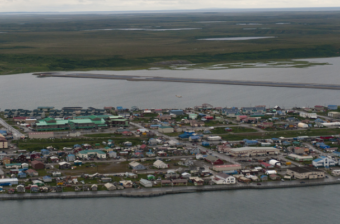
Kotzebue. (Photo by Neal Herbert/ National Park Service)

Kotzebue’s fire chief is appearing in court Thursday after being arrested Saturday and being charged with driving under the influence.

According to a press release from Kotzebue’s Police Department, 37-year-old Sean Ralston was driving the city’s fire chief vehicle when an officer stopped him outside his home.

Ralston showed signs of impairment during a field sobriety test. A police officer found one crushed and one half-full beer can on the driver side floor of the vehicle. Ralston was taken to the Kotzebue Regional Jail, where he blew a .167 breath alcohol content. That’s more than twice the legal limit in the state of Alaska.

Ralston was charged with driving under the influence and his arraignment is scheduled for 1:15 p.m. Thursday.

Correction: Sean Ralston’s age has been corrected. He is 37, not 36. 

Site notifications
Update notification options
Subscribe to notifications