Iditarod

33 mushers leave Fairbanks to take on the longest-ever Iditarod trail

Rookie musher Bryce Mumford of Preston, Idaho, heads down the Chena River. Thirty-three mushers and dog teams began the 2025 Iditarod Trail Sled Dog Race from Fairbanks on March 3, 2025. (Marc Lester/Anchorage Daily News)

Thirty-three sled dog teams raced out of Fairbanks Monday onto the longest Iditarod trail in history. The last-minute plan to change the route went off without a hitch despite significant changes to the original trail. The race start was moved up to Fairbanks due to dismal snow on the normal route in Willow.

Even still, it was a balmy 40 degrees at the front of Pike’s Waterfront Lodge, with the melting snow under the dogs’ booties starting to look a little like mashed potatoes by the 11 a.m. start time. Iditarod CEO Rob Urbach said he’s optimistic about the race ahead, but he acknowledged the strain of changing the route on such short notice.

“There’s always challenges,” Urbach said. “We’re synonymous with challenges. And this year, clearly the universe even decided, ‘Hey, we need more challenges to try to overcome.’ So, we try to laugh at adversity and focus our energies on just getting it done.”

Dogs in the team of Big Lake musher Riley Dyche run down the Chena River. (Marc Lester/Anchorage Daily News)

The day was full of superlatives — race officials said this could be the warmest Fairbanks start on record. It’s also the longest Iditarod trail yet, and this year’s field of 33 teams is tied with the smallest in race history. Plus, it’s the 100-year anniversary of the 1925 serum run to Nome, when sled dog teams relayed antitoxin from Nenana to Nome to combat a diphtheria outbreak.

This year’s race will mirror that historic route, and the significance isn’t lost on Willow-based musher Gabe Dunham.

“The history of mushing that basically came in and helped save so many lives… I get goosebumps whenever you talk about it,” she said. “And that is the history of these dogs — they were modes of transportation and everything. It just encompasses everything that the Iditarod stands for.”

A dog in Gabe Dunham’s team howls before the race begins. Thirty-three mushers and dog teams began the 2025 Iditarod Trail Sled Dog Race from Fairbanks on March 3, 2025. (Marc Lester/Anchorage Daily News)

Dunham said the race is also the sum of the support it gets from sponsors and fans — like the one who gave her a tiny stuffed T-rex that is now lashed to her sled.

“I got him when I raced the Idaho sled dog challenge from a little, little guy that wanted to give me a gift,” Dunham said. “I zip-tied him on the sled, and he was starting to cry. And I’m like, ‘What’s wrong?’ And he’s like, ‘He’s a dinosaur. He’s gonna get cold.’ So, ever since then, he’s kind of been my sled mascot.”

Musher Gabe Dunham does T-rex arms next to her stuffed T-rex, gifted to her by a fan. (Shelby Herbert/KUAC)

Hundreds of people lined the starting chute as Dunham and the other mushers readied their dog teams, including other young superfans like 9-year-old Lucy Lee who huddled next to the fence with her mom. Lucy said she isn’t rooting for any musher in particular — she’s solidly “team dog.”

“I just love dogs!” Lucy said, giggling. “I just love them so much.”

Lucy and her mom, Katie Lee, wait for the race to start. (Shelby Herbert/KUAC)

Further up the line, a few people carried signs who did not love what they were seeing. It wouldn’t be the Iditarod without PETA protestors, and the last-minute route change didn’t throw them off course. John Di Leonardo flew out from New York to protest the restart in Fairbanks, as well as the ceremonial start in Anchorage.

“The Iditarod doesn’t resemble the serum run at all,” he said. “I think it’s time that we evolve this tradition into something more humane and leave the dogs out of it.”

Fairbanks musher Jason Mackey was first up to the starting line — and grateful for it. He was also the first out when he raced this year’s Yukon Quest sled dog race. He scratched on the Quest, he said, due to poor weather conditions. But this time, Mackey said, he feels like the gold is in reach.

“My goal is everybody’s goal, whether they tell you it is or not. It’s to get to Nome healthy, with a healthy team — but to get to Nome first,” he said. “I’m not saying I’m going to win the race, I’m not saying I’m not going to, but that’s my goal. I’m not here to mess around.”

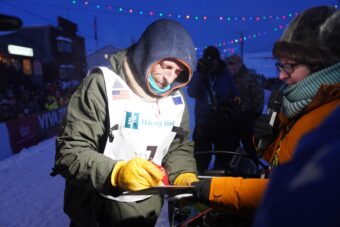
Musher Jason Mackey gets help putting on his race bib before the race restarts in Fairbanks. (Marc Lester/Anchorage Daily News)

He said his team is in great shape to run. All but one of the dogs are Iditarod veterans, like him.

“I do have one dog in there that has never done this before,” Mackey said. “His name is Flash, he’s a team dog. He’s a 3-year-old, but he’s an all-star 3-year-old.”

Just after 11 a.m., Mackey and his seasoned team — and MVP Flash — charged through the corridor of cheering spectators and into the taiga beyond, with nearly 1,150 miles of snow and ice between them and the finish line in Nome.

This Unalakleet restaurant is delivering hot pizza and warm messages to exhausted Iditarod mushers

Bret Hanson puts Canadian bacon on a pizza in the kitchen at Peace on Earth, the restaurant in Unalakleet he owns with his wife, Davida. The couple was busy baking pizzas for mushers in the Iditarod Trail Sled Dog Race on Sunday, March 10, 2024. (Casey Grove/Alaska Public Media)

UNALAKLEET – They’re selling love by the slice at the local pizzeria.

Encouraging messages from all over the globe come with each pizza that the Peace on Earth restaurant delivers to this Iditarod Trail Sled Dog Race checkpoint, about three-quarters of the way into the 1,000-mile race. The mushers have been arriving here at the edge of Alaska, cold and tired after long stretches with only sled dogs to keep them company.

Their family, friends and fans began placing pizza orders by phone weeks ago. The calls kept coming as the front-running sled dog teams came in Sunday.

a woman is on the phone, while another two people look at a cellphone
Left to right: Davida, Bret and Joann Hanson in the family’s restaurant, Peace on Earth, as they took pizza orders for mushers. (Casey Grove/Alaska Public Media)

The messages say things like “Good luck” and “Keep on mushing.” Some are inside jokes or written in a language other than English that Peace on Earth owners Davida and Bret Hanson, who cook the pizzas and write the messages in marker atop each box, don’t even understand.

“You get moms and dads, you know, ordering their kids pizzas,” Davida said. “And so you get, ‘Love, from Mom and Dad. Oh, and can you put a heart on there?’”

And, yes, they will draw a heart on the box, she said.

a woman holds a baby
Davida Hanson holds her grandson, Christopher, while looking over pizza orders with her daughter-in-law, Joann, at Peace on Earth, the family’s restaurant. (Casey Grove/Alaska Public Media)

“Some of them get pretty personal,” Davida said. “Some of them are long, you know, so you’re sitting there, and you don’t want to mess up on the message, and it might be a couple sentences, and you’re actually writing a whole note to this person.”

A few make you want to cry.

That’s what happened last year when Australian musher Christian Turner’s wife called in an order from their home in Queensland, over 6,500 miles away. She included a message from their baby daughter.

“The message on there says, ‘Love you, Daddy, from your bubby girl,’” Davida said, holding up her phone to show a picture of Turner eating the pizza. “And when he read that, he just teared up, and it got the whole Iditarod checkpoint emotional.”

Even a year later, standing in her kitchen at home, Davida’s eyes were welling up.

“It was the most gut-wrenching happiness I’ve ever seen, because it was just, when he saw that, you know, there was that connection,” she said. “Maybe they haven’t seen their family in a long time, and when you get a message like that on one of these pizza boxes, it gives you that extra push to say, ‘OK, I’m almost there. I can do this.’ Or, you know, it kind of just lights that spirit back up in them, I think.”

notes hang in a kitchen
A note to go with a pizza order for Iditarod musher Travis Beals Sunday. (Casey Grove/Alaska Public Media)

The Hansons have recognized that connection for years. They’ve operated Peace on Earth since they fired up the pizza oven the day after Christmas in 1996. Their house is right next door, and when the Iditarod racers are coming through, they’re often going back and forth between home and the restaurant, taking orders and making the pizzas: rolling out dough, spreading the dark red tomato sauce, sprinkling toppings like pepperoni and sausage and firing the pies in the oven.

Bret is constantly checking the Iditarod’s GPS tracker to make sure he’s ready to cook the right pizza for the right musher at the right time, to get it to them still hot when they get here.

“It’s just important,” Bret said. “It’s important to the people that made the orders, and it’s important to the mushers, because I’ve seen it in their eyes, to have something special and a little message from whoever is sending it.”

a man puts pizzas on a rack
Bret Hanson puts a prepped pizza in a rack in the kitchen at Peace on Earth. (Casey Grove/Alaska Public Media)

Bret remembers the first time he saw a musher’s eyes light up when they got a pizza and a message from afar.

Swiss musher Sven Haltmann, by way of Fairbanks, had mushed in after more than 700 miles on the Iditarod Trail and was trudging along with buckets of water to mix with food for his dogs. Bret told Haltmann he had a pizza for him, from an order someone called in from the Lower 48.

“He turns around and says, ‘Wow, really?’” Bret recalled. “His face changed, and his eyes lit up and everything lit up all at the same time … and the change in his whole posture and emotion is just so memorable in my mind that I just think of him as the first one.”

Iditarod musher Matt Hall arrived here in fourth place Sunday, the musher and dogs all wearing red jackets that were only a slightly brighter hue than the pizza sauce. It had gotten down to 45 below zero the night before on the trail. After bedding down and feeding his dogs, Hall ambled into the checkpoint building to get something to eat for himself.

a musher hits frozen meat with the back of an axe outside
Musher Matt Hall hits a frozen bag of meat with the back of his axe to break it apart at the Unalakleet checkpoint. (Casey Grove/Alaska Public Media)

Hall spotted a stack of three pizza boxes with the name “Matt” on it, but thought at first it was for his competitor Matt Failor. Hall was going to take a piece anyway, then he realized the box had his bib number, 16, on it.

“I would’ve still stolen a piece,” Hall said.

Hall took a big bite of the cheese pizza. It was much better than the freeze-dried meals he’d been eating on the trail, he said.

“Yeah, this is super cool,” Hall said. “This is really hitting the spot. Mm hmm. This is delicious.”

a musher eats pizza
Musher Matt Hall enjoys a slice of cheese pizza from Peace on Earth, a restaurant. (Casey Grove/Alaska Public Media)

Scrawled atop the box were the words “Good luck at the race. Have fun.” It was from a 4th grade class in West Newbury, Mass.

The pizza messaging really took off, the Hansons said, with a group of fans known as the Ugly Dogs, cultivated online by Wisconsin writers and dog mushers Blair Braverman and Quince Mountain, a married couple who’ve both run the Iditarod. (Ugly Dogs is a reference to a message Braverman got on the social media platform then called Twitter, in response to something she’d written about Taylor Swift, when a Swift fan told her to, “Go back to you ugly dogs, Karen.” Braverman and Mountain thought that was hilarious, and the name stuck).

The Ugly Dogs comprise a wide and active network online, and when they learned they could buy pizzas for mushers about five years ago, the orders started pouring in from all over, the Hansons said.

At first, the Ugly Dogs would order pizzas for specific mushers, Bret said. But some mushers would have a stack of them at the checkpoint, and others wouldn’t have any, he said.

“They decided that nobody should go without a pizza, and they made sure everybody down to the Red Lantern had a pizza,” Bret said. “And that was all the Ugly Dogs.”

Nowadays, the mushers come in anticipating the pizza and heartfelt messages. They walk into the checkpoint building, a part of the post office a short walk from the dog yard, asking if there’s a pie waiting for them, Davida said.

A former Iditarod musher had recently explained how good it felt to get a hot pizza with a warm note, Davida said.

“I was like, ‘OK, that’s why that’s why we do it,” she said. “So somebody knows they’re being thought of.”

The 2023 Iditarod starts this weekend. Here’s what to know.

Ramey Smyth’s team run into Finger Lake during the 2022 Iditarod. (Jeff Chen/Alaska Public Media)

The 2023 Iditarod kicks off Saturday with a ceremonial start in Anchorage followed by an official race start in Willow.

From there, 33 mushers and dozens of sled dogs will make the 1,000-mile dash to Nome.

It’s the smallest group of teams in the Iditarod’s history, but it’s a pretty competitive one.

Here’s what to know about this year’s race:

When will the Iditarod start?

The race begins with a parade-like ceremonial start in Anchorage on Saturday, March 4.

Mushers and their sled dogs will gather downtown early that morning to get ready.

Starting at 10 a.m., they’ll take off one-by-one every couple minutes from Fourth Avenue, near D Street. They’ll head down city streets, onto the trails and end at the Campbell Airstrip.

people near an iditarod sign
The 2020 Iditarod ceremonial start in Anchorage. (Joey Mendolia/Alaska Public Media)

Here are places to watch from. People gather all along the trail for the event, but some hotspots include downtown, the hill on Cordova Street and the Trailgate party in the Eastchester Park area.

Next up: the official race start on Sunday.

A dog team drops down a short hill in spruce forsest
Travis Beals descends onto Willow Lake at the official start of the 2022 Iditarod. (Lex Treinen/Alaska Public Media)

After the ceremonial start, mushers and their dog teams truck to Willow for the official start at 2 p.m. on Willow Lake. They’ll again leave at two-minute intervals, and head to Nome.

The Iditarod says folks wanting to watch the start should look for signs on the Parks Highway in Wasilla and at Houston High School that will have information on available parking.

What’s the trail route this year?

The trail will go from Willow to Nome along what the Iditarod calls its “southern route.” Teams have not taken that route since 2019.

The first part of the southern route is the same as the northern one. Then, once teams get to Ophir, it cuts south through the Beaver Mountains to the ghost town of Iditarod. From there, there’s a lot of river running through Shageluk, Grayling and Anvik before linking up with the main trail in Kaltag.

The southern route is slightly longer and is thought to be more challenging with mountains and lots of mushing on the exposed Yukon River.

How are the trail conditions? 

Generally, very good, according to race director Mark Nordman.

Snow has hammered much of Southcentral, including the first chunk of the trail up to Rainy Pass Lodge.

From there, teams must tackle the notorious Dalzell Gorge — a twisty trail marked by a series of steep downhills and some very tight turns. Nordman said the gorge is in good condition.

But then things get tough: He said the route from Rohn to Nikolai has among the worst moguls in race history.

“Imagine a washboard except every ridge in the washboard is 4-feet high,” said Nordman, “So it’s just this up and down, up and down.”

A dog team in the middle of some scattered spruce
A dog team on the flat section of trail before Nikolai. Some mushers in 2022 described the section as having the worst moguls they’d ever seen, and a race official says, this year, they’ll be worse. (Lex Treinen/Alaska Public Media)

From there, the trail is in good condition until the ghost town of Ophir, said Nordman. He said the snow level is still lower than he’d like from Ophir to Shageluk, though some snowfall is in the forecast.

Once mushers hit the coast, there may be some rerouting.

Traditionally, teams go across the sea ice on Norton Sound and Golovin Bay, but winter storms have pushed some of that ice out. He said it’s unclear if mushers will travel over the ice or take an overland route around it.

Who’s competing in this year’s race?

There are 33 teams signed up including most of last year’s top 10 mushers. That includes reigning champ Brent Sass and 2019 winner Pete Kaiser, plus Jessie Holmes, Dan Kaduce, Richie Diehl, Ryan Redington and Aaron Peck.

RELATED: All eyes on Brent Sass in highly competitive Iditarod field

A man with two dogs
Slater and Morello led Brent Sass’s team to his first Iditarod victory in 2022. (Lex Treinen/Alaska Public Media)

There’s also nine rookie mushers hoping to cross the Nome finish line for their first time, including a Denali climber, a former Anchorage garbage truck driver and a father-son duo.

RELATED: Meet 5 Iditarod rookies

Noticeably absent: There are no Seaveys in the race for the first time in more than a dozen years. Five-time champion Dallas Seavey said he’s sitting out to spend time with his family and his dad, three-time champ Mitch Seavey, said he’s taking a year off to let his body recover. But they both have dog teams in the competition: Kelly Maixner is running dogs from Dallas, and Christian Turner is running Mitch’s team.

Here’s the full list of teams.

Why are there so few mushers racing this year?

The Associated Press crunched some numbers and found the average number of mushers starting the Iditarod over the last 50 years was 63. The highest? 96 in 2008.

So 33 teams is not only the smallest field ever, but it’s just about half the average size.

The Iditarod community has cited a variety of reasons for the low turnout.

A couple of them:

• There are quite a few longtime Iditarod mushers who have stepped away from mushing in recent years, and there isn’t a big group of teams to replace them. Aside from the Seaveys, Aaron Burmeister and former champ Joar Leifseth Ulsom say they’re taking a break to be with family. Four-time winners Jeff King and Martin Buser, plus fan-favorite Aliy Zirkle also aren’t racing. Race icon Lance Mackey died last year.

• There’s also the cost. Many mushers say inflation has hit them hard with dog food prices doubling in the last couple years, plus many missed out on tourism income during COVID-19. Some estimate that running the Iditarod takes at least a $20,000 investment, and prize money has been stagnant for years as the Iditarod loses big-name sponsors.

A musher feeds a dog team outside
Richie Diehl feeds his sled dogs at the Nikolai checkpoint during the 2022 Iditarod. (Jeff Chen/Alaska Public Media)

How many dogs are on a team?

Mushers can start with up to 14 dogs and as few as 12. They must have at least five dogs pulling the sled across the finish line in Nome.

Where do the dogs go that don’t make it to the finish line?

Mushers can leave dogs with veterinarians at race checkpoints along the trail. Mushers must provide them with four pounds of food and coats, according to race rules.

There’s a variety of reasons a musher may send a dog home, including illness and injury or because the dog can’t keep up. Also, near the end of the race, mushers will often slim down their teams to just their fastest dogs.

The dogs left behind get flown back to Anchorage or Nome depending on their location.

two officials walk two dogs in the snow
Iditarod veterinarians walk two dogs sent home from the Unalakleet checkpoint. (Jeff Chen/Alaska Public Media)

Are there any COVID-19 protocols this year?

COVID precautions are basically gone this year, with the vaccine requirement removed and no regular testing out on trail. All the checkpoints that were closed down before will be open this year. Race director Mark Nordman said that there will be an epidemiologist out on the trail in case there are COVID infections.

women in mask and face shield swabs inside a mans nostrils
Musher Jeremy Traska gets a mandatory COVID test before the 2021 Iditarod. (Hannah Lies/Alaska Public Media)

When can we expect a winner?

Historically, the race winner has arrived in Nome in as little as eight days, so that would mean a finish late Monday night, March 13, or early Tuesday morning, March 14.

How do I follow along? 

Bookmark alaskapublic.org/Iditarod!

Alaska Public Media reporters Lex Treinen and Ben Matheson are headed out on the trail this year. We’ll have stories and photos from them on alaskapublic.org and on 91.1 FM.

Plus, keep an eye out for the latest episodes of our Iditapod podcast, now in its seventh season. You can listen on iTunesSpotify or wherever you get your podcasts.

On top of that, we have the Iditarod newsletter! Subscribe here. During the race, we’ll send you a daily round-up of the latest Iditarod stories, podcast episodes and even dog profiles straight to your inbox.

a portrait of a dog
A sled dog on Yuka Honda’s team in McGrath. (Jeff Chen/Alaska Public Media)

Other local news outlets will also be following the race, and there’s coverage provided by the Iditarod itself on iditarod.com.

Have a question we missed? Email Tegan Hanlon and Casey Grove at thanlon@alaskapublic.org and cgrove@alaskapublic.org.

4-time Iditarod champion disqualified for positive meth test during race

Iditarod musher Lance Mackey at the 2020 Iditarod Trail Sled Dog Race ceremonial start in Anchorage on March 7. (Photo by Joey Mendolia/Alaska Public Media)

A positive drug test for methamphetamine has disqualified veteran dog musher Lance Mackey from the 2020 Iditarod Trail Sled Dog Race, according to a message that race organizers sent to sponsors Thursday.

Mackey’s 21st-place finish in this year’s race will be vacated after the positive test from a sample collected in White Mountain, the Iditarod statement says. Mackey finished the race, his 16th Iditarod, in Nome on March 19.

Mackey is a four-time Iditarod champion, from 2007-2010, and a four-time Yukon Quest champion, from 2006-2009. He’s also the only musher to have won both of the 1,000-mile races the same year, in 2007 and 2008.

In the Iditarod’s written statement, Mackey said he planned to go into treatment.

“I’m tired of lying to myself, friends, family, and fans, who have all supported me, rooted for me, or been inspired by me. I apologize to all of you,” Mackey said. “The truth is that I need professional help with my latest life challenge. I am in the process of making arrangements to go to a treatment center where I can get the professional help and real change I need. I’m ready to confront this with all of my focus and determination.”

Mackey did not immediately respond to a request for comment. He has spoken openly in the past about heavy drug and alcohol use earlier in his life, mostly cocaine and whisky.

The Iditarod has tested sled dogs for drugs since 1994 and instituted drug testing for mushers during the race in 2010. The decision by the Iditarod Trail Committee to test mushers came after a complaint about musher drug use from the Iditarod Official Finishers’ Club.

At the time, Mackey was the most vocal musher in pushing back against the testing, claiming he had been singled out because of his use of marijuana for pain management as a cancer survivor.

The first Iditarod disqualification for drug use came in 2012, when 38th-place finisher Matt Giblin tested positive for marijuana.

Shaktoolik awarded for COVID-19 accommodations, hospitality during Iditarod

Drop bags are lined up outside the makeshift Iditarod checkpoint near the community of Shaktoolik. (Photo by Emily Hofstaedter/KNOM)

The Native Village of Shaktoolik is being recognized for their makeshift checkpoint during this year’s unusual Iditarod sled dog race. The community has been given the Golden Clipboard Award from the Iditarod Official Finishers Club.

In a press release, the Iditarod Trail Committee said Shaktoolik is being recognized for their commitment to “providing the best possible checkpoint in light of restrictions and concerns over COVID-19.”

Just days before mushers racing the 2020 Iditarod were expected to reach Shaktoolik, city leaders decided to close the community checkpoint to prevent any local spread of the novel coronavirus.

U.S. Sen. Lisa Murkowski said the community’s efforts were an example of rural Alaska resiliency.

“That was very early on in terms of the impact and the response in the state of Alaska,” Murkowski said. “So you had individuals coming together and saying, ‘We haven’t seen this threat (coronavirus) out here, but we know that we need to be prepared.’”

But efforts to protect the community weren’t going to prevent community members from also providing hospitality. They set up their own last-minute shelter.

Shaktoolik residents found a ruined house at the old Shaktoolik site, about two miles from the current village. They outfitted the shelter with food, water, and a warm place to rest for mushers and dogs as the teams prepared to cross the barren sea ice across the Norton Bay.

One of the leaders for that effort was Hannah Lynn Sookiyak, who told KNOM at the checkpoint in March that she comes from a family history of Iditarod volunteering. She said her parents were checkers for the race when it first started in the 1970s.

“I don’t know how many years they did it but they did it in their own personal two-story home with 11 of us kids,” she said. “And back when it first started, we had no running water, no sewer, so my brothers were busy hauling ice and dumping honey buckets!”

Iditarod Race Director Mark Nordman said he, “appreciated Shaktoolik’s efforts to go above and beyond for the race teams.”

The actual award will be given to the community at a later date.

Nome, Iditarod officials postpone end-of-race festivities

Aliy Zirkle and her team arrive in Nome at the end of the 1,000-mile Iditarod Trail Sled Dog Race on Wednesday, March 13, 2019. (Photo by Zachariah Hughes/Alaska Public Media)

Iditarod mushers will still be finishing on Front Street in Nome next week, but the city of Nome will not be hosting any festivities.

After meetings with state medical officials, the Iditarod Trail Committee announced Thursday that they are postponing the Iditarod Finishers’ Banquet and Musher Meet and Greet.

The Nome Common Council voted to follow suit and postpone all Nome Iditarod events, including the famous annual Lonnie O’Connor Iditarod Basketball Classic, an event that attracts visitors from the across the state and hosts crowds of between 500-800 people in the Nome Recreational Center.

After listening to recommendations from public health officials and hearing testimony from the community, the Nome Common Council reasoned that the precautions were necessary to restrict any potential spread of the coronavirus — not only just within the city, but also especially for rural communities outside of Nome, where Elders may have more limited access to medical care.

Before the Iditarod started, race officials said they planned to step up sanitation this year and distribute information about best practices to avoid getting sick, including washing hands.

The Iditarod confirmed Thursday that there are no plans to call off the race.

Alaska Public Media’s Tegan Hanlon contributed to this report.


Site notifications
Update notification options
Subscribe to notifications