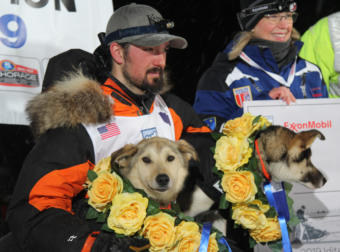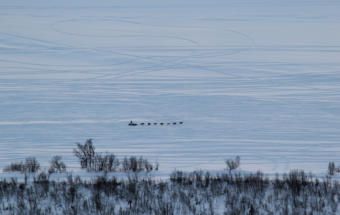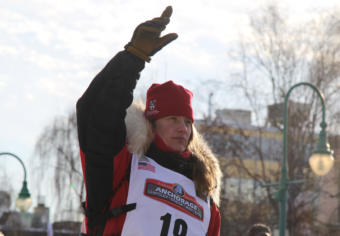
Aliy Zirkle at the ceremonial start of the 2019 Iditarod Trail Sled Dog Race in Anchorage. (Photo by Zachariah Hughes/Alaska Public Media)
The 47th running of the Iditarod Trail Sled Dog Race is underway.
Fifty-two dog teams sped out of Willow Sunday afternoon for the 1,000-mile race to Nome. With 35 men and 17 women slated to run, it’s the smallest field of mushers starting an Iditarod in decades. But that doesn’t mean the competition is any easier.
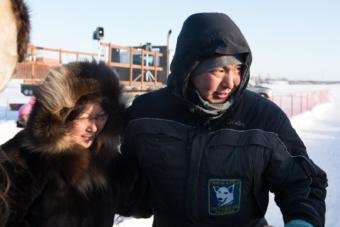
Two Rivers musher Aliy Zirkle is one of the contenders.
“It’s incredibly competitive, just as competitive as last year,” Zirkle said. “The sad part is we’ve lost some folks who do it for the sake of doing the Iditarod, but maybe they’ll come back next year.
This year’s field includes five former race champions, as well as 10 rookies. After poor snow forced the race to relocate twice in recent years, race officials said conditions are better than average. One of last year’s top rookies, Matt Hall, is happy with what he’s hearing.
“Seems like a lot of snow that’s also a slow trail, which is kind of good,” Hall said. “We train a little slower than most teams. We compete in the Yukon Quest right before Iditarod each year, so we’re kind of geared down a bit. I’m looking forward to another sort of soft trail out there.”
And the recent weeks of good weather have four-time champion Martin Buser feeling optimistic about the trail.
“The forecast looks really good, including the trip up and over the Alaska Range. That’s always the challenge,” Buser said.
Trail crews had to build bridges over open water in parts of the Dalzell Gorge. The race’s most technical sections are within the first couple days, a fact that rookie Jessica Klejka knows well.
“I’m just going to take it one checkpoint at a time,” Klejka said. “The sections we all hear about, my husband keeps saying, ‘They’re not that long of sections, you’re going to be fine.’ (And I say) ‘Well what about the steps?’ (He says) ‘There are going to be a few minutes of terror, and then you’ll be fine.’”
There’s spotty snow around the Iditarod checkpoint, and much of the sea ice along the coast is in poor shape after severe winter storms pounded the region.
A winner is expected to reach Nome in about nine days and will take home $50,000 plus a new truck, out of a race purse of $500,000.
Mike Williams Jr. of Akiak completes the 2017 K300. (Photo by Katie Basile/KYUK)
The Iditarod restart kicks off Sunday afternoon in Willow. Five Yukon-Kuskokwim Delta teams will be competing across 1,000 miles of Alaska wilderness, but a notable Western Alaska musher will be absent from the pack. However, his time will still be going to the dogs.
Mike Williams Jr. has competed in nearly every Iditarod since 2010, but this year, as the race approaches, he isn’t busy flying his team to the start.
“Right now I’m scooping up some poop and there’s a lot of water,” he told KYUK over the phone from his Akiak dog yard on Thursday. He laughed as he talked.
The warm weather right now means that he can’t let the mess sit for long, or else it all melts together.
He made the decision to not race shortly after last year’s Iditarod, and he has five good reasons why: “My newest one is Corlaine, and she’s six months. Anna, she just turned three. My twin boys, they’re five. And my stepson is eight,” he explained.
He also has a new litter of pups and a 40-dog kennel. Williams says that if conditions were better he’d be entering the dogs in local races, but everything has turned to mush.
The watery winter has destroyed more than local trails.
“Some of the dog houses, well a lot of them,” he said, “got damaged this past year from all the rain.”
On another note, the winter has brought some good things for the Williams’ household. The whitefish harvest is the best he’s ever seen.
“This morning, one of my nets, I pulled up about 35,” he said.
Williams catches about 90 percent of the food that his dogs eat, and this year, they have something new on the menu.
“My uncle up in Barrow (Utqiagvik) sent us some whale blubber,” Williams said. “It keeps good weight on them, and they have shiny coats from it.”
Meanwhile, Williams’ father, Mike Williams Sr., catches lush fish, also known as burbot, for his son’s team. Growing up, the younger Williams watched his father compete in the Iditarod. When asked if he’d be following the race this year, Williams didn’t hesitate.
“Oh yeah. Of course!” he responded.
Williams says that he will be checking the Iditarod Tracker whenever he pulls out his phone, cheering on the local teams while home in Akiak, surrounded by family and dogs.
Located halfway between Cantwell and Paxson on the Denali Highway, The Alpine Creek Lodge has become a popular mushing destination. (Photo by Joey Mendolia/Alaska’s Energy Desk)
Along one of the most remote stretches of the state’s road system is a wilderness lodge that’s become thoroughly popular with elite dog-mushers. The spot offers some of the best winter training for long-distance mushers anywhere in Alaska. The fact that there’s also hot food and cold beer, mushers say, just happens to be a bonus.
For a decade, the Alpine Creek Lodge in the middle of the Denali Highway has built a share of its business around being a convenient way station for mushers training their teams along the 135 miles of nearly un-trafficked winter road.
The Alpine Creek Lodge sits at mile 67 of the highway, equidistant from Paxson to the east and Cantwell to the west. From October to May it is technically closed. Which means that during the winter, people transit primarily with sled-dogs or a snowmachine.
The Denali Highway is not maintained for the majority of the year and sees limited vehicle traffic for most of the winter (Photo by Zachariah Hughes/Alaska Public Media)
During a recent trip to the Alpine Creek Lodge from the Cantwell side, the local borough had recently groomed the trail, scraping it neatly free of drifts or sizable moguls. Besides some small groups of caribou and a half-dozen moose along the way, the hard-packed trail was clear and fast.
When Claude Bondy first bought the lodge back in 2008, the main building was just a shell. At the time, Bondy lived on the Kenai Peninsula and would make the 10 hour drive with his wife after work on Fridays to fit as many renovation projects as they could into each weekend.
“We’re open every day year-round,” Bondy said, sitting midway between a big bellied woodstove and the long tables where guests eat communal meals, a subtle way to get unacquainted guests talking with one another like they might in an old roadhouse. On the wall was an impressive array of shimmering pelts: Beaver, marten, fox, all trapped and fleshed by his entrepreneurial 15-year-old son Bob. On a nearby table was a price-list for the hides.
Claude Bondy’s son, Bob, collects and sells furs out of the Alpine Creek Lodge. (Photo by Joey Mendolia/Alaska’s Energy Desk)
Back when the family was getting the lodge going, there was almost no traffic down the Denali Highway from the Cantwell side during the winter, according to Bondy. A few mushers would use the road for training their dog teams, but they tended to pack in supplies and rough it.
“To me that sounded like an opportunity,” Bondy said.
The family’s business caters primarily to hunters, snowmachiners and well-to-do adventure seekers who can afford lavish wilderness experiences, like a $950-a-day trapping package. In the snowy months, a steady flow mushers pass through, some for a single night, others for weeks at a time.
“One particular year,” Bondy recalled, “50 of 80 mushers in the Iditarod had trained out of here.”
Opened ten years ago, the lodge is owned and operated by Claude Bondy and his family. (Photo by Joey Mendolia/Alaska’s Energy Desk)
As a clientele, Bondy says, mushers are relatively self-reliant, hearty and low-maintenance. To other guests, they give the lodge a touch of rugged flavor. Many mushers run businesses of their own showcasing sled-dogs to tourists, and may pass along recommendations for the lodge. Cultivating those relationships, Bondy explained, has been good for the lodge.
There are other accommodations along the Denali Highway, but they close up for parts of the year.
Nathan Krzynski, a handler for Jeff King’s kennel, was finishing up breakfast after a night at the lodge breaking up a long training run.
“This is the lap of luxury,” Krzynski said. So far, he’d made four trips to Alpine Creek this winter.
Musher Quince Mountain training his dog team on the Denali Highway heading west toward Cantwell (Photo by Zachariah Hughes/Alaska Public Media)
The hot meals, soft bed and hospitality make hours standing on a cold sled a little more bearable. But Krzynski was quick to add that the reason for coming this far is less about creature comforts than how the snowy stretches of highway fit into conditioning a competitive dog team.
“The trail is groomed, the trail is wider,” he said. “The dogs can just get in the zone and work on their endurance.”
One of the distinguishing features of the Iditarod trail is how varied the terrain is. There are highly technical sections that test a mushers ability to hold on to the sled. Then there are long, flat sections, that can be a struggle to mentally endure or merely stay awake on. The highway helps with practicing the latter.
“We are living on what may be the greatest dog-sled training trail in the world, and we don’t have to groom it ourselves,” chuckled Blair Braverman.
Musher Quince Mountain toward the end of a 44-mile run with his dog team as they train for their first Iditarod (Photo by Zachariah Hughes/Alaska Public Media).
Braverman is an Iditarod rookie whose kennel is in Wisconsin. She has lived at Alpine Creek for most of the winter, renting a tiny cabin a stone’s throw from the lodge’s one permanent dog yard. As a relative newcomer to Alaska’s mushing scene, getting the chance to meet and talk with so many of the sports veterans is another major benefit.
“This place is the Chelsea Hotel for long-distance dog-sledders,” Braverman said, referring to a New York City hotel famous for hosting luminaries from the worlds of art and entertainment.
The other perk to posting up at the lodge is that many basic chores are essentially outsourced. Braverman compared it to an artist residency, where food and lodging are provided.
“Those things are taken care of so that you can train obsessively hard on the thing you’re there to do,” she said. “I’m mushing harder than I have in my life, and one of the reasons I can do that is because I know I can come in and I don’t also have to cook.”
Braverman and her partner Quince Mountain were trading off turns driving the dogs on long jaunts with a 300-mile series. After getting harnessed, bootied and clipped onto the gang-line, the dogs were riled up, barking in a canine chorus that kept getting louder.
But when Mountain pulled the snow-hook and bid the team forward, the shrill husky yapping quickly tapered off, replaced by the soft squeak of snow under sled runners and a flutter of paws down a hard packed ribbon of trail. Besides the occasional moose lumbering into the willows, this was all there was for the dogs to concentrate on.
“The longer I’ve been mushing, the more I want to decrease the variables involved in training, so that the training is really just about the dogs getting conditioned to run and getting mentally tough,” Mountain said from the sled, riding the drag-mat to keep the energetic team running evenly at 10 miles-per-hour.
The run lasted 44 miles, followed by a few hours of rest right beside the road, then 44 miles back to the lodge. Repeated over and over, as the young team gets ready to try running all the way to Nome.
Nome musher Aaron Burmeister at the Iditarod Ceremonial Start in downtown Anchorage, March 1, 2014. Burmeister resigned from the Iditarod Trail Committee Inc. board, one of three members who resigned. (Photo by David Dodman/KNOM). (Photo by David Dodman/KNOM)
The Iditarod announced Monday it had added four new members to the Iditarod Trail Committee board.
The move comes as a response to growing criticism of the race’s leadership team.
The new members are Nina Kemppel, Karen King, Mike Mills and Ryan York. Unlike many of the Iditarod Trail Committee’s current board members, none are Iditarod race veterans, and there are no apparent conflicts of interest.
The move partially is a response to concerns that nepotism and cozy relationships were guiding board decisions on controversial changes in recent years.
The restructured board leaves 10 members total, with three people departing the body: Rick Swenson, Aaron Burmeister and Wade Marrs — all of whom are current or former Iditarod mushers.
Different scandals hounded the Iditarod last year, including high-profile allegations of doping, withdrawal of major sponsors and calls from mushers for the ITC board chair to resign.
Nome musher Aaron Burmeister at the Iditarod Ceremonial Start in downtown Anchorage, March 1, 2014. Burmeister is one of the ITC board members who may be resigning soon. (Photo by David Dodman/KNOM)
Changes are coming to the Iditarod’s board of directors. According to a press release, the board of the Iditarod Trail Committee approved expanding its numbers from nine to 12 earlier this month. And several directors may step down.
The changes come after a December report by the nonprofit Foraker Group found major flaws within the trail committee, which plans and oversees the thousand-mile sled dog race.
The board’s restructuring is a balancing act, board member John Handeland said.
“It’s always good to get new blood in an organization, with new ideas and new contacts, but the historical knowledge is also deemed to be important,” Handeland said. “We want to ensure that this transition is as seamless as possible.”
According to Handeland, the Foraker report identified six board members who have potential conflicts of interest.
Three have ties to race sponsors: Handeland and Stan Foo, who was associated with Donlin Gold. Foo was recently named chief operating officer of Graphite One Alaska, which wants to build a graphite mine on the Seward Peninsula.
Two have family ties to mushers. And one is a musher himself: Iditarod Official Finishers Club president Wade Marrs, the official musher representative on the board.
None of the six are being pushed out, Handeland said.
The board didn’t feel those conflicts were significant. But they did take away the musher rep’s vote.
“We felt that it was very important to include the mushers and current mushers on the board so that we had their perspective of any changes or any current activities with the trail,” Handeland said.
Marrs could not be reached for comment before the airing of this story. In February, IOFC demanded the resignation of board president Andy Baker, the brother of musher John Baker.
As for who might be leaving now, Handeland only named Aaron Burmeister and Rick Swenson.
If they do resign, there’ll be five vacant seats, and the board says it hopes to fill them by the end of June.
A three-member committee will seek candidates for the board to vote on, Handeland said.
“We’re looking for both diversity in it and also, then, folks that bring to the table sponsors and other organizations that would be a benefit to the organization and the Iditarod as a whole,” Handeland said.
New board members will be subject to a new limit of three three-year terms. But current board members won’t be required to leave immediately. The Foraker report specifically recommended that the board not dump everyone at the same time.
The board also approved using the Mush with P.R.I.D.E. kennel management standards as official Iditarod policy.
The austere Iditarod checkpoint, with just two major shelter structures, and tents or converted out buildings set up for Iditarod. (Photo by Zachariah Hughes/Alaska Public Media)
For 46 years, the Iditarod Sled Dog Race has traced a thousand-mile path from Anchorage or Willow up to Nome.
But the original route actually started in Seward, and only existed for a few year’s time — the product of gold rushes, boom towns and a creeping interest by the federal government.
This year, along the southern route, the race passed through its namesake: the ghost town of Iditarod, which sits on the shores of the Iditarod River.
The checkpoint is the remnant of a large town that was once here, straddling the river.
“It was a major commercial operation with a bank, with their own electric system, with a couple of hotels, the typical brothel and shoes stores,” said Jim Paulus, a race judge at the checkpoint. “It served a lot of people.”
The checkpoint is run out of a restored cabin, and is surrounded by a few tiny out-buildings and temporary pop-up tents.
A newer shelter cabin serves as a place for mushers to sleep during the race.
Paulus said that this side of the river was once filled with homes, a blacksmith shop and more.
But it’s a shadow of its former self.
In 1908, gold was discovered within what became known as the Iditarod Mining District, a vast area from Ruby on the Yukon River down all the way to the drainages of the upper Kuskokwim.
It was an unexploited terrain within the state that prospectors referred to as the Inland Empire.
A gold rush kicked off by 1910, and the town Iditarod became a hub of about 3,000 residents serving a greater population of 10,000.
“You had boatloads of people coming and going, miners coming in, leaving, coming back in and out, a very fluid community,” Paulus said.
Today, on the other side of the river are the skeletal wooden husks of old buildings that haven’t totally yet collapsed.
Iditarod was one of Alaska’s last big gold stampedes. A decade prior, the boom in Nome brought 20,000-30,000 people to the Seward Peninsula.
Locked in by sea ice for much of the year, during the long winters there was virtually no way for people to get out, or to bring much in.
Many of Alaska’s gold-rush newcomers were from the United States, and the federal government had an interest in connecting them with some semblance of services.
In 1908, the Alaska Road Commission began scouting a unified trail that could connect Nome with the ice-free harbor in Seward to facilitate travel and freighting mail.
After the rush in Iditarod brought traffic and commerce to the sparsely populated Inland Empire, a viable route was forged through the boom town, connecting the Bering Sea coast, Yukon River, Turnagain Arm, and Gulf of Alaska.
Hundreds of miles from the road system, Iditarod doesn’t get many tourists.
Today there are three: Danica and Woodsen Saunders, who tote their not-quite-2-year-old daughter Atlee around in a small blue plastic sled.
The Saunders fly along the trail in a small Super Cub, and for the third year have turned the sled dog race into a kind of hearty family spring break for themselves, stopping along the trail to explore.
Woodsen Saunders explores a collapsed building at the Iditarod checkpoint from the historic site. (Photo by Zachariah Hughes/Alaska Public Media)
At this particular moment, we’ve all crawled through a warped window into a long two-story structure that is folding in on itself on one side like a devastated ginger-bread house.
“Collapsing, collapsed, deteriorating old building,” Woodsen Saunders sums up, probing the debris strewn floor for hinges, screws, and the occasional pump valve.
The town of Iditarod didn’t last long. It surged after 1910.
By 1920, much of the gold had been scratched out of the land, and the census noted just 50 year-round residents.
By the 1940 census, the number was one. The departures were so quick there are remnants of everyday life still scattered on the floor and taped to the walls.
“Dawson, Fairbanks, Tanana, Bettles, Nulato,” Danica Saunders read off a faint piece of paper on a beam. “It is a barge schedule.”
What we call the Iditarod Trail today was a tapestry of parochial routes linked together for a few years by commerce.
There were traditional indigenous routes like the portage trail between Unalakleet and Kaltag. And there were newer pathways blazed by fortune-seeking newcomers.
Much of what made the full Seward-to-Nome route possible was the presence of roadhouses scattered amply along the way to offer shelter and a hot meal to travelers.
The trail depended on traffic, and as the Iditarod boom waned that became a problem.
Most travelers used just a portion of the 1,000-mile trail; few made the full journey from Nome to Seward or vice versa.
The federal mail contract that paid for sled dog drivers to haul freight the full length of the trail was only in effect for a few years in the 1910s.
After 1918, mail runs were routed through Fairbanks.
Not far from the two-story building is a concrete bank vault left standing, its floor littered with old paper notes nibbled down by time and nesting mice.
We peek into another crumpled one-story structure that looks like it must have been a home.
“Abandoned ghost town building,” Woodsen Saunders says, looking past the old tile flooring.
There’s a an irony to the Iditarod Sled Dog Race now being in its 46th year, having survived longer than both the historic trail and the the town itself did.
Close
Update notification options
Subscribe to notifications
Subscribe
Get notifications about news related to the topics you care about. You can unsubscribe anytime.