Iditarod

Sled dog superfan and Iditarod veteran connect over ‘Fantasy Mushing’

In Alaska, we’re totally obsessed with the Iditarod and dog mushing. But what if you don’t live here? And what if where you live, there isn’t even snow?

Enter a new virtual sport for Iditarod superfans: Fantasy Mushing.

In Paris, Texas, software developer David Hunt is riding his bike, except not really.

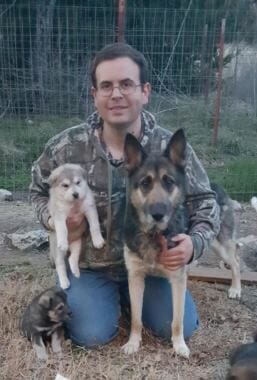
David Hunt of Paris, Texas with his dogs Tundra, left, and Rainy, named after Rainy Pass. Hunt follows the Iditarod with great attention every year, and now helps Danny Seavey manage the Fantasy Mushing website (Photo courtesy David Hunt)

He’s running his sled dogs. Yes, sled dogs. In Texas.

Improvised traces connect their harnesses to the handlebars of the bicycle and they’re running like the wind down a county road.

“I’ve always been kind of drawn to the outdoors,” Hunt said. “I’ve done a little bit of hunting and fishing. I’ve always liked the idea of a race across the Alaskan wilderness. Alaska is kind of like the last remaining open spaces in the United States for the most part. I like the idea of an untamed wilderness and everything it holds.”

Hunt’s long-standing fascination with Alaska began in his fourth-grade classroom when he learned about the Iditarod.

He’s been a dedicated follower of the race ever since.

Hunt’s never been to Alaska, but he’s found a few ways to bring Alaska to him.

“I just got the idea one day that I wanted to run dogs,” Hunt said. “I wanted to see what it was all about. I made the decision to get a couple of dogs. Started working with ’em and trained them. I found out it was a lot more difficult than I thought.”

He named his first two dogs Rainy and Ruby after Iditarod checkpoints. Blaze is his newest addition.

He usually runs them on his bike.

Sometimes he uses a land rig — a sled that runs on dry land — that he’s built from scratch, with everything from scrap metal to chain link fence.

Running dogs in Texas comes with a few challenges.

You have to wait for the temperature to drop, so you can only run a few months out of the year.

And there aren’t a lot of trails to choose from, so sometimes your only option is a county road.

“People stop and ask me if I need help. Why are you out here with these dogs on a bike?” Hunt said. “I do get some looks, but it’s all good. That just goes with it.”

A few months a year? Only short runs? That’s not much for someone with David’s passion for mushing.

Luckily he has another way to get involved with a sport he’s long appreciated from afar.

“OK, Dad, can we get you to do a plug for Fantasy Iditarod?”

“Fantasy what?” laughs an incredulous three-time Iditarod champion Mitch Seavey in a promotional video for FantasyMushing.com.

His son, Danny Seavey, who is also an Iditarod veteran, thinks that many people interested in the Iditarod might be a little daunted by the information and stats involved with the sport.

“I think very few people really understand competitively what’s going on out there,” Seavey said. “It’s sort of like the Tour de France. We know there are time trials and stages. But no one really knows what’s going on over there. Either Lance Armstrong is winning or he’s not. The Iditarod is kind of the same way. I’ve long felt that if we could make it more accessible to people so they understood what was going on, that it would be more enjoyable to watch.”

In the early 2000s, Seavey and his cousin began to work on a program, one he hoped would make the Iditarod more accessible to students and fans.

Originally called Fantasy Iditarod, the program started out as a Google doc and a spreadsheet that Seavey shared with fans through Facebook. When you sign up, you’re allotted 27,000 imaginary dollars. You make up a team of seven mushers. You can join a “pack” of friends you’ll compete against.

“I understand that in principal the reason we have fantasy football is because they want you to care about games that don’t involve your home team. Right, if you’re a fan in Seattle you don’t really care when Miami plays Philadelphia, unless those players are on your team,” Seavey says. “Now you have a reason to watch an out-of-market game if you will.”

The Fantasy Mushing setup encourages followers to pick mushers they’re less familiar with.

Danny’s brother, Conway, updated the algorithm in 2014 but the fans really pushed them to make it grow.

One of those fans was Hunt.

“We found that some of our fans would really get into it,” Seavey said. “They were starting to post really advanced mathematics. Through that I met David. He was putting some advanced analytics in there. He’s one of those computer genius guys who can make a computer do anything.”

They formed a long-distance friendship over their love for mushing.

In 2015, Seavey had to run an Iditarod tour, so he asked David to take over the fantasy page.

“He not only took over, but he built a website and made it way better,” Seavey said. “I’ve been really happy with it and I hope he wants to keep doing it.”

For now, David is going to keep planning his own run, a trail spanning close over 100 miles in Northeast, Texas, then hopefully a trip to Alaska in the near future.

He owns a real dog sled, and brings it into his wife’s kindergarten class to teach students about the Iditarod and dog mushing.

And he has a new litter of puppies, only a few weeks old.

“I did pick out some awesome Alaskan names,” Hunt said. “But our 4-year-old son, he decided to pick out his puppy and he has named it ‘Favorite.’ Because it is his ‘favorite.’ So I think that name is gonna stick. I’m gonna have to find some other names for the others.”

Favorite is a perfect name. He’s already one of the fastest sled dogs in Texas.

Joar Ulsom wins the 46th Iditarod

Joar Ulsom at the Rainy Pass checkpoint early in the 2018 Iditarod. (Photo by Zachariah Hughes/Alaska Public Media photo)

For the first time in seven years, someone with a last name other than Seavey has won the Iditarod.

Joar Ulsom, a 31-year-old musher who ran his first Iditarod only five years ago, pulled under Nome’s Burled Arch early Wednesday morning at 3:00 a.m. with eight dogs to claim first place in Iditarod 46. Ulsom’s win makes him the first foreign-born musher to  win the 1,000-mile sled dog race since Norway’s Robert Sørlie in 2005. The older musher’s legacy has been a huge influence.

“It’s been a dream for me. Since he won it, I’ve been watching him,” Ulsom said after arriving on Front Street. “It’s just, it feels good.”

Ulsom’s 2018 first-place title comes after an upset on Monday when Nicolas Petit, then in the lead, took a wrong turn down a stretch of trail on the Bering Sea coast between Shaktoolik and Koyuk. The mistake ultimately cost Petit about an hour and a half  to get back on the right course and allowed Ulsom to take first position, which he maintained for the remainder of the 200-plus miles to Nome. He didn’t know how close Petit was to him at points.

“When I left Koyuk, he was sleeping, or pretending to be sleeping, so I had no idea he was coming out right behind me,” Ulsom explained.

Brutal winds and fresh snow slowed dog teams on the Yukon River, part of what Ulsom described as an overall challenging route this year.

“It was a slow trail, a soft trail. We had wind and it was just–every leg was more challenging than the other legs,” Ulsom said.

For the first time in five years, the trail took the southern route through the ghost town of Iditarod and three smaller Yukon communities. Ulsom’s rookie year was the most recent running of that trail.

Beginning with his 2013 rookie run Ulsom’s rise to Iditarod champion has been swift. He took seventh place, and Rookie of the Year, in his first Iditarod; that year, he also set the record, which he still holds, for all-time-fastest rookie to finish the Last Great Race. Ulsom has placed in the top ten in all of his six Iditarod finishes.

Ulsom wins $50,000 and a new truck for his victory, along with prize-money from earlier awards along the trail.

Girdwood musher Nicolas Petit arrived in Nome a little more than two hours later, pulling under the Burled Arch at 5:15 a.m. with 10 dogs. Defending champion Mitch Seavey was racing in third position early Wednesday morning.

At a run time of nine days and 12 hours, this was one of the longer Iditarods in recent years. The last time a leader took more than nine days to reach Nome was 2013 along the same southern route. Since 2012, Mitch Seavey and his son Dallas have traded off victories.

Iditarod checkpoint enforces ordinance to control loose dog population as mushers arrive

Nic Petit mushes out of Unalakleet on Sunday. (Photo by Zachariah Hughes/Alaska Public Media)

Coinciding with the Iditarod sled dog race, Unalakleet issued an emergency ordinance to address loose dogs running free around the community.

Many residents complained about a problem,  and not everyone is happy with the solution:

Interim City Manager Davida Hanson explained why the City Council voted in January, before the 2018 Iditarod began, to allow local law enforcement to catch loose dogs with or without collars.

“One of the reasons that the city decided to do an emergency ordinance was because there were so many loose dogs in town and also because Iditarod was going to be coming through,” Hanson said. “With the problem we were having, we didn’t want that to affect Iditarod, and we didn’t want to have loose dogs running around during Iditarod, with all the dog mushers coming through.”

Another concern, according to Hanson, was that the growing population of foxes in the area could carry a risk of rabies and potentially infect one of these loose dogs, which would be even more of a concern to deal with.

If dogs with collars are found, then they are held in a public dog pen for 24 hours, where their owners can pick up the dogs for a fine of $50.

Hanson said the city then contacts the pet owner and allows them time to get their pets, but if the 24 hours is up or the dog is found without a collar, then something more drastic happens.

“If the dogs don’t have a collar on them, then we are assuming that the dog doesn’t belong to anybody, and can be, according to the ordinance, all uncollared dogs will be caught and dispatched immediately in a humane manner,” Hanson said.

According to Hanson, it’s up to the Unalakleet police department to determine what qualifies as a humane way to dispatch un-collared dogs.

Local resident Charaleigh (Chara) Blatchford said their methods have not been exactly humane.

“I have had pets before that I’ve never collared, we don’t believe in tying our pets up,” Blatchford said. “Mom had let the dog out to use the bathroom, tried to call him back in, within a 20-minute period, and the dog never came back, so we figured he was just running around, he’d be fine, it has happened before.”

The next day after her dog didn’t return, Blatchford found her pet had been dispatched or shot and disposed of, then left at the community dump.

Blatchford knows of at least two local family’s dogs, including her own pet, who have been shot and killed in Unalakleet.

She would like to prevent that from happening to more pet owners in the community.

“I think that they could have kept putting the dogs inside the kennels, with or without a collar. I don’t understand the difference between the two,” Blatchford said. “It’s a small enough community where you know who everyone’s pets are, and just simply asking somebody if you don’t know, somebody in the neighborhood is going to know.”

To people like Blatchford, who have found their pets deceased in the local dump, Hanson said the city of Unalakleet apologizes, but the local government felt it needed to do something to control the number of untethered dogs.

“It seems to be working, and we hope that the community will continue to keep their dogs tied up,” Hanson said. “If you are out walking your dog, walk it with a leash. And if this is your pet and you don’t want something to happen to it, then everybody should take care of their pets.”

The Unalakleet City Council will meet in tonight, and Hanson said the loose dog issue is on the agenda.

This emergency ordinance is set to expire nine days from now, on March 22, after all the Iditarod mushers have come and gone.

Old guard content to watch new generation of mushers take reins of sport

Currently, the top of the Iditarod leader-board is filled out with younger mushers, most of them in their 20s and 30s — the race’s up-and-comers.

Mitch Seavey is the only former champion among the top-20 teams.

Most of the sport’s titans are way further back, if they’re still running at all.

Many esteemed members of mushing’s old guard are content to watch a new generation inherit the mantel.

Usually along the trail, Jeff King has a giant tub of animal crackers. But right now in Unalakleet, surrounded by bags of snacks, he’s liberally enjoying a bag of candy.

“I’m eating a couple of peanut butter cups by Reese’s, before I go up to the community center,” King said.

Jeff King bringing water to his team in Galena during the Iditarod. (Photo by Zachariah Hughes/Alaska Public Media)
Jeff King bringing water to his team in Galena during the 2017 Iditarod. (Photo by Zachariah Hughes/Alaska Public Media)

King has won the Iditarod four times, among innumerable other distinctions in a sport he’s helped define for decades. But his drive to win is diminished.

“My motto has been, ‘I’m gonna get there as fast as I can without rushing,'” King said. “I just need sleep now I didn’t used to need, or at least I’m not willing to go without to keep up with these yayhoo’s. I’m not physically up to it.”

As he watches younger mushers stress over minutes lost in their scramble to win, King doesn’t feel envy.

Instead, it’s causing him to re-examine a notorious reputation for competitiveness that came at the expense of much else.

“There’s even part of me on the Yukon watching these guys go, why are you and why did I used to feel so compelled to get my dogs to Nome faster than your dogs,” King said. Who really gives a rip?”

Instead, he’s approaching the race more philosophically, and compares racing his dog-team a thousand miles to his mother growing heirloom tomatoes.

“You don’t rush it. You plant it, you nurture it, you care for it, and then you monitor the fruit,” he said. “In this case the fruit is the energy and athleticism of the dogs. But you don’t pick the fruit until its ready.”

What King means, is that he isn’t going to push his dogs or himself for the sake of race position.

King sang a similar tune last year when, early in the race, he was solidly in the middle of the pack, yet sprinted down the coast and seized 11th place.

Though he’s kept a comfortable pace this year, he’s looking forward to speeding down the next few hundred miles.

He insists it has nothing to do with winning. It’s just fun to do when you’ve got a gang-line full of ripe tomatoes.

A single spot ahead of King is one of his main competitive rivals: Martin Buser, a four-time champion.

He’s just finished a baggie of muktuk given to him as a gift, and is on the way inside for a nap.

Martin Buser poses with a fan in Unalakleet during the Iditarod. (Photo by Zachariah Hughes/Alaska Public Media)
Martin Buser poses with a fan in Unalakleet during the 2017 Iditarod. (Photo by Zachariah Hughes/Alaska Public Media)

“Hahahaha. It wasn’t any faster than the Yukon,” Buser said, chuckling while describing his slog over the portage into Unalakleet. “Everything feels like going in slow motion this year.”

Buser is upbeat, but there are notes of melancholy. He’s had a little bit of fun this year, but after years of jockeying for first place he says its frustrating to have a good team, solid strategy, and familiar routines, yet still be just barely in the top 30.

“It’s just part of the game,” he said.” One of the trials and tribulations we have to overcome.”

Buser and King haven’t said anything about not running future Iditarods.

But that isn’t the case for DeeDee Jonrowe, one of mushing’s most vibrant celebrities.

She announced a while back that she’d be retiring from competition, then scratched early in this year’s race.

“My personal health had gotten to the point where dog care could possibly be compromised,” she said. “That’s not who I am, that’s not who I want to be. And quite frankly I think I could have been a burden.”

Jonrowe flew to Unalakleet to stay with friends, greet peers at the checkpoint, and start enjoying the race from a new vantage point.

“I thought it could possibly be kind of sad, wishing I was on a team,” she said. “It is not. It feels good on this end.”

Jonrowe said she’d like to spend the next few Iditarods as a volunteer at the checkpoint in Unalakleet.

As Iditarod has changed, so has its relationship with its Native roots, mushers say

Pete Kaiser at the ceremonial start of the 2018 Iditarod in Anchorage. (Photo by Zachariah Hughes/Alaska Public Media)

Fewer than 10 mushers out of the 67 competing in this year’s Iditarod are Alaska Native.

John Baker of Kotzebue, the only Inupiaq musher to win the Iditarod, is not racing this year.

Before the ceremonial start Saturday of the 2018 Iditarod, veteran musher Ketil Reitan of Kaktovik remarked on how fewer Inupiaq people are dog mushing nowadays.

“One of my main motivations is to pass along the traditions to my sons,” Reitan said. “It’s not that many young Inupiaq people that are dog mushing anymore; it’s hard to get into it, so to keep our team going and keep the traditions alive, that’s very meaningful. I think lots of people appreciate that we are trying to do that.”

In February, Reitan’s son, Vebjorn Aishanna Reitan, completed the Yukon Quest, a 1,000-mile sled dog race, but he’s not racing in this year’s Iditarod.

Yupik musher and longtime resident of Bethel, Pete Kaiser, figures it’s harder for some who live in smaller rural communities to afford the Iditarod.

“It’s a really expensive sport, so you kind of have to have all your ducks in a row” Kaiser said. “It’s really not a hobby or anything else, it’s a lifestyle, and it requires my time 365 days a year. When you have other things going on like family and kids, you kind of need a job to support this job. It gets very complicated.”

Mike Williams Jr. of Akiak agreed with Kaiser, saying that the cost is prohibitive for some Alaska Native mushers.

Williams sees more and more Native people mushing in his hometown.

“Back home, there’s more mushers starting teams and racing,” Williams said. “That’s a really good feeling and good to see, and as far as Iditarod goes, doesn’t look like there’s a whole lot of Native mushers.”

Traditionally, sled dog mushing was an activity many Native Alaskans enjoyed before it became a competitive sport, which Williams, a Yupik musher, knows better than most.

Since he was a boy, Williams has been training sled dogs with his father, Mike Williams Sr., who has completed 15 Iditarods, his last one in 2013.

As Mike Williams Jr. departed the Iditarod checkpoint of Takotna at 11:45 a.m. Thursday morning with 13 dogs, he said he was happy with his position in the middle of the pack.

The younger Williams has run six Iditarods and finished in the top 10 once thus far.

Kaiser, on the other hand, has four top 10 finishes in his eight Iditarods.

When asked whehter he would be the next Alaska Native to win the Iditarod since John Baker, the four-time Kuskokwim 300 champ wasn’t very cocky.

“I don’t know, it’s hard to know; we are definitely giving it our best shot, but we’re only 300 miles into this, so it’s hard to know right now… we’ll do the best we can,” Kaiser said.

Some mushers deck out in ‘full body armor’ to tackle Dalzell Gorge

Jim Lanier handling his dogs at the Finger Lake checkpoint in his protective mountain biking gear. (Photo by Zachariah Hughes/Alaska Public Media)

As the Iditarod route winds up the wooded hillsides of the Happy River Steps, toward the jagged mountains ringing frozen Pontilla Lake, they head through a narrow canyon toward the zig-zagging Dalzell Gorge.

Even years later, the infamous 2014 conditions along the stretch have left a lasting impression on mushers – one that they bring specialty gear for.

Jim Lanier did not become a 77-year-old musher by fooling around.

“Well, the thing is, it’s a contact sport,” Lanier said.

Standing in the sunshine with his team of ghostly white huskies at the Finger Lake checkpoint, Lanier is wearing what looks like a black, high-tech exoskeleton.

“It’s sort of full body armor,” Lanier said. “Neck to crotch, I’m covered. And elbows and knees. I got it there, too.”

The gear is technically for mountain-bike racing, an upgrade from the hockey pads Lanier has worn in past years.

The protective equipment is specifically for the hundred miles of trail through the Alaska Range, on past Rohn and into Nikolai.

Lanier has broken enough bones in the course of his mushing career to dress with precaution in mind.

“It’s like the old bold pilot thing,” Lanier said. “There’s old pilots, and there’s bold pilots. But there’s no old, bold pilots. Same for mushers.”

Lanier’s hardly alone in treating this section of trail with extra reverence.

One checkpoint ahead at Rainy Pass, Scott Jansen reaches into a drop-bag shipped up just for this particular part of the race, and pulls out a chest-protector meant for high-speed snowmachining.

“It’s all hard-sided, keep me from breaking some ribs. And then, I got my boy’s snowmachining helmet,” Jansen said. “Better safe than sorry. I don’t want to hit my head and get knocked out of the race.”

In the 2014 race, when the downhill gorge was so icy there was no way to control dog teams as they charged over rocks and tree stumps, Jansen made it down relatively unscathed.

His luck ran out going through the Buffalo Tunnels on the way to Rohn.

“I crashed and got a concussion,” Jansen said. “About four hours later I broke through some ice, ran back to my sled, slipped on the ice, broke my foot.”

Jansen scratched that year. And the experience seriously affected him.

He had bad anxiety in the two weeks before this year’s race, stuck in thoughts about the most brutal parts of the trail.

That’s similar for Kelly Maixner, who in 2014 lead the pack down the gorge and was the first to make it to Rohn.

“It is a little bit of PTSD from that,” Maixner said. “I think anytime you’re fearing for your life or anything – which at that point in time I was, because that was pretty nerve-wracking that year.”

Maixner did not pack extra protective gear this time around, largely because the snow conditions are vastly better.

Mushers were assured they wouldn’t face that degree of hazard again.

An outcry after the 2014 race prompted the Iditarod to take extra precautions determining if areas of the trail were suitably safe.

From overhead, the thin ribbon of trail snaking through the gorge had plenty of snow, but also plenty of open water, which could make for a soggy run out of the mountain.

Site notifications
Update notification options
Subscribe to notifications