Iditarod

From queen of the yard to life of the party: Meet 5 of this year’s Iditarod dogs

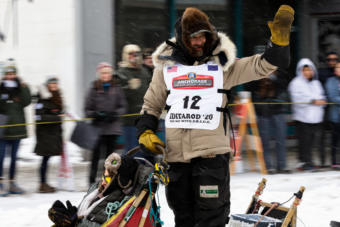
Defending Iditarod champion Pete Kaiser mushing into Nikolai on Tuesday, March 10, 2020. (Photo by Zachariah Hughes/Alaska Public Media)

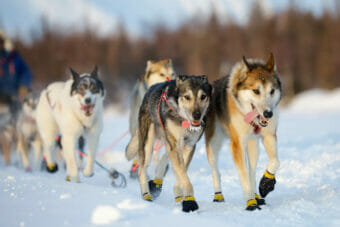
Hundreds of sled dogs are running across Alaska this week as the Iditarod Trail Sled Dog Race plays out over 1,000 miles from Willow to Nome.
While the teams race to the finish line, we’re featuring a sled dog a day on our “Iditapod” podcast.

Meet Forrest, Sarah Jane, Sparky, Jeep and Juke — five exceptional sled dogs with a lot of personality.

Forrest: A very hard worker

Forrest is a 5-year-old team dog on Monica Zappa’s team. (Photo by Casey Grove/Alaska Public Media)

Forrest is a 5-year-old team dog with Monica Zappa. A team dog basically means Forrest doesn’t run in the front or in the back. He’s in the middle. Zappa, of Kasilof, said Forrest always wants to run — it doesn’t matter the place or the time.

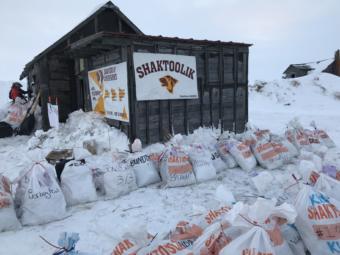
“He’s a solid, hard-pulling dog. His first year was the year I had to scratch, and he was the only one, when we were sitting out on the ice outside of Shaktoolik, that just would not lay down for like five hours,” Zappa said about the 2017 Iditarod. “He always wants to go.”

Listen here for more about Forrest.

Sarah Jane: The queen of the dog yard

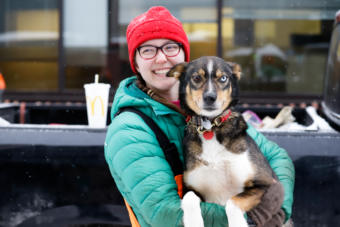
Sarah Jane is a 5-year-old dog on Iditarod musher Meredith Mape’s team. (Photo by Joey Mendolia/Alaska Public Media)

Sarah Jane is a 5-year-old lead dog on Meredith Mapes’ team, and she’s the queen. Mapes, of Palmer, said Sarah Jane always rides in the cab of her pickup truck and sleeps in her bed. In the morning, she runs out to the dog yard to check on her teammates. She can be a bit bossy.

“She’s very commanding,” Mapes said. “She knows that she’s the queen of the dog yard. So if somebody is doing something that she doesn’t like, she yells at them for stepping out of line and things like that.”

Listen here for more about Sarah Jane.

Sparky: The sensitive soul

Sparky is a 6-year-old lead dog on Aliy Zirkle’s team. (Photo by Casey Grove/Alaska Public Media)

His real name is Sparky, but he actually goes by Sparky Dooh Dah, and he’s a 6-year-old lead dog on Aliy Zirkle’s team. His parents are Nacho and Olivia. Zirkle, of Two Rivers, said Sparky Dooh Dah needs a lot of attention.

“He definitely needs TLC,” Zirkle said. “Just like people, there’s the hardcore kind of guy football player who’s just like, ‘Ugh. Just leave me alone, I’ll do it.’ And we’ve got a couple of them. But I would have to say Sparky is not that. Sparky needs like, ‘Hey, Sparky. How are you doing? Good boy. Do you need a little massage? Is it OK?’ And then he works perfectly.”

Listen here for more about Sparky Dooh Dah.

Jeep: A high-energy leader with sentimental roots

Jeep is a 6-year-old lead dog on Brent Sass’ team. (Photo by Casey Grove/Alaska Public Media)

Jeep is a 6-year-old sled dog. At exactly 59 pounds, he’s the heaviest dog on Brent Sass’ team. Sass said he has a special connection to Jeep. Jeep belonged to Joee Redington Jr., a sprint musher and a mentor who died in 2017.

“He loved this dog Jeep. And he always told me that, ‘This dog can run a distance race. I’m confident that he has the head to do it,’” said Sass, of Eureka. “But, he’s like, ‘Oh, you’re never going to get the chance because he’s my favorite dog.’ But after Joee passed away, I had the opportunity to buy Jeep.”

Jeep has been a staple in Sass’ team ever since. He led the team to victory in the 2019 Yukon Quest. Sass said it’s a testament to Redington and the sense he had about dogs. He described Jeep as a high-energy, fun-loving and positive sled dog.

Listen here for more about Jeep.

Juke: The life of the party

Juke is a 2-year-old dog on Iditarod musher Karin Hendrickson’s team. (Photo by Tegan Hanlon/Alaska Public Media)

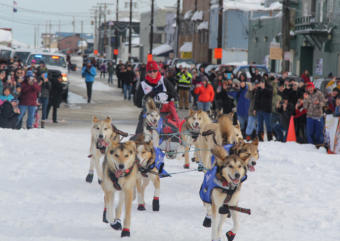
Juke is Karin Hendrickson’s loudest, biggest and most excitable dog. He’s the life of the party and he never seems to get tired, Hendrickson said, as Juke jumped on her truck at the Iditarod ceremonial start.

Hendrickson, of Wasilla, would like Juke to step up and lead the team more. But, she said, she also has to keep telling him who’s boss.

“He’s a two-year-old male so he thinks he’s the toughest dog around, and I have to keep reminding him that I’m the toughest dog around,” she said.

Listen here for more about Juke.

Alaska Public Media’s Casey Grove contributed reporting to this story.


Here are 16 photos of frosty Iditarod mushers and fuzzy muzzles

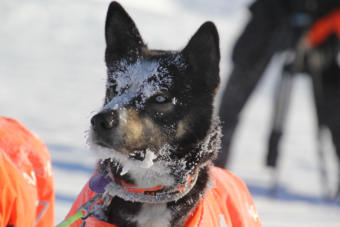
With temperatures plunging deep into the negatives on Tuesday, mushers and dogs sported a coating of frost when they pulled into Nikolai, a small village about a quarter of the way into the Iditarod Trail Sled Dog Race.

Here are some of our favorite photos from the cold day in Nikolai.


What foods do Iditarod mushers pack? Trail mix, chile relleno — and pork for the dogs.

Iditarod volunteers sort mushers’ bags of food and gear at Air Land Transport in Anchorage on Wednesday. The 1,000-mile sled dog race starts in early March. (Photo by Tegan Hanlon/Alaska Public Media)

The Iditarod Trail Sled Dog Race starts next month.

But before mushers and their sled dogs take off on the race to Nome, there’s a lot of preparation to do — and that includes getting teams’ supplies to the remote communities along the trail.

On Wednesday, mushers dropped off their food and gear in Anchorage, so it could be sorted and flown to race checkpoints.

Chugiak musher Jim Lanier brought 64 bags of food and gear to send out to the Iditarod trail. Together, the bags weighed nearly 2,500 pounds.

Packing all of that gear, he said, is a challenge.

“This is the 21st time I’ve done it for Iditarod, and it’s always a huge job,” said 79-year-old Lanier, the oldest musher in this year’s race.

Lanier joined a stream of mushers who hauled truckloads of bags to a cavernous building in South Anchorage. Volunteers then weighed and sorted the bags, readying them for flights to the remote communities and ghost towns that serve as race checkpoints along the trail. It’s part of the massive web of logistics to prepare for the annual 1,000-mile sled dog race.

Iditarod volunteers sort mushers’ bags of food and gear at Air Land Transport in Anchorage on Wednesday. The 1,000-mile sled dog race starts in early March. (Photo by Tegan Hanlon/Alaska Public Media)

Iditarod race marshal Mark Nordman said each team usually sends about 1,500 to 2,700 pounds of supplies to the trail ahead of the race. The bags contain a little bit of everything, he said.

“From personal clothing to extra runner plastic to, of course, the most important thing: the dog food,” he said.

Nordman described getting those bags ready as a “huge chore.”

“So many people say that the hardest part about Iditarod is getting your drop bags together, because everything is portioned out how you want it for your team, and different size booties and plastic — everything else that they need on their trip to Nome,” he said.

To pack, mushers need to map out where they might need more food for longer breaks.

Iditarod musher Linwood Fiedler at Air Land Transport in Anchorage on Wednesday. (Photo by Tegan Hanlon/Alaska Public Media)

Willow musher Linwood Fiedler said he also considers the weather.

“I’ve done this race a bunch, and I’ve gotten stuck at checkpoints where there is no going forward. There is no trail,” he said. “And so being able to calculate, to be able to sit in Unalakleet for a day if there’s a coastal storm, that sort of thing is part of the equation as well.”

Fiedler brought about 1,800 pounds of supplies to Anchorage on Wednesday. He packed a couple thousand dog booties, plus batteries, plastic sled runners and food, he said.

The food for his dogs includes frozen beef and pork. For himself, it’s vacuum-sealed meals made by his wife, Cathy.

“I kind of like spicy things, like chile relleno and some lasagna with a little zip in it, that sort of thing,” he said. “She makes killer chili.”

Iditarod musher Jim Lanier writes a check for $1,394.90 to send his bags of food and gear to communities along the race trail on Wednesday in Anchorage. At 79 years old, Lanier is the oldest musher on the trail year. (Photo by Tegan Hanlon/Alaska Public Media)

For Lanier, it’s all about trail mix.

“I open a little package and pour it into my mitt, and then I can extract one little kernel of trail mix — a nut or an M&M or whatever — at a time and chew on it,” he said. “The process of chewing really helps to stay awake.”

Lanier wrote a check for nearly $1,400 to send his food and gear to the trail. He’ll reunite with the bags next month.

The Iditarod begins with a ceremonial start in Anchorage on March 7, followed by the official race start in Willow the next day.

Lanier and Fiedler are among the 57 mushers signed up to compete.


Iditarod 2020 roster stocked with past champions — with one notable exception

Iditarod 2019 champion Pete Kaiser and his dogs Marrow and Lucy at the end of the 1,000-mile race in Nome.
Iditarod 2019 champion Pete Kaiser and his dogs Marrow and Lucy at the end of the 1,000-mile race in Nome, March 13, 2019. (Photo by Zachariah Hughes/Alaska Public Media)

Fifty-eight mushers have signed up for the 2020 Iditarod. It promises to be a competitive field, with six former champions registered to run the thousand-mile race, along with numerous other top teams.

Among the winners returning to the trail in March are recent winners Pete Kaiser of Bethel, Norwegian Joar Ulsom, and Seward’s Mitch Seavey. Past four-time winners Lance Mackey, Jeff King, and Martin Buser are also signed up.

So far, there are 12 rookies slated to run as well.

One noticeable name missing from the roster is Dallas Seavey. The four-time champion has not competed in the Iditarod since a scandal in 2017 when four dogs on his team tested positive for a banned substance, although race officials have since apologized for how the incident was handled. Since then, there have been substantial changes in the Iditarod Trail Committee’s board and governing rules.

Dec. 2 was the last day for mushers to sign up without paying a hefty late fee. Potential competitors have until mid-February to decide if they want to sign up.

This year’s trail follows the northern route for the first time since 2016, leaving Willow on March 8 and heading through Ruby, Galena and Nulato along the way to the Norton Sound coast.

Bethel’s Pete Kaiser wins 2019 Iditarod

Iditarod 2019 champion Pete Kaiser and his dogs Marrow and Lucy at the end of the 1,000-mile race in Nome.
Iditarod 2019 champion Pete Kaiser and his dogs Marrow and Lucy at the end of the 1,000-mile race in Nome, March 13, 2019. (Photo by Zachariah Hughes/Alaska Public Media)

A new Iditarod champion has been crowned. Bethel musher Pete Kaiser’s team of eight dogs crossed under the Burled Arch in Nome at 3:39 a.m.

A boisterous crowd of friends and family from the Bethel area traveled to Nome to celebrate Kaiser’s victory. The 31-year-old wins $50,000 and a new truck.

It’s a career highlight for Kaiser, who has raced the Iditarod each year since 2010. On three separate occasions he’s placed as high as fifth, but this is his first win. The team’s run took 9 days, 12 hours and 39 minutes.

Kaiser had to hold off Joar Leifseth Ulsom, the defending champion, who surged on the final run in from White Mountain to trim 30 minutes of Kaiser’s 42-minute edge. The 1,000-mile race came down to 12 minutes. Leifseth Ulsom arrived in Nome at 3:51 a.m.

It was a chaotic scene in the chute as the two dog teams parked side-by-side. Kaiser’s dad fed the team a snack of frozen meat and dragged the sled, quickly moving the team over to give Leifseth Ulsom space. After Leifseth Ulsom was checked in, the party continued with champagne bottles, songs and cheers.

“Pete! Pete! Pete! Pete!” the fans cheered.

Kaiser is the first competitor from Western Alaska to win the race since Kotzebue musher John Baker’s 2011 victory. He’s the only winner hailing from the Yukon-Kuskokwim Delta, with the one exception of Dick Wilmarth, who came in first during the inaugural Iditarod in 1973 when he lived in Red Devil. Kaiser is the first Iditarod champion with Yupik roots. He hopes his win will help spark an interest in the Delta and beyond.

“Not just Yupik people but all of the rural Native people from Western Alaska, or anywhere in the state, for that matter. It really doesn’t matter,” Kaiser said. “Anybody who can get a kick out of this, that’s awesome.”

Bethel's Pete Kaiser is victorious in the 2019 Iditarod Trail Sled Dog Race, securing his first win Wednesday, March 13.
Bethel’s Pete Kaiser is victorious in the 2019 Iditarod Trail Sled Dog Race, securing his first win Wednesday, March 13. (Photo by Zachariah Hughes/Alaska Public Media)

Kaiser was raised around sled dogs in Bethel. His father raced dogs in local races before he was born. As a child, he got interested in dogs and began training with his family. By the time he was a senior in high school, he was winning local races like the Akiak Dash.

Kaiser’s racing style has tended to be conservative during the early parts of the race, in which he banks extra rest and ensures that his team will have speed when the opportunities arise. It was a variation of that style that positioned Kaiser for the victory in 2019.

“I generally have kind of an idea of what I’m gonna do, but it’s not set in stone,” Kaiser said. “A run can take five hours on a good trail and eight hours on a bad trail, just like this race played out. I mean, all these runs turned out to be two or three hours longer than they could have been on a long trail, so you gotta be able to adjust your race accordingly, I feel. If you just have something put pen to paper what you’re gonna do, no matter what, I don’t think it’s gonna work out so well.”

Kaiser raced a bit behind the leaders for the early and midsection of the race, preparing for the right time to show off his team’s speed. It was on the approach to the coast and the final few hundred miles of trail that he made his mark. Kaiser waited until Kaltag to take his mandatory eight-hour rest on the Yukon River. It was on that last push up the Yukon that his team hit a critical stride.

“We just got some trail that the team really likes, and we didn’t see much of that this race,” Kaiser said. “My team really likes hard, fast trails where they can go fast, and that was probably the best type of trail for that kind of race. So when they got on that (trail), they really wanted to roar. And actually (I) held ‘em back for most of that run.”

With fresh rest in his dogs, he was still three hours behind the race leader Nicolas Petit, but running fast at the right time.

Joar Leifseth Ulsom carried one dog into the checkpoint of Iditarod on March 7, 2019.
Joar Leifseth Ulsom carried one dog into the checkpoint of Iditarod on March 7, 2019. Leifseth Ulsom finished the race in second, just 12 minutes behind Iditarod champion Pete Kaiser. (Photo by Ben Matheson/KNOM/Alaska Public Media)

He matched Petit for the fastest run time to Shaktoolik, and after that checkpoint is when the race broke open. Petit’s dogs stalled on the ice between Shaktoolik and Koyuk, costing Petit his race, but clearing the way for Kaiser and Leifseth Ulsom to battle for the win. Kaiser said as he passed Petit going up the coast he knew things weren’t going well for his competitor.

“I had an idea when I got there that something was going on,” Kaiser said. “I said, ‘Hi,’ and he said, “Hi,’ and that was it.”

On the windy push up to Koyuk, Kaiser again led the field. He gained an hour on Leifseth Ulsom into Koyuk. From there, Kaiser needed to maintain an edge on the athletic Leifseth Ulsom, which over the next few runs resulted in the first title for the Bethel musher.

As Kaiser rested after his win, Jessie Royer mushed in and out of Safety, the last checkpoint before Nome, running in third place. In fourth, Aliy Zirkle was between White Mountain at the time.

And if Royer, Zirkle and Fairbanks musher Paige Drobny — sitting in seventh in White Mountain — maintain their positions, it’ll be the first time ever that three women have finished in the top 10. It’ll also be an enormous leap up the standings for Drobny, who, in four previous Iditarod finishes has never placed higher than 25th.

Iditarod mushers react to rules reducing maximum dog team size

A dog team heading toward the Yentna Station checkpoint.
A dog team heading toward the Yentna Station checkpoint. (Photo by Zachariah Hughes/Alaska Public Media)

Iditarod mushers racing their dogs to Nome this year are doing it with a smaller team on the gangline. The race reduced the maximum team size from 16 to 14. This means quite a bit for race strategies, speeds and the trade-offs that mushers face as they travel across Alaska.

Just a day before the race began, defending Iditarod champion Joar Leifseth Ulsom, was facing a tough decision on which dogs to bring to the starting chute.

He hadn’t chosen his 14 dogs.

This year, competitive mushers like Leifseth Ulsom had to be extra choosy in building their lineup.

“I really thought 16 dogs was kind of something that made this race unique and special. Just one of the things, you know?” Leifseth Ulsom said. “Personally I would like to run 16 dogs, but we’ll see how it goes this year. Maybe I’ll like it, we’ll see.”

Over the course of a race, there are eight fewer booties to change, less food to pack and eight fewer paws that need ointment. And that’s one of the main reasons why the Iditarod Board of Directors changed the rule: because of the potential for enhanced dog care. But more dogs mean more pulling and climbing power for mushers looking to move quickly across the country.

Nenana musher Aaron Burmeister said he has mixed emotions. He likes racing 16 dogs and even the 20-dog teams that were allowed when he first started racing.

“Do we need that dog power? No. In today’s Iditarod, with the nutrition, the training, with the evolving of the sled dogs and the incredible athletes they are, you really don’t need more than 12,” Burmeister said.

The Iditarod joins other top races in restricting mushers to smaller teams. The 1,000-mile Yukon Quest only allows 14 dogs, and a few years ago Kuskokwim 300 dropped from 14 to 12 dogs.

Four-time Iditarod winner Martin Buser doesn’t like the new rule, saying it puts heavier mushers at a slight disadvantage.

“I want to maintain an open mind. Maybe we’re selecting a little tighter, so maybe the 14 dogs have no question marks in them. If we have a buffer of 16 or even 20 dogs, we would maybe take a dog that could be left behind,” Buser said. “I don’t mind going one year with 14 dogs, even though we know it’s not because of strategy or race statistics. It’s simply done because of money savings for the race committee, and that’s why I don’t agree with the rule.”

Buser is referring to the hundreds of dogs that are dropped each year in remote checkpoints. Veterinarians and volunteers in checkpoints watch over the dogs before the Iditarod Air Force flies them back to Anchorage.

Mushers have never been required to start with 16 dogs, and some teams chose in the past to start with a smaller string. But more dogs means more options. Mushers can bring a young dog that will gain valuable racing experience but doesn’t need to make the full trip to Nome. And in recent years, some mushers have experimented with carrying a few dogs in the sled bag or in a trailer to both modulate speed and bank extra rest. A smaller team complicates the developing strategy.

2017 winner Mitch Seavey would prefer to stick with 16.

“I predict that mushers are going to be more reluctant to return dogs from the trail. I think they’re going to want to keep them in the team as long as possible,” Seavey said. “I personally would rather see it stay at 16. I think it’s a diminished race, and I think it’s a little bit more stress and pressure put on fewer dogs. We’ve shown we can handle 16 year after year, so that’s really not a problem.”

Once the race is down to the last few days, mushers typically drop their slower dogs and sometimes finish with small teams. When they pass beneath the burled arch, they can finish with as few as five.

Site notifications
Update notification options
Subscribe to notifications