Iditarod

Redington, Pettersson and Seavey first into Skwentna checkpoint

Mitch Seavey feeds his dogs shortly after arriving at the Skwentna checkpoint Sunday night in the 2018 Iditarod Trail Sled Dog Race. (Photo by Zachariah Hughes/Alaska Public Media photo)

From Anchorage the mushers restarted Sunday in Willow.

Then, every two minutes, they took off headed east to the first two checkpoints: Yentna and Skwentna.

It was a festive atmosphere overnight as Iditarod mushers pulled into the Skwentna checkpoint, 83 miles into the trail.

A bonfire blazed, while a musician belted out songs from a small heated tent.

A few dozen fans and onlookers were gathered when the first musher’s blue-headlamp emerged out of the darkness and headed toward the race checkers under a welcome banner.

“Bib number?” “17” “And name?” “Ray Redington.” “Welcome Ray, you staying or going?” “Staying.” “Ok, you know the drill.”

After signing in, Ray Redington Jr. and all 16 of his dogs pulled in for a rest at about 9:30 p.m. Sunday.

Just one minute behind him was Mats Pettersson, who led the full pack of mushers for a stretch of the evening before being overtaken not long before arriving.
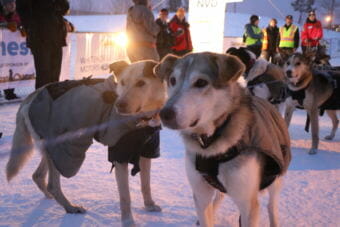
Pettersson said so far, trail conditions are good.

“A little bit soft in the beginning, I think for everybody, but after Yentna it was really fine all the way here,” Pettersson said.

Pettersson, too, came in with a full string of dogs.

The third musher into the checkpoint was Mitch Seavey.

He made the run in about the same amount of time, but did so with just 12 dogs on the line when he pulled in. Even still, Seavey said he was working to keep them at a slower, more controlled pace.

“I got four dogs in the sled, that helps slow things down.”

Seavey and his son, Dallas, have dominated the Iditarod in recent years while refining a strategy that involves rotating dogs in and out of their sleds for rest along the way.

The next few checkpoints after Skwentna pass through the Alaska Range, one of the most technically difficult sections of the trail.

Mushers, fans gather for world’s most famous sled dog race

ANCHORAGE — Mushers, barking dogs and excited fans are converging on Alaska’s largest city for the ceremonial start of the famed Iditarod Trail Sled Dog Race.

The Saturday morning trek through downtown Anchorage gives fans a chance to mingle with mushers and their teams. The competitive portion of the race to Nome begins Sunday in the community of Willow.

This year’s race comes amid a plethora of troubles for organizers, including a dog doping scandal, the loss of a major sponsor and increasing pressure from animal rights activists following the deaths of five dogs connected to last year’s race.

Sixty-seven teams are signed up to vie for a total purse of $500,000. Organizers say the winner’s share of the prize money will be determined later in the race.

How an Arkansas duck tagger became a champion musher

Allen Moore strokes his dogs ears at Braeburn Checkpoint. (Photo by Zoe Rom/KUAC)

It’s 40 below and snowing.

I’m huddled next to a wood-burning stove inside an old schoolhouse in Eagle, Alaska, a small village in the bush with a population of about 200 to 300 – depending on the season.

It’s a strange place to find myself, a reporter from Arkansas chasing sled dogs as they race across Alaska and Canada. Which is why I’m even more surprised to run into a fellow Arkansan — and his 14 Alaska huskies.

Allen Moore, sometimes known as the Southern Gentleman of Mushing is an elite sled dog runner, who’s path from small-town Arkansas to mushing fame surprises even him.

“It does not make sense, a redneck from Arkansas coming here and runnin’ dogs.” Moore said.

Moore grew up in Arkansas’ northeast corner in a small town called Manila. He was always active and loved being outside. Most of all, he loved animals. Moore studied wildlife management at Arkansas State University and eventually went on to work for the U.S. Fish and Wildlife Service, tagging ducks and counting deer.

One thing Moore didn’t like was the Arkansas heat.

“When I left Arkansas, it was 100-plus degrees with the heat index and all that,” Moore said. “I wanted to go where it was cool.”

Moore sold almost everything he owned and loaded the rest into his truck along with his two young daughters, Bridgett and Jennifer, and he drove to the coldest place he knew – Alaska.

Moore was drawn north by childhood memories of cool blue ice and glacial streams from a visit to Anchorage, memories that drew him north to Fairbanks, where he settled with his daughters and started working in wildlife management.

Almost immediately, Moore felt the allure of a sled and a dog team.

“First thing we saw in Fairbanks were these little dog races. Kids with one dog, one little sled, going around this one little oval track,” Moore said. “So what do you think she wanted to do? I got a dog, and I had to help her train this one dog. She did it for the first winter and enjoyed it so much that then her older sister wanted to do it, so I had to get another dog.”

Moore was hooked.

“It is addictive,” Moore said. “I wish everyone could experience it.”

Moore started competing in sprints, working his way up to 100, 300 and finally – 1,000 mile distances.

Allen Moore’s dogs just after crossing the finish line in Whitehorse. (Photo by Zoe Rom/KUAC)

“It’s cool knowing how people traveled 100-plus years ago. That’s the only means of transportation they had,” Moore said. “And when we go to these isolated places, even today, it looks no different.”

Moore met his wife, Ally Zirkle, and they started work building houses and then selling them, using the meager profits to run dogs all winter long.

Zirkle, an experienced musher herself with multiple second place Iditarod finishes, won a smaller race – the Yukon Quest.

Zirkle built a house herself with the winnings.

They started a kennel – SP Kennel – to grow their passion for mushing.

After a few more racing successes, sponsorships started rolling in, allowing Moore to pursue mushing full time.

“Here we are, running dogs for a living. You can’t beat that. It’s a passion, number one,” Moore said. “But when you can turn your passion into a vocation, it seems like that would be everyone’s dream.”

For Moore, mushing combines many of his favorite things – a passion for the outdoors, curiosity about fitness, and a love of animals.

There’s no relationship quite like that between a musher and their team – even Moore, who’s been running dogs for 20-plus years, struggles to describe it.

“Sled dogs, I don’t know how to pinpoint it, but it’s just different,” Moore said. “It’s like you and a sled dog are the same. I mean, you sleep together, you do everything together.”

It’s this relationship, this passion for canine companionship that’s fueled much of Moore’s success.

It’s not just surprising to find an Arkansan on the back of a dog sled.

Moore is really good at it.

Aside from several successful Iditarod runs, he has won the rugged Yukon Quest three times.

He and his wife now have a kennel of almost 40 dogs.

“We just love to be around dogs. That’s what it was all about,” Moore said. “And now it’s become so much more than dogs.”

For Moore’s part – he just glad to be enjoying the cooler weather.

“Up here if it’s 40 below, 50 below, I can always put more clothes on,” Moore said. “Because you can only take so much off.”

Role reversal: Anchorage Iditarod prep means dumping snow on city streets

Willow musher Lisbet Norris prepares for the 2015 Iditarod ceremonial start. (Photo by Zachariah Hughes/KSKA)

Set up for Saturday’s ceremonial Iditarod Trail Sled Dog Race start in Anchorage means dumping thousands of pounds of snow on downtown streets.

Sled dog teams set off in a festival-like atmosphere on the city’s streets and trails for an 11-mile run that does not count toward their official race time.

Downtown street closures started Friday in Anchorage.

Road maintenance crews began bringing in truckloads of snow Friday evening and will work overnight smoothing out the downtown portion of the course.

According to Street Maintenance Manager Paul VanLandingham, they need about 250 dumptruck loads of snow — or 5,000 cubic yards — to spread out over city streets.

Anchorage has gotten plenty of suitable snow in the last couple weeks.

The crews’ main stash is at city airport Merrill Field, where there’s an abundance of gravel-free snow, VanLandingham said.

“I know a lot of people don’t understand the fact we get all this snow, we spend a couple days removing it, and then we bring in more snow on top of the streets,” VanLandingham said. “But for the dogs and for the event and everything, you really need to bring in good fresh snow for the track to set up right and give the dogs a quality track to run on and just make it a better event.”

It’s a bit of a role reversal.

Crews that have been busy around the clock clearing snow off city streets are suddenly dumping it back onto the roadways.

But the street maintenance workers enjoy being a part of the Iditarod, VanLandingham said.

“It’s something that breaks up the monotony for the guys and gals doing the work out there,” VanLandingham said. “It’s a big event for the community, for the state, Iditarod, world-famous sled dog race, so it’s exciting for all of us to be a part of the festivities.”

After leaving downtown, mushers head onto city trails groomed by Parks and Recreation Department workers and volunteers from the mushing community.

Iditarod set to start under a cloud of scandals

Wade Marrs, mushing along the Iditarod 2016 Trail on the outskirts of Nome. (Photo by Laura Collins/KNOM)

The Iditarod Trail Sled Dog Race kicks off this Saturday, as mushers and their teams begin cross a thousand miles of the Alaska wilderness.

But this year the event is mired in scandals: Fallout from a dog doping fiasco, a musher mutiny, and unprecedented pressure from protest groups.

All of which, according to a leaked report, are putting the event’s future in dire jeopardy.

Saturday marks the “ceremonial start” of the race, when the streets of downtown Anchorage fill with at least 1,072 yapping sled dogs.

Looking on from the snowy sidewalks are tourists, townies, and mushing fans outfitted in their finest furs.

The festivities arrive at the tail end of the city’s annual Fur Rondy, a week of festivities hearkening back to the yearly rendezvous among fur trappers, where pelts and antlers are sold openly in the streets.

By the time the Iditarod kicks off, the vibe is somewhere between a parade and a dog pageant, with notes of a folksy rural carnival.

The next day, dozens of competitors set out on the grueling journey over snowy mountains, icy rivers and frozen tundra toward the tiny town of Nome on the Bering Sea coast.

As the race has grown increasingly competitive in recent years, top teams make the trek in between eight and nine days.

But this year’s race is up against extra challenges.

Multiple controversies have crashed down all at once — even driving one of mushing’s stars to post a 17-minute video on YouTube lashing out at race leadership.

Dallas Seavey arrives second to Ruby just after the sun set Wednesday night during hte Iditarod. (Photo by Zachariah Hughes/Alaska Public Media)
Dallas Seavey arrives second to Ruby just after the sun set Wednesday night during the Iditarod. (Photo by Zachariah Hughes/Alaska Public Media)

“The Iditarod can try to run me over, they can try to throw me under the bus,” Dallas Seavey said, speaking directly into the camera in the video, posted October 23 of last year. “They’re going to find out I don’t fit under the bus.”

Seavey is a mushing wunderkind, having won the race four times before age 30.

But since last fall, Seavey has been embroiled in the sport’s first high-profile doping scandal after it came out that some of his dogs tested positive for a banned painkiller at the end of last year’s race.

Seavey vigorously denies that he drugged his team, something other top mushers have backed him up on.

He faults the Iditarod’s board of directors for mishandling the investigation, hurting his reputation in the process.

“This is part of this race that is a cancer right now,” Seavey said in the video, alluding to the Iditarod Trail Committee’s board. “There is a corruption in this race.”

Seavey snubbed this year’s Iditarod, and is competing in a Norwegian race that runs at the same time.

He’s also pushed back on the damning doping narrative by hiring a public relations firm, casting doubt on science behind the drug tests, and aggressively defending his record in the press.

So how did high levels of Tramadol, a widely prescribed opioid, get into four of Seavey’s dogs within hours of his arrival in Nome last year? Theories abound.

“I believe this was given to my dogs maliciously,” Seavey said. “I think that’s the most likely option.”

The idea that a saboteur drugged Seavey’s dogs is accepted by many in Alaska’s mushing community.

Some believe it could have been an unintentional accident. Some think it might have a been a rival competitor.

Others point to animal rights activists, who have done more in recent years to take down the Iditarod’s public image.

Leading that charge is People for the Ethical Treatment of Animals, or PETA.

The group says it did not have any personnel in Alaska last year, and condemns dogs being given banned substances.

The group is escalating its tactics by leaning harder than ever on corporate sponsors to drop their support for the event.

“One of the biggest lies that the Iditarod community has tried to sell the public is that these dogs aren’t like the dogs we share our homes with, and it’s not true,” Colleen O’Brien, a spokesperson for PETA, said.

The group wants for the Iditarod to become a race without dogs, saying too many animals have died as a result of competition, and that mushing is fundamentally abusive.

PETA claims that sponsor flight is taking a toll on the Iditarod’s financial health. And this year, for the first time ever, they are sending protesters to Alaska, with demonstrations planned in Anchorage and at the finish in Nome.

On top of all that, earlier in February a prominent group of race veterans called for the president of the board of directors to resign immediately.

letter was sent by members of the Iditarod Official Finisher’s Club, alleging his mismanagement and conflicts of interest they say are jeopardizing the whole sport.

The demand came on the heels of a confidential report by the Foraker group commissioned by the race’s main sponsors leaked to the media.

It pointed to many of the same problems, saying the board needs major reforms for companies to remain comfortable financing it.

Following a closed door meeting, ITC board members voted unanimously to leave president Andy Baker (who’s brother, John Baker, is a champion Iditarod musher) at the helm for the time being.

“Everybody wants the race to do better,” Baker said to reporters after the meeting. “Our whole focus is we want to have a safe race. We want dogs to be safe, we want mushers to be safe, and we want a successful race that’s good for Alaska.”

Baker said the board is planning to revise its governing rules in the spring, once this year’s race is over, which opens the door for reforming leadership practices criticized by the finisher’s club and Foraker report.

Many are pining for the old days, when the Iditarod was more like a weeks-long wilderness adventure than a race.

“There’s a big part of me that feels that way,” Stan Hooley, Iditarod’s CEO, said. “Unfortunately I’m in the business, and in the role of working to grow this race.”

Some people say that means the Iditarod isn’t as fun — that the race doesn’t resemble the state-wide celebration it used to be.

Others say the global audience and increase in corporate money that it has drawn could be what carries dog mushing on into the future.

If you want more news on all things mushing, you can subscribe to the Iditapod, a podcast about the Iditarod from Alaska Public Media and KNOM Radio.

Seavey attorney: Report shows musher didn’t drug dogs

Defending Iditarod champion Dallas Seavey greets his leaders prior to the ceremonial start of Iditarod 2016. (Photo by Ben Matheson/Alaska Public Media.)

An attorney for four-time Iditarod champion Dallas Seavey released a toxicology report Wednesday that he says proves the musher did not drug his dogs in last year’s race.

Seavey has claimed innocence since the Iditarod announced in October that dogs on his team tested positive for the banned painkiller Tramadol.

According to the new toxicologist’s review, Seavey’s dogs did not receive Tramadol until hours after reaching the finish line in Nome.

Clint Campion, a former district attorney, said that proves Seavey did not give the drug to the dogs and that someone else did.

Campion revealed the new information at a news conference organized by a Bay Area public relations firm.

Seavey has hired both Campion and the firm to represent him.

“He doesn’t want to speculate about why someone would do that or who might’ve done that,” Campion said.

Still, some have speculated that a rival musher or someone opposed to dog mushing tried to sabotage Seavey.

Seavey finished second in the race and was away from the dog yard when he says the doping occurred.

The Iditarod did not penalize him for the positive tests. The race’s board said they made that decision because of an ambiguous rule that has since been rewritten.

But Seavey withdrew from this year’s race in protest after the Iditarod named his dogs as those that’d failed the tests.

On Wednesday, Campion said the Iditarod should admit it made a mistake.

“We’d like them to say that we mistakenly released Dallas’ name, that the evidence shows that it’s completely unclear or it’s impossible to believe that Dallas would’ve this and that we want to remove any suspicion about Dallas’ involvement in drug doping,” Campion said.

Seavey’s evidence comes in the form of the 20-page report, written by Patricia Williams, an expert toxicologist who lives in Louisiana. Williams described herself as a huge fan of the Iditarod.

Williams said she offered to conduct the review for free after hearing what’d happened.

“I was shocked, and I said, ‘Whoa.’ I said, ‘Look, let me get all the lab work and let me see what I can see,’” Williams said.

Williams said she saw a lack of understanding on the part of the Iditarod’s toxicologist in how quickly dogs metabolize Tramadol, as well as evidence the testing instruments were not calibrated correctly.

Williams also said the high levels of Tramadol found in the tests indicate the drug was given well after Seavey arrived in Nome.

“This is definitely a dosing after the trail,” Williams said. “Every musher should be worried about this. Every sponsor should want to tighten security and make sure this never happens again.”

Campion agrees that security needs to be improved and said the Iditarod should adopt anti-doping regulations more in line with the International Federation of Sleddog Sports.

He said that would bar the release of a musher’s name if a confidential investigation finds doping rules have not been broken.

Asked whether Seavey is considering legal action in regards to the release of his name, Campion said the musher is not ruling anything out.

“His goal is to move forward from this, but he hasn’t taken anything off the table,” Campion said. “As to the next steps, we’re not ready to talk about that yet.”

In a written statement, the Iditarod Board of Directors said it’s not ready to talk about the report, saying the board is still reviewing the new information.

But the board’s news release Wednesday repeated earlier statements that the board never blamed Seavey directly for the positive drug tests.

The 2018 Iditarod starts March 3.

Site notifications
Update notification options
Subscribe to notifications