Iditarod

The weird, wonderful world of Nome after Iditarod

An MC at the Make Your Own Bikini contest at Nome’s Polar Bar, announcing the year’s winner and runner up (Photo – Zachariah Hughes, Alaska Public Media)

Nome turns into a bit of a carnival when the Iditarod winner mushes into town. For nearly a week, racers continue arriving before the banquet that officially concludes each year’s Iditarod. For some, that means days of free time. And plenty of fun, strange events to fill it.
In the very back of a long, crowded bar, an MC auctioned off all kinds of random swag branded with booze company logos.

“Alright, we have a Budweiser poker set,” he called out, opening bidding at $15 and eventually working it up to $30. There were also coolers, beach-chairs, and a Fireball cornhole set.

The auction lasts nearly an hour, and the point is to raise money for an annual event inside the Polar Bar each Iditarod week: the Make Your Own Bikini Contest.

To wild cheers, a handful of contestants walk out of a back room, off a small stage, and down an improvised runway past the crowd. The outfits range from haphazardly last-minute to impressively inventive.

“Ace in the Hole,” the MC reads off, introducing a young woman in a dress made out of playing cards.

There’s also a bra fashioned out of two red king crabs. The winning contestant, whose stage name is ‘IditaFox,’ sports a two-piece ensemble from a pelt.

The contest is like a lot of Iditarod week in Nome: a mix of sordid and scandalous with crafty and community-minded. Visitors pour into the Bering Sea-side hub of 3,700 people for a kind of sub-Arctic Spring Break, a Cancun of the North. Restaurants, bars and seemingly every spare bedroom are filled. Schools across the region are on vacation, allowing for athletes and families travel in on discounted flights from surrounding communities for a huge basketball tournament.

Some of the annual night-time events are known for racy debauchery — like the “wet buns” contest. Others are grittier, like the arm-wrestling tournament at Breaker’s Bar, where two years ago Aliy Zirkle broke another competitor’s limb.

This year, a similar thing happened — though not with Zirkle. Tara Cicatello, a handler for Kristin Bacon who competed in the light-weight class, was watching the women’s middle-weight contest. After an elbow slipped, the two competitors re-set.

“As soon as they start to wrestle again, you just here this popping noise,” Cicatello recalled two days later. “The whole room goes silent, it was like a gunshot. And then, we look, and the woman’s arm is just hanging.”

Beyond the bars, beneath the season’s expanding daylight, the region’s unique culture and history is on display throughout the festive week. Snowmachines race along the sea-ice to check crab-pots. Rugged literary types listen to the poems of Robert Service, read aloud in a convention center. Musher Hugh Neff got married at an informal outdoors ceremony officiated by Nome’s mayor, Richard Beneville.

This year, the new Carrie M. McClaine museum, which opened last October, gave tours to 105 people by the week’s end.

“One of the favorite pieces in this case is this engraved ivory drill bow at the top,” Museum Director Amy Phillips-Chan said, standing in front of old tools collected from around the region, some etched with scenes of walrus, whale and seal harvests.

“Drill bows are really fascinating objects, because Inupiaq was primarily a spoken language, so the older drill bows that were used and passed down among carvers were actually used as mnemonic devices to record and then pass on oral traditions and stories,” Phillips-Chan explained.

As the museum tour wound down, a crowd filled up a library room next door to listen to a talk by Iditarod champion Martin Buser.

Not far away, behind the snow-dump, unrelenting wind is whipped up a ground-storm around a bunch of trucks and sled-dogs. Even by Nome standards, it was miserable weather — especially for a sled-dog race.

These aren’t Iditarod teams. The animals belong to local mushers, who are clipping three-dog teams to light sleds for the Nome Kennel Club’s Businessman’s Race. For a $150 entry-fee, amateurs hire someone else’s dog team to race a three mile loop. Ducking behind a truck for cover from the wind, race official Kirsten Bay said the 110-year-old Kennel Club aims to keep alive traditions of mushing — which, most years, includes putting on the Businessman’s Race.

“It’s totally fun and sport,” Bey said. “It’s to give people the opportunity to be a dog musher, to run a little team a few miles around a course and see what it’s like.”

As the tiny teams took off, they were quickly swallowed by the murky swirl of snow. Spectators and supporters huddled by trucks in the parking lot, while just a few blocks away, the back-of-the-pack Iditaroders kept arriving under Front Street’s Burled Arch.

Tight finishes and ‘crazy’ speeds distinguish Iditarod’s top 20

Teams have continued pouring into Nome, filling out the upper ranks of the 2017 Iditarod Sled Dog Race.

Champion Mitch Seavey won his third title Tuesday in a record time of eight days, three hours, and 40 minutes, slashing more than seven hours off the previous record.

Dallas Seavey and Nicolas Petit arrived in a tight race for second and third, respectively.

Norwegian Joar Ulsom earned fourth place late Tuesday with his team of 8 dogs.

The fifth place finisher had twice that number.

Jessie Royer did not drop a single team member over the 1,000-mile race and pulled onto Front Street with each of the 16 dogs she drove from the Fairbanks start.

“I think running the (Yukon) Quest beforehand had a lot to do with that; 11 of these finished the Quest with me,” Royer said. “I think that had a lot to do with ‘em. The other five I added to that, 11 are all, like, five- and six-time Iditarod finishers. I had one that just finished his seventh Iditarod with me.”

“All 16 of these dogs are thousand-mile finishers, before I finished this race,” Royer said. “But even then, the good Lord blessed me with a good bunch of dogs and good luck to get ‘em here.”

Wade Marrs and Ray Redington Jr. followed Royer on Wednesday morning.

There was a race out of White Mountain for eighth place.

Pete Kaiser left the checkpoint just two minutes ahead of Aliy Zirkle.

By the time they were speeding into Nome, Zirkle had overtaken him, as she explained just as Nome’s air raid siren heralded Kaiser’s ninth place arrival.

“I didn’t catch him until Topkok, when we couldn’t see very well,” Zirkle said. “I rode his skirts almost all the way up Topkok, and then, he stopped. He was like ‘OK, you can take your turn goin’.’ It’s hard to drive a dog team into a 40-mile-an-hour wind.”

Kaiser’s finish is the best of any team from off-the-road system.

When asked why this year’s was an exceptionally fast race, Kaiser says that’s just where dog mushing is at right now.

“It’s just an evolving sport every year,” Kaiser said. “There’s those guys up front who are pushing the envelope every year, and getting better and better and better at this, and you’re seeing faster dog teams, and they look better than ever. I mean, ninth place in under nine days? It’s crazy.”

To round out the top 10, veteran musher Paul Gebhardt notched his eighth career top 10 finish.

There were a few upsets in the standings, as some mushers faded along the coast and others rallied.

Four-time champion Jeff King struggled to stay within top 20 range and, at one point, worried this year might mark his worst finish ever.

But he roared out of Unalakleet, passing numerous competitors and ultimately arriving 11th under the Burled Arch in the bulky garment he’s deemed the “Arctic mumu.”

“I just don’t think I have the energy to race the whole race like this. … I had a strong fourth quarter,” he said. “I couldn’t have done this without doing what I did earlier. I wouldn’t have been able to keep up this pace without taking it pretty easy at the beginning.”

Rounding out the top 20, King was followed by Ramey Smyth, Michelle Phillips, Ryan Redington, Hans Gatt, Ralph Johannessen and Ken Anderson.

Eighteenth place was a bit of a tie, as partners John Baker and Katherine Keith from Kotzebue opted to cross the finish line together.

The pair was greeted by singers and drummers from St. Lawrence Island.

In 20th position was Linwood Fiedler.

Alaska Public Media’s Zachariah Hughes also contributed to this story.


Monica Zappa Scratches in Shaktoolik

As mushers are crossing under the Burled Arch in Nome, another musher has scratched further back on the trail.

Veteran Monica Zappa, of Kasilof, Alaska, scratched at 3:30 a.m. Thursday morning in Shaktoolik.

Zappa chose to scratch due to the best interest of her dogs, according to a release from the the Iditarod Trail Committee. She noted that her team did not wish to continue on the trail.

Nine dogs were in harness at the time of her decision.

Margaret DeMaioribus, KNOM-Nome


You can follow Alaska Public Media’s Iditarod coverage here, or listen to the Iditapod podcast below:

Mitch Seavey wins the 2017 Iditarod in record time

Update | 11 a.m. Wednesday

Iditarod musher Mitch Seavey won the 2017 race in record time Tuesday afternoon.

The Seward musher’s team ran a blistering pace from Fairbanks along winding rivers, tundra and sea ice to Nome.

Seavey slashed seven hours off the record set last year by his son, Dallas Seavey, with his run of eight days, three hours, and 40 minutes.

The elder Seavey won more than $70,000, a new truck, and bragging rights as a three-time champion — and now, the fastest champion in 45 years of racing.

The veteran musher is looking forward to achieving new levels of dog team performance in the peak of his career.

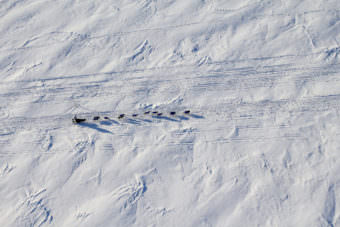
The trucks had barely finished dumping snow on Nome’s Front Street for the final stretch of the dog trail when Mitch Seavey roared up off the sea ice with his 11 huskies.

Seavey arrived at 3:40 p.m. and enjoyed hugs from family and friends.

Mushing is the family business for the Seaveys. His father, Dan Seavey, ran the first Iditarod and greeted him in the bright afternoon sun.

Race officials draped his leaders Crisp and Pilot with harnesses of golden roses.

Seavey started the race with a schedule that would bring him in under record time, but his fast team, one that he said loves speed, eclipsed even that schedule.

“So that’s pretty cool, the trail was a little faster and smoother than it might have been,” Seavey said. “I really, strongly believe in preparing the dogs to go do what they’re going to do, and you shouldn’t really be surprised that it happens.”

To build a team with that speed, Seavey maintains a year-round training program that keeps the athletes active in the summer and has them achieving winter-level workouts by autumn.

He doesn’t reveal details about a training regime that seems to involve running dogs at a ceiling of 9-and-a-half to 10 miles per hour and preparing for the specific rigors of racing.

Mitch Seavey had a two-hour edge on Dallas Seavey leaving White Mountain on Tuesday morning. After banking a luxurious amount of rest on the coast, his team ran a blistering pace to Nome to extend that lead by another 45 minutes on the 77 miles in from White Mountain.

One of the key moves of the race that helped him build a defendable gap on his competition was pushing north to Huslia to take his 24-hour break.

Other top racers rested earlier in Ruby or Galena.

“You know, if you’re going to take a late 24, you’re going to have to get there in hurry,” Seavey said. “You can’t lose a lot of time, because you need to be there in position. I felt like we came off that late 24 with a lot more energy than teams that may have taken their long break earlier.”

Speed has been the mantra since Seavey departed Fairbanks with 70 other mushers. At 57 years old, Seavey is the oldest musher to win the race, breaking the record he set in 2013 as a 53-year-winner.

“I do feel like I’m getting younger, not older, so as long as this is a thing that interests me the most, this is probably what I’ll keep doing,” Seavey said. “At some point there might be other things when I grow up, but I’m having so much fun with these dogs. And we’ve turned a corner, like, there’s a whole new world of things we can do. What if we can go even faster? What if we can run the Iditarod on a good trail as fast as the North American? Who knows?”

That is, the Open North American Championships, a sprint mushing race.

This is the sixth year in a row in which Dallas or Mitch Seavey has won the race. As the elder Seavey this time ran away with the title, the real race unfolding over the Topkok hills and Safety Sound was for second place, as Girdwood musher Nicolas Petit and Willow racer Dallas Seavey battled for silver.

Dallas Seavey said it was as they neared Nome that he spotted the team in pursuit.

“I kept checking,” he said. “I saw no sign of him, and then, we stopped for another snack break on the top of Cape Nome, and after I take off, I look back, and he’s right behind me.”

Petit cut an already thin, 13-minute edge to less than five minutes in Nome, bringing the two teams side-by-side under the Burled Arch.

It was here that Petit returned Seavey’s veterinarian log book — a piece of required equipment — to the musher at the finish line after he lost it at the safety checkpoint where he dropped a dog.

In Nome, Seavey and Petit joked about the race’s sportsmanship award:

“I appreciated it, thank you, that was very kind of you,” Dallas Seavey said. “No problem; remember that when we talk about sportsmanship [award]!” Petit said with a laugh.

Both Dallas Seavey and Petit joined the winner with times below the old speed record set a year ago.

Following his best finish ever, Petit said his team is just getting started.

“They’re amazing,” Petit said. “They’re just 2- and 3-year-old dogs, so watch out, Seaveys, we’re going to get you.”

Norwegian Joar Ulsom arrived in fourth place, while Jessie Royer drove her full string of 16 to claim fifth place.


Original story | 4 p.m. Tuesday

Mitch Seavey blasted through Nulato without stopping to rest as the trail heads toward Kaltag.
Mitch Seavey blasted through Nulato without stopping to rest as the trail heads toward Kaltag. (Photo by Ben Matheson/KNOM)

For the sixth year in a row, a member of the Seavey mushing family has claimed the top spot in the Last Great Race. This year it was Mitch Seavey who finished the Iditarod at 3:40 p.m. Tuesday, March 14.

According to the Associated Press, Seavey is the oldest musher to winner the race at the age of 57. The new record for the Iditarod is eight days, three hours, 40 minutes and 13 seconds.

Following behind Mitch at the time of his win are Dallas Seavey and Nicolas Petit roughly two miles apart, about 40 miles from the finish.

Wesley Early, Alaska Public Media

This is a developing story.

Correction: A previous version of this story said Mitch Seavey was the oldest to finish the Iditarod. He is the oldest to win the race. This version has been corrected.


You can follow Alaska Public Media’s Iditarod coverage here, or listen to the Iditapod podcast below:

Waiting for Martin Buser in Unalakleet: Old friends, and muktuk

Mushers who have been competing in the Iditarod a long time have relationships and traditions they revisit each time they run the race.

When Martin Buser gets to Unalakleet, that means a bag of muktuk.

“I love eating the local food, and for about 15 years, a little girl would come and meet me, no matter what time of my arrival, her mom would drag her down,” Buser said. “Now, of course, the girl is grown up and out of Unalakleet.”

That tradition is being held up by someone new, who stood patiently by Buser’s dog team before handing him a zip-lock bag of whale skin and blubber.

“This little boy has come and brought me muktuk, local boy Wasook Jones, brings me muktuk every time I show up, inconveniencing himself and his family to make sure I have some of the most delicious muktuk around,” Buser said. “It’s just always heart-warming when he shows up and brings me that. I always gobble it down right away.”

As Buser watered his dogs, he chatted with Clarence Towarak, who has come down to say hello to the musher each year since the 1980s.

As Buser attended to his dogs, Towarak explained that when mushers are at the front of the pack, they don’t have much time or energy for talking with folks.

“At least he’s got a sense of humor at this point in time,” Towarak said. “Those guys in the top five to 10, they’re all business.”

It’s not been a great race for Buser.

His dogs have been persistently sick, which, at one point, made him doubt he’d be able to finish. That’s never occurred.

In nearly four decades of mushing, Buser hasn’t scratched in an Iditarod.

But the worst seems to be over, and he said the dogs finally looked ready to run.

“All we need to do is get it done,” Buser said. “Just get to Nome, get this over with, that’s all I need. Get another one under the books and regroup.”

This will be Buser’s 34th full Iditarod if he finishes.


You can follow Alaska Public Media’s Iditarod coverage here, or listen to the Iditapod podcast below:

Nome could see Iditarod champ as early as Tuesday afternoon

Mitch Seavey beds down his team in Kaltag during the Iditarod. Seavey was expected to finish in Nome sometime Tuesday evening. (Photo by Ben Matheson/KNOM)

Updated | 2:11 p.m. Tuesday

Mitch Seavey’s speed continues to exceed expectations. With Seavey out of the Safety checkpoint at 1:10 p.m. Tuesday, an arrival in Nome as early as 3:30–4 p.m. is now possible.

Original story | noon Tuesday

Nome may be less than 24 hours away from its 2017 Iditarod finish.

Assuming no unexpected complications or changes in his pace, Mitch Seavey could arrive under the Burled Arch as this year’s Iditarod champion by about 7 p.m. Tuesday — perhaps slightly earlier.

The elder Seavey, currently Iditarod’s race leader, departed the Elim checkpoint at 6:13 p.m. Monday with 12 dogs, having spent two hours 47 minutes resting there.

A good rule of thumb for approximating an Iditarod champion’s finish is to add 24 hours to his or her departure from Elim.

This would, therefore, place Mitch Seavey in Nome at about 6:15 p.m. Tuesday.

Another, slightly more complicated means of reckoning places Mitch Seavey in Nome around the same time.

In 2015, when the Iditarod ran the same route as this year, Dallas Seavey, the eventual champion, arrived in Elim at 11:51 p.m. on the Monday a week after the race start. This year,

Mitch Seavey arrived in Elim about eight and a half hours earlier than Dallas in 2015. Both men — Dallas in 2015, Mitch in 2017 — rested in Elim for about 3 hours. If Mitch Seavey matches his son’s 2015 pace from Elim to Nome — which may be a reasonable guess, given that both Seaveys have similar mushing mentalities, similar dogs and, of course, come from shared mushing backgrounds — we might expect Mitch to arrive eight and a half hours earlier than Dallas did, which would place him in Nome at 7:45 p.m. Tuesday (8.5 hours earlier than Dallas’ 2015 arrival at 4:15 a.m. Wednesday).

Nome could see an early evening finish 6:15-7:45 p.m.

Of course, these estimates assume the absence of unpredictable factors like strong winds or other disruptions on the trail to Nome.

Certain areas near Safety, such as Topkok and “the Blowhole,” are especially notorious for their unpredictable, sometimes-suddenly-blustery weather.

Such a storm — in a remarkable series of events — derailed the Iditarod run of Jeff King in 2014, pushing Aliy Zirkle to second and giving Dallas Seavey the first of his (so far) three-in-a-row Iditarod victories.

But if Mitch Seavey’s current pace continues, the 2017 race seems to be his to win or lose. And if he does win, Nome might expect him around dinnertime Tuesday.


You can follow Alaska Public Media’s Iditarod coverage here, or listen to the Iditapod podcast below:

300 miles to Nome: Race dynamics change as Iditarod moves to the coast

Jeff King mushes into Kaltag in the Iditarod. (Photo by Zachariah Hughes/Alaska Public Media)
A sleepy sled dog lays down in Kaltag during the Iditarod. (Photo by Zachariah Hughes/Alaska Public Media)

Iditarod teams have left the Yukon river and reached the Bering Sea coast.

Mushers are shedding equipment, dropping slow dogs, and looking to make a move in the final 300 miles of the Iditarod.

Willow musher Wade Marrs was the first to reach Unalakleet, winning a bag of Bering Sea gold nuggets worth $3,500 as part of the Wells Fargo Gold Coast Award.

But it was two-time champion Mitch Seavey who left first, breezing through the checkpoint in the bright Sunday afternoon.

After posting some of the fastest run times among the leaders, Seavey said in Kaltag he’s focused on keeping his team moving at a fast clip for the final third of the race:

“Whatever we do will be to keep the speed in the dogs. I don’t want to slow down; it takes too long and is too boring,” he said. “Maybe right at the end. Keep resting them, keep taking care of them.”

“We need to be clever because the guys behind me haven’t given up,” Seavey said.

After arriving, Seavey has swapped out his large sled for a smaller, more nimble one to head toward the coast. He has systematically rotated out dogs from the gangline to rest in the sled, but now, that technique is over.

A dozen sleds bearing freight tags were lined up in Unalakleet, awaiting mushers looking to pick up speed.

Racing in the front, Seavey will work his way north, seeking to hold off four mushers who are all decades his junior.

“I guess I’m little bit anxious, because I’m in a position where I can win this thing if something doesn’t go wrong,” Seavey said. “My son, Dallas, is extremely tough and extremely competitive. He’s already talking to me like, ‘oh, you’ve got this sewn up.’ I think he’s playing poker. I don’t think he believes that.”

“He won’t quit; he won’t give up. So, it will be a race,” he said. “I think I have better speed and a better position, but that can change.”

After completing the portage trail over from Kaltag, Dallas Seavey arrived Sunday afternoon in Unalakleet and rested just shy of four hours before leaving in pursuit of his father.

He’s resisting the temptation to chase down his dad.

“We’re going to run these guys; we’re going to keep running our race. I’m not saying we’re tapping out. The simple math says chasing him doesn’t help anybody; chasing him makes us vulnerable to mushers behind us, and all of that is really irrelevant. I’m going to get these guys down the trail as fast as possible. If we end up closer to him at the finish line, I guess we gained on him.”

The younger Seavey said he expects the gap to widen between him and his dad, but he’s not throwing in the towel.

“[In] 2014, I thought I finished in third. You never give up, you keep plugging away,” he said. “If my dad gets lost and is in the middle of nowhere for two hours, I don’t want to say ‘what if I had pushed harder, would I have been able to snatch that spot?’”

Beginning with the Fairbanks start on the Chena River, the 2017 Iditarod trail has been dominated by river miles.

That changes now, as the course takes teams over sea ice and exposed, treeless expanses.

Coastal dog mushing is all about the wind, said  Middy Johnson, Unalakleet checkpoint boss and Iditarod veteran.

“The biggest thing is the wind: you can face it between here and Shaktoolik, Shaktoolik on, you can face it at Safety, at Topkok,” Johnson said. “It’s brought teams to a halt before.”

2011 champion John Baker lives in Kotzebue and has built a team in those conditions.

“Any type of weather comes at any minute.”

For the mushers chasing Mitch Seavey, any opening is welcome, but it needs to come soon if they’re to reel in the two-time champion on the trail to Nome.


You can follow Alaska Public Media’s Iditarod coverage here, or listen to the Iditapod podcast below:

Site notifications
Update notification options
Subscribe to notifications