Iditarod

Iditarod’s mid-pack mushers prepare final pushes to Nome

Iditarod mushers face a grueling next few days.

Not just those fighting tooth-and-nail at the top of the pack but, also, everyone else with competitive ambitions jockeying for spots in the top 10, 20 and 30.
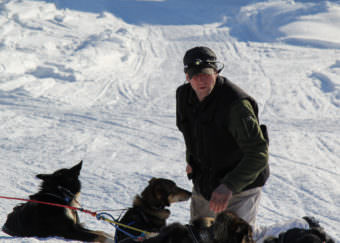
At this point in the race, the leader board is hardly set in stone. At the Kaltag checkpoint, a lot of mid-pack mushers are getting ready to make moves.

This is the fourth Iditarod for Katherine Keith of Kotzebue, but she’s not where she wants to be.

“I had hoped for a top 15 or 20 finish, and that’s such a competitive space, so I’m not sure that that’s what we’ll be looking for, but I haven’t given up yet.”

Keith is running her best race yet, with very few mistakes. She overslept once, but just by 20 minutes. And her hands were acting up. The deep cold early along the trail revived frostbite from the Yukon Quest a few weeks ago.

“It slows me down. I have to take more time for doing things that require fine-motor skills, so, I just give myself more time,” Keith said. “Instead of 20 minutes to bootie, I have to give myself 30.”

“Everything’s Velcro,” she said. “Velcro’s, like, the worst thing when you have fingertips that aren’t happy.”

Even at the top of her game, Keith was just barely one of the top 20 mushers into Kaltag.

She’s down to just 10 dogs heading toward the coast.

At one point, her partner, John Baker, an Iditarod champion, was parked next to her, and she asked him how with such relentless competition he’d ever been able to win.

“It just boggles me. I have no idea how people accomplish it.”

Keith is hoping she’ll be able to maintain an edge once teams start hitting the coast. With its hills and rolling terrain, she thinks her team will be at an advantage over teams that are more accustomed to flat trail.

Others, like Noah Burmeister, have been saving up energy in order to let their teams speed up in the last few 100 miles of the race.

“I’ve been trying to keep ‘em slowed down and takin’ it easy,” Burmeister said. “Saving some for the coast. You gotta save it for the coast. You don’t want to start pushin’ too early.”

Burmeister got 11th place last year. This time around, that’s looking like a long shot.

He’s had some problems with his team and made a mistake early on sticking to his planned strategy instead of trying to push ahead of the pack to get to better trail conditions.

The early cold made for sugary snow, and the trail was churned up more with each passing sled. Like a lot of competitors, Burmeister got slowed down.

Now, his aim is to overtake tired teams that pushed too hard getting into the positions where they are now.

“I’d like to climb up another five or 10 places. But we’ll just see what happens with the teams in front, and how hard they’re pushing and if they’re pushing too early.”

Burmeister is hardly the only one hoping a second wind will nudge him up in the leaderboard.

Just a few spots away in the dog lot is Scott Smith, who finished 10th last year. His team’s been fighting a bug. But now, he thinks they’re about to hit their stride.

“I’d say we’re kinda, like, in the building-up end of things, which is good,” Smith said. “I’ve had two or three key dogs in here start to get healthy, which is optimal for hitting the coast. I just want to put myself in a position to pick up the pieces.”

At this point, Smith doesn’t even know which position he’s in, let alone who he might feasibly overtake. But he’s planning a big push.

Not long after we talk, Keith finishes packing her sled, getting ready to go over the long portage from the Yukon River over to the Bering Sea Coast.

As she does, she chats with a different former champion, Joe Runyan.

“Oh, you’re taking a new sled, huh?” “Yeah, I am. Compared to this big old thing.” “Oh, you’ll fly.” “Yeah, I’m excited.” “Ok, have fun.” “Yeah, it’s very cathartic, it’s like ‘I need this! I need this!’”

And with that, Keith and her 10 dogs trotted off toward Unalakleet.


You can follow Alaska Public Media’s Iditarod coverage here, or listen to the Iditapod podcast below:

Iditarod changes dropped dog transport standards following Friday death

Update | 12:37 p.m. Monday

The Iditarod Trail Committee said it’s changing protocols for how it transports dropped sled dogs after an one died Friday while in the organization’s care.

An early necropsy on the dog showed it had overheated, dying of hyperthermia while on board a plane.

Scott Smith is lighting a crumpled pile of straw to get a fire going in his cooker.

His team is spread out on straw in the warm sunshine as he talks about Smoke, the young dog that died.

Even though Smith had dropped the dog at an early checkpoint in Manley Hot Springs, it was days later, when he arrived in Huslia that he was asked to contact race marshal Mark Nordman.

“I went into Huslia the other morning and I was told we need to call Mark Nordman, and I spoke with Mark for a few minutes, but there wasn’t much in the way of details,” Smith said. “Horrible day. Horrible, horrible, horrible day. I mean just hearing that news, and I started to get sick on top of that, I was dealing with sick dogs.”

“I mean I’ve never lost a dog in any race, and obviously this had nothing to do with me, but yeah, super low point in my career to ever lose an animal. Smoke was a nice little dog,” Smith said. “A nice big little dog. He was only a yearling but, I mean, he’s a horse. Frankly, I put him in this race to give him some experience, I didn’t think he’d finish, I just wanted to get him as far as I could and expose him to it.”

Dog deaths during the Iditarod are not uncommon, though it is extremely rare for them to occur while an animal is being looked after off the trail.

Smoke was dropped because of a wrist injury.

He was moved to Galena, and on a plane with 74 other dropped dogs en route to Anchorage, all part of the Iditarod’s protocols for getting injured dogs safely off the trail.

After discovering Smoke had died from overheating, the Trail Committee sent out a statement that they’d been unaware dogs could get hyperthermic in a cool aircraft.

They’ll no longer transport dropped dogs in coats, and will keep airplane cabins chillier and better ventilated to keep it from happening again.

Smith said he doesn’t blame anyone for what happened.

“Accidents occur every day, both in the animal kingdom and the human world,” Smith said. “I just think that was probably the case here. All my dogs are my family, and it’s a really tight knit group of animals. Smoke was pretty new to the fold, but it was no different.”

In spite of what’s happened, Smith is glad to be where he is: with his dogs on a warm day by the Yukon River, ready to race with them all the way to the finish.


Original story | 11:58 a.m. Monday

Iditarod sled dog died from overheating during transport, necropsy suggests

The necropsy results for an Iditarod dog that died Friday while flying to Anchorage indicate that it died from overheating.

Smoke, a 2-year-old male from Iditarod veteran Scott Smith’s team, was dropped in Manley Hot Springs and was being transported from Galena to Anchorage when it died.

The Iditarod Trail Committee will implement changes to reduce the risk of similar incidents, it said in a release. This includes not transporting dogs wearing protective coats and making sure that future flights have more ventilation and cooler temperatures.

This is the second dog death in the 2017 race.

A dog from Seth Barnes’ team died last week.

Necropsy results found abnormalities but did not determine an underlying cause of death, according to a release.

Ben Matheson, KNOM-Nome


You can follow Alaska Public Media’s Iditarod coverage here, or listen to the Iditapod podcast below:

Mitch Seavey, first to Kaltag, is confident yet cautious

Mitch Seavey travels on the Yukon River toward Kaltag after leaving Nulato.
Mitch Seavey travels on the Yukon River toward Kaltag after leaving Nulato. (Photo by Ben Matheson/KNOM)

Mitch Seavey is the first Iditarod musher to reach Kaltag. He arrived at the Yukon River checkpoint at 7:40 pm Saturday after running his team from Koyukuk. Seavey blew through Nulato in the heat of the afternoon and declared his eight-hour rest upon checking into Kaltag, the last possible spot. As the race leaves the Yukon River for the 85-mile portage trail to the coast, Seavey was confident.

“This isn’t even really that hard. I hate to say it like that. The way we train, I mean, I ended up telling Dallas it’s only 1,000 miles, we do what we’ve been doing. We go 9-10 miles per hour and take short breaks. It’s going to be hard because we’re going to put the hammer down. But to here, we’re sort of maintaining. We put a little push on today. We need to make use of this eight (hour rest), right, so I did a couple of shorter stops. The speed was the same. The dogs are happy; they ate every scrap.”

For being the first to reach Kaltag, Seavey wins the Bristol Bay Native Corporation Fish First Award, and with it, $2,000 cash and 25 pounds of Bristol Bay salmon.

The race picture is coming into focus now that the top teams have completed their mandatory rest. Seavey will swap out his large sled for a smaller, more nimble one to head toward the coast. Seavey has strategically rotated out dogs from the gangline throughout the race to rest in the sled, but that technique is coming to an end.

“Whatever we do will be to keep the speed in the dogs. I don’t want to slow down; it takes too long and is too boring. I don’t want to slow down. Maybe right at the end. Keep resting them (and) keep taking care of them. We need to be clever because the guys behind me haven’t given up.”

In Kaltag, Mitch Seavey beds his dogs with straw.
In Kaltag, Mitch Seavey beds his dogs with straw. (Photo by Ben Matheson/KNOM)

Seavey has a shot at earning his third Iditarod title. He says he’s too tired to be nervous, but he knows there are a handful of young mushers pushing to Kaltag overnight that will be looking to make a move.

“I guess I’m little bit anxious because I’m in a position where I can win this thing if something doesn’t go wrong. My son Dallas is extremely tough and extremely competitive. He’s already talking to me like ‘oh, you’ve got this sewn up.’ I think he’s playing poker. I don’t think he believes that. He won’t quit; he won’t give up. It will be a race. I think I have more speed and a better position, but that can change.”

Seavey has placed second to his son Dallas in the past two races.


You can follow Alaska Public Media’s Iditarod coverage here, or listen to the Iditapod podcast below:

Musher suffers dog loss at Galena checkpoint

The trail between Ruby and Galena.
The trail between Ruby and Galena (Photo by Ben Matheson/KNOM)

A dog has died in this year’s Iditarod. It happened shortly before midnight at the Galena checkpoint.

The dog was part of race veteran Seth Barnes’s team. Upon arriving at the checkpoint vets tried resuscitating the animal but to no avail.

There is no official cause of death yet or official statement from the Iditarod Trail Committee. Typically a necropsy is performed on dogs that pass away during the race.

Barnes first ran the race in 2015.

Mitch Seavey is first musher to Huslia checkpoint

Iditarod racer Mitch Seavey is the first musher to reach the halfway checkpoint of Huslia.

The two-time champion was the first to leave Galena early Thursday and arrived in Huslia more than 80 miles up the trail at 8:18 p.m.

A big crowd lined the main street to welcome in Seavey.

For being the first musher to Huslia, Seavey wins the GCI Dorothy G. Page Halfway Award, which includes $3,000 in gold nuggets.

Huslia residents gave Seavey several gifts, such as dog collars with custom beadwork and handmade fur gloves.

Seavey settled in to take his 24-hour break in the checkpoint that is hosting the race for only the second time in history.

“Last time the race came here, (there were) such good reports of the hospitality and the good people, and I missed out,” he said. “I came through in just a few minutes.”

“Even then, they gave me food and water and a present, kids hugged me,” Seavey said. “I wanted to make it back here, and the dogs didn’t need a big rest earlier. You can always do it, but I think I’ve maximized the team by coming here, and I still save my eight-hour for on the river.”

Huslia has a long tradition of mushing and was the home of the late mushing champion George Attla Jr., the “Huslia Huster.”

The trail in this year’s Fairbanks route forks north off the Yukon River to Huslia and loops south to Koyukuk.

While the real prize is hundreds of miles down the trail in Nome, Seavey said that the racing has indeed begun.

“We used to just camp along and race at the end, and now, we’re racing from the beginning,” he said. “It’s not all-out sprinting to the finish line, but it’s a strategy and sets you up for other parts of the trail.”

Top Iditarod teams are running their dogs between the checkpoints of Ruby and Huslia.


You can follow Alaska Public Media’s Iditarod coverage here, or listen to the Iditapod podcast below:

Push or pause? Near Iditarod’s mid-point, mushers decide when to rest

It’s break time on the Iditarod trail, as teams hunker down for 24 hours of uninterrupted rest along the Yukon River or consider pushing down the trail to a later checkpoint.

As the race approaches the halfway point mushers try to plan how to get the most from their tactical breaks.

As Jason Mackey laid out beds for his team’s rest he bangs tug line clips against one another to break off frozen dog poop.

Mackey is racing at the front of the pack and arrived sixth into the checkpoint Thursday morning.

“I’ve been feeding beaver meat all year,” Mackey said. “I don’t know, maybe the temperature wasn’t adequate for it; but, I’ll tell you what, it wasn’t pleasant when these girls were getting rid of it.”

Mackey calls this year’s team boisterous.

“These guys have been looking good and getting stronger every step of the way; they had been until this last run,” Mackey said. “Maybe it did have something to do with the beaver meat. They were a little bit flat. They do look good, but these guys have a spark to them like not many teams.”

Mackey said that means it might be time for a day off at the Galena checkpoint. As the race detours off the Yukon River for a sharp, out-and-back loop up to Huslia, several contending teams are on their 24-hour rests or are getting close to it.

Yukon musher Michelle Phillips is pushing ahead and stops only briefly in Galena to snack her dogs frozen chunks of meat and drop one dog.

She left seconds behind Jessie Royer with a full bale of straw to have camping options along the way.

Mushers’ individual plans for eight- and 24-hour breaks are spreading teams across hundreds of miles of trail.

Some have yet to take the long breaks, like Mitch Seavey, who is racing toward Huslia.

Jeff King already did his eight-hour break in Tanana, which he said was less about banking rest and more about getting his team on circadian rhythms in which they rest overnight and run in milder, daytime temperatures through the deep freeze of the early race. The exhausted four-time champion plans to take his 24-hour break in Galena.

“I want to make sure I get the full benefit from my 24,” King said. “If you go too far before you take it, it’s real hard to get it back.”

Overall, it’s a relatively tight race, with the entire field on the section of trail between Huslia and down river of Tanana.

As some mushers push to get to their long, 24-hour rests, others aren’t far from coming off their breaks and hitting the trail with fresh teams.


You can follow Alaska Public Media’s Iditarod coverage here, or listen to the Iditapod podcast below:

Site notifications
Update notification options
Subscribe to notifications