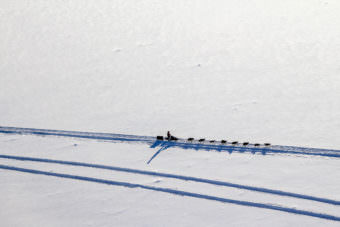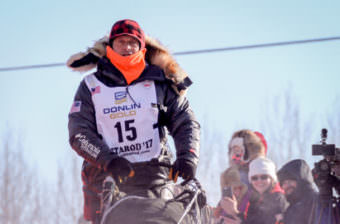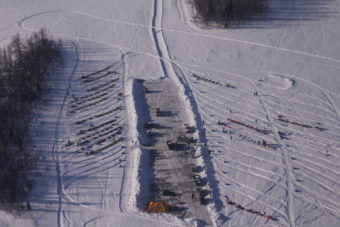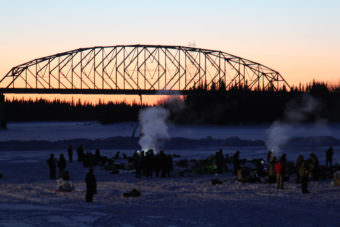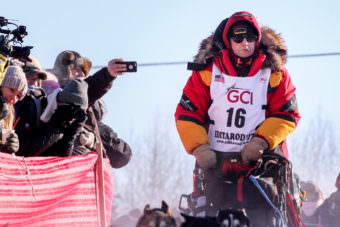
Teams rest at Nenana, on Tuesday, March 7, 2017. (Photo by Zachariah Hughes)
It’s hard to talk about the Iditarod without mentioning weather and climate. And this year is no exception, with mushers and dogs enduring extreme cold in first part of the race.
Climatologist Brian Brettschneider looks into how this year’s cold and snow stacks up to weather records from past races. He says the start Monday in Fairbanks was -19, by far the coldest in Iditarod history.
“If you look at the low for the day, it was -38, but it had warmed up — using the term “warm” loosely — to -19,” he said
Since the Iditarod started in 1973 that was the coldest start by a wide margin. The cold is only supposed to last for a couple of days, then rise into the 20s or even 30s, with lows in the single digits and teens.
“So the extreme cold going on right now is a short term phenomenon,” he said.
As for snow, there’s plenty on the route already, but “none of the checkpoints along the way are forecasting even a flake of snow,” Brettschneider said. “That’s subject to change, potentially, but to have no snow for that long a period for the entire route is really uncommon.”
Even though March is the driest month of the year in much of Alaska, there have been very few years when the week of the Iditarod recorded no snow.
The extreme cold seems notable now, but “when you average the beginning to the end, it’s going to go down as probably a pretty typical race period, temperature-wise,” according to Brettschneider.
Alaska’s Energy Desk is checking in with climatologist Brian Brettschneider each week as part of the segment, Ask a Climatologist. What do you want to ask?
Annie Kelley is the Teacher on the Trail for the 2017 Iditarod (Photo by Wesley Early/Alaska Public Media)
The Iditarod trail won’t be full of just mushers: a teacher will be following along as part of a yearly program.
For two years, Annie Kelley, of St. Andrew’s School in Chicago has been preparing for a new type of lesson plan.
“My job is to fly out on the trail in little planes and report back to classrooms across the country that are using the Iditarod as a teaching tool,” Kelley said.
Kelley found out she was a finalist for the Teacher on the Trail program in January of last year.
Just as mushers have extensive planning on the Iditarod with years of training and work, so too, does Kelley.
Between an application process that required letters of recommendation and long-term lesson planning, she said the experience has been constant.
“Since I was selected as Teacher on the Trail, I’ve been keeping a website, and that has tons of lessons that I’ve been doing with my kids in Chicago and I share it with teachers across the country,” Kelley said. “I’ve been presenting at a couple conferences, and getting my cold gear weather clothes ready. Chicago did not prepare me well this year. It was a very mild, mild winter there.”
For Kelley, getting ready for the weather means more than a hat and gloves. She listed all the clothes she plans on wearing:
“I think four layers on the bottom, topped with some heavy duty LL Bean snowpants. Boots that go down to negative 100, and there’ll be feet warmers in those boots. Probably four layers on top with a parka that was well tested at the Junior Iditarod. A giant hat and like four pairs of gloves, and I’ll probably only be wearing two at each time, but I’ve got lots of gloves. And hand and feet warmers will be used at all times.”
While this is the first and probably only time Kelley will be Teacher on the Trail, she said back in Chicago, she loves incorporating the Iditarod into lesson plans for her fourth graders.
“My lessons, a lot of them revolve around language arts. We write letters to the mushers – so writing friendly letters,” Kelley said. “A lot of times they write back, which is really fun. My favorite is one year, one of the rookie mushers handwrote a letter to my students, front-back side of a sheet of loose-leaf and it was just so cool that he took the time to do that.”
While Kelley will be reporting to her students on all of the mushers, she said she has a couple favorites.
“You know, I have a few favorites,” Kelley said. “Charley Bejna is a musher from Chicago, and he’s come into my classroom and it’s been really awesome. Ally Zirkle – girl power – I’m excited to see her come in at the finish.”
Kelley’s students are just excited as she is for the opportunity.
“They’ve been hearing about for about two years now, this whole process. The biggest thing is ‘Just keep warm, Ms. Kelley’ is all they tell me and be safe,” Kelley said. “I had one student write me a card and it said: ‘If you’re afraid of heights and small, little planes, don’t worry. You’re the Teacher on the Trail. You’re not scared of anything.’”
The last great race formally started Monday and Ms. Kelley will be reporting to teachers across the country every step of the way on the Iditarod website.
Fairbanks volunteers prepare for race start on banks of Chena River (Photo by Ben Matheson/KNOM)
Mushers are on the rivers heading out of Fairbanks right now, as the 45th Iditarod starts in earnest.
This is the second time in three races that the restart has been in Fairbanks. And a lot of the mushers have vivid memories of the 2015 race, so this year, they’re trying to pack accordingly.
It was chilly in Fairbanks, with overnight lows dipping toward 30 below. But by the time mushers were harnessing dogs and running through checklists the clear weather was easing toward a balmy zero degrees.
Though not running the race this year, four-time winner Lance Mackey was on hand, and said this year’s serious winter in the Interior may prove strong factor to content with.
“The wind has been blowing all winter,” Mackey said. “It snows when least expected. I’ve said many times – if these people haven’t tried their snowshoes on they’re gonna be hurtin’. ‘Cause I think this is the year you might need ‘em. Even to get off the trail to camp.”
Trailbreakers have been adding passing lanes to the early part of the route heading toward Tanana where the snows have been the heaviest.
The long stretches in the first leg of the race will require most mushers to stop for rest between checkpoints, a break to feed and rest the dogs.
All around the parking lot that’s been converted to a dog yard, mushers are attaching bails of straw to their sleds. Some on the baskets. Others, like veteran Pete Kaiser, were piling it into trailers hitched behind the sled.
“This just gives a little extra room for some of these long runs between checkpoints where we’re gonna be stopping on the trail and camping, and requires a little more gear,” Kaiser said.
What will not be hauled in a trailer this year is dogs.
A controversial rule change bars mushers from carrying dogs in trailers, throwing a wrench in many people’s strategies from year’s past, which involved regularly rotating animals through rest along runs.
Many people are experimenting with a workaround, most notably, returning champion Dallas Seavey.
“Without being able to carry dogs in trailers, we had to find a way to bridge that gap,” Seavey said. “We just made a bigger sled.”
Seavey is standing over what looks like the Batmobile of dog-sleds.
It’s almost totally black, and instead of an external frame with a bag suspended from supports, this looks more like a plastic shell. It’s about 10 percent bigger than a regular sled.
He had it custom built from Kevlar and carbon-fiber, and mounted to the runners behind where the musher stands is another heavy duty cube that could hold supplies or dogs.
According to the rules, as long as it’s safe and fixed to the structure of the primary sled, you can use it for an animal.
“There’s many sleds here that have the ability to carry just as many dogs as I do in the same way, they just don’t have hard sides,” Seavey said. “I like the hard sides because it helps protect the dogs, so that if there’s just a piece of fabric between them and the great big world it’s a little less than carbon fiber and Kevlar. I’ve got them in a little cocoon in there.”
Hundreds of people took buses from the Carlson center to view the event at Pike’s Landing.
Spectators lined the long shoot clapping as mushers rushed below celebratory arches, down onto the Cheena River, and on toward Nome.
The official start of this year’s Iditarod Trail Sled Dog Race could take place in Fairbanks because of poor conditions on key parts of the nearly 1,000-mile route from Anchorage to Nome.
The Fairbanks Daily News-Miner reports the Iditarod Trail Committee announced Wednesday that a decision on the location of the restart, which marks the beginning of actual racing, will come Feb. 10.
The ceremonial start kicks off in Anchorage March 4, with the restart currently scheduled for the following day in Willow.
Since the first Iditarod 44 years ago, the restart has been held in Fairbanks twice, in 2003 and 2015.
Iditarod officials considered holding the restart in Fairbanks again last year because of poor snow conditions in south-central Alaska, but ultimately decided to keep it in Willow.
Teams began the journey to Nome from the re-start at Willow Lake in Iditarod 44. (Photo by Ben Matheson/Alaska Public Media)
The Iditarod may once again be moving to Fairbanks.
Though the decision has not been made, low snow conditions along difficult parts of the trail are prompting officials to consider moving the race’s re-start from Willow to Fairbanks, as they did in 2015, and for a first time in 2003.
According to the Iditarod Trail Committee, despite good snow conditions throughout much of Southcentral Alaska, the areas around Rainy Pass and the Dalzell Gorge do not look good.
It’s the same section of trail where mushers saw dangerous conditions that led to injuries and widespread criticism over routing during the 2014 race.
The ITC said crews are monitoring trail conditions closely, and it will not render a final decision on the re-start until February 10th.
If the move to Fairbanks happens again, it’ll be the second time in a row that the southern route is skipped, bypassing communities like Shageluk, Anvik and Grayling.
The Fairbanks route extends west to Tanana, then down the Yukon toward Ruby, with a detour north to Huslia. The longest leg is 119 miles, a far greater distance than the biggest stretch along the traditional routes.
Currently there are 75 teams signed up to run this year’s race. Regardless of whether or not the official location is moved, the ceremonial start will be March 4 in Anchorage.
Kelly Maixner can carry up to four dogs in his tow-behind trailer. (Photo by Ben Matheson/Alaska Public Media)
Citing safety concerns, Iditarod officials have ruled that its mushers will no longer be able to carry dogs in trailers behind their sleds.
Aaron Burmeister is treasurer for the Iditarod Board of Directors and said the change came during a meeting on Oct. 28.
“Mainly it clarifies that dogs will be hauled in the front sled if they’re being hauled during the race,” Burmeister said. “It’s clarifying we’re not hauling dogs in trailers for safety reasons.”
Though used by a minority of Iditarod mushers, trailers fixed behind the primary sled have grown in popularity as a way to cycle dogs through rest, particularly among the sport’s top performers. Burmeister said as their use becomes more common, mushers risk losing or injuring animals if a trailer detaches.
“This is a rule that didn’t just come up yesterday or at the last board meeting, this is a rule that’s been in discussion for several years,” Burmeister said. “We’re not saying that you can’t haul a dog or anything else, we’re saying you can’t haul dogs in trailers, that way the dogs will be hauled in front of you in the main sled, where they can be supervised and managed if anything should happen.”
Some mushers have been critical of the rule, along with another controversial change passed by the board that allows for two-way communications devices like cell phones to be carried on the trail.
The new rules will be in effect for the upcoming Iditarod in March.
Close
Update notification options
Subscribe to notifications
Subscribe
Get notifications about news related to the topics you care about. You can unsubscribe anytime.