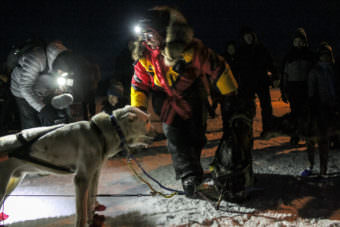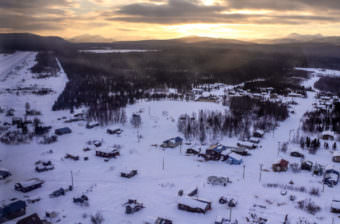
Aliy Zirkle coming into the checkpoint in Galena on Thursday. Zirkle has had to upend her race plans and declare a 24-hour rest in Galena because of sick dogs. (Photo by Zachariah Hughes, Alaska Public Media)
Iditarod veteran Aliy Zirkle has had to upend her race plans and declare a 24-hour rest in Galena because of sick dogs.
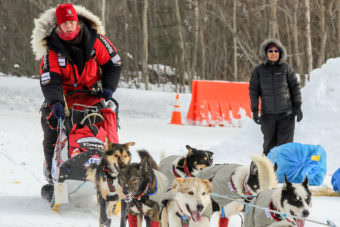
Aliy Zirkle gets water while stopped Thursday, March 9, 2017, at the Nenana checkpoint of the Iditarod. (Photo by Zachariah Hughes/Alaska Public Media)
After pulling off the Yukon River, Zirkle had several vets checking out her team. She said the leaders started looking ill Tuesday afternoon.
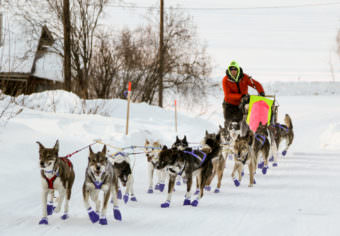
“My dogs aren’t extremely healthy right now; they all have this bug, and a few of ‘em have a fever,” Zirkle said.
Zirkle was feeding the dogs medicine to help with diarrhea, and vets were monitoring temperatures up to 105 degree. Normally, dogs have a resting temperature of 102.5 degrees.
Zirkle doesn’t think the problems came from something they ate, but a lot of the team ran the Yukon Quest a few weeks ago.
“Some of these dogs were sick on the Quest,” Zirkle said. “I don’t know if it’s a bug that never went away. I dunno know, really, elementary schools get bugs and dog races get bugs.”
The illness throws a wrench in Zirkle’s plan to push to Huslia to take her 24-hour rest.
It was a move she budgeted for when she opted to rest for a few hours in Ruby, in preparation for a big push.
But she’s hoping the layover in Galena gets her team, and her, back in shape for the hundreds of miles ahead.
“I’ll be doing alright if my team’s doing alright,” Zirkle said. “I’ll be a little mopey if my team’s mopey.”
Zirkle will be cleared to leave her 24-hour break Friday afternoon after 1 p.m.
Two-time champion Mitch Seavey begins his Iditarod run at the Fairbanks re-start on Monday. (Photo by Ben Matheson/KNOM)
A team travels on the Iditarod trail to Manley Hot Springs. (Photo by Ben Matheson/KNOM)
A team travels on the Iditarod trail to Tanana. (Photo by Ben Matheson/KNOM)
Nicolas Petit’s Iditarod team begins its 2017 race in Fairbanks. (Photo by Ben Matheson/KNOM)
Martin Buser is chasing his fifth Iditarod title in 2017. (Photo by Ben Matheson/KNOM)
The Manley Checkpoint (Photo by Ben Matheson/ KNOM)
Annie Kelley is the Teacher on the Trail for the 2017 Iditarod (Photo by Wesley Early/Alaska Public Media)
Teams began the journey to Nome from the re-start at Willow Lake in Iditarod 44 . (Photo by Ben Matheson/Alaska Public Media)
Wade Marrs was the first musher to reach the Ruby checkpoint of the Iditarod, coming off the Yukon River into town at sunset. (Photo by Zachariah Hughes/Alaska Public Media)
Dallas Seavey’s high-tech new sled includes a mounted, rectangular cook stove, which he says has more surface area to heat water in a shorter amount of time. (Photo by Zachariah Hughes/Alaska Public Media)
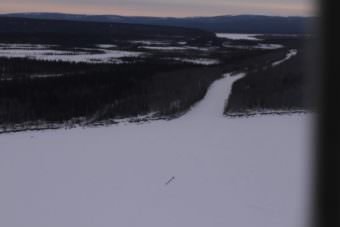
Ruby is located on the south bank of the Yukon River. (Photo by Zachariah Hughes/Alaska Public Media)
Ruby, on the south bank of the Yukon River, seen before mushers started arriving Wednesday during the Iditarod. (Photo by Zachariah Hughes/Alaska Public Media)
Dallas Seavey arrives second to Ruby just after the sun set Wednesday night during the Iditarod. (Photo by Zachariah Hughes/Alaska Public Media)
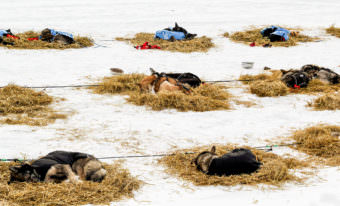
Teams rest in the cold at Manley Hot Springs, Tues. March 7th, 2017. (Photo by Zachariah Hughes)
Wade Marrs was the first musher to reach the Ruby checkpoint of the Iditarod, coming off the Yukon River into town at sunset. (Photo by Zachariah Hughes/Alaska Public Media)
Upon arriving in Ruby, Dallas Seavey quickly attended to chores during the Iditarod. (Photo by Zachariah Hughes/Alaska Public Media)
Ruby, on the south bank of the Yukon River, seen before mushers started arriving Wednesday during the Iditarod. (Photo by Zachariah Hughes/Alaska Public Media)
Ruby is located on the south bank of the Yukon River. (Photo by Zachariah Hughes/Alaska Public Media)
Dallas Seavey’s high-tech new sled includes a mounted, rectangular cook stove, which he says has more surface area to heat water in a shorter amount of time. (Photo by Zachariah Hughes/Alaska Public Media)
Dallas Seavey arrives second to Ruby just after the sun set Wednesday night during the Iditarod. (Photo by Zachariah Hughes/Alaska Public Media)
Wade Marrs led two past champions into the Ruby checkpoint last night in the 2017 Iditarod.
Three-hundred-fifty miles into the trail, the racing is underway as teams plot their next moves along hundreds of winding miles on the Yukon River.
Willow musher Wade Marrs arrived first into the checkpoint a little before 7 o’clock.
“There’s a lot of people out here, am I the first one here?” Marrs asked. “You are,” the response came. “Oh wow, that’s cool,” Marrs said.
Marrs quickly tells checkers that he’s declaring his 24-hour rest.
As the first musher to Ruby, Marrs won the Pen Air Spirit of Alaska award, which comes with a special print, plus a handmade gift from Ruby residents.
Marrs’s pause is brief, and he sets off to take care of his chores.
Marrs quickly parks his team to settle in for some rest. He sets down beds of straw and tosses out hunks of frozen salmon, which the team devours.
“These guys are monsters, they’re screaming coming up the hill. Literally barking going down the trail last night,” he said. “I’ve never had a team this animated and amped up.”
“They definitely seem like they’re just down a notch, not on attitude, definitely, but down a notch on something.”
Teams can now take their 24-hour or eight-hour Yukon breaks as they leapfrog one another on opposing schedules. Mushers declare the breaks to checkers, but they don’t commit to it and can leave if they want to.
Marrs was confident in his plan.
“Hopefully, it works out good, as long as Dallas does what I expect him to, it will work out really well.”
That is, he’s expecting Dallas to do the same as 2015, when he took his eight-hour break here, camped outside Galena, and did his 24 down the trail in Huslia.
“I have to try playing his game on him and get a step ahead of him, which we are now, which is perfect. Now, I just need to play my cards right.”
Forty-six minutes later, Dallas Seavey arrives in all black.
“I’m going to declare a 24, and I’m going to declare an 8, and I’m going to declare I’m indecisive.”
Seavey pulls three resting dogs out of his carbon fiber sled and sprints up and down the gang line, doing chores. He throws down thin pieces of foam — camping pads, a novel addition to the straw-piles used to to keep the dogs cozy.
The stretch from Tanana to Ruby is the longest on the trail, nearly 120 miles. Along the way, both Seavey and Marrs rested for about four hours to break up the journey. After leaving Wednesday morning at 1 a.m., the two camped near each other for a morning rest, and hours later found themselves parked a few feet from one another in Ruby.
That was close enough to swap race plans — or at least tentative race plans — as they worked along their dog-lines.
“You taking your 24?” “I think so, yeah. Why not? It’s cold out there.”
Seavey says the critical 24-hour break should be tailored to the specific team and ultimately involves making a bet on the trail to come.
“If I felt the trail was going to be bad, I would have gone farther. It’s a little bit of a bet that the trail is good, and it’s going to benefit me to have a good trail, particularly when it comes to being able to rest dogs in the sled. That’s the short version.”
Dallas’s dad, Mitch Seavey, pulled into Ruby third and says he’ll be sticking around for four to six hours.
“There’s nothing about this team that needs to be 24’ed right now.”
The elder Seavey pulls two dogs out of his sled that he’s rested along the way, on a schedule he described as “secret.”
The next two mushers were cagey, as well.
Nicolas Petit arrived fourth, wearing a polar bear ruff from Kotzebue. He was put off by the steep hills and sharp turns getting back out onto the trail, and didn’t think it was a safe idea to attempt with a super-charged dog-team.
Arriving in fifth, Joar Ulsom was less committal about his plans.
“It’s always good to declare your eight-hour break, because if I was to oversleep, nothing bad would happen.”
Ulsom was relatively upbeat, saying he got a relaxing, hour-long nap in while the sun was up and felt wide-awake.
As the sleepless nights add up, mushers will focus on avoiding mistakes and exploiting any they see by their competitors.
Two-time champion Mitch Seavey begins his Iditarod run at the Fairbanks re-start on Monday. (Photo by Ben Matheson/KNOM)
As mushers speed toward Nome, a controversial new Iditarod rule is in effect for the first time.
After a vote by the board of directors last fall, mushers are now allowed to carry two-way communication devices, like cell and satellite phones.
Many competitors both young and old think the presence of technology goes against the spirit of the race.
Speaking at the Ceremonial Start, Kasilof musher Monica Zappa has a reputation for being outspoken. And she doesn’t mince words about why she’s “boycotting” the two-way communication rule.
“Because it’s pointless,” Zappa sad. “My cellphone would be dead in two seconds in the cold, anyway. There’s no service on the trail. And it’s a really lame rule.”
The change is to language in rule number 35, governing electronic devices. Communicators can be brought along and used, though not for any media purposes.
Paul Gebhardt sits on the Iditarod’s board of directors and said he won’t be bringing any kind of phone.
“I don’t like it, I got nobody I really want to talk to when I’m out there, just my dogs and me,” Gebhardt said. “That’s what I think the spirit of the race is about. I voted, personally, against the two-way communication device, and most of the mushers agree with me.”
A lot of racers say the technology is not only cumbersome, but could prove a distraction. Norwegian Joar Ulsom thinks it also opens up the possibility of getting mentally derailed at a time when psychological fortitude is crucial.
“People can send you text messages that you receive and you have no control (of) what they’re saying to you,” Ulsom said. “They could say a thing that’s gonna benefit me, or a thing that’s gonna mess up my day.”
A team travels on the Iditarod trail to Manley Hot Springs. (Photo by Ben Matheson/KNOM)
A team travels on the Iditarod trail to Tanana. (Photo by Ben Matheson/KNOM)
The Manley Checkpoint (Photo by Ben Matheson/ KNOM)
Martin Buser is chasing his fifth Iditarod title in 2017. (Photo by Ben Matheson/KNOM)
Nicolas Petit’s Iditarod team begins its 2017 race in Fairbanks. (Photo by Ben Matheson/KNOM)
Teams began the journey to Nome from the re-start at Willow Lake in Iditarod 44 . (Photo by Ben Matheson/Alaska Public Media)
Annie Kelley is the Teacher on the Trail for the 2017 Iditarod (Photo by Wesley Early/Alaska Public Media)
Not everyone is against the change, though. And some like it for the very reason that others are dismissive. Wade Marrs is bringing both a satellite and cell phone, and says while communication can’t be a part of his strategy, it’ll be a boost to check in with his girlfriend at tough points in the race.
“I do my best thinking on my own, and not with any pressure. So definitely not looking to find any advice or anything like that from it,” Marrs said. “But be able to call Sophie and say hi and tell her I love her — that’ll be nice.”
While racers still aren’t allowed to accept outside help, it’s unclear how that prohibition can be monitored and enforced when it comes to calls or communication.
There’s lingering ambiguity about what is and isn’t allowed under the rule change, even among some of the race’s most experienced veterans.
Past champion Mitch Seavey is bringing a cell phone — somewhat reluctantly. And he said for those mushers gunning for a first-place finish, there’s no use not seizing every available tool to gain an edge.
“I didn’t make the rule, I wish the rule wasn’t there, but if they’re gonna have that device allowed – and it isn’t just cell phones it’s any two-way communication, so remember it’s not limited by cell coverage – then I would be foolish to not participate in that,” Seavey said. “Although, honestly, we’re at the starting line and I’m not quite sure yet what we’re allowed to use them for and what we’re not.”
The change was spurred by safety concerns after last year’s race, when an intoxicated snowmachiner attacked two mushers on a remote stretch of trail.
Defenders of the rule say that with the technology available, there’s no longer a good reason not to have an extra security option available for those who want it.
One of the racers attacked was Aliy Zirkle, who, with the new rule in place, would be able to call race officials for help if something similar every happened.
But few mushers cite safety in their decision on whether or not to bring a device.
Zirkle’s partner, Allen Moore, won’t be carrying one. But he is bringing another safety precaution.
“I got a flare gun, I don’t know if that counts,” Moore said. “To scare off moose or bad people or whatever.”
Correction: The byline for a previous version of this story was incorrect. It has been corrected.
A team travels on the Iditarod trail to Tanana. (Photo by Ben Matheson/KNOM)
The checkpoint of Tanana is the first stop on the Yukon River. (Photo by Ben Matheson/KNOM)
A team travels on the Iditarod trail to Manley Hot Springs. (Photo by Ben Matheson/KNOM)
Nicolas Petit was the first musher to reach the Yukon River. (Photo by Ben Matheson/KNOM)
Nicolas Petit and Tanana resident Blanche Edwin enjoy the five-course meal Petit won for being the first musher to the Yukon River. (Photo by Ben Matheson/KNOM)
Iditarod mushers reached the Yukon River at Tanana on Tuesday night.
Teams are ready to launch their race plans as the eight-hour and 24-hour rest periods come into view.
But first, they must run the longest stretch of the race between checkpoints and make it through the early race with their teams intact.
As the sun went down Tuesday, Nicolas Petit staked his claim as the first musher to the Yukon River. He receives $3,500 in $1 bills and a five-course meal prepared by chefs at the Lakefront Hotel.
First, he needed to find a guest. Martin Buser, the musher who arrived 36 minutes after him wasn’t up for it.
“The Yukon River dinner? I might? Otherwise, I may have to find someone else,” Buser said. “I have to go to sleep; I don’t like all of that hoopla.”
Tanana Mayor Donna Folger presented him with gifts from the community and, ultimately, found him a date.
“You guys arm wrestle for it? Blanche, will you eat with him for me? Yes, Blanche!” Folger said.
Tanana resident Blanche Edwin joined Petit for the gourmet meal as cameras clicked. Andrew Adlesperger, food and beverage director at the Lakefront Hotel, described the salad course.
“Our sun-dried cranberry pear and gorgonzola salad on fresh springs, and it’s topped with a raspberry lime dressing.”
Petit’s team, however ate a less leafy meal in the dog yard at 25 below.
“Chicken fat and chicken skins and beef tripe and kibble,” Petit said. “No rib eye steaks. I’ve done that before, and it backfired.”
While Petit ate, several teams pulled into Tanana.
Jason Mackey arrived fourth, right behind Mitch Seavey.
“I had no idea there were only three teams here in front of me,” Mackey said. “I had no clue. Well, I did see a bunch of teams parked.”
Dozens of teams Tuesday afternoon pulled off to the side of the trail and rested in the midday sun before Tanana.
While the forecast is for mellower temperatures, Iditarod chief veterinarian Stuart Nelson and his volunteers are playing close attention to the athletes’ body condition over the course of another frigid interior Alaska night.
“Very few dropped dogs, very low numbers. Overall, the dogs are healthy; we want to really monitor the hydration and body weights,” he said. “But they’re pretty perky and peppy.”
Upon reaching the Yukon, mushers’ mandatory rest strategies are on the horizon: teams can now take their eight-hour rest at checkpoints between here and Kaltag in addition to their 24-hour layover.
Mackey wants to get hundreds of more miles behind him before taking the big rest.
“I’m set up in my 24 starting in Galena, and Huslia, Koyukuk and Nulato,” Mackey said. “If I can get all the way to Nulato, that would be the best, I think. The further you can go for the 24, the better off. There is a slew of teams that are thinking the same way.”
Before many take the eight-hour break, teams will head west on the Yukon to Ruby: the longest stretch between checkpoints at close to 120 miles.
Petit’s plan is to have options with the gear and supplies he packs.
“I plan on loading up my sled with anything I might need,” Petit said. “You see I still have straw? I still have a bunch of food. I don’t make a plan because I don’t know what the trail is going to do, and I don’t know what the weather is going to do, and I don’t know what my dogs are going to do. I just leave equipped for anything.”
For Wade Marrs, the fifth musher into the checkpoint, the next couple runs to Ruby will determine how quickly he needs to bank his big rest.
“If the dog team does really good coming across here, then we’ll take an eight and keep on going,” Marrs said. “If they don’t, we’ll take a 24 when we get to the end of this run and go from there.”
Twenty-five minutes behind Marrs was Bethel musher Pete Kaiser.
“I prefer to take my 24 first; we’ll see how it goes,” Kaiser said. “It all depends on what the dogs need at any given time. It’s nice to have the option for either from now on. But I don’t think we’ll need either of them, here.”
Martin Buser is chasing his fifth Iditarod title in 2017. (Photo by Ben Matheson/KNOM)
Last year, Martin Buser had a tough Iditarod.
He finished in 37th place, his lowest position on the leader-board in a decades-long career.
But this year, as the four-time champion charges through the race’s early checkpoints, a lot of things are going better.
In 2016, Buser had a bad fall on the stretch of trail heading from Kaltag toward Unalakleet.
With more than 200 miles to go, he was barely able to walk far enough to water all his dogs.
“Well that was actually, it ended up being a pretty well-torn hamstring,” Buser said. “It was very, very painful, and by the time I got to Nome it was as big a bruise as I have ever seen. It took almost the whole year to heal up.”
Buser was preoccupied at the time. His son, Nikolai, was in a terrible car accident a few weeks earlier, and was receiving treatment in Seattle.
Now Nikolai is well enough that Buser “dad jokes” that he can start looking for a job.
“We joke that this might be the first year in 28 years when I don’t have to worry about the children,” Buser said. “So, this is gonna be about just the dogs and myself.”
Buser is experimenting with a few new elements in this year’s race.
He’s testing a clothing system for the Columbia sportswear brand.
He also has a new gang-line system for wrangling the dogs into a straighter pulling formation. The team itself is a mix of old and new.
“It’s a very seasoned team of experienced dogs between one Iditarod experience team and six or seven,” Buser said. “So it’s a nice tapper, a nice stagger between oldest being 7-and-a-half and youngest being 2-and-a-half. Well-balanced team.”
Buser sounds almost excited as he explains his plans to rest along the longer legs of the early trail, even with overnight temperatures forecasted to dip beneath 30 below.
“I’ll be camping a lot,” Buser said. “I’ll have my tent again; I have a tiny little light-weight tent that I incorporated in my gear, and I’ll be totally self-contained and totally happy to be that. Privacy, comfort, and you’re totally independent of the checkpoints by doing that.”
Buser, who ran his first Iditarod in 1980, said his goal remains the same as ever: get to Nome as quickly as possible.
The Manley Checkpoint (Photo by Ben Matheson/KNOM)
During the first night of this year’s Iditarod, teams endured frigid temperatures on the Tanana River to reach the second checkpoint of Manley Hot Springs.
Teams are adjusting to the deep cold and preparing to push to the Yukon River, where the race will unfold.
Nicolas Petit drove far into the night before pausing to rest.
In Tuesday’s bright afternoon sun, Petit said the long, early run on the way to Manley behind past champions Martin Buser and Mitch Seavey is all part of the plan.
“If they’re not tired enough to not go 100 miles an hour, they’ll get frostbit,” Petit said. “There is a reason for my madness.”
Other mushers cruised through Manley, choosing to camp further up the trail.
Petit said the trail was hard and fast out of Nenana, meaning, he needs to watch his speed at this early stage in the race.
“They’re good enough to where I can tell them which speed to go, and they’ll just go that speed, so I don’t really have to hold them back too much to go 7-and-a-half miles an hour,” Petit said. “If I ask them to they’ll go 12. But we don’t have to do that quite yet. And then we can go 14 (mph) on the way to Nome.”
Veteran Rick Casillo swapped out dog coats for a different style to keep the males from getting frostbitten. He was breaking up his runs into five-hour stretches to manage the cold and keep his string of 16 dogs intact.
“I think it’s going to be a cold one tonight,” Casillo said. “I think we’ve got one more day of this crap.”
The forecast call for milder temperatures after Wednesday.
A few parking areas away from Petit, Dallas Seavey, the winner of the last three years, was feeding an extra snack before he left the warm sun of Manley Hot Springs.
Seavey wanted to load up before the next big run, because dogs burn extra calories in the deep cold.
“Some of these guys are really good about eating snacks on the trail regardless of temperature, other dogs don’t like cold meat so much,” Seavey said. “I think I saw 47 below this morning, was the coldest I saw.”
Seavey was multitasking, working his way up and down his team fitting booties and cooking the meal.
He’s focused on the details that add up of a 1,000-mile race.
“One of those mushers dog’s may have gotten 20 percent more sleep during that time because they were a little more efficient,” Seavey said. “In my theory, if the dogs aren’t running, eating or sleeping, pretty much everything else is wasted time, albeit often times necessary wasted time, like putting booties on.”
Seavey left in the midday sun with only 11 dogs strung out in front, but he had five stowed in his new carbon fiber and Kevlar sled.
Several past champions left in quick succession Tuesday afternoon: Martin Buser first, followed by Jeff King, Mitch Seavey and Dallas Seavey.
The trail takes them to Tanana to meet the Yukon River, where the real racing can begin.