Iditarod

Iditarod mushers demand board president resignation, don’t get it

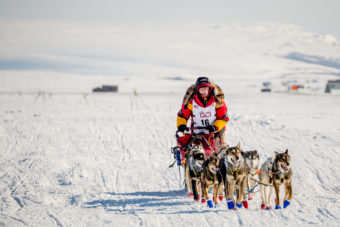
Dallas Seavey runs into Nome on Tuesday, March 14, 2017, during the Iditarod. (Photo by Ben Matheson/KNOM)

With only three weeks until the 2018 Iditarod, there’s more drama swirling around Alaska’s premier long-distance dog mushing event.

The Iditarod Official Finisher’s Club called for the immediate resignation of Iditarod Board President Andy Baker.

The club’s letter to the board, first reported by the Anchorage Daily News, said Baker has “jeopardized the integrity of our whole livelihood through his poor leadership.”
The club calls itself the “players’ union” for Iditarod mushers.

The letter comes after controversy surrounding a dog-doping scandal that caused four-time champion Dallas Seavey to withdraw from this year’s race and a confidential consultant’s report, leaked to news media, that recommended board members with conflicts of interest step down to avoid losing sponsors and trust.

Despite the Finisher’s Club demand that Baker resign to avoid what the letter says will be “negative discourse” overshadowing this year’s race, Baker did not step down.

After the Board of Directors’ meeting Friday in Anchorage, the board released a statement saying its members had decided unanimously to make no changes.

Shortly thereafter, Baker spoke to reporters about his reaction to the letter.

“There’s so much emotion and there’s so much emotion this time of year, with, the mushers are getting ready for the race,” Baker said. “Everybody wants the race to do well. So I took it very positively. Everybody wants the race to do better, and the board, our whole focus is we want to have a safe race, we want dogs to be safe, we want mushers to be safe and we want a successful race.”

However, Baker said there may be changes coming after this year’s Iditarod that will be in line with recommendations from a December report by consultants with the Foraker Group.

Among other things, the report said the Iditarod should replace board members with conflicts of interest to restore trust with mushers, sponsors and race fans.

Baker, brother of Iditarod musher John Baker, says the board agrees but has not yet made a formal decision on the matter. He added that having board members with close ties to mushing has always been seen as a benefit to the race.

Finisher’s Club President Wade Marrs did not respond to a request for comment in time for this story.

Meantime, the Iditarod announced  the race would restart in Willow on its normal southern route after the March 3 ceremonial start in Anchorage.

Confidential report paints bleak picture for Iditarod

Mitch Seavey mushes on the outskirts of Nome on Tuesday afternoon. The elder Seavey finished the 2017 Iditarod in record time Tuesday, March 14, 2017. (Photo by David Dodman/ KNOM)
Mitch Seavey mushes on the outskirts of Nome on Tuesday afternoon, March 14, 2017. (Photo by David Dodman/ KNOM)

The Iditarod sled dog race is in trouble.

That’s the finding from a confidential report looking into the financial sustainability and leadership of the race’s governing body. Iditarod officials are planning to implement a series of reforms later this year, but not until after the race wraps up in March.

The December report was put together by the Foraker Group, and was commissioned by the race’s main corporate sponsors. The Iditarod Trail Committee has received waves of criticism the last few years over controversial new policies, loss of sponsors and a high-profile doping scandal many feel was mishandled.

The document was first reported on by blogger Craig Medred earlier this week.

In interviews with board members, staff, sponsors and mushers, along with a review of financial documents and policies, Foraker concludes the Iditarod’s relationship with key stakeholders is severely damaged. It finds mushers don’t have confidence in the ITC board. And that without internal reforms sponsors aren’t likely to continue supporting the event.

That’s a big threat to Alaska’s premier sled dog race, because most of the Iditarod’s revenues come from corporate sponsorship. The Foraker report notes that the annual event depends heavily on unpaid volunteer labor, and questions whether that model is financially sustainable.

The author also says the handling of the recent doping incident exacerbated mistrust of the board among mushers, and gave ammo to animal rights activists, who have long-criticized the event and pushed sponsors to drop support.

Through its public relations firm Iditarod officials declined a request for an interview.

But in four pages of comments sent to Alaska Public Media, ITC’s board commits to making reforms that will make the race viable long-term.

The document is an extensive list of policy changes they are planning.

Some are quite general, such as improving communication with sponsors and mushers.

Others are extremely specific, like finding a plan to replace board members with clear conflicts of interest before this summer and annual review of race rules.

Iditarod to tighten race trail security, rewrite “gag rule”

Dallas Seavey arrives second to Ruby just after the sun set Wednesday night during hte Iditarod. (Photo by Zachariah Hughes/Alaska Public Media)
Dallas Seavey arrives second to Ruby just after the sun set Wednesday night during the Iditarod. (Photo by Zachariah Hughes/Alaska Public Media)

The Iditarod Trail Committee is taking steps to tighten security along the race route in the near future.

Iditarod spokesman Chas St. George says the board and staff are considering adding security cameras at the Nome dog lot, as well as at the White Mountain and Unalakleet checkpoints.

“Based on last year’s experience, these two checkpoints are extremely active,” St. George said. “There’s a lot of folks that come in and out of Unalakleet, especially during this race.”

St. George said other strategies are in the works, as well:

“This is just the beginning. We’re not talking about, ‘This is what we’re going to do, and that’s it.’ We’re looking at a number of different protocols that we can deploy in the future,” St. George said. “This year, for instance, you will see, more visibly, individuals who are boots on the ground that will be monitoring our dog lots.”

This discussion comes after the committee’s announcement in October that four dogs on four-time champion Dallas Seavey’s team tested positive for the prohibited painkiller tramadol at the end of the 2017 race. It was the first time a positive drug test had been returned in Iditarod history.

The committee changed the race drug-use policy following the positive test, shifting the burden of proof to the musher if there is a positive result.

Seavey has denied he gave his dogs tramadol and alleged that foul play was involved, calling for better race security.

In the wake of the announcement, the Iditarod Official Finishers Club issued a statement calling for several changes to Iditarod race rules.

Among those was a more comprehensive drug policy, including the withholding of prize money in the event of a positive test. St. George says the board also discussed such a policy at its regular meeting Dec. 1.

“The board of directors is looking at working on the mechanics of that protocol, how that will look,” St. George said. “When the need arises, and when the opportunity arises to move on action items, I’m sure this board will come together and make that happen.”

No action items related to the drug-use policy were brought forward at the Dec. 1 meeting. But

Wade Marrs, who’s president of the Finishers Club and sits on the Iditarod Board as the musher representative, said the so-called “gag rule” Rule 53, which has been criticized by mushers and the club, is in the process of being rewritten.

“The gag rule was intended to make sure that we didn’t bash sponsors, or bash one another, or bash the race publicly, which is totally understandable,” Marrs said. “But our main worry as mushers was we had to be able to call the board or staff out on issues. They’re rewriting for the proper wordage on making sure those things are known.”

Marrs is happy with the progress that’s been made on the issues raised recently. He says the Finishers Club, board and staff held a closed-door meeting in November to discuss concerns:

“Some of the thoughts were heeded, some of the thoughts were productive, some of the thoughts were non-productive, so it went both ways, quite a bit,” Marrs said. “But it was an interesting meeting, and I think it was good to have everything aired out and have everybody know what page each group is on.”

Sixty-nine mushers are currently signed up for the 2018 Iditarod, which begins March 3 in Anchorage.

Can the Iditarod standardize kennel care?

A Siberian husky rests at a well-maintained kennel in Willow. (Photo by Zachariah Hughes/Alaska Public Media)

The Iditarod Trail Committee’s Board of Directors wants to set up a kennel management program, a move aiming to set up new guidelines and counteract negative press directed at mushing’s most high-profile event.

Mushers who qualify for and race in the Iditarod already are expected to maintain standards of care for their animals and kennels. But many of those guidelines are fuzzy, outdated and due for review.

Now, ITC’s board is establishing an advisory committee made up of prominent mushers like Jeff King, Aliy Zirkle and DeeDee Jonrowe to begin drafting more specific standards for kennel management.

“There needed to be a better way to communicate what was really happening in our Iditarod kennels,” said Chas St. George, ITC’s operations director.

According to St. George, board members have been considering setting up kennel management standards for some time.

One of the motivating factors is a change over the last decade in how mushers run their dog lots, including more year-round training and tourism programming outside of winter race season.

ITC’s board also wants to counter a recent wave of negative press leveled at the Iditarod and mushing community from animal rights activists.

“This actually all began after the film ‘Sled Dogs’ first came out, and we recognized right away that this film was literally attacking kennels,” St. George said of the 2016 film, which alleges widespread abuse in commercial kennels catering to mushing tourism and draws a link teams competing in the Iditarod.

The hope is that the advisory group will have plans ready for implementing the kennel management program by June 2018, as mushers are beginning to register for the 2019 race.

But as for the particulars of the eventual proposals, they don’t yet exist.

With dozens of mushers entering the Iditarod in recent years from around the globe, states in the Lower 48 and kennels in many far flung parts of Alaska, policing dog lots for bad behavior is a practical impossibility for the Iditarod Trail Committee’s small permanent staff.

According to St. George, ITC’s board of directors isn’t imagining a regulatory body with agents monitoring compliance.

Instead, the advisory group will come up with a set of best-practices and guidelines for mushers, veterinarians, handlers, and community members to observe.

At present, St. George said it is still too early to know if race officials will be forced to modify the race’s planned route because of snow conditions.

The Board of Directors voted in May to break precedent and have the race follow its southern route in both 2018 and 2019. Typically, the event alternates between a northern path going through middle Yukon communities like Galena, and a southern route through the historic Iditarod checkpoint and several communities in the Yukon-Koyukuk census area.

Poor snow conditions in sections of the Alaska Range in 2015 and 2017 led to alternate routes that skipped those communities.

Race officials hope that back-to-back Iditarods through the southern route will help restore relationships and checkpoint protocols with residents.

Almost 70 mushers will compete in 2018 Iditarod

Mitch Seavey pulls his team past the finish line after officially checking off the Iditarod Trail. (Photo by David Dodman/KNOM)

Almost 70 mushers signed up for the 2018 Iditarod sled dog race by the Friday registration deadline.

Veteran musher John Baker of Kotzebue was the final one out of 69 people to enter into the 1,000-mile sled dog race before this morning. Also on the list are 16 rookies, mushers representing more than four different nationalities, and the 2017 champion, Mitch Seavey.

Mitch’s son, Dallas Seavey, is still listed as withdrawn since he took himself out of the race in protest for the way the Iditarod Trail Committee handled the positive drug tests that were taken from his dog team earlier this year.

Seavey is joined by six other mushers who withdrew from the Iditarod for various reasons.

On Thursday, Seavey announced that he would compete in Norway’s 745-mile Finnmarkslopet. held about the same time as the Iditarod.

All 69 mushers signed up to compete in the 2018 Iditarod sled dog race will participate in the ceremonial start on March 3, with the race restart taking place the day after.

A mushing dog whodunit amid Iditarod doping scandal

Dallas Seavey arrives second to Ruby just after the sun set Wednesday night during hte Iditarod. (Photo by Zachariah Hughes/Alaska Public Media)
Dallas Seavey arrives second to Ruby just after the sun set Wednesday night during the Iditarod. (Photo by Zachariah Hughes/Alaska Public Media)

The mushing world has been rocked by an unfolding scandal over doping in the Iditarod.

It started two weeks ago, when the race’s governing body announced it was changing rules for drug tests after a banned substance was found in four dogs from a top team.

Speculation ignited.

The Iditarod Trail Committee announced Monday that the dogs belonged to four-time champion Dallas Seavey.

Seavey insists he didn’t do it, which is fueling a mystery right beside the ballooning controversy.

As the dust settles on news that four of Seavey’s dogs tested positive for the synthetic opioid tramadol, there are a few major questions looming.

The biggest is: Did Seavey give his dogs drugs to do better in mushing’s most high-profile and lucrative race?

“I am probably the only person on the planet who can say 100 percent definitively that I did not give this to my dogs,” Seavey said in a phone interview on his way to the airport for a pre-scheduled business trip out of the country.

“This timing is not ideal,” Seavey said.

Seavey reiterated many of the points he discussed in a 17-minute-long video he posted just as his name was coming out in the news.

He doesn’t believe it makes sense that someone familiar with the race’s drug-testing program would give high-levels of a banned substance to dogs in the hours close to finishing in Nome.

He was only away from his dogs for a few minutes at the last checkpoint in Safety, and for four or five hours after arriving in Nome for dinner and rest.

Seavey does not know when his dogs might have been exposed to tramadol, but he sees a few opportunities.

However, Seavey doesn’t dispute the positive drug test results, which has left him and everyone else involved searching for an explanation of who gave illicit painkillers to his dogs.

“I can’t honestly say,” Seavey said. “I don’t know. I want to find out, and I think this is the type of stuff the Iditarod should be looking into.”

According to Seavey, when race officials told him about the positive drug test in April he worked with them to figure out where the tramadol came from.

His understanding was that based on the facts of the investigation, he was presumed innocent of breaking the rules and knowingly giving his dogs a substance to gain a competitive advantage.

The Iditarod Trail Committee’s Board of Directors never sanctioned him.

His second-place finish still stands, he wasn’t asked to return any prize money, nor was he banned from future races.

But here is where things get complicated.

The Iditarod announced Oct. 9 that its board of directors had voted to change the race’s drug testing rules in a way that places the burden of proof on the musher if there’s a positive drug test.

Previously, intent on the part of the musher had to be proven, which is a difficult standard to prove.

When the Iditarod Trail Committee announced that change in a news release, they referenced a top-place musher’s failed test — without naming him or her, citing the sensitivity of the matter.

Rumors of who it could be exploded, as did a demand from mushers for the offender to be identified.

In that vacuum of information, Seavey said enough clues emerged in committee releases and leaks to members of the media that it was only a matter of time until people began accusing him of intentionally doping his dogs.

“I would have been shut up,” Seavey said, adding that once accusations started it would have removed his credibility.

The video was a way to try and get ahead of what he saw as a damning and false narrative.

Seavey says the incident was mishandled. He feels mistreated by the Iditarod’s board of directors, which he believes made it sound like he was guilty when there was no evidence he gave his dogs drugs.

In the past, Seavey has used his star-power to criticize board decisions, like the allowance of two-way communication devices.

Because of the so-called “gag rule,” which limits mushers’ ability to publicly criticize the race or its sponsors, Seavey felt he couldn’t speak openly about flaws he saw in the investigation and its handling, which is why he withdrew from the 2018 race.

“I will not subjugate myself to this board, the only authority they have over me is when I choose to compete in this race,” Seavey said. “The feeling from the board is that they can do whatever they want. The mushers will kick and scream, but come March we will be at the start. So I’m saying ‘no,’ I will not be at the start.”

“If you take all of the elements that we have in front of us, somehow those dogs were provided with tramadol,” said Committee chief operations officer Chas St. George.

This is the first time there’s been a positive test in this mold,  according to St. George, since the race started screening dogs for banned drugs in 1994.

If the process of handling it appears flawed, St. George said that might be in part because it’s a precedent-setting response. And St. George pointed out, friction and disagreement between ITC’s board and mushers is as old as the race itself.

In his mind what’s concerning is that there is no prevailing explanation of how a top musher’s animals were given a powerful controlled substance used in veterinary medicine to treat chronic pain after surgery and from diseases like cancer.

“That unanswered question is disturbing,” St. George said.

Right now, Seavey and others are floating around the word “sabotage.” Perhaps from another competitor, a disgruntled handler, a rival fan or an anti-mushing animal-rights group.

Several people mentioned the 2017 film “Sled Dogs” by director Fern Levitt, which ITC and Alaska mushers say was surreptitiously filmed under false pretenses to tell a one-sided story about abuses within a small number of kennels.

People for the Ethical Treatment of Animals has been using the unfolding incident as an opportunity to further condemn the race for alleged mistreatment, though a spokesperson said Tuesday they had no personnel in Alaska during last year’s Iditarod.

If these theories seem conspiratorial and far-fetched, for many closest to the world of elite mushing they are more plausible explanations than the idea that Seavey intentionally doped his dog.

On Facebook, a number of mushers have come out on Seavey’s side, including former champions like Lance Mackey to outspoken upstarts like Monica Zappa, who wrote simply, “I believe Dallas.”

One prominent defender is Jeff King, a four-time Iditarod winner and one of mushing’s elder statesmen, who’s competed neck-and-neck with the younger Seavey in recent years.

“I would love to find out who did this,” King said in an interview Tuesday. “I can think of several scenarios that are more believable than Dallas doing this. It strikes me as ludicrous.”

King has watched Seavey’s career progress over the years, and holds him and his prominent mushing family in the highest regard.

“His brothers took my daughters to the prom. And I don’t let just anybody take my daughters to the prom,” King said.

To King, the idea Seavey cheated in a way that was so surely going to be caught does not add up.

King thinks mushing is getting a black eye from what’s happening, but he isn’t pointing at any particular person or group as deserving of blame. He wishes the information had come to light sooner.

King also hopes the issue will not become a wedge the divides Iditarod mushers from Iditarod’s governing body.

Seavey said one of the only redeeming parts of what’s unfolded in the last few weeks is the outpouring of support he’s received from fans, peers, and sponsors, none of whom have dropped him at this point.

“I have been through some incredibly physically challenging things, but I’ve always done OK on that,” Seavey said. “This is stressful and exhausting on a different level.”

Site notifications
Update notification options
Subscribe to notifications