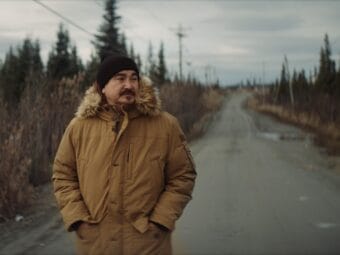
James Dommek Jr. is the executive producer of the new documentary, “Blood & Myth” (Image courtesy of Disney)
A haunting crime story and an Alaska Native legend are at the center of a new documentary that will premiere on Hulu on Sept. 4.
“Blood & Myth” looks into a real-life crime case that happened in Kiana, in Northwest Alaska, over a decade ago.
“It’s all very much rooted in reality,” said James Dommek Jr., the executive producer of the new documentary. “Incredible story of survival and legends and violence and culture.”
Teddy Kyle Smith is an Iñupiaq actor from Kiana who starred in “On the Ice,” a 2011 drama about two Utqiagvik teenagers. In 2012, Alaska State Troopers were investigating the suspicious death of Smith’s mother when he fled to a cabin and had a violent encounter with two hunters. He was later convicted of attempted murder.
In court, Smith said that Iñukuns, or Little People, guided his actions.
Dommek has been intrigued by this incident for years. When he worked at KNBA in 2016, that case came to mind when a coworker asked him if he knew any Alaska stories that would make for a good podcast.
Dommek described Smith’s story in his 2019 bestselling audiobook, “Midnight Son.” The new Hulu documentary is a movie adaptation of the audiobook, where he is also a part of the narrative, trying to uncover what happened in Kiana.
Dommek grew up in Kotzebue hearing about Iñukuns, evil creatures in the high Arctic. They came up in local stories and in conversations with Dommek’s great grandfather, Paul Monroe, who was an Inupiaq storyteller known as Palangun. Dommek said that Iñukuns exist in various legends from Inuit groups across the globe – in Siberia, Alaska, Canada and Greenland.
“If all of us had the same story, and we’re also spread out, it might have an air of truth to it, and my great grandfather’s stories were no different,” he said. “That was one of the big draws to the story for me.”
“Blood & Myth” is a true crime documentary told through an Indigenous perspective, which is rare in today’s entertainment industry, Dommek said.
“There’s the type of story I wanted to see, and no one was making it,” he said. “Everyone else is invited to listen and watch, but at the end of the day, it’s something I made for me.”
With a few exceptions, most of the filming took place in Alaska, including Kotzebue and Kiana. Dommek said it was important for him to make the story look and feel authentic.
“I took my crew up to Kiana, skeleton crew – four wheelers, and boats and village dogs and all that,” he said. “I was like, ‘We’re going to do this, and I’m an Alaskan making an Alaskan story, we can’t fake this.'”
Dommek is also a musician who has played in such Alaska bands as Pamyua
and Medium Build. He has worked in film production, but being an executive producer in his own film is a first. He said he wondered if it was his story to tell but decided to do it after talking to his family and elders in his community. He said he wanted it to be a story about staying true to your culture.
“You pull back all the layers in this story, and at the real heart of the documentary, the main message is, don’t forget who you are,” he said. “Remembering your roots, where you come from, and what makes our people strong, and what has made us survive in a place as harsh as Alaska for this long.”
The film will be streamed on Hulu in the U.S. and Disney+ internationally.
Sen. Donny Olson, D-Golovin, is seen in his office within the Alaska Capitol on May 20, 2025. (James Brooks photo/Alaska Beacon)
On the last day of Alaska’s legislative session in May, Sen. Donny Olson made a mistake.
The longtime Democratic senator from Golovin, mishearing Senate Majority Leader Cathy Giessel, voted to sustain Gov. Mike Dunleavy’s veto of a bill that increases the state’s public school education formula.
Heads snapped to Olson, and his colleague, Sen. Lyman Hoffman, D-Bethel, elbowed him.
When Senate President Gary Stevens asked if any lawmakers wanted to change their votes. Olson stood, and without speaking, pointed at the voting board.
Olson’s silent statement was emblematic of his session.
Sen. Donny Olson, D-Golovin, rises to point to the tally board to change his vote and override Gov. Mike Dunleavy’s veto of HB 57 on Tuesday, May 20, 2025. (Photo by James Brooks/Alaska Beacon)
Now, he’s about to return to the Capitol for a special session called by Dunleavy. Again, education issues are on the calendar, and again, Olson will be asked to cast his vote.
Olson sat down for an interview on May 20, shortly after the Alaska Senate adjourned its regular session for the year. Since then, in a series of interviews, colleagues and those familiar with his work have described a man healing from a severe health condition but one still able to serve in the Legislature.
Olson isn’t up for election until 2028. Barring early retirement, he will become the most senior legislator in 2027, as several of his colleagues leave office.
“The thinking is still the same. The articulation, that’s what, uh, is,” Olson said, struggling to finish the sentence.
Can he still do his job as a senator?
He nodded.
Olson has an extensive career — he’s been a doctor, a reindeer herder, a commercial pilot, and earned a law degree. He graduated from the University of Minnesota-Duluth with a bachelor’s in chemistry before getting a medical degree from Oral Roberts University and, later, graduating from the University of Colorado School of Law.
As challenging as each of those degrees has been — plus family life and his legislative career — recovering from his stroke-like illness may be the toughest obstacle yet.
“It’s still pretty fresh. It’s like a tailspin,” he said.
“You know your feelings, but you can’t quite articulate what your feelings are,” he said.
When Olson left the Capitol in January, several of his colleagues weren’t sure whether he would be able to return. In private discussions, they debated who might fill his seat if he were to resign.
“I did hear a rumor that I am retiring,” he said by text message on July 10. “That is not true.”
“My time in Chicago was incredibly beneficial, and I am grateful for the therapy I received. While I will continue participating in speech therapy as part of my recovery, I am feeling strong and energized to be back at work,” he said in a written statement on March 10, after returning to the Capitol.
He’s continued to undergo speech therapy here in Alaska.
Does he feel like things are improving?
“Oh, for sure. With the month down in intensive (therapy) in Chicago … when I was talking to the stroke people, (U.S. Sen. John Fetterman), the senator from Pennsylvania, I think he was a lot farther down than I am,” Olson said.
Fetterman suffered a stroke in 2022 while running for office and was hospitalized for weeks with depression after being sworn into the U.S. Senate. Afterward, he relied on transcription services and other technological tools to do his job.
Olson’s colleagues say they’ve seen nothing like that from Olson.
“I think he’s got the same sense of humor. He’s got the same — I think he’s got the same cognitive ability. I think it’s just his ability to speak, but even that has improved,” said Rep. Robyn Burke, D-Utqiagvik and one of the two state representatives in Olson’s state Senate district.
Rep. Neal Foster, D-Nome, is the other and could not be reached for comment.
Since his illness, Olson has continued to meet with constituents, lobbyists and local government officials, who said they haven’t had problems communicating with him, even if he can’t speak clearly.
In a pair of interviews with the Nome Nugget — one in April and another after the end of the legislative session — Olson was able to make his positions clear through written responses. When speaking, his staff frequently finished his sentences.
Senate Majority Leader Cathy Giessel, R-Anchorage, has worked as a registered nurse and an advanced nurse practitioner and is familiar with stroke-like symptoms.
She said she hasn’t observed any personality changes. Other lawmakers said the same.
Olson said he’s not 100%, but he is getting better.
“I’m still on the road to recovery … what’s important are the milestones,” Olson said in May.
Sen. Bill Wielechowski, D-Anchorage, said on Wednesday that he spoke with Olson a few days ago.
“He sounded a lot better,” Wielechowski said.
“It was a short conversation; he called me, and he sounded much better than he was. … There was definite progress there,” he said.
Burke is supportive.
“I think he’s still there. I think his speech will continue to improve and come back stronger,” she said, “and he’ll be here. He’ll be here for years to come.”
Rep. Jared Huffman, D-Calif., employed puns and posters denounce the GOP reconciliation bill when the U.S. House Natural Resources Committee marked up the bill on May 6, 2025. (Screenshot/U.S. House Video)
WASHINGTON — In an unusually quiet session, the U.S. House Natural Resources Committee passed a bill to mandate new oil lease sales in the Arctic National Wildlife Refuge and allow construction of the Ambler Road, crossing protected federal land in Northwest Alaska.
Lawmakers approved those items early Wednesday, as part of a budget reconciliation bill, with barely a peep from the Republican side of the room.
Democrats taunted. They fired off passionate assertions that usually get a rise out of the other side. They cajoled. They pleaded. Nothing they did could get Republicans on the committee to debate them.
Alaska Congressman Nick Begich III, like other Republicans, sat calmly scrolling on his phone or leafing through papers.
Republicans had a strategy, and they stuck with it.
Democrats tried to defeat portions of the bill with more than a hundred amendments. The first one would’ve removed the requirement to hold oil lease sales in the Arctic Refuge and killed any chance of ever drilling there.
“The Trump administration’s reckless and thoughtless push to sell off the refuge isn’t about lowering energy costs. It’s about sacrificing your public lands for his billionaire buddies, and that’s why I urge support for this amendment,” said Rep. Jared Huffman, D-Calif. “We should be voting to permanently protect this special place rather than auctioning it off to the highest bidder.”
In response, Republicans said nothing. Although, as soon as Huffman yielded the mic, Committee Chairman Bruce Westerman, R-Ark., made an announcement: Sandwiches were enroute.
“Soon we’ll have lunch in the back,” Westerman said. “We’re not going to recess for lunch, but if you want to go have lunch, you can go in the back room and have lunch.”
That’s how it went, through more than a hundred amendments, for hours at a time.
Democrats said Republicans wanted to avoid debating policy so that the bill wouldn’t get derailed in the Senate. A reconciliation bill is special because Senators can’t filibuster it, but to qualify, all the components have to be about revenue and spending.
The silent treatment had another benefit: The proceedings moved along faster. Still, it was after midnight when the committee passed the bill, by a vote of 26-17. One Democrat voted for it.
Alaska Congressman Nick Begich did not respond to an interview request but he claimed the win.
“This is a major victory for Alaska and for American energy independence,” he said in a statement emailed from his office.
At the U.S. Capitol, opponents of drilling in the refuge often cite the Gwich’in people, whose traditional culture depends on the caribou that give birth in the refuge. But oil development is more popular on the North Slope, in and near the refuge.
The bill “will advance Iñupiaq self-determination on our homelands and support economic development opportunities in our region that are crucial to sustaining our Indigenous culture,” said Nagruk Harcharek, president of a well-funded advocacy group called Voice of Arctic Iñupiat, by email.
Athan Manuel, the Sierra Club’s director of public land protection, has watched the House Resources Committee hold countless Arctic Refuge debates, many of them fiery, since 1998.
“This one feels weirder and worse,” he said.
Years ago, there were Republicans and Democrats on both sides of the debate. The Arctic Refuge fight didn’t entirely align with party labels.
Now, Manuel said, there’s less independent thought in Congress and more partisan dictates.
It was clear from the start, Manuel said, that all the Democratic amendments would fail. And they did.
In addition to the Arctic Refuge provisions, the bill mandates lease sales in the National Petroleum Reserve and Cook Inlet.
The reconciliation bill is controversial for other reasons, and GOP unity might not hold in Congress. Some Republicans say they’ll vote no because the bill adds trillions to the deficit.
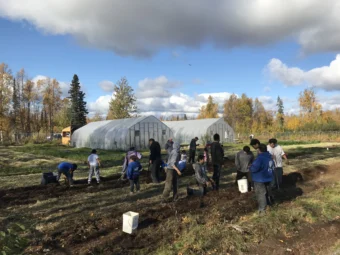
Tebughna School students harvest potatoes at the Tyonek Garden in 2018. (Photo courtesy of Tyonek Tribal Conservation District)
Spring is a busy time at Tyonek Grown, a community farm on the west side of Cook Inlet. Local students come to plant seeds, water them and then harvest organic fruits and vegetables.
This summer, the farm managers had even bigger plans. They wanted to set up a community food forest that would include Indigenous plants and fruit trees.
But the forest – and many more of Tyonek Grown’s plans – are now up in the air. That’s due to federal staff and funding cuts, said Laurie Stuart, the executive director for Tyonek Tribal Conservation District, which manages the farm.
“The loss of those funds in the coming years is going to have a big impact on the growth that we were building,” Stuart said. “The future of the garden is having to be rethought.”
In Alaska, nearly all produce is imported, which makes the food supply vulnerable, especially in rural areas. Some support for local producers comes from the U.S. Department of Agriculture, which is one of many agencies that are cutting employees and programs in response to Trump’s executive orders.
That’s the case for Amanda Compton, who lives in Palmer and works in the USDA’s Natural Resources Conservation Service. The program helps landowners – in Alaska, mainly tribes – to sustainably manage their natural resources. It’s helped villages set up fish passages, reindeer ranches and programs like Tyonek Grown.
That changed with the layoffs and disruptions, Compton said.
“We lost our entire team of people that are working to get Native communities greenhouses, our team that’s getting the Native entities fish passages,” Compton said. “We lost our entire team that communicates between the engineers and tribal entities.”
Tyonek Garden in 2024. (Photo courtesy of Tyonek Tribal Conservation District)
Tyonek, an off-the-road community of about 300 people, is about 40 miles southwest of Anchorage as the crow flies. Produce needs to be flown in, so fruits and vegetables grown at the Tyonek farm give locals a rare chance to enjoy affordable fresh food.
The USDA’s Forest Service, through the Arbor Day Foundation, awarded $900,000 to Tyonek Tribal Conservation District in December. The grant was meant to grow their team and set up a quarter-acre community food forest next to the farmthat would promote food sovereignty and traditional ecological knowledge, Stuart said.
“It’s kind of a community, cultural harvesting space,” she said.
The Forest Service terminated the award, in an effort to comply with Trump’s objectives.
Another terminated USDA grant is the Local Food Purchase Assistance Program. It’s meant to provide money to schools and food banks to buy produce from local farmers and fishermen, said Cayley Eller, Tyonek Grown’s programs manager.
“In Tyonek that meant that we were able to support our local farm operation and compensate the farm for the food that we’re growing and feed community members at low costs, as well as supporting local fishermen and supporting other tribal producers,” Eller said.
Overall, Tyonek Grown has funds to operate now, but the near future is uncertain.
“It’s a food security farm production space, and that means we’re not making a profit on our produce,” Eller said. “Our goal is to feed the community, and that means we’re heavily reliant on grant funds.”
Reindeer herders in limbo
Meanwhile, about 500 miles northwest, around Nome, reindeer herders are wondering about their future, too. Tribal liaisons used to help herders apply for grants and establish rotational grazing plans, said Nathan Baring, director of the Reindeer Herding Association, which provides technical assistance to herders in Bering Strait communities.
Reindeer graze at the Midnite Sun Reindeer Ranch near Nome. (Photo courtesy of Midnite Sun Reindeer Ranch)
The Trump administration also halted a USDA grant meant to support Indigenous peoples’ animal harvests and help communities expand their meat processing, he said.
“Having all of that kind of just thrown either into the air or outright eliminated just simply means that we start over in terms of shopping those projects around again, which then further delays what I would describe as Alaska’s untapped potential in a pre-existing livestock industry,” Baring said.
Bonnie Suaŋa Scheele is an Iñupiaq reindeer herder at the Midnite Sun Reindeer Ranch near Nome. She said that for herders like her, interruptions in federal programs mean that it’s harder to find funds to build temporary housing for workers and corrals for holding animals.
Scheele said she should be at her ranch now, but she can’t be. She was counting on another frozen grant — this one from the Bureau of Indian Affairs — to help pay for upgrading her power source.
Despite the challenges, Scheele said herders will figure out a way to continue the practice, even if it means providing food for just their villages instead of expanding their operations.
“We’ll overcome it. We’ll figure it out,” she said. “It’s going to come back around, and we’re still, we’re still here, we’re still herding reindeer. We’re still providing for communities.”
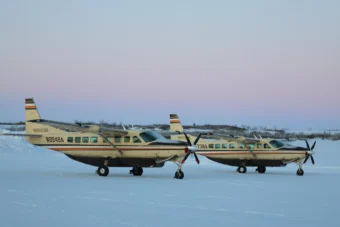
The Cessna Caravan is a mainstay in Bering Air’s fleets. Caravans were parked at the Nome Airport on Friday, Feb. 7, 2025, as a massive search was ongoing for the plane that went missing the day before on its way from Unalakleet. (Ben Townsend/KNOM)
The passenger plane that crashed near Nome last month, killing all 10 people on board, was hundreds of pounds overweight according to a preliminary report from the National Transportation Safety Board.
The NTSB released its first report Wednesday on the crash of Bering Air Flight 445. The Cessna Caravan was en route from Unalakleet to Nome. A massive search extending into the next day found the plane on an ice floe, which had been moving up to 10 miles per day, at a location 34 miles southeast of Nome.
The dead include:
34-year-old Chad Antill of Nome (pilot)
52-year-old Liane Ryan of Wasilla
58-year-old Donnell Erickson of Nome
30-year-old Andrew Gonzalez of Wasilla
41-year-old Kameron Hartvigson of Anchorage
46-year-old Rhone Baumgartner of Anchorage
52-year-old Jadee Moncur of Eagle River
45-year-old Ian Hofmann of Anchorage
34-year-old Talaluk Katchatag of Unalakleet
48-year-old Carol Mooers of Unalakleet
At the request of U.S. Sen. Dan Sullivan, NTSB Chair Jennifer Homendy visited Nome soon after the crash, one of the deadliest in recent Alaska history. Residents of the region came together to support families of the victims as well as Bering Air, which has flown in Northwest Alaska for 45 years.
‘A tremendous amount of information’
Clint Johnson, the NTSB’s Alaska chief, said Wednesday that investigators haven’t yet determined why the plane was overweight.
“There’s no way around that. Unfortunately, our estimations are that the airplane was about 1,000 pounds over gross (weight),” Johnson said.
Still, Johnson said, it isn’t yet clear what specific role the weight might have played in the plane’s crash and whether other factors were involved.
Johnson noted that investigators have recovered several avionics components from the plane, with data from them still being assessed.
“That has given us a tremendous amount of information,” he said. “We’re still poring over that information at this point.”
According to the report, the flight originated in Nome and headed to St. Michael and Unalakleet, before taking off on a return leg to Nome at 2:37 p.m. on Feb. 6. It headed to Nome at a cruising altitude of 8,000 feet, under instrument-only flight rules for a time, then began a planned descent to 6,000 feet just before 3 p.m.
At about 3:15 p.m., an air traffic controller informed the Caravan that the Nome airport’s runway was closed for about 10 to 15 minutes due to deicing.
“The controller added that if the pilot wanted to ‘slow down a little bit’ to prevent the flight from arriving before the runway reopened, that would be fine, and the pilot acknowledged,” investigators wrote.
A minute later, the controller asked the plane to descend to 4,000 feet, which the pilot acknowledged.
In about 15 minutes, between 3 p.m. and 3:15 p.m., the plane’s airspeed gradually fell from a peak of about 160 knots to 112 knots and continued to decrease. It had also turned from a westerly heading to a southerly one.
“At (3:19 p.m.), the autopilot disengaged,” investigators wrote. “At that time, the airplane’s airspeed was 99 knots. About 19 seconds later, the airspeed had decreased to about 70 knots, and the altitude was about 3,100 (feet above sea level) which was the end of the data available from the onboard avionics.”
A final data point from the plane’s avionics, at 3:20 p.m., showed it 32 miles east of Nome and 12 miles offshore over Norton Sound. Third-party satellite data eight seconds later showed it at an altitude of 200 feet.
“(One second later), the controller transmitted a low altitude alert to the pilot,” investigators said. “The controller’s efforts to contact the pilot were not successful, and no further communications were received.”
Plane was 969 pounds overweight, NTSB says
Antill’s pilot records showed that he had about 2,500 hours of flight time, including just over 1,000 hours in Cessna Caravans. He had flown with Bering Air since 2022, completing a Cessna cold-weather operations course in October and recurrent ground training in January.
The crashed Caravan was fitted with a TKS ice protection system, which Johnson called a “weeping wing” designed to dispense deicing fluid from wing and tail surfaces’ leading edges in flight. That system was mechanically functional based on examination of the wreckage, he said.
The plane was also fitted with a fuselage cargo pod, according to the NTSB. Preliminary calculations found that the plane’s gross takeoff weight was about 9,776 pounds.
“This was about 969 (pounds) over the maximum takeoff gross weight for flight into known or forecast icing conditions under the TKS system supplement,” investigators wrote. “It was also about 714 (pounds) over the maximum gross takeoff weight for any flight operation under (a) flight manual supplement.”
The report says Bering Air’s load manifest estimated that the plane was carrying about 709 pounds of baggage and cargo. A post-accident examination found that approximately 798 pounds was aboard at the time of the accident.
A weather report from the Nome airport at 3:45 p.m. noted light snow for about 10 minutes shortly after 3 p.m., as well as “trace precipitation” and “trace icing” just before 3 p.m.
Searchers had said no emergency locator transmitter signal was detected from the plane, which investigators at the crash site initially confirmed.
“However, the on-scene examination determined that the ELT had become disconnected from the antenna likely during the impact sequence,” investigators said. “When a portable ELT antenna was installed, a strong signal was heard from a handheld receiver.”
Bering Air crash was ‘eerily similar’ to 2021 incident
Johnson said the flight data, and the sequence of events it depicted, has led investigators to revisit a 2021 incident near Fairbanks in which a Wright Air Service Caravan suddenly dropped thousands of feet. Nobody was injured in that incident, but a final NTSB report found that the plane was overweight when it encountered icing and suffered an abrupt loss in airspeed, with its autopilot subsequently disengaging.
Johnson called the events of the 2021 altitude drop “eerily similar” to the Bering Air crash, although the Wright Air Service plane was fitted with a less-powerful engine. Autopilot procedures often call for them to be checked during flight in icing conditions, but what happened during last month’s Bering Air crash is still not clear, Johnson said.
“We are in the process of looking to see what the sequence of events were, as far as the airspeed drop, the disconnection (of) the autopilot,” he said. “Was that pilot-induced? Was that automatically done? We don’t know, but we are drilling down into that information as we speak right now to see if we can get a little bit better of an idea and understand the final moments of this flight.”
Johnson said Wednesday that a total of 15 to 20 people are involved in the crash investigation, including NTSB officials and expert sources whom they are consulting. A final investigation report is expected in 12 to 18 months.
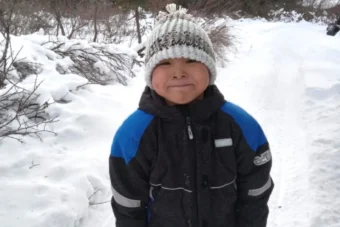
Colton Koonooka-Kowchee. (Photo courtesy of Photo courtesy of Venessa Marie Koonooka)
Roseann Titus was getting ready Thursday morning when she saw flames coming from a bathroom at the front of her house in the Western Alaska village of White Mountain. Her granddaughter and great-grandson were still in bed.
Titus said she tried unsuccessfully to put out the fire and then rushed to wake them up. But the flames spread into the hallway, blocking the way out of the house.
That’s when her great-grandson, 8-year-old Colton Koonooka-Kowchee, sprang into action.
“We didn’t know how to contain it, so he kind of jumped out the window and ran for help,” Colton’s mother, Venessa Marie Koonooka, said.
A multigenerational home in White Mountain burns in the early morning of Feb. 20, 2025. (Photo courtesy of Venessa Marie Koonooka)
She said her son plunged 10 feet from the window into a snowdrift below. Then he ran through deep snow to get help – which came in the form of Shane Bergamaschi, a volunteer firefighter.
Bergamaschi helped pull Titus through a window and rushed her to the local clinic to await a medevac.
“They helped us right away when we got in there with my grandma’s burns and smoke inhalation,” Marie Koonooka said. “I only had a popped knee and a few frostbites on my toes. I was okay.”
Titus was flown to Anchorage, where she was treated for burns on her shoulder and arm. The home was a loss, including personal belongings and two moose legs from a recent hunt.
Roseann Titus at work at the White Mountain School. (Courtesy photo)
Colton’s grandmother, Nora Brown, who was not in the home at the time, credited her grandson with keeping the situation from getting much worse.
“If it wasn’t for Colton jumping out on his own, we would have probably lost my mother, and the houses nearby probably would have caught fire,” Brown said.
Titus has worked for the Bering Strait School District since 1988. Bering Air is ferrying donations to the family, and a GoFundMe has been set up.
Close
Update notification options
Subscribe to notifications
Subscribe
Get notifications about news related to the topics you care about. You can unsubscribe anytime.