ICT

‘Always in our hearts’: September is an important month for boarding school survivors

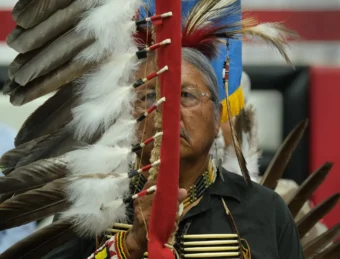
James Nells, Navajo, a U.S. combat veteran, carries an eagle staff as part of the color guard presentation beginning the “Road to Healing” hearing at Riverside Indian boarding school in Anadarko, Oklahoma, on Saturday, July 9, 2022. Survivors of boarding schools told then-U.S. Interior Secretary Deb Haaland, Laguna Pueblo, of the abuses they sustained at the schools. (Photo by Mary Annette Pember/ICT)

WARNING: This story contains disturbing details about residential and boarding schools. If you are feeling triggered, here is a resource list for trauma responses from the National Native American Boarding School Healing Coalition in the U.S. In Canada, the National Indian Residential School Crisis Hotline can be reached at 1-866-925-4419.

For Ponka-we Cozad, the National Day of Remembrance for Indian boarding school survivors is personal.

Members of her family attended boarding schools and shared hurtful stories about their days in the schools.

“In some way, shape or form, as Native peoples, we all have a story to share about the Indian boarding school era,” said Cozad, director of policy and advocacy at the National Native American Boarding School Healing Coalition. Cozad is Tohono O’odham Nation of Arizona and the Ponca Tribe of Indians of Oklahoma.

“This is why I’m doing this work; when we talk about something always being in our hearts, it’s personal,” she told ICT.

The annual National Day of Remembrance for U.S. Indian boarding school survivors on Sept. 16 in Washington, D.C., includes a special event sponsored by the coalition, known as NABS, from 5-7 p.m. EST at the Indian Gaming Association building.

The theme of this year’s event is “Always in our hearts.”

A number of other gatherings are scheduled across Indian Country to commemorate the Day of Remembrance with vigils, prayers, and other events in museums, churches and local communities.

September is an important month on both sides of the U.S. border. September 30 is the National Day for Truth and Reconciliation in Canada, known as Orange Shirt Day, in memory of the residential school students and the harsh conditions they endured. It became a national holiday after more than 1,000 unmarked graves were found at residential schools, including at the Kamloops Indian Residential School.

In the U.S., where thousands of Native children died in boarding schools, the National Day of Remembrance provides an opportunity for tribal leaders, survivors, descendants of survivors as well as congressional members and the public to come together to honor and recognize children who never returned home from the schools.

This year, the event coincides with the National Congress of American Indians Tribal Unity Impact Days, Sept. 16-18, also in Washington, D.C.

During the Impact Days,  NCAI organizes sessions in which tribal leaders can meet with members of Congress and federal agency officials in order to advocate for priorities such as fiscal year 2026 appropriations, public safety, economic development, housing, self-determination and other issues.

The Day of Remembrance also coincides with the fall session of the U.S. Congress, which convened on Sept. 2, giving lawmakers another opportunity to consider passing the Truth and Healing Commission on the Indian Boarding School Policies  Act (S.761). The act would establish a commission to investigate, document and report on the histories of Indian boarding schools, develop recommendations for federal efforts based on those findings and promote healing for survivors and descendants.

Although the bill passed  the Senate with a unanimous vote in December 2024, the House of Representatives did not bring the bill up for a vote before the legislative session ended.

In March, 2025, U.S. Sens. Lisa Murkowski, a Republican from Alaska, and Elizabeth Warren, a Democrat from Massachusetts, reintroduced the bill. It is now awaiting further consideration and a full vote in the Senate.

At the event in Washington, a light reception and candlelight vigil will be held, and will include remarks from Deb Parker, the chief executive officer of NABS and a citizen of the Tulalip Tribe and descendant of the Yaqui and Apache tribes.

This story was originally published by ICT.

One branch at a time: 2025 Herring Egg Harvest

men sit in a small boat filled with hemlock branches on the ocean
Jeff Jackson, Tlingit of the Kaach.ádi Clan from Kake, and Chris Pata, adopted into the Shangukeidí Clan of Juneau, prepare to set a tree into the waters of the Kasiana Islands in Sitka Sound in March 2024. The traditional process, used during herring spawning season, involves anchoring the tree with a rock and marking it with a buoy. Knowledge of local tides, spawning patterns, and the ocean floor is key to a successful set. (Photo courtesy of Gooshdeihéen)

The sunlight bounces off the glassy surface of Sitka Sound as community herring fish egg harvesters navigate the waters with boats loaded with hemlock branches for the fish to lay eggs on. Surrounded by the whales, and the sounds of lively seals, sea otters, sea lions and countless seabirds, this annual harvest is a cherished sign of spring for people living in Southeast Alaska. After months of gray skies and cold weather, both people and wildlife eagerly embrace this moment.

Steve Johnson, recognized by his Łingít name Ixt’Ik’Eesh, is a prominent community leader from Sitka.

“It’s like the first real taste of spring that we get here,” Ixt’Ik’Eesh said excitedly

Of the Kiks.adi Clan of Sitka, Ixt’Ik’Eesh has been harvesting herring fish eggs for most of his life. His earliest recollection of the harvest dates back to his childhood, a memory he cherishes deeply. Ixt’Ik’Eesh recalls being on the skiff with his father and uncle, surrounded by the vast ocean.

“I remember putting my hand in the water, and I could feel the herring as they ran around it, and just the sight and the smell of it and the beauty of the world around us,” recalled Ixt’Ik’Eesh. “It’s an amazing time of the year.”

He now plays a vital role in educating community members on the techniques of harvesting herring eggs. He has successfully trained around 100 participants in the community harvest program he leads. This volunteer-driven program involves coordinating volunteers to collect and distribute the eggs through a Facebook group. Active for two decades, the program has successfully distributed about 17,000 pounds of eggs, benefiting roughly 20,000 people. This initiative not only feeds the community but has also empowered individuals by providing them with the necessary experience and knowledge to launch their own fishing operations.

people stand along a dock surrounded by bins of herring eggs
Volunteers at the production line packing up herring eggs. Left to right: Lucas Goddard, Tlingit of Kik.sadi Clan;, Ixt’Ik’Eesh, Tlingit of Kiks.adi Clan;, Oliver Koutchak, Inupiaq; and CJ Johnson-Yellow Hawk, Dakota band of Ihanktownna. (Photo courtesy of Mary Goddard)

“There was a period of time not too long ago where there was just a little over a dozen harvesters left, and that was really scary to me on a number of ways,” explains Ixt’Ik’Eesh.

For Ixt’Ik’Eesh, it is crucial to preserve and pass on the traditional knowledge of herring egg harvesting to ensure it remains a vital part of Łingít culture rather than fading into history.

“This is one of the few practices that we have that have been unbroken by colonization.” says Ixt’Ik’Eesh.

He not only brings valuable experience and oversees a community harvest program, but also holds formal leadership roles for both Sitka and the state of Alaska, serving on various boards and commissions, in addition to being a Council member of the Sitka Tribe of Alaska. Last year, he represented the Sitka Tribe of Alaska at the Alaska Board of Fisheries meeting as a traditional harvester, where he advocated for the protection of Promisla Bay from commercial fishing. He proposed designating the bay as part of the subsistence conservation zone, highlighting its significance as a major producer of herring eggs and a vital harvesting area for locals.

The proposal didn’t pass but that hasn’t stopped Ixt’Ik’Eesh, and his work doesn’t go unnoticed. In a nomination form for the Joint Board of Fisheries/Commercial Fisheries Entry Commission Herring Revitalization Committee, which is a combined board of the Alaska Commercial Fisheries Entry Commission and the Alaska Board of Fisheries to herring across the state. Ixt’Ik’Eesh has been recognized as the number one producer of subsistence herring egg harvesting.

The nomination highlighted his work providing herring eggs to over 10,000 households through the implementation and 20 years of distribution of tribal food security initiatives. Additionally, it recognized his extensive experience, exceeding 25 years, in both subsistence and commercial fishing.

Ixt’Ik’Eesh shared that he is guided by the Kiks.adi Clan principle of sharing. It serves as a powerful reminder of generosity.

“We measure people, and particularly leaders, not by what they have or what they show but by what they give away,” says Ixt’Ik’Eesh. “And so for me, that’s a big part of my upbringing, of my core values, and that whenever we have an abundance of something, we share it.”

This philosophy is reflected in the numbers. According to the Alaska Department of Fish and Game, in 2023, “93% of the harvest was shared with other households within Sitka or in other communities in the state and beyond.” This level of sharing underscores ancestral traditions that prioritize community health and connection.

Despite the unsuccessful Promisla Bay proposal and complexities of colonial management systems, Ixt’Ik’Eesh will always be found on his traditional homelands and ocean. This bond is rooted in a deep cultural understanding of his place and calling. Engaging in the labor of harvesting for community members and individuals who are unable to access the eggs is a task that is both physically and mentally demanding. However, Ixt’Ik’Eesh finds joy in this work, as it allows him to contribute to the well-being of his people while honoring traditional practices. The Facebook group plays a crucial role in this dynamic, serving not only as a means of communication and organizing but also as a place to share memories.

Left to right: Lucas Goddard, Tlingit of Kik.sadi Clan, and Ixt’Ik’Eesh, Tlingit of the Kiks.adi Clan, box up herring eggs to send to Juneau for tribal citizens to enjoy. (Photo courtesy of Mary Goddard)

“I really like it when people send pictures and when they post pictures of their family meals and their gatherings and people enjoying them and knowing that myself and my friends and volunteers all had a very strong hand in producing that food that’s on their table that they’re enjoying.” says Ixt’Ik’Eesh.

Capturing Community

One of the volunteers aboard Ixt’Ik’Eesh’s boat this season was Mary Goddard, a Łingít filmmaker and artist. She experienced the herring egg harvest in Yakutat as a young girl and remembers her and her mother running to the beach to witness the herring spawn. They’d return the next day to check if the eggs were ready to eat. She recalls pulling seaweed from the ocean, each strand covered in herring eggs. Originally from Yakutat, a Southeast Alaska community about 230 miles from Sitka, Goddard hadn’t experienced the large harvest that Sitka is known for but still felt the same excitement.

A smiling woman holds a branch covered in herring eggs
Mary Goddard, Tlingit of the Kaagwaantaan clan, proudly holds up a hemlock branch thick with herring eggs. (Photo courtesy of Dave Fedorski)

“It was fun to be able to just walk down from our house to the beach and grab those herring eggs and eat them for dinner that night,” says Goddard. Her first career path was in acting, which took Goddard across the country to New York City, where she attended the American Musical and Dramatic Academy. But along the way, she fell in love with filmmaking. After spending 15 years in the industry, she returned to Alaska.

That leap of faith led her to found her own production company, MidnightRun LLC. After moving to Sitka, she came to see the harvest as a community celebration to welcome spring. Due to her curiosity as a filmmaker, Goddard herself began harvesting.

Aboard a boat in the ocean loaded with about 30 hemlock trees, Goddard was nervous yet excited because of her role in the harvesting process.

“My role this year was really fun, because I gotta do it from start to finish,” says Goddard.

The process begins by determining the spawning locations and timing for herring, which, according to Goddard, happen during the spring season when dollar-sized snowflakes are falling from the sky. Following this, the volunteer crew prepares by searching for medium-sized hemlock trees that have fresh needles, as these provide a desirable flavor for the herring eggs. Once enough branches are collected, they are placed in the water, secured with weights and buoys. The next step involves checking the branches one or two days later, with the hope that the herring will have laid their eggs on the gathered branches.

“Then a couple of days later, you’ll come back and pull up those trees and if it’s a good harvest, they’re rich and thick, full of herring eggs,” says Goddard.

Harvesting has evolved into more than just a filming opportunity; it has become a chance for Goddard to share this tradition with her son. This season, she took her 9-year-old out on a Saturday to scout for trees in preparation for the harvest. By bringing her community on screen, Goddard also returned home to connect younger generations with their elders, utilizing filmmaking as a tool to generate enthusiasm for traditional practices.

“Being able to teach the youth in a way that maybe they’re already engaged with is one way to ensure that the youth will continue to practice our harvesting ways,” says Goddard.

Ultimately, Goddard wants her son to appreciate the effort involved in harvesting from the land and recognize the value of natural resources like herring eggs. She emphasizes that it is far easier to waste food purchased from a grocery store than to invest the time and energy required to gather and prepare food sourced directly from the earth or sea. Additionally, she highlights the deep connection that Indigenous peoples have with the animals they rely on, underscoring the importance of respect and stewardship in their relationship with nature.

herring eggs on hemlock branches sit in an orange plastic basket
Baskets of herring eggs are transferred from coolers to fish boxes in preparation to ship out around Alaska and Washington to share with tribal citizens. (Photo courtesy of Mary Goddard)

“I want him to be able to respectfully harvest, respectfully take care of his body through healthy food that he knows where it came from,” Goddard said.

“I want him to really care for himself by eating really healthy food, and being connected to community and gratitude, and all these amazing things that subsistence living teaches you,” Goddard continued.

Family tradition

Like Goddard, for Ricardo Worl, known by his Łingít name Gooshdeihéen, this is a family tradition, something he has looked forward to since childhood. Although he was too young to be on the ocean, he was able to contribute to the harvesting process in other meaningful ways. Gooshdeihéen remembers packaging the eggs collected by his uncles in Sitka, often handling boxes that weighed as much as 50 pounds. Surrounded by family, he participated in the enduring tradition of utilizing and processing the resources provided by the land.

“I just remember me and my cousins receiving that box excitedly, and vacuum sealing it, sharing it out,” reflects Gooshdeihéen.

As a community harvester, he can now be found alongside his uncles in the ocean each spring. As a nephew, he is expected to learn from their experience. His responsibilities extend beyond merely acquiring knowledge; he is also tasked with engaging in physically demanding work.

“My role was to cut down all the trees, bring them from out of the woods, down to the boat so they could put the trees and branches into the water,” Gooshdeihéen said. “And after the herring had spawned on the trees, my job was to pull the trees up to the boat so we could clip the branches off and pull them in.”

Gooshdeihéen didn’t formally participate in the harvest until after completing his undergraduate education at Whitworth University in Spokane, Washington, in 2021. After Gooshdeihéen returned home to Juneau he enrolled in the Haa Yoo X’atángi Deiyí: Our Language Pathway Project to learn his Łingít language. In the program, Gooshdeihéen expressed that he was interested in reconnecting his language with subsistence practices.

men on a fishing boat examine branches covered in herring eggs
Left to right: Jonathan Ross, Dena’ina and Gooshdeihéen, Tlingit of the Kaagwaantaan Clan, harvest herring eggs from submerged trees. After the herring finish spawning, the trees are pulled up and tied off to the boat. Large branches are clipped for easier handling, while the rest are returned to the ocean to support the herring’s life cycle. (Photo courtesy of Anna Michelle Schumacher)

“I found that becoming a language scholar has made me a better fisherman and being a better fisherman has made me a better language learner,” says Gooshdeihéen.

He believes that both elements of the language and ways of living are inherently intertwined, and says he now has a greater appreciation when learning about his heritage.

Although Haa Yoo X’atángi Deiyí ended in 2023, Gooshdeihéen continues his linguistic journey to translate the Łingít language, aiming to contribute to the development of educational curricula. He shares that he is not only grateful for past language speakers but that his community is “lucky that our aunties, uncles, and grandparents documented a lot of our language, so there’s a lot to be translated. ”

Gooshdeihéen is one of the 22,601 individuals of Łingít descent, according to the latest Census data. The Łingít people are the largest group of Alaska Natives with a rich cultural heritage and historical presence in Alaska. According to the Alaska Native Language Center there are about 500 speakers of the Łingít language.

“I’d love to do translation and curriculum development to create some curriculum and language learning resources for future generations,” says Gooshdeihéen.

Gooshdeihéen’s goal and data figures highlight the ongoing efforts to preserve and revitalize the language, which is an integral part of the Łingít identity.

In the meantime, he is enrolled in language classes at the University of Alaska Southeast and coaches the Yadaa.at Kalé ski team, and the cross-country, and track teams at Juneau-Douglas High School. When he isn’t focused on language studies, skiing, or retrieving heavy tree branches from the ocean, Gooshdeihéen enjoys preparing herring eggs by blanching them on the branches, then picking them off and dipping them in seal grease. He has also been experimenting with new methods to enjoy this traditional delicacy.

“But recently, I have been trying new recipes with the row on kelp, where I sort of marinate it like you would kimchi,” says Gooshdeihéen.

Beyond trying new recipes and learning traditional ways of living, Gooshdeihéen is part of a larger network of Indigenous people who are living the traditional ways of their ancestors. Belonging to the Kaagwaantaan clan, Gooshdeihéen shares that having the opportunity to harvest herring eggs with his uncles not only reinforces his connection to the land but also the connection to his clans and community. He explained that when he is out on the ocean, he is amazed that he can “connect with the lands that my ancestors stewarded and do the things that they’ve been doing since time immemorial.”

“I’m doing the same thing in 2025 that my ancestors were similarly doing 10, 15,000 years ago,” Gooshdeihéen continued.

A 2019 study by the University of Alaska Southeast confirms this.

“In northwestern North America, the archaeological record of faunal remains shows that herring were fished for more than 10,000 years and were routinely taken by at least 4,000 BP (Before Present),” the university announcement of the study said.

He is dedicated to continuing his ancestral traditions in other ways as well.

“I made sure I shared a box with my grandparent’s people, the T’akhdeintaan out of Hoonah, and it’s really rewarding, and it feels good to reinforce these clan connections that have been also maintained since time immemorial,” says Gooshdeihéen.

The lessons he learned in childhood remain meaningful as he continues to pack eggs into boxes for his community.

Historical Athabascan and Tlingit trade routes

One of the special boxes was sent to Val Adams, a Gwich’in and Koyukon Athabascan from Beaver, who lives in Fairbanks, Alaska. Her friend, Sara Beaber-Fujioka, whom she knows through church, sent the box from Sitka. Beaber-Fujioka’s late husband was a fisherman who also harvested herring eggs and through his knowledge and relationship with Alaska Native traditions, also packaged and sent similar boxes.

“Harvesting and sharing food was central to his life, and so we had been harvesting and sharing herring eggs as this amazing abundance that we have in Sitka,” says Beaber-Fujioka.

After her late husband’s passing, Beaber-Fujioka and her daughters decided to carry on the legacy. She says that being able to share this abundance with people she knows will carry forward the joy of giving, especially among elders, is Beaber-Fujioka’s way of giving back to the community.

Adams chose to share the mail by distributing the eggs among the elders in the Denakkanaaga program, a nonprofit organization that provides cultural programming for elders living in the Interior.

“It’s our traditional way,” says Adams. “It’s our custom to share, especially delicacies such as this.”

A woman standing in a kitchen smiles while a long strand of seaweed covered in herring eggs
Val Adams, Gwich’in and Koyukon Athabascan of Beaver, Title VI Director at Denakkanaaga, cuts up the herring eggs to distribute to elders in Fairbanks, Alaska, on April 1, 2025. (Photo courtesy of Denakkanaaga)

Sharon McConnell, the executive director of Denakkanaaga, emphasizes that this generosity illustrates the historical trade relationships that existed before Western contact. As noted by Sealaska Heritage, Łingít people have always historically traded amongst themselves and neighboring communities for goods that couldn’t be found in the region. Łingít’s offered, “greenstone for tools, clams, mussels, red and yellow cedar, dried halibut and salmon, seal oil, herring eggs, seal meat, hooligan oil, and berries.”

“Through the decades we’ve traded with other tribes throughout the state of Alaska, and the bonds have been made between Native people in different regions of Alaska, and one is between Southeast Alaska and Interior Alaska,” says McConnell.

While the box of herring eggs didn’t cross the vast landscape through the rivers, mountains, and lakes on a trade route, the eggs were still enjoyed by the elders. McConnell shared that everyone loved it as the elders enjoyed the eggs to their liking, such as eating them raw or blanching the eggs before eating.

“For those in Southeast to share it with us, it’s very meaningful and very appreciated,” reflects McConnell.

the sun sets behind mountains overlooking the ocean of Sitka Sound
Harvesters return home from harvesting herring eggs while the Sitka sun sets marking the beginning of spring. (Photo courtesy of Mary Goddard)

The 2025 herring egg harvest in April serves as a reminder of how traditional values continue to foster unity among diverse communities of Alaska. This annual harvest, deeply rooted in Indigenous practices, reflects a respect for nature and a commitment to sharing resources. As the herring spawned, various clans, each with their own histories, came together to participate.

Goddard shares that the act of gathering isn’t only a means of food security but also reinforces the community aspect of this practice.

“I don’t think we were meant to do it on our own, or especially in our cultures, we weren’t meant to do it on our own,” Goddard said. “We’re meant to rely on each other, and I think that is something like the herring egg harvest really represents.”

ICT originally published this article. ICT is an independent, nonprofit, multimedia news enterprise. ICT covers Indigenous peoples.

Number of Native and Alaska Native-owned businesses slips by 2%

The Anchorage office of Arctic Slope Regional Corp. is pictured, on Feb. 19, 2020. (Photo by Joaqlin Estus/ICT)

The number of American Indian and Alaska Native-owned businesses in the United States declined by more than 2% from 2021 to 2022, though those businesses enjoyed a 44% increase in receipts, an 8% increase in employees and a 13% increase in employee payroll, according to U.S. Census Bureau estimates released on Dec. 19.

The bureau’s 2023 Annual Business Survey, which covers reference year 2022, showed there were 47,519 American Indian and Alaska Native-owned businesses that year with $78.5 billion in receipts, 333,153 employees and about $14.6 billion in annual payroll in 2022.

The survey also found that the number of Native Hawaiian and other Pacific Islander-owned businesses increased by nearly 15% from 2021 to 2022, from 8,324 to 9,552. Those businesses saw a more than 31% increase in receipts from $10.5 billion to $13.8 billion, a 29% increase in employees from 53,277 to 68,795, and a 28% increase in annual payroll, from $2.5 billion to $3.2 billion.

Overall, the Annual Business Survey found that the number of U.S. businesses from 2021 to 2022 held steady at 5.9 million, while minority-owned businesses increased 8% from 1.2 million to 1.3 million, veteran-owned businesses declined by 10% from 304,823 to 273,542, and women-owned businesses remained around 1.3 million.

Other findings from the Annual Business Survey include:

  • Veteran-owned businesses had an estimated $884.5 billion in receipts, 3.2 million employees, and $179.7 billion in annual payroll.
  • Women-owned businesses had an estimated $2.1 trillion in receipts, 11.4 million employees, and $508.5 billion in annual payroll.
  • There were an estimated 650,680 Asian-owned businesses in the United States in 2022, an estimated 144,141 (22.2%) of them were in the Accommodation and Food Services sector. Asian-owned businesses had the largest estimated receipts ($1.2 trillion) among minority race groups.
  • There were an estimated 194,585 Black or African American-owned businesses, with $211.8 billion in annual receipts, 1.6 million employees and about $61.2 billion in annual payroll. About 49,872 (25.6%) of them were in the Health Care and Social Assistance sector.
  • The number of Hispanic-owned businesses grew about 14.6%, from 406,086 in 2021 to 465,202 in 2022, and made up about 7.9% of all U.S. businesses with an estimated $653.5 billion in annual receipts, 3.6 million employees, and approximately $143.2 billion in annual payroll.

ICT originally published this article. ICT is an independent, nonprofit, multimedia news enterprise. ICT covers Indigenous peoples.

Thousands of Alaska Natives to gather in Anchorage this week

Audience watches a dance group perform at the Alaska Federation of Natives convention in October 2018 at the Dena’ina Convention Center in Anchorage, Alaska. (Photo from video by Joaqlin Estus/ICT)

Coming up in Anchorage next week is the First Alaskans Institute’s Elders and Youth conference Oct. 13 to 16, followed by the larger Alaska Federation of Natives (AFN) convention Oct. 17 to 19.

The second and larger of the two gatherings, the Alaska Federation of Natives Convention, brings together delegates from tribes, village and regional for-profit corporations, and regional nonprofit entities. It’s a public event that draws from 4,000 to 6,000 people. AFN’s 2024 convention theme is “Our Children – Our Future Ancestors.” AFN’s website describes it as, “the principal forum and voice for the Alaska Native community in addressing critical issues of public policy and government.”

AFN’s keynote speaker will be outgoing president Julie Kitka, who is Chugach. She announced her resignation from AFN in February. She’s been with the statewide advocacy organization for 40 years, after getting her start there in 1984 as a special assistant for human resources. She went on to serve as AFN’s Washington, D.C., lobbyist and vice president before the board elected her as president in 1990. She recently was inducted into the National Native American Hall of Fame.

At the convention, delegates hear speeches, reports from political leaders, and presentations by panels of experts. On its website, AFN said participants “share stories of resilience, experiences, strengths, knowledge, and hope for the future. The resolutions passed by the voting delegates set the priorities for the year and guide AFN’s efforts. The Convention is the largest representative annual gathering in the United States of Native peoples.”
The 2024 convention will host panels on strengthening subsistence rights, Alaska’s brain drain, and a report by the Alyce Spotted Bear & Walter Soboleff Commission on Native Children. Another session will cover barriers that Alaska Natives face in education, access to public services, and the right to vote, as well as legislative and judicial efforts to remove those barriers.

Tickets for the evening traditional dance performances, called Quyana Alaska, regularly sell out. The Alaska Native Customary Art market, where hundreds of artisans sell items such as jewelry, clothing, sculptures, paintings, and regalia, is likewise popular.

The first of the two gatherings, the Elders and Youth conference, is hosted by the policy and advocacy nonprofit First Alaskans Institute. Its website described the conference as, “a unique space for our communities to come together and learn about a variety of topics such as traditional and subsistence practices, arts, advocacy and more.” The 2024 conference theme is: “Dinjii Zhuh K’yàa Zhit Gwarandaii,” a Gwich’in Athabascan phrase that translates to “Our Land Our Food – We are Living Our Indigenous Ways of Life.”

The institute’s president and CEO Roy Agloinga, who is Yup’ik and Iñupiaq, said a special feature this year is the presence of several traditional healers to help people. Agloinga said even some sessions that are not meant to be heavy can “bring up deep issues around colonization or really reclaiming our language, our culture, and our food.” For example, some may “involve people talking about and acknowledging the loss that they’ve had around language and the memories of their parents or their grandparents being able to speak,” Agloinga said.

There will also be more lighthearted sessions such as a talent show and a teen dance, and hands-on sessions such as one on how to cut fish. “They’re really about affirming our culture, our language, and our practices. We (also) have a session that’s going to be about stewarding the land, which is a strong session where we’re really talking about our tradition of taking care of this place that we are from and our deep connection to the land that we have,” Agloinga said.

The Elder keynote address will be by Rosita Worl, a longtime advocate for subsistence and the president and CEO of Sealaska Heritage Institute. The Youth keynote speaker will be Sam Hiratsuka, who is Aleut, Yu’pik, Winnemem Wintu, and Navajo. He’s a legislative assistant for U.S. Rep. Mary Peltola.

The First Alaskans Institute on its website said the conference typically attracts more than a thousand people.

Both gatherings will be at the Dena’ina Convention Center, at 600 W. 7th Ave., in downtown Anchorage.

The week also features a half-day tribal workshop on Oct. 16 on subsistence, various receptions, entertainment and meetings of other organizations.

ICT originally published this article. ICT is an an independent, nonprofit, multimedia news enterprise. ICT covers Indigenous peoples.

KTOO 360TV will broadcast the Elders & Youth and AFN conventions. Tune in online or on television. 

Alaska enacts law to reduce high rates of missing and murdered Indigenous persons

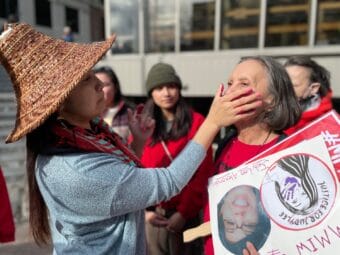
Candace Frank gets a red handprint pressed onto her face at the Missing and Murdered Indigenous People Rally in Juneau on May 5, 2022. (Lisa Phu/Alaska Beacon)

ANCHORAGE, Alaska — Despite Alaska’s small population, a 2018 report by the Urban Indian Health Institute identified it as the state with the fourth-highest number of missing and murdered Indigenous women and girls, and Anchorage as the city with the third-highest number of such cases in the nation.

A new law aims to address some of the reasons for those high rates.

Experts say the causes are complex but clearly the lack of any law enforcement in a third of rural Alaska villages is an issue. Then, where there is law enforcement, there are various layers, including: Alaska police departments, village public safety officers, Alaska state troopers, and sometimes the Federal Bureau of Investigation.

In a 2021 report, the nonprofit Data for Indigenous Justice said when jurisdictions overlap, the result is not dual coverage, but an “unwillingness by either system to assume responsibility for the safety of Indigenous people.”

“One sentiment that illustrates the issue is that law enforcement and criminal prosecution often mobilize to address hunting violations more quickly than they do for cases of homicide against Indigenous people,” the report stated.

In an effort to change course, Alaska has a new law addressing missing and murdered Indigenous persons (MMIP).

Kendra Kloster, who is Tlingit, is co-director of law and policy with the Alaska Native Women’s Resource Center. The center is part of the Missing and Murdered Indigenous Women, Girls, and Two-Spirit Relatives (MMIWG2S) Working Group. The other group members are the Alaska Native Justice Center, Alaska Native Heritage Center, Data for Indigenous Justice and Native Movement.

Kloster said the bill addresses issues identified through working with and listening to Indigenous peoples. “So these ideas and these things that have come up are things that we’ve talked with our tribes about, we’ve talked about with our communities. And these were kind of some of the things that rose to the top that we really needed to do to really look into cases to develop our resources, to really understand what else we can do better.”

She continued, “we collaborate with a lot of other organizations across the state that are doing really great work on this as well, and talking with families who we really appreciate them sharing stories and their information. It’s really hard to do that. But without them, we wouldn’t be able to identify all the different things that really need to be addressed and kind of the loopholes. And so it really takes our whole communities coming together to make this change.”

Kloster said much more is needed — for example, 911 services that are available and responsive, better and more accessible data, and wellness and trauma services—but this new law is the result of efforts beginning in 2018.

Gov. Mike Dunleavy signed Senate Bill 151 into law on Sept. 3. In a prepared statement he said, “this legislation is a continuation of Alaska’s mission to recognize and solve missing and murdered Indigenous persons cases. My administration will continue to support law enforcement, victim advocacy groups, Alaska Native Tribes and other entities working together to solve these cases and bring closure to victims’ families.”

“Senate Bill 151 represents a pivotal moment in our fight to end the crisis of Missing and Murdered Indigenous Peoples,” bill sponsor Sen. Donny Olson (D-Golovin) said in the prepared statement. “By bringing diverse voices together and enhancing our investigative efforts, we are making a clear statement: every life matters, and we will not rest until justice is served for all our missing and murdered loved ones. This legislation is a critical step in the state’s dedication towards healing our communities and ensuring that no family is left without answers.”

“The Alaska Department of Public Safety has led the local, state, and federal government efforts in Alaska of reducing instances of missing and murdered indigenous persons and will continue to invest resources into all of our MMIP initiatives,” Alaska Department of Public Safety Commissioner James Cockrell said in the statement. “With Senate Bill 151 becoming law today many of the initiatives that we started within DPS will now be codified into Alaska Statute and carried on into the future. Your Alaska State Troopers are committed to continuing to aggressively investigate cold case homicides and suspicious missing persons cases that involve Alaska Native victims.”

The prepared statement states the new law:

  • Creates a nine-member MMIP Review Commission to review unsolved cases and submit a report to the Legislature every three years with its recommendations and findings;
  • Requires indigenous cultural training for new police officers;
  • Requires the Alaska Department of Public Safety to conduct a one-time assessment of its protective and investigative resources for identifying and reporting MMIP cases; and
  • Requires the Department of Public Safety to file a missing persons report to the National Missing and Unidentified Persons System database within 60 days after the first report is filed with state and local law enforcement.

The legislation takes effect Jan. 1.

ICT originally published this article. ICT is an an independent, nonprofit, multimedia news enterprise. ICT covers Indigenous peoples.

Southeast Alaska tribe continues hands-on response to glacial flooding

A flooded house is pictured in Juneau, Alaska. (Photo courtesy of National Weather Service)

A Southeast Alaska tribe is continuing to respond to a glacial outburst that flooded some 290 homes in Juneau.

Early estimates show around 14.6 billion gallons of water were released from an ice dam on the Mendenhall Glacier. That’s according to Aaron Jacobs, a senior service hydrologist at the National Weather Service office in Juneau. The Mendenhall River gauge crested at 15.99 feet at 3:15 a.m. on Aug 6.

The National Weather Service had issued alerts two days before about the likelihood of major flooding from a glacial dam outburst. It had happened before. In 2023, two homes were demolished when erosion undermined their foundations, and flooding to a lesser degree also occurred in other years. So, many homeowners took precautions. They piled up sandbags and lifted things off their basement floors.

However, the flooding was deeper and more widespread than expected. As many as 500 tribal citizens live in the flood zone, but a door-to-door check showed not all were impacted, said Chalyee Éesh Richard Peterson, who is Tlingit and Haida, and heads the Central Council of Tlingit and Haida Indian Tribes of Alaska.

“It’s devastating to see what people are going through and then to hear people had minutes to respond in some cases, depending on where they were located. Hearing the story of just, ‘I was just trying to get my kids out.’ That’s all they thought. And then they lost their family dog and their other animals and it’s devastating, but they got their kids out,” he said in a Facebook video posted by the council.

Water fills the streets and floods houses in the Mendenhall Valley early the morning of Tuesday, July 6, 2024. (Photo courtesy of Rich Ross)

Robbert Holland, age 9, said in the video, “I was nervous, but I just went for it to save my life.”

Peterson said the council and the Tlingit-Haida Regional Housing Authority set up an emergency operations center within hours of the flood’s peak.

Sabrina Grubitz, Tlingit, is incident commander for the tribe. “The first phase is dewatering and getting the debris out of the homes in order to dewater the homes. We were not able to move into a second phase with standing water in those houses,” she said in an Instagram post.

Next comes removal of hazardous materials such as refrigerators, dishwashers, washers, and dryers that are no longer working, and then removal of drywall and insulation.

“By removing those, we’re ensuring that mold will not be growing in those homes in the next few days. And then our phase three is moving into sanitization, so we wanted to ensure that we were able to put together sanitization kits consisting of Simple Green, Clorox, gloves, masks, anything that someone who’s done a self demolition of removing drywall and installation in their home would need to spray on afterwards and use so that they can ensure that the mold’s not going to grow back and have later health concerns,” Grubitz said.

The tribe has 65 staff in the field working closely with 20 National Guard assigned to them to assist. It has issued an emergency declaration, which will help it access resources. Next steps include the tribe helping tribal citizens connect with other services to rebuild as needed.

Jacobs said scientists need to continue to improve their understanding of complex glacial systems, especially as the climate continues to change and warm throughout Alaska.

ICT originally published this article. ICT is an an independent, nonprofit, multimedia news enterprise. ICT covers Indigenous peoples.

Site notifications
Update notification options
Subscribe to notifications