ICT

Supreme Court takes up the Indian Child Welfare Act

The U.S. Supreme Court building in Washington, D.C. (Photo by Liz Ruskin/Alaska Public Media)

The words “Equal Justice Under Law” are inscribed above the U.S. Supreme Court building in Washington, D.C.

The terse phrase powerfully underscores the conviction that the nation’s judiciary occupies a special plane of existence in which momentous decisions are made in a protected sphere of legal purity.

For many Supreme Court watchers, however, the court’s recent rulings overturning abortion rights, expanding gun rights, limiting the authority of the Environmental Protection Agency and blurring the lines separating church and state reflect the alarming impact of an ultra-conservative majority among justices.

Indeed, a September 2022 Gallup poll shows that 42% of Americans think the Supreme Court is too conservative, a new high for that response.

The trend could spill over onto how justices view the Indian Child Welfare Act, a law supported by the sovereignty of tribal nations that many opponents insist is race-based.

On Wednesday, Nov. 9, the Supreme Court will begin hearing oral arguments in Haaland v. Brackeen, a case that will decide if the ICWA is constitutional.

The case has enormous implications for Indian Country, its children and the ongoing existence of tribal sovereignty, said Sarah Deer, professor at the University of Kansas and chief justice for the Prairie Island Indian Community. Deer is a citizen of the Muscogee (Creek) Nation.

“Most opposition to the ICWA focuses largely on the flawed assumption that Native people are strictly a racial category,” Deer said, “rather than citizens of independent sovereign governments.”

Broad constitutional issues

It’s not an easy, either/or decision for the court, because the case addresses several elements of constitutional law.

The ICWA, enacted in 1978 by Congress, came in response to reports that large numbers of Native children were being separated from their families and communities by state welfare officials and private adoption agencies.

The law gives tribal nations the right to be involved in child welfare cases involving their citizens, in hopes of keeping Indigenous children with their family and tribe.

The lawsuit that has reached the Supreme Court was filed by the state of Texas and several adoptive parents, claiming that the ICWA unfairly discriminated against non-Native people in the adoption process by setting a preference for Indigenous parents over non-Indigenous. The preference violates a provision for equal protection under the law in the U.S. Constitution, they argue.

Supporters, however, point out that tribal citizenship is not a racial classification but rather a political, legal status. And they argue that a ruling by the Supreme Court that the ICWA is unconstitutional based on race could take Indigenous rights back to a pre-civil rights era in which White hegemony was accepted as an indisputable norm.

Such a ruling could open the door to challenging the entirety of Indian law and tribal sovereignty, they say — which could be the point for the diverse group of people and organizations that have banded together in opposition to the act in recent years.

The law chugged along in obscurity for most Americans for about 35 years, offering guidelines for placement of Native children within the country’s child welfare systems. Mostly unnoticed and unknown by non-Native people during this time, the ICWA includes what is considered the gold standard or guiding principles for child welfare systems, including interagency collaboration, acknowledging each child’s and family’s strength and challenges, cultural competence, respect and partnership between families and professionals, and engaging community based services and accountability.

In 2013, however, the well-known Adoptive Couple v. Baby Girl case, also known as the Baby Veronica case, went before the U.S. Supreme Court, which held that the ICWA does not bar termination of the biological father’s paternal rights. Covered extensively in the , the law was often framed as draconian and race-based, unfairly depriving children of their best interests and constitutional due process.

Cases reported in mainstream media often frame the ICWA as a racist law that allows tribes to take children away from loving families because the child may have a minuscule amount of Native blood, according to Deer, the Kansas lawyer and judge.

“In fact, most ICWA cases are so conventional they don’t warrant any particular media attention,” Deer said. “Most media coverage focuses on a handful of specific, high-profile cases that actually involve a dispute … They don’t cover the successful stories.”

A tribe, for example, may choose to intervene in a child welfare case without exerting jurisdiction.

“Intervening simply means that a tribe has the ability to come in and make recommendations regarding a child,” said Stacey Lara, an assistant teaching professor at the University of Washington School of Law.

Although data is difficult to obtain since ICWA actions vary from state to state and tribe to tribe, there are many instances in which tribes choose not to intervene or exert jurisdiction at all for a number of reasons, including lack of resources.

And tribes that do intervene may recommend the child remain with a non-Native family member, Lara said.

“ICWA, at its heart, is really about a tribe being involved with decisions that affect the best outcomes for the child,” Lara said. “The law’s preference is keeping families together.”

Notably, there are no legal penalties for failing to abide by the ICWA, and oversight of the law is largely left to the court system.

Growth of ICWA opposition

Additional challenges to the law followed the widespread media coverage of the 2013 Baby Veronica case.

Organizations such as the National Council for Adoption claimed the law violated the U.S. Constitution on several counts, including denying Native children due process and equal protection, and commandeered state agencies for federal purposes, exceeding Congress’s authority in Indian affairs. Other efforts challenged ICWA’s state and federal provisions on proof for child removal, placement preferences and termination of parental rights.

As ICT reported in 2019, opposition to the ICWA has united a seemingly disparate group of organizations and interests whose ultimate goal appears to be in gaining access to Indian Country’s land and resources, including Native children. People and organizations forwarding Federalist philosophies have also joined opposition to ICWA, seeing it as an opportunity to further an agenda favoring states rights over federal policies.

In January 2021, the Fifth U.S. Circuit Court of Appeals took the unusual step of holding a special hearing of the full court and vacated an August 2020 decision by a three-judge panel that concluded the ICWA was not a race-based law and therefore constitutional.

The appeals court issued a complex, 352-page ruling in April 2021 that generally upheld Congress’ right to enact the ICWA and ruled that the law’s definition of “Indian child” doesn’t operate on the basis of race and therefore doesn’t violate Article 1 of the 14th Amendment regarding equal protection.

The ruling, however, found ICWA unconstitutional based on claims that the act violates the anti-commandeering doctrine included in the 10th Amendment. According to the doctrine, the federal government can’t make states adopt or enforce federal law, such as the ICWA. This means that the federal government can’t require state agencies to give notice to tribes or require qualified witnesses in adoption cases, or require states to keep records on Indian child welfare cases.

Many legal experts attribute claims that ICWA violates the anti-commandeering doctrine to the rise of conservative groups and politics supporting states’ rights over federal authority.

Opponents and supporters of the ICWA filed four petitions to the U.S. Supreme Court in the case. The opposing petitions raise constitutional questions that included equal protection, legal standing, anti-commandeering and nondelegation. They also claim that ICWA violates the Administrative Procedures Act.

The United States and four intervening tribes — the Cherokee Nation, Morongo Band of Mission Indians, the Oneida Nation and the Quinault Indian Nation — filed petitions defending the ICWA and its constitutionality.

The outpouring of support for the act has been substantial. Nearly 500 tribal nations, scores of Native organizations, members of Congress and child welfare organizations have signed on to 21 friend-of-the-court briefs in defense of ICWA.

Among those working to defend the landmark legislation include attorneys with the Native American Rights Fund, the National Congress of American Indians and several tribes, all of whom have banded together under the Tribal Supreme Court Project to help tribes develop litigation strategies regarding ICWA.

The goal for tribes and most Native people is simple — protecting their children.

“I am not aware of a case that has generated this much support in Indian Country,” said Dan Lewerenz, assistant professor at the University of North Dakota school of law and a contract attorney for the Native American Rights Fund.

“Our children are very important to us, so it’s heartening to see how much support we’ve gotten from outside Indian Country as well,” said Lewerenz, who is a citizen of the Iowa Tribe of Kansas and Nebraska.

Bad timing for Indian law

The cases the Supreme Court is considering this term, including the ICWA, may reflect the decidedly conservative bent of the majority of its justices. Former Republican President Donald Trump appointed three justices to the court – Neil Gorsuch, Brett Kavanaugh and Amy Coney Barrett. They join the other conservatives – Chief Justice John G. Roberts and Justices Clarence Thomas and Samuel A. Alito – for a 6-3 majority on the court.

In addition to the ICWA case, the court is also set to consider this term two voting rights cases that contend voting practices discriminate on the basis of race, challenges to affirmative action in student admissions at Harvard University and the University of North Carolina, a free speech claim from a website designer who opposes same-sex marriage, as well as a challenge to the Clean Water Act of 1972.

With the exception of Gorsuch, who wrote the majority opinion in the McGirt v. Oklahoma opinion finding that much of the eastern portion of Oklahoma remains as Indian lands, few of the other justices have experience litigating cases relating to Indian law.

Earlier in 2022, Kavanaugh delivered the Castro-Huerta v. Oklahomaopinion, which partially walked back McGirt v Oklahoma by holding that the federal government and the state have concurrent jurisdiction to prosecute crimes by non-Indians against Indians in Indian Country.

What’s ahead

The Supreme Court justices’ lack of experience in Indian law, an ultra-conservative stance on race and a demonstrated support for a federalist agenda raises the likelihood that the ICWA could be dismantled by the court, Indian law experts say.

The current Supreme Court has demonstrated it cares about states’ rights and is hostile to any programs that attempt to remediate past racial discrimination, according to Elizabeth Hidalgo Reese, a citizen of the Nambe’ Pueblo and an assistant professor at Stanford Law School.

“There are just so many ways to lose this case,” Reese said. “This doesn’t bode well for the ICWA.”

In one of the worst-case scenarios, she said, the court could rule that the law violates the U.S. Constitution’s guarantees of equal protection regardless of race.

“This would be incredibly disruptive to the rest of Indian law and tribal sovereignty,” Reese said.

A decision finding the ICWA unconstitutional based on Article 1 of the Constitution, in which Congress is granted the power to regulate commerce with Indian tribes, could be equally catastrophic. Such a decision would declare that Congress has no power to pass laws such as the ICWA, thereby calling decades of its decisions in Indian law into question.

“The scope of Congress’s power over Indians has been a cornerstone of federal Indian law for a very long time,” Reese said. “Almost every law passed by Congress involving Indians would now come under a microscope.”

Many Supreme Court watchers have also noted that Justice Clarence Thomas has expressed an interest in the Indian Commerce Clause. In Turtle Talk, the leading blog on legal issues in Indian Country, Matthew Fletcher quoted Thomas’s opinion in United States v. Lara.

“I cannot agree that the Indian Commerce Clause provides Congress with plenary power to legislate in the field of Indian Affairs,” Thomas wrote.

Fletcher, a citizen of the Grand Traverse Band of Ottawa and Chippewa Indians, is a law professor at the University of Michigan School of Law and director of the Indigenous Law and Policy Center.

If the court finds the law unconstitutional under the anti-commandeering clause, however, it’s likely that only the ICWA would be impacted. At least six states have enacted their own ICWA laws, which include provisions from the federal act.

Such a decision, Reese said, “would be about the mechanics of the specific ICWA statute which tell states how they implement the law.”

As Reese notes, the constitutional challenges to the law are very broad.

“So many people are focused on the race issue in this case; I feel like everybody’s about to get blind-sided by the court’s decision,” she said. “We need to be listening very closely during oral arguments, The outcome could be a bit of a surprise.”

This story originally appeared in Indian Country Today and is republished here with permission.

Church commits $1 million to repair closure of Juneau’s Memorial Presbyterian Church

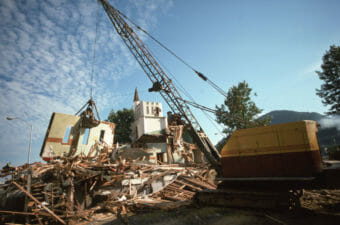
A crane lifts a wall from a building that's being demolished
Memorial Presbyterian church demolition. (Photo by Skip Gray)

In the 1950s and ‘60s, the “Native church” in Juneau was packed for holiday services. Seven days a week it housed civic and church-related gatherings.

The Memorial Presbyterian Church served a predominantly Lingít congregation, true to its 1887 roots in a town that practiced segregation in restaurants and movie theaters into the mid-1940s.

Then, to “end segregation,” the Alaska Presbytery and the Presbyterian Board of National Missions closed the thriving Native church in 1962.

Maxine Reichert, Lingít and Athabascan, recently told the Northern Light United Church congregation the closure meant the loss of the Juneau Indian Village’s support system, “the heart of the community,” just as it was undergoing even greater trauma. The Juneau Indian Village, and just across the bridge, the Douglas Indian Village were destroyed for 1960s-era urban renewal and development.

Now the Presbyterian Church USA, Northwest Coast Presbytery, and Ḵunéix̱ Hídi Northern Light United Church have committed to pay nearly a million dollars in reparations for the harm and pain the closure caused.

The amount is significant but what it will be used for is even more so. Most of it is to go to programs to promote healing, cultural preservation, and education.

We’ll get into that some more but first, let’s go back to 1940, when pastor Walter Soboleff, Lingít, held his first service in Memorial Presbyterian Church.

Only he, his wife, and one friend attended.

But he was brilliant at growing a congregation. Soboleff advertised in the newspaper and broadcast his sermons on the radio. He reached out with hundreds of letters of support and encouragement to acquaintances, parishioners, and prison inmates.

A black-and-white photo of a man in a suit and bowtie, sitting in front of a radio microphone
Rev. Walter Soboleff preparing to go on the radio (Photo courtesy of the Presbyterian Historical Society)

The church offered Bible study, choir practice, prayer groups, and teenage fireside chats. It was open for day care, Girl Scout meetings, and health checkups. It housed visiting basketball teams from surrounding predominantly Lingít, Haida, and Tsimpshian villages.

The church “was an extension of our family, our extended family,” Judy Franklet, Lingít, said in a 2019 interview.

Franklet remembered, “playing with friends down in the, we called it the basement, but that’s where they held the potlucks and other activities. And then we had coffee probably right after the worship service. And I remember Dr. Soboleff very clearly giving part of the service in English and in Lingít. That was very special to us… you love to hear your own language.”

Franklet also recalled the day when Soboleff told the congregation the church was closing.

“I just remember I was in a state of shock and when I look back, I’m sure he was hurting. His explanations were just very short,” Franklet said. “It was just like you were hit in the stomach. It was such a surprise.”

Last year, as the Native Ministries Committee of the church began discussing reparations, “I remember one moment in particular,” said Lillian Petershoare, Lingít. “We were talking about the closure of the Memorial church and I said to everyone, ‘You know, what really disturbs me here is that in our research, we have seen that the Presbytery and the national church leaders came to Memorial many times over the years. The women of the church sponsored tea for the regional and the national leader. They were not strangers. They knew this church. They knew the people in this church.’”

A black-and-white photo of a large group of people in church clothes posing on a staircase
Memorial Presbyterian Church choir members at home of Tom and Connie Paddock after Christmas caroling in Juneau. The choir was treated to cookies, punch, smoked salmon, and crackers. December 24, 1962 (Photo courtesy of Maxine Richert)

She said it was inhumane of church leaders to abandon Soboleff to announce the closure alone.

“Why didn’t they come and have a beautiful ceremony to celebrate the wonderful work of the Memorial church and the Presbyterian church in the Juneau Indian Village? Its predecessor? Why wasn’t there all that circumstance? Why wasn’t there all that acknowledgement? Why wasn’t there that shared grieving?” Petershoare asked.

“If this had been a traditional Lingít setting, there would’ve been all of that protocol. And so there should have been.”

Petershoare said the national officials should have expressed the church’s deep roots in the community and its role in the life of the community. “We felt that profoundly.”

A former minister of Northern Light United Church, Phil Campbell, told filmmaker Laurence A. Goldin in a 2022 interview that as he met Native people, he learned time had not healed the wound of the church’s closure “even though it had been almost 50 years.”

“I did have one occasion to ask Dr. Soboleff about it. I was visiting with him a couple of months before his death as it turned out … as I began asking about this, I saw the pained look on his face. He was saddened and troubled by the question, and said in effect, ‘I don’t know why they closed it,’” Campbell said.

At the same time the Presbytery said it couldn’t afford to continue to subsidize the Native church, it loaned $200,000 to a White congregation to build a new church just a few blocks away from Memorial.

The Presbytery and Board of Missions advised the Native church members to join the new Northern Light Presbyterian Church. Less than half did. Most joined other denominations or drifted away from church altogether.

In the 1990s, a group of Indigenous members of Northern Light church formed a Native Ministries Committee. With Campbell’s help, in 2021 they wrote an “Overture,” (similar to a resolution) entitled “On Directing the Office of the General Assembly to Issue Apologies and Reparations for the Racist Closure of the Memorial Presbyterian Church, Juneau, Alaska.”

The Overture stated: “The forced closure of this thriving, multiethnic, intercultural church was an egregious act of spiritual abuse committed in alignment with the prevailing White racist treatment of Alaska Natives, statewide, and of Native Americans, nationwide.” It was distributed nationally to Presbyterian churches and discussed in regional and national gatherings of church leaders.

A black and white photo of people leaving a church
In Juneau, Memorial Presbyterian Church congregants leaving the church. n.d. (William Paul Jr. Collection via Ben Paul)

The Presbyterian Church USA adopted the Overture unanimously without amendment at its July General Assembly. In adopting it, the church acknowledges its justification for the closure ”merely substituted assimilationist racism for the previous practice of segregationist racism.”

The Overture includes a list of actions for reparations.

The church, with regional and national leaders present, will acknowledge, confess, and apologize to the late Walter Soboleff and his surviving family members “for the act of spiritual abuse committed by the Presbyterian Church’s decision of closure, which was sadly aligned with nationwide racism toward Alaska Natives, Native Americans, and other people of color.”

By adopting the Overture, the church committed to become engaged and accountable for “interactions with churches of primarily people of color congregations so that difficult decisions about support and funding are made in a spirit that recognizes the importance and contributions of these congregations to the Presbyterian Church (USA), which outweigh superficial considerations of their membership numbers or perceived lack of financial resources.”

The Overture also encourages Presbyterians nationwide to donate funds and to renew commitments to dismantle systemic racism and amplify the voices of people of color.

It urges all to continue to walk away from the doctrine of discovery, the idea that when a European nation “discovers” land uninhabited by Christians, it acquires rights to that land.

As one of the first steps in reparations, the church was renamed Ḵunéix̱ Hídi (people’s house of healing) Northern Light United Church.

A man in a suit sits in a chair next to a man lying in bed
Rev. Walter Soboleff ministering to a sick man, n.d. (Photo courtesy of the Presbyterian Historical Society).

As the successor and beneficiary of the Memorial Church’s closure, Ḵunéix̱ Hídi committed $350,000 for reparations, which will include the creation of art and remodeling of the Ḵunéix̱ Hídi church to be more welcoming to people of color and to reflect southeast Native cultures.

Money will go to scholarships and programs for revitalization of southeast Alaska Indigenous languages. Ḵunéix̱ Hídi will also gather oral histories and develop curriculum to teach the history of the Memorial Church.

Ḵunéix̱ Hídi will also pay for a “highly visible recognition” of the Memorial Church at its former location.

Reichert said additional money will go to “Tlingit, Haida, and Tsimpshian languages, (and) scholarships for students who want to go into the seminary to become ministers.” For these and other efforts, the church has committed nearly a million dollars.

The reparations were accepted by the local congregation, then at the regional and national levels. The commitments call for some soul searching, with the understanding that healing from racism is an ongoing process.

Ministries committee member Myra Munson said the history of racism, of slavery, of what happened to Indigenous people, and actions against LGBTQ people, “all of these things create a burden that maintains an “us and other” approach to the world and to each other in the community and at large nationally, and internationally. Every step we take that overcomes that or reduces it helps us all live in a healthier way and healthier place.”

Reichert said she was relieved when the General Assembly voted to accept the Overture. “It felt like Walter Soboleff and what he had been doing with Memorial Presbyterian church, he had been vindicated and, and I felt just really good about that.”

The Presbyterian church has a history of racism, perhaps most strongly exemplified in the boarding schools it ran to assimilate Indigenous children. The boarding school experience traumatized generations of Native children and led to the near loss of Indigenous cultures and languages.

However, Reichert said Indigenous people, “they have churches still existing, like in the Dakotas where they have a number of churches that are run by Native ministers. And a lot of them have not graduated from seminary and they have very little funding for those churches, but the Native people are still going to them and they still want that religion. But they want it in their own culture.” The reparations will help make that happen for Southeast Alaska Indigenous peoples.

This article was originally published by Indian Country Today and is republished here with permission.

This article draws on one written in 2019 for “First Alaskans” magazine. The author also narrated a short film, “The Native Church,” on the subject.

US Supreme Court limits historic McGirt ruling

The U.S. Supreme Court building in Washington, D.C. (Photo by Liz Ruskin/Alaska Public Media)

The United States Supreme Court has limited the scope of its historic McGirt decision.

In a 5-4 vote, the high court ruled in Oklahoma v. Castro-Huerta that the state of Oklahoma has concurrent jurisdiction and the ability to prosecute non-Natives when the victim is Native and the crime is committed on tribal land.

“From start to finish, the dissent employs extraordinary rhetoric in articulating its deeply held policy views about what Indian law should be,” Justice Brett Kavanaugh’s opinion reads.

Justice Kavanaugh wrote the majority opinion and was joined by Chief Justice John Roberts and Justices Clarence Thomas, Samuel Alito and Amy Coney Barrett in the majority. Justice Kavanaugh wrote that the views of the justices in the dissent were contrary to previous Supreme Court precedents and other laws.

“The dissent goes so far as to draft a proposed statute for Congress. But this Court’s proper role under Article III of the Constitution is to declare what the law is, not what we think the law should be,” Justice Kavanaugh wrote.

Tribes, Native lawyers and advocates were disappointed in the decision.

The Muscogee Nation called the ruling an “alarming step backward.”
“It hands jurisdictional responsibility in these cases to the State, which during its long, pre-McGirt, history of illegal jurisdiction on our reservation, routinely failed to deliver justice for Native victims,” the tribe said in a statement. “While we hope for the best, we are not optimistic that the quality of effort from the State of Oklahoma will be any better than before.”

Similarly, Cherokee Nation Principal Chief Chuck Hoskin Jr. said the court folded to what amounted to a social media campaign by the state and ruled against legal precedent, congressional authority and federal Indian law.

“The dissent today did not mince words — the Court failed in its duty to honor this nation’s promises, defied Congress’s statutes, and accepted the ‘lawless disregard of the Cherokee’s sovereignty,” Hoskin said in the statement.

Both tribes expressed commitment to continue to work to meet public safety and criminal justice responsibilities, as well as working with Congress, state and federal authorities moving forward.

Justice Neil Gorsuch wrote the dissenting opinion and was joined by Justices Stephen Breyer, Sonia Sotomayor and Elena Kagan.

Gorsuch, the author of the historic McGirt decision, wrote that tribes were promised to be free from interference by state authorities.

“Where this Court once stood firm, today it wilts,” Gorsuch wrote. “Where our predecessors refused to participate in one State’s unlawful power grab at the expense of the Cherokee, today’s Court accedes to another’s.”

The case pertains to Victor Manuel Castro-Huerta, a non-Native man who was convicted by the state of Oklahoma for criminal child neglect of his step-daughter, a citizen of the Eastern Band of Cherokee Indians.

His conviction came before the 2020 McGirt decision and after the McGirt ruling, Castro-Huerta argued that the federal government had jurisdiction over his prosecution. His conviction was vacated and Castro-Huerta later pleaded guilty to a federal charge.

The state of Oklahoma appealed to the Supreme Court seeking to overturn McGirt entirely, but the high court allowed only to hear arguments regarding the scope of criminal jurisdiction the state has over crimes committed by non-Natives against Natives on tribal lands.

Mary Kathryn Nagle, Cherokee, said Wednesday’s ruling will lead to an increase in violence in Indian Country.

“This, you know, just really broad and epic rewriting of federal Indian law all throughout Indian Country is only going to create chaos and it’s not going to result in greater safety for Native victims,” Nagle, a partner at Pipestem law, said.

Reaction throughout Indian Country was swift, with many sharing the same disappointment expressed from Oklahoma tribes.

After reading Kavanaugh’s opinion, Nagle found it concerning and said Kavanaugh misreads and misuses the 10th amendment, which she says could have implications outside of criminal law in Indian Country.

“He just concludes that states have unlimited authority on tribal reservations and cites the 10th amendment,” Nagle said. “He doesn’t quote any language in the 10th amendment that gives states such authority on tribal reservations. There is no language in the 10th amendment that gives states uninhibited authority on tribal lands.”

Stanford University assistant professor of law, Elizabeth Reese, Nambé Pueblo, described the decision as insulting.

“This #SCOTUS opinion in Castro Huerta is horrifying and insulting to Indian people and tribes. I’m shaken. Every few paragraphs of the majority opinion has another line that dismissively and casually cuts apart tribal independence that Native ancestors gave their lives for.”

Stacy Leeds, Cherokee and Arizona State University law professor, said in a tweet that the ruling is disruptive.

“Wow. Redo the federal Indian law criminal charts! SCOTUS rules, for the 1st time ever, states have prosecutorial power over Indian country crimes involving Natives (as victims) despite zero Congressional delegation. Very disruptive for Indian country nationally. #CastroHuerta”

Moving forward, Nagle said tribes need to come together to find a legislative fix to this case.

“We have a lot of work to do,” Nagle said. “I think tribes need to read this decision carefully. The decision is not limited to criminal law, which is scary.”

With the Castro-Huerta decision being handed down, the Supreme Court has two remaining cases to rule on for the current term before its summer recess. The court will reconvene in October.

Today’s opinion can be found and read here.

This story was originally published by Indian Country Today and is republished here with permission.

US boarding school investigative report released

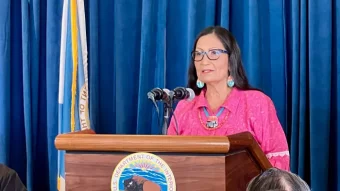
Interior Secretary Deb Haaland at the Interior Department’s press conference on its federal boarding school investigation in Washington, D.C. on Wednesday, May 11, 2022. (Photo by Jourdan Bennett-Begaye, Indian Country Today)

The U.S. Department of Interior released its investigative report Wednesday on the Federal Indian Boarding School Initiative. It’s being called the first volume of the report and comes nearly a year after the department announced a “comprehensive” review.

Interior Secretary Deb Haaland, Bryan Newland, assistant secretary for Indian Affairs, Deborah Parker who is the chief executive officer of the National Native American Boarding School Healing Coalition and James LaBelle Sr., a boarding school survivor and the first vice president of the coalition’s board, spoke at a news conference in Washington announcing the report’s findings.

“The consequences of federal Indian boarding school policies — including the intergenerational trauma caused by the family separation and cultural eradication inflicted upon generations of children as young as 4 years old — are heartbreaking and undeniable,” Haaland said in a statement. “We continue to see the evidence of this attempt to forcibly assimilate Indigenous people in the disparities that communities face. It is my priority to not only give voice to the survivors and descendants of federal Indian boarding school policies, but also to address the lasting legacies of these policies so Indigenous Peoples can continue to grow and heal.”

Newland led the over 100-page report, which includes historical records of boarding school locations and their names, and the first official list of burial sites.

The findings show from 1819 to 1969, the federal Indian boarding school system consisted of 408 federal schools across 37 states, some territories at that time, including 21 schools in Alaska and seven schools in Hawai’i. Some of these schools operated across multiple sites. The list includes religious mission schools that received federal support, however, government funding streams were complex therefore, all religious schools receiving federal, Indian trust and treaty funds are likely not included. The final list of Indian boarding schools will surely grow as the investigation continues. For instance, the number of Catholic Indian boarding schools receiving direct funding alone is at least 113 according to records at the Bureau of Catholic Indian Missions.

About 50% of federal Indian boarding schools may have received support or involvement from religious institutions or organizations including funding, infrastructure and personnel, Newland said.

The federal government, at times, paid them on a per capita basis for the children to enter into the schools.

Approximately 53 different schools had been identified with marked or unmarked burial sites. Specific locations of the burial sites will not be released to protect against grave robbing, vandalism and other desecration. The department expects the number to increase as the investigation continues.
In June 2021, Haaland announced an Interior investigation in federal Indian boarding schools to make “a comprehensive review of the troubled legacy of federal boarding school policies” from as early as the 19th century.

She said the initiative was created after the discovery of 215 unmarked graves of Indigenous children by Canada’s Tk’emlúps te Secwépemc First Nation at the Kamloops Indian Residential School in May 2021.

The first volume of the report highlights some of the harsh conditions children endured at the schools. Children’s Indigenous names were changed to English names; children’s hair were cut; the use of their Native languages, religions and cultural practices were discouraged or prevented; and the children were organized into units to perform military drills.

The report cites findings from the 1928 Meriam report in which the Interior acknowledged “frankly and unequivocally that the provisions for the care of Indian children in boarding schools are grossly inadequate.”

A map of boarding school sites provided by the Interior Department

Click here to see other maps

Examples included descriptions of accommodations at select boarding schools such as the White Earth Boarding School in Minnesota where two children slept in one bed, the Kickapoo Boarding School in Kansas where three children shared a bed and the Rainy Mountain Boarding School in Oklahoma where, “single beds pushed together so closely to preclude passage between them and each bed has two or more occupants.”

The 1969 Kennedy Report, cited in the Department investigation, noted that rampant physical, sexual and emotional abuse: disease; malnourishment; overcrowding and lack of health care at Indian boarding schools are well-documented.

It also found schools focused on “manual labor and vocational skills that left American Indian, Alaska Native, and Native Hawaiian graduates with employment options often irrelevant to the industrial U.S. economy, further disrupting Tribal economies.”

Federal boarding schools first started with the Indian Civilization Act of 1819 when the government enacted laws and policies to establish and support Indian boarding schools. For more than 150 years, Indigenous children were taken from their communities and forced into boarding schools that focused on assimilation. An unknown number of religious Indian boarding schools, funded by private and government funds, predate the Civilization Act by at least 100 years.

Native land and wealth diminished

In a major finding, the report documents the use of tribal trust and treaty funds for the federal boarding school system as well as mission schools operated by religious institutions and organizations. Although the total amount of these funds used to directly fund schools is unknown, according to an investigation by Indian Country Today, more than $30 million in today’s dollars were siphoned away during a nine year period by Catholic schools alone.

The U.S. also set apart tracts of Native lands for use by religious institutions and organizations. According to an ongoing investigation by Indian Country Today, a large portion of this land may still be held by churches.

Indeed, the relationship between major religious denominations and the federal government regarding Indian mission schools is described as “an unprecedented delegation of power to church bodies that were given the right to nominate new agents, direct educational and other activities on the reservations.

Members of the Sicangu Youth Council help provide a formal burial at the Rosebud Indian Reservation on July 17, 2021, for some of the nine Rosebud students who died at Carlisle Indian Industrial School in the 1880s. The children’s remains were finally returned to their homelands after 140 years, wrapped in a buffalo robe bundle and placed in a cedar box. Earth collected at the Carlisle graves were added to the children’s final resting places. (Photo by Vi Waln for Indian Country Today)

Although the report makes little mention of accountability for religious organizations that operated boarding schools, it does indicate that non-federal entities will be given support in releasing their records associated with the schools.

Parker said the organization’s collaboration with the Interior found an additional 89 boarding schools that did not receive any federal funding.

As part of the initiative and in response to recommendations from the report, Haaland announced the launch of “The Road to Healing” year-long tour. It’ll consist of a tour across the country to allow boarding school survivors to share their stories, help connect communities with trauma-informed support and to gather a permanent oral history.

The report also points to the 2019 watershed Running Bear studies, funded by the National Institute of Health. This research contains the first medical studies to systematically and quantitatively show that the Indian boarding school system experience continues to impact the present day health of adult boarding school survivors.

Newland cited the need for more investigation because of the COVID-19 pandemic and its resulting closures of federal facilities that affected obtaining and reviewing documents and the department’s limited funds at that time.

The second volume will be aided by a $7 million investment from Congress through fiscal year 2022. Newland recommended for it to include a list of marked and unmarked burial sites at federal Indian boarding schools — with names, ages, tribal affiliations of the children at those locations — an approximation of the total amount of federal funding used to support the boarding school system and to further probe the impacts on Indigenous communities. Additionally, the department wants to approximate the total number of children who attended the boarding schools.

“This report presents the opportunity for us to reorient federal policies to support the revitalization of Tribal languages and cultural practices to counteract nearly two centuries of federal policies aimed at their destruction,” Newland said in a statement. “Together, we can help begin a healing process for Indian Country, the Native Hawaiian Community and across the United States, from the Alaskan tundra to the Florida everglades, and everywhere in between.”

Opportunity to submit stories

On Thursday, members of Congress held a hearing at 1 p.m. ET, for the bill “Truth and Healing Commission on Indian Boarding School Policies in the US.” Rep. Sharice Davids, Ho-Chunk, is the lead sponsor of the bill.

The National Boarding School Healing Coalition is requesting people who attended a boarding school or are a descendent of a boarding school attendee to submit their written testimonies to the House of Natural Resources Committee by May 26. Email submissions to HNRCDocs@mail.house.gov and CC NABS at info@nabshc.org.

The National Boarding School Healing Coalition has an available template to use here.

ICT’s Mary Annette Pember contributed to this report.

This story was originally published by Indian Country Today and is republished here with permission.

Berries, wildlife and toxic land: The continuing push to clean up contamination in rural Alaska

Project Chariot. (Alaska Public Media)

When a string of Yup’ik elders from St. Lawrence Island, Alaska, all received the same cancer diagnoses, officials initially shrugged it off as a bizarre medical mystery. But not long after, a different village reported an increase in unusual cancer symptoms as well. Then another case struck. Hours away in Unalakleet, several locals were diagnosed with Parkinson’s, a rare disease for Alaska Native populations.
It was becoming clear that these grim trends weren’t a coincidence.

And upon further investigation, it turned out the residents in all three villages had unknowingly been consuming contaminated drinking water and food.

“Emotionally, it cuts you to the core,” said Delbert Rexford, Inupiaq, president and CEO of Ukpeaġvik Iñupiat Corporation, the village corporation for Utqiagvik, the nation’s northernmost community. “My cousins, my aunts and uncles have been a part of that.”

Rexford has been advocating for the cleanup of contaminated lands for the past few decades. It’s a challenge that many Alaska Native leaders are familiar with.

When the Alaska Native Claims Settlement passed into law in 1971, 44 million acres of Alaskan land were promised to Alaska Native regional and village corporations. As it turned out, a significant portion of these lands were contaminated prior to their conveyance — berries poisoned and harvests tainted by long forgotten war relics abandoned on the outskirts of Alaska Native villages.

“Let me be clear: under ANCSA, Alaska Native people gave up 88 percent of our traditional lands. In exchange, we received, in part, contaminated sites that we may be legally liable for,” Sarah Lukin, Alutiiq, said in a 2017 testimony on the issue.

Pollution and chemical runoffs aren’t exactly what most people would expect to find in Alaska’s wilderness, especially in the remote areas where affected villages are located. The explanation lies in an often overlooked chapter of the state’s past.

Alaska served as a critical military outpost from World War II through the Cold War. It was an ideal location for strategists — the region was close to Russia yet still U.S. territory, it had large stretches of wilderness perfect for training, and there was little regulatory oversight. Somewhere between a reliable homebase and a foothold abroad, Alaska drew the attention of the sharpest military minds of the day.

Simple combat drills soon turned more ambitious. In 1958, the U.S. government planned to explode an atomic bomb in the Arctic, just 26 miles away from the Inupiaq village Point Hope. The proposal, coined Project Chariot, was intended to create an instant harbor in the frozen coastal region.

The front page of the Tundra Times with the headline “Project Chariot Still On.” (Photo courtesy of Tundra Times)

Leaders across the state widely supported the initiative. Alaska had joined the union just one year earlier, and many residents hoped the nuclear blast would ignite a new era of economic opportunity.

The neighboring Inupiat village however, was not sold on the idea. To spread word of the upcoming detonations, local Inupiaq artist Howard Rock founded Tundra Times, the first Alaska Native newspaper. It would go on to become an organizing powerhouse, and later set the stage for ANCSA itself. Armed with support from the state’s other Indigenous cultures and joined by a handful of defecting U.S. Atomic Energy Commission scientists, the Point Hope community was able to successfully halt Project Chariot.

Tundra Times headlines about nuclear experiments. (Photo courtesy of the Tundra Times)

Unfortunately, remnants of these covert Cold War era missions remain. Still in the early days of statehood, there wasn’t extensive protocol for military withdraws. Chemicals, equipment, and weapons were simply left behind — sometimes with a sign that warned of their danger, but usually with no notice at all.

Today, chemicals such as arsenic, asbestos, lead, mercury, pesticides, and polychlorinated biphenyls are still found in rural Alaska. Many of these contaminants are linked to illnesses, such as cancer and Parkinson’s.

To make matters worse, multiple contaminated sites are found on traditional subsistence lands, locations that Alaska Natives have harvested for centuries. Part of the ecosystem for decades now, some of these toxins have seeped into the food chain. For example,  recent study discovered that marine life near affected areas contain significant amounts of PCBs.

It’s a particularly unjust situation. Families go to harvest in areas that are known for nourishment and generational gathering. Years later, they find out that these abundant lands had been endangering them all along.

“What’s happening on our traditional lands… it’s hard to fathom. We do continue to harvest, but are there contaminants out there that we don’t know about?” Rexford asked. “Only studies will show.”

In recent years, melting permafrost has unveiled new dangers. As temperatures rise and the geography shifts, more unidentified landfills, debris, and equipment are starting to appear.

The list of incidents keeps growing: sharp cables emerging from riverbanks, thousands of crushed barrels rising out of the tundra, a landfill discovered in a lagoon valued for beluga harvesting.

“We haven’t even come to scratch the surface of what is really there,” Rexford said.

‘There’s a lot of finger pointing’

According to a 1998 U.S. Department of the Interior report, at least 650 of these sites were known to be contaminated at the time of their conveyance. Around a third of the contaminated areas were Formerly Used Defense Sites, known as FUDS.

The U.S. Department of Defense is responsible for cleaning the Formerly Used Defense Sites, in accordance with the Comprehensive Environmental Response, Compensation and Liability Act. However, they are not responsible for cleanup of privately owned defense sites, which technically includes any land conveyed under ANCSA.

Abandoned army barracks in the Aleutian-Pribilof Islands. (Photo courtesy of Tundra Times)

As people grew sick, and more attention was brought to the contaminated sites, Alaska Native communities faced an additional problem: they were now responsible for cleaning up toxic land that they had not contaminated themselves, per the legal dynamics.

“It is damaged goods, effectively. And you are a small, small village, and you’re up against the federal government saying, ‘Hey, don’t you have a responsibility to clean this up before you give it to us?’ It is truly a situation that is daunting,” said Alaska Sen. Lisa Murkowski in a 2020 interview.

It’s not a minor cost. The Alaska Native Village Corporation Association estimates Alaska Native corporations would have to spend at least $6 billion to complete the cleanup of all of these locations.

“In return for the extinguishment of Aboriginal rights to these lands, the federal government gives us lands that are contaminated, then they make us clean it up? Everybody agrees, that’s going a little too far,” said Brennan Cain, Vice President and General Counsel Eyak Corporation, the village corporation for Cordova, a small southern Alaskan community near Prince William Sound.

All parties involved recognize that the situation is unfair. The challenge isn’t proving the need for a clean up — it’s determining who is responsible for it.

The Department of the Interior’s Bureau of Land Management is in charge of transferring ANCSA conveyances to ANCs. They aren’t in charge of cleaning the conveyances, but they also can’t transfer lands that are known to be contaminated. The Bureau says they were uninformed about any contaminated lands they had previously handed over. Meanwhile, the Alaska Department of Environmental Conservation and the Environmental Protection Agency oversee the physical clean up. However, they aren’t liable for the contamination, so they aren’t expected to cover the costs. Technically, the original entity that damaged the land is supposed to fund the cleanup. But this information isn’t always available, and around 100 sites don’t have their past owners identified.

“There’s a lot of finger pointing,” said Cain.

The debate is still occurring today.

In May 2021, Alaska Gov. Dunleavy sent a letter to President Biden, requesting that the federal government complete the required cleanup of hundreds of contaminated sites found on ANCSA lands.

“It has been 50 years since ANCSA became law, and the cleanup of contaminated lands has yet to be addressed,” said Kim Reitmeier, executive director of the Alaska Native Corporation Regional Association, in the governor’s press release.

Reitmeier’s statement summarizes the frustration many feel about this topic. The sites have been identified, the negative impacts have been witnessed, and everyone agrees it’s a problem. So what will it take to get rid of contaminated lands?

Next generation needs to ‘pick up the mantle’

It’s been decades since the government first acknowledged the poisoned lands, but Rexford doesn’t believe the surprises have ended.

His region has a reason to be wary.

In 1990, a series of government documents from the 60s became declassified. They revealed that radioactive soil had been buried underground near Point Hope after Project Chariot was shut down. By the time locals were informed of this, it was too late – the effects had taken root. Today, cancer is still the leading cause of death in the village.

Tundra Times article discussing the radiation discovery. The question posed in the headline — “When will the next shoe drop?” — still stands today. (Photo courtesy of Tundra Times)

The community fears more cases like this could occur if extensive clean up measures aren’t implemented in the near future.

There has been some progress over the past few years. In 2018, legislation was passed that amended CERCLA, to ensure that Alaska Native Corporations would not be held liable for the contaminated sites.

Other organizations have helped where they can as well, such as the Bureau of Land Management.

“The BLM working cooperatively with all stakeholders and using four databases from Alaska Department of Environmental Conservation developed a comprehensive Contaminated Lands Inventory to aid in cleanup prioritization. More than 6,000 sites were reviewed resulting in 94 sites identified with an additional 104 sites as possibly containing contaminated lands,” said Lesli Ellis-Wouters, communications director for the Alaska Bureau of Land Management.

A map of contaminated sites in Alaska. (Image courtesy of Bureau of Land Management)

It’s a strong step in the right direction, but Cain fears the momentum will fade.

“There’s been some progress, but we need to keep going. It’s such a huge issue,” said Cain. “And at this rate, it’s literally going to be 100 years before all these sites get cleaned up.”

Thirty years ago, it appeared the situation had been solved. A resolution was passed, with concrete steps to address contamination. But after the initial excitement around the announcement died down, people slowly forgot about the issue. In the end, only minor changes resulted from the well thought out plan.

Today, there are now additional obstacles to consider.

For one, this problem has been around for so long, that many of the go-to experts are starting to retire. Most of this task force has been somewhat volunteer based, working outside of the regular job description and hours, so there aren’t direct replacements for the roles. As the original advocates begin to leave the scene, new leaders will have to step in to take their place.

“The next generation of folks need to sort of pick up the mantle,” Cain said.

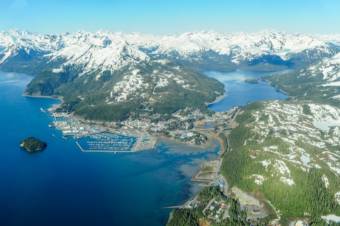
Cordova, Alaska. (Photo courtesy of David Little)

There is also the issue of coordination.

Future advocates might find success in establishing a lead department to oversee clean up. One option would be the Army Corp of Engineers, which is already in charge of removing the Formerly Used Defense Sites.

Cain also recommends increased logistical planning between regions. Sites could be ranked by order of importance based on subsistence use and village proximity. Regional leaders could then determine the most efficient route for the equipment to be transported.

Employment opportunities from the operation could go to local Alaska Native shareholders, suggests Rexford. The training they would receive from these roles could be applied to other cases as well.

“It’s our homeland. It’s under our feet. And we want a sense of ownership in cleaning it up,” he said.

Even with all logistics in place, one major challenge would still remain: there isn’t enough funding. With clean up costs in the billions and tight federal budgets, the government isn’t likely to foot the entire bill anytime soon.

However, outside funding initiatives could make a difference. Putting capital toward the cleanup effort is a direct way for nonprofits, such as environmental justice initiatives, to assist. Their impact would be visible, immediate, and in many cases, life saving.

As Rexford prepares to begin another year advocating for the ANCSA conveyances to be cleaned, he reflects on the circumstances. Despite their small population, his community has been able to raise awareness about an injustice that threatens thousands across Alaska.

But that’s part of the problem. Something tells Rexford that more populated areas of the United States wouldn’t have been left to face nuclear waste and cancer causing toxins alone for this long.

“What about a community of 800 that is exposed to some of these elements that are life threatening? Don’t they deserve equity? Don’t they deserve the same level of environmental justice that our brothers and sisters to the south receive?” he asked. “Or are they just termed as being expendable? As collateral damage?”

This story is part of a reporting collaboration between Alaska Public Media, Indian Country Today and the Anchorage Daily News on the 50th anniversary of the Alaska Native Claims Settlement Act. Funding for the ANCSA project was provided by the Alaska Center for Excellence in Journalism. Read more in the series on Indian Country Today’s website.

‘Being good relatives’: New program aims to increase collaboration between Alaska Native tribes and corporations

(Photo courtesy of Sealaska)

There is a phrase that Iñupiaq elder Vernita Sitaktun Qutquq Herdman likes to say: “When Natives fight Natives, someone else is winning.”

It’s the mentality behind a new initiative from First Alaskans Institute, a non-profit that focuses on empowering Alaska Native people. The program, called “Being Good Relatives,” aims to increase collaboration between Alaska Native tribes and Alaska Native corporations.

“People have noted for many years about the need for our tribes and corporations to bring their power together, and work through some federally created divides that make it hard for tribes and other entities to have the relationship that we know that they could have,” said La quen náay Liz Medicine Crow, Lingít and Haida, president and CEO of First Alaskans.

Alaska’s Indigenous legal landscape is unique when compared to the rest of the Lower 48: there are Alaska Native regional and village corporations, which oversee around 44 million acres of Indigenous land. And then there are 231 federally recognized Alaska Native tribes, which have a government to government relationship with the United States.

“They’re different entities that derive their authority from different places, each operating to take care of our Alaska Native people, but operating with different missions, drivers, and responsibility,” said Barbara ‘Wáahlaal Gidáak Blake, Haida, Lingít, and Ahtna Athabascan, who works as the Alaska Native Policy Center Director at First Alaskans Institute.

It’s an interesting dynamic. The corporations and tribes technically serve the same Alaska Native people in their region, and sometimes even have overlap in leadership. Still, in the past there have been times that the two entities were at odds with each other over community decisions like resource development. Even when there aren’t disagreements, some have found it difficult to fully coordinate plans.

(Illustration by Holly Mititquq Nordlum of Naniq Design)

Medicine Crow doesn’t think this is a coincidence, but rather the result of federal policies intended to divide the community.

“Our tribes and our corporations were not set up to have a great relationship … And it speaks volumes to how strong and amazing our people are, that they’ve been working since the inception of these different entities, to always try to protect our people,” she explained. “People want to see our corporations and our tribes coming together and really utilizing their strengths together on behalf of our Native peoples.”

50 years after ANCSA established Alaska Native corporations, the community is finding new ways to bridge these types of institutional divides.

“Being Good Relatives” is one example. The program first started in 2018, with an event that promoted dialogue between corporate leaders, tribal councils, and the Indigenous Alaskans they both serve. The approach was simple: create a forum where everyone felt safe to have difficult conversations. Discussions highlighted specific local concerns, but also focused on strengthening relationships and laying the groundwork for better communication in the future. Most importantly, participants centered cultural solutions.

“The work comes from what they’re willing to come into the room with and share, and then be able to do with one another,” said Medicine Crow.

The forums are typically organized by region, seeing as each region has slightly different topics they might want to address. The understanding between each region also runs deep — with each one having their own separate traditions, cultural history, and family ties.

First Alaskans Institute had planned to host more in person events, but the COVID-19 pandemic put a pause on that idea. Now, they’re looking at ways they can recreate it virtually.

“Unification doesn’t mean 100 percent agreement or uniformity. But it means that we can come together and make a decision that together working on behalf of our people, we will get further than one would fighting each other,” said Medicine Crow.

This type of collaboration is increasing in other parts of Alaska as well. In early October, the Organized Village of Saxman and Cape Fox Corporation, Saxman’s village corporation, announced the creation of the joint Community Development Corporation. The new organization will lead a development project intended to revitalize the region. It’s a historic move that brings leaders together to act in unison, according to the Organized Village of Saxman’s President Joe Williams Jr.

“Never before in the history of Saxman have OVS, the City of Saxman and Cape Fox Corporation, the ANC of the Village of Saxman, met to discuss the future of Saxman. I have been working for 26 years to make this reunion happen and it finally happened!”, he said in a press release.

Similarly, the Alaska Native regional corporation Sealaska recently created a fund that will support regional solutions led by a combination of village corporations, tribes, and local businesses.

First Alaskans Institute hopes to continue facilitating programs like “Being Good Relatives” in the coming years.

“If their region is interested in doing this work, First Alaskans would love to be able to be in support of that,” said Blake.

This story is part of a joint project between Indian Country Today, Alaska Public Media, and Anchorage Daily News on the 50th anniversary of the landmark Alaska Native Claims Settlement Act. Funding for ICT’s ANCSA project is provided in part by the Alaska Center for Excellence in Journalism and the Solutions Journalism Network. Stay updated on ICT’s ANCSA project using #ANCSA50. Read more in the series here

Site notifications
Update notification options
Subscribe to notifications